What is an Unsponsored ADR?

The stocks of foreign companies trading as American Depository Receipts(ADRs) on the US Over-The-Counter (OTC) market can be of two types – Sponsored ADR and Unsponsored ADR. In this post, let us discuss about the Unsponsored ADR type.

All foreign firms that are listed on the organized exchanges are sponsored. This simply means the company or the issuer asked a depository to issue ADRs and listed them on an exchange like the NYSE or NASDAQ. Sponsored ADRs can also trade on the OTC market. For example, Swiss-based Nestle is a sponsored ADR and trades on the OTC under the ticker NSRGY.

So what is an Unsponsored ADR (UADR) ?

A recent report from Deutsche Bank on UADRs had the following defintion:

An Unsponsored ADR (“UADR”) is one in which no deposit agreement and no legal relationship is entered into between a depositary bank and the issuer. An unlimited number of depositary banks may issue the depositary receipts evidencing ownership of the underlying ordinary shares held in custody in the issuer’s home market. It is not uncommon for all four of the Depositary Banks to administer an Unsponsored ADR programme for a particular issuer company. The ADRs trade in the United States on the over-the-counter (OTC) market.

The establishment of a UADR is initiated by the depositary bank, mainly in response to investor demand and requires no action on the company’s part in the form of legal documentation or otherwise. There are no costs involved to the issuer, no incremental reporting obligations on the part of the issuer, no requirements to comply with Sarbanes-Oxley and no US GAAP reconciliation (local financial statements suffice). Though there are key differences between a UADR and a sponsored Level 1 ADR programme (“Level I”), from an investor perspective – both instruments provide an opportunity to access foreign securities more easily within the framework of the US securities infrastructure.

A few facts about UADRs:

  • In 2008 the SEC amended the rule allowing more issuers to establish Level 1 sponsored or an UADR program.
  • Today about 1605 UARs trade on the US market up from just 169 in September 2008.
  • UADRs from 40 countries are available for investors with China and Hong Kong, Japan and the UK topping the rank of countries.

Source: Unsponsored ADRs -Market Review, November 2016

Some of the big foreign firms that trade as Unsponsored ADR  include Royal Mail (ROYMY) of UK, Singapore Airlines (SINGY) of Singapore, Munich Re Group (MURGY) of Germany, etc.

Also checkout:

Disclosure: No Positions

Trade: Which Countries Are Most Exposed To The US?

Global trade has been running smoothly among countries for a few decades now. However with the election of Trump trade has become an important factor to consider for investors. This is because President-elect Trump has proposed to withdraw the US from trade agreements or amend the terms and conditions of those deals. In addition, he has also warned of imposing tariffs on goods imported into the US especially from countries like Mexico and China.

So should he implement any of those campaign trade promises, which countries will be negatively impacted the most?

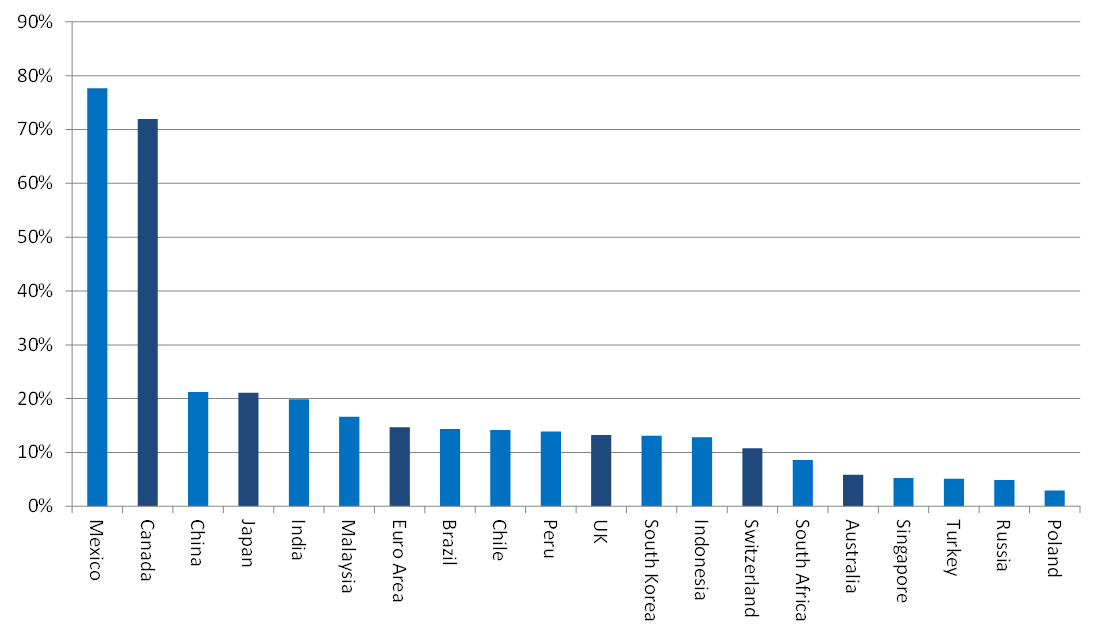
The chart below shows the countries that are most exposed to the US:

Click to enlarge

major-exporting-countries-to-the-usa

Source: Global Emerging Markets: Possible Impacts from a Trump Presidency, Nikko Asset Management

The top countries that stand to lose the most are the neighbors – Mexico and Canada. China will suffer heavily since only over 20% of its total exports go the US. Though China exports over $500 billion worth of goods to the US it is still only a small portion of its overall exports. Because the US imports more than its exports to China, it runs a trade deficit year-after-year. This deficit stands at well over $300 billion annually.

The Mexican economy stands suffer significantly since over 80% of its total exports head to the US market. Because the economies of Mexico and USA are highly integrated it will be very difficult to decouple them.

Canada is the second major exporter to the US with its exports accounting for over 70% of total exports. Some of the major items that Canada ships to its southern neighbor include autos, auto parts, lumber,agricultural grains, crude oil, natural gas, etc. In fact, the Canadian economy is so highly dependent on USA that it is said that when US sneezes Canada catches a cold. For years and years Canadian politicians failed to diversify the economy and explore additional markets to trade with and simply made Canada as the 51st state of the US.

RBC: 20 Canadian Stocks To Gain From Trump’s Policies

President-elect Trump has proposed sweeping changes to many areas like immigration, trade, taxes, etc. While Mexico stands to be highly impacted by amended trade policies, Canada will also be affected as it is a member of the NAFTA agreement. Some of the Canadian firms may benefit from any changes to the current policies.

RBC Capital Markets has published a list of 20 stocks that stands to benefit. From the article in Financial Post quoting the list:

TD Bank, Magna International and TransCanada are among the 20 Canadian stocks best positioned to gain from U.S. president-elect Donald Trump’s “good policies” while being somewhat sheltered from any downside, RBC Capital Markets said on Monday.

“Canadian companies stand to benefit from President-elect Trump’s policies in two ways: 1) The direct impacts from lower corporate taxes and fewer regulations and 2) The impact of stronger U.S. growth and the flow through to Canada both through better domestic growth and some of the knock-on impacts,” said RBC analyst Matthew Barasch in a research note.

“The offset to this is trade and the potential barriers that president-elect Trump might erect.”

Canadian companies could benefit if they have significant U.S. revenues (and therefore would get a boost from economic growth under Trump’s corporate tax cuts), are leveraged to U.S. growth, are positively correlated to rising interest rates, and could potentially be rewarded by tighter oil differentials and increased oil demand, Barasch wrote.

As such, RBC constructed a basket of 20 Canadian stocks set to win in the Trump era, while avoiding the fallout from the president elect’s “disruptive proposals.”

Some of the popular stocks in the list are: Toronto-Dominion Bank (TD), Manulife Financial Corporation (MFC), Canadian National Railway Co (CNI), Magna International Inc(MGA) and TransCanada Corp (TRP).

For the rest picks please visit the link below.

Source: 20 Canadian stocks set to win from Trump’s ‘good policies’, according to RBC, Financial Post

Disclosure: Long CNI, MGA and TD


Ten Advantages of Investing in ADRs

US investors can invest in many foreign companies via American Depository Receipts(ADRs). They are basically share ownership in a foreign firm in an indirect way. In order to create an ADR for the US market, a brokers buys ordinary shares of a foreign in the domestic market and delivers them to a US-based depository bank such as BNY Mellon. Then the depository issues ADRs that are traded on the organized exchanges or the OTC market.

With that brief introduction to ADRs, below are ten of the advantages of investing in ADRs:

  1. Easy accessibility: Setting up trading accounts to buy in the local market in many foreign markets is difficult and complex. Many brokers may not allow direct access to overseas markets that will allow investors to buy and sell stocks in that country’s local market. So ADRs eliminates this issues and allows investors to access companies in far away countries easily. For example, it is not easy to simply open an account with a broker in Chile and buy Banco Santander-Chile in the Santiago Stock Exchange. But buying the ADR (BSAC) on the NYSE does not require any extra effort for an investor
  2. Diversification: The second most important advantage of owing ADRs is diversification. Since emerging, frontier and developed vary in economic growth ADRs provide an opportunity to diversify across countries. So while the US economy and the equity market may in doldrums, countries in emerging markets like Brazil or Indonesia may grow. Owing ADRs from those countries could help to boost the portfolio returns. In addition, investors can invest in hidden companies in places like Thailand or Jamaica via ADRs that institutions and others are unaware of.
  3. Taxes: Owing ADRs eases the pain of dealing with various tax issues. If an investor sells a common stock in a domestic market like Germany for example, then he/she is subject to the tax rules of Germany, If there is a capital gain, then the investor has to calculate and fill up the paperwork and pay taxes in Germany. Buy buying the same company’s ADR this problem does not exist. Since all dealings are in US dollars any gain or loss is easily reported to US tax system.
  4. Security type and currency denomination: ADRs are basically like any other US security. So they provide that benefit of reporting financial date to US authorities like the SEC. And ADRs are denominated in US dollars making it very easy for Americans to invest in them without worrying much about currency conversions and other issues.
  5. Dividends: All dividends paid out by foreign firms are paid out in US dollars to their ADR holders. Hence an investors is not burdened with the converting dividends from local currency to US dollars. All currency-related work are taken care of by the ADR issuer.
  6. Settlement cycle: Because ADRs are US securities and held in US-based depositories they follow the typical settlement cycle. This is a big advantage as some countries have settlement cycles that run into many days.
  7. Vast Universe: Currently over 3,000 ADRs trade on the US exchanges or the OTC market. Hence this greatly expands the pool of companies to explore and invest in for American investors. They are no longer restricted to the limited number of US firms that trade publicly. Moreover this ADR universe continues to grow as more and more foreign firms try to access capital in the US.
  8. Benefit from currency fluctuations: When a foreign company pays out dividends they are paid to investors in local currency. If the local currency appreciates then the US holder of the ADR will benefit since the dividends have to be converted to US dollars. Because the foreign currency has gained in value, the dividends paid out in US dollars will be more. So in addition to any gains from price appreciation of the ADR, an investor can also benefit from currency volatility. But it is also possible to receive in dividends when the same foreign currency depreciates against the dollar.
  9. Liquidity: Many ADRs offer ample liquidity when an investors wants to buy or sell. Sometimes an ADR may have more daily trading volume than the ordinary trading in the home market since stock market participation rate may be low in that country. This is especially true in many emerging and frontier markets where stocks are considered as highly risky by ordinary people. So an investor in the US holding a company’s ADR avoids this issue.
  10. Information flow: Firms that have ADRs distribute all information to investors widely in English. This allows ADRs to keep themselves fully informed of all the news regarding that company. Such information not only includes statements filed with the SEC but also includes things like press releases. For example, Colombian oil major Ecopetrol(EC) released a press release for about their divestment plan for equity held in another company. An ADR holder did not have to know Spanish or visit the firm’s website to find this information since it was distributed widely including in Yahoo Finance. Sometimes other information such as options to receive dividends in cash or stock, proxy votes, splits, rights offers, etc. are all submitted by the firms to their ADR depository and investors can go the depository site to find all the info. Big companies also send important info to ADR holders’ email if they are registered for this option.

Of course, investing in ADRs have disadvantages also. We will discuss about the disadvantages in a future post.

Disclosure: Long EC

Annual Return of Key Indices Chart 1996-2015

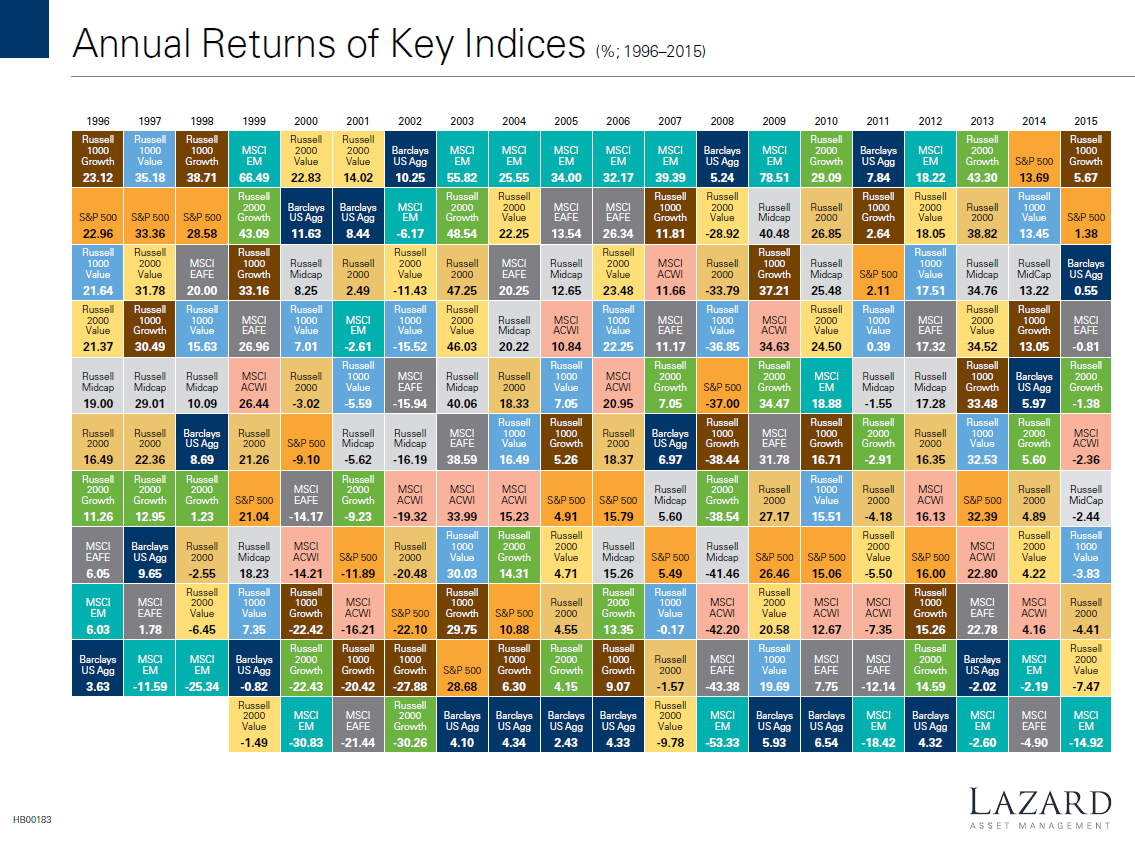
The following chart shows the returns of various indices from 1996 thru 2015. Emerging markets were hot from 2003 until 2007. After a huge jump in 2009 their returns have been average to worse since then.

Click to enlarge

annual-returns-of-key-indices-1996-to-2015

Source: Lazard Asset Management

Download: Annual Returns of Key Indices Chart 1996-2015 (in pdf)

The above chart visually demonstrates the need for diversification.