Knowledge is Power: Oil Opportunities, Emerging Markets and American Democracy Edition

Sunset over the Pacific Ocean in Mazatlan, Mexico
Small Caps Are Attractive Relative To Large Caps

Global small cap stocks are attractive now compared to large caps based on valuation, according to an article by David Brett at Schroders.

Small caps as measured by the MSCI Small Cap Index has returned three times as much as large caps since March 2001. Small caps returned 317%  including dividends compared with 107% for the MSCI Global Large Cap Index.

From the article:

Do small caps remain good value?

On average small-cap valuations have so far remained relatively attractive, despite their rapid rise.

One way to value individual shares or the stockmarket as a whole is to compare share prices and earnings in a price-to-earnings ratio (P/E). A lower P/E ratio suggests better value.

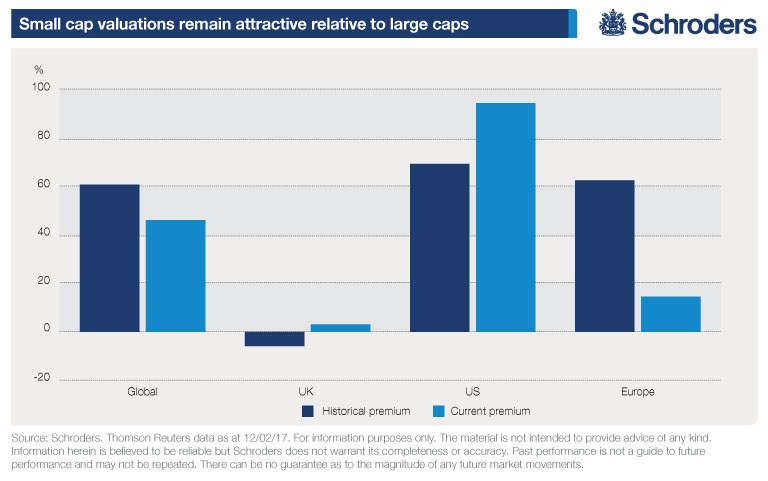
Global small caps’ 10-year median P/E is 25.8, compared with large caps’ P/E of 16. So on average global small caps have traded on a 61% premium to large caps since 2007.

The premium is currently 46%. Small cap P/Es have risen to 30.8 from 27.5 in 2007, while large cap P/Es have climbed to 21 from 16.3.

Regional bias

Global and European small caps trade below their historical (10 years from Q4 2006 to Q4 2016) median premiums, compared with large caps, according to MSCI data. The US and the UK appear more expensive.

Source: Small cap vs large cap: how valuations compare, Schroders

Generally investing in small companies involves more risk than larger companies.Since higher risk means the possibility of higher reward they tend to perform better than large caps. Though definitions of a small cap can vary, usually companies with market caps of less than $1.0 billion can be considered small companies. Researching and identifying individual small companies to invest in is more time-consuming than large ones since the universe of available firms is huge. So it may be easier for most retail investors to go with small cap ETFs.

Related ETFs:

  • iShares MSCI EAFE Small-Cap ETF (SCZ)
  • Vanguard FTSE All-World ex-US Small-Cap ETF (VSSS)
  • SPDR S&P International SmallCap ETF (GWX)

Disclosure: No Positions

Emerging Markets: Companies Showing Signs Of Recovery ?

Emerging markets are performing well so far this year. But until last year they were depressed as investors avoided them for a variety of reasons including the plunge in commodity prices. According to an article at Franklin Templeton, these markets are showing signs of recovery ass earnings, exports and commodity prices are on the upswing.

Click to enlarge

Source: Why Things Aren’t What They Used to Be in Emerging Markets, Franklin Templeton Investments, Mar 23, 2017

Related ETFs:

  • iShares MSCI Emerging Markets ETF (EEM)
  • Vanguard MSCI Emerging Markets ETF (VWO)

Disclosure: No Positions

Reverse Stock Splits Never Work Especially When A Company Is Losing Money

Listed companies can implement reverse stock splits for many reasons. For example, they can consolidate the number of stocks outstanding in order to bring the stock price above a certain point like $1 after the price falls below that level. This is necessary for liquidity, preventing de-listing by exchanges, etc. Investors should be very careful of firms that do reverse stock splits especially if a the firm is losing money. Another factor that investors must be wary of is multiple reverse stock splits.

A recent article by Peter Hodson, CFA, is CEO of 5i Research Inc. in Financial Post discussed some of the lessons to learn from five losing stocks. One of them is the effect of stock consolidations. From the article:

DryShips (DRYS on NASDAQ)

First, the stunning fact. When adjusted for share consolidations over the years, shares of DryShips have gone from $1.515 million per share to $1.17 per share in 10 years. That is not a typo. That is a decline of 99.9999992 per cent. This year alone, the stock has declined 94.2 per cent. Of bizarre note, the company recently declared a dividend, after omitting them in 2008. The company operates dry bulk shipping carriers. In 2016, it lost $464.76 per share on $51.9 million in revenue. Market cap is $177 million and it still brings in buyers, with trading usually more than 30 million shares a day.

Lesson to be learned: Investors can’t stand share consolidations, and losing money is not great for share prices (split-adjusted, DRYS lost $10,023 per share in 2015!).

Source: Five stocks that have burned investors, and the lessons we all can learn from them, Financial Post

DryShips(DRYS) did reverse stock splits 4 times in just two years (2016 and 2017). The splits were as follows:

Date Ratio
03/11/2016 1 for 25
08/15/2016 1 for 4
11/01/2016 1 for 15
01/23/2017 1 for 8


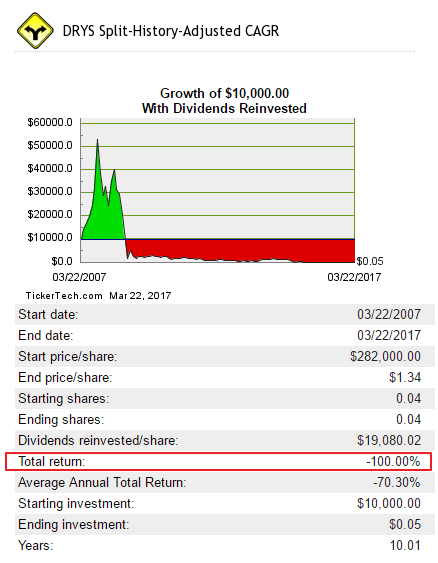
The impact of these splits with the firm losing money was disastrous to investors. A $10,000 investment in March, 2007 in DRYS would have turned to just $0.05 on 3/22/17 with dividend reinvested.  So Total Return  equals to -100.00% according to split history website. This is indeed shocking.

Click to enlarge

Source: Split History

DRYS closed at $1.34 yesterday.

Disclosure: No Positions

Update(April 7, 2017): 

DryShips announced yet another reverse split in the ratio of 1:4 today with an effective date of April 11. This is incredible. From a journal story:

DryShips, a Greek owner of dry bulk carriers and tankers, announced late Thursday that it will execute a reverse stock split effective April 11. Every four shares outstanding will be combined into one share of common stock.

DryShips stock plunged more than 25% Friday morning, possibly because its maneuver should sound familiar. This will mark the second reverse split of the year and the fifth time since February 2016.  Meanwhile, the latest reverse split comes less than a month after completing a $200 million share offering, in which the company raised net proceeds of $198 million.

DryShips shares have experienced extraordinary volatility, including a more than 1500% rise immediately after the election. But the company is worth a small fraction of its value from several years ago.
Source: WSJ