Knowledge is Power: Fizzling Trump Trade, Australian Economy, Canada Real Estate Edition

Now that he has launched some cruise missiles and dropped the MOAB and really became the President, the real question is: Will he be nominated for the Nobel Peace prize…


Click to enlarge

Mazatlan Beach, Mexico
Why Do US Airlines Treat Most Passengers With Contempt?

 “Competition is a sin.” – John D. Rockefeller, American industrialist and philanthropist

The recent atrocious behavior of United Airlines treating a fare-paying passenger has shocked Americans and others like.Millions of people are learning that as a passenger their rights are limited. All the millions of regulations and laws won’t help them even if they are dragged like a dog off a plane because airlines are allowed to overbook flights and kick out any passenger they choose at the last time. So buying a ticket in this case does not guarantee that you will fly from point A to point B for sure. I wrote an article last year listing some of the reasons why Americans are treated like sheep by the airline industry. From that article:

here are many reasons why US airlines are able to what can be called as daylight robbery and still get away with it. Listed below are four of the reasons:

  • The airline industry is an oligopoly with a handful of companies dominating the market. Just four airlines – Delta (DAL), United-Continental (UAL), Southwest (LUV) and American (AAL) – control the majority of the market share. I have written articles before about the industry’s oligopoly structure which you can find here and here.
  • Since the industry is an oligopoly and not a monopoly, the state cannot prevent airlines from all the things they do. So laws like The Sherman Anti-Trust Act of 1890 that makes monopoly illegal do not apply.
  • As airlines are allowed by the state to merge with one another, competition is eliminated. Lack of competition is one of the main reasons why air travelers are forced to endure misery at the hands of the airlines.
  • Unlike in other countries, alternative forms of transportation is practically non-existent in the US. The airlines know this simple fact and take advantage of it. For instance, an American trying to go from New York to LA on the west coast has to travel by airlines. There is no direct high-speed train service between these cities that this passenger can take and avoid all the airlines. Hence unlike Japanese or an European, we are held “hostage” by the airline industry in our own country without us realizing it. This is sad since the US is technically a free market economy where competition among companies and industries is supposed to be exist. As a result everyone including Nobel prize winners, educated professionals, free-market believers, world-class doctors, media pundits, legal scholars, regulators, politicians, corporate lobbyists, etc. have to fly in one of the airlines when travelling from point A to point B quickly.

Another point is that it is not just United Airlines that is able to subject customers to pain and suffering and try to get away with it legally. Many other industries also treat their customers with contempt. Because most industries are oligopolies ordinary people have no choice but to suffer at the invisible hands of the industry players. Ordinary people are treated with utter contempt by the political system also. Here is an excerpt from an op-ed at the Times:

The same dynamic plays out in our political lives. In a study published in 2014, Martin Gilens at Princeton University and Benjamin Page at Northwestern University found government policy and actions rarely reflected majority sentiment, but instead favored corporate interests and the wealthiest Americans. When congressional Republicans offered up a health insurance reform package earlier this year that would have covered fewer people than the Affordable Care Act, Representative Jason Chaffetz, Republican of Utah, initially defended it by claiming Americans needed to choose between spending on necessary medical care or buying an iPhone. Meantime, the fabled 1 percent would have received an average tax cut totaling $37,000 if the legislation were fully enacted.

Don’t mistake me. There are a lot of other things you can take away from this sorry event. There is the increased militarization of American life, with authorities reacting to common disputes in increasingly aggressive ways. There is a positive lesson, too, in that ordinary Americans have access to more potential publicity — and, hopefully, recourse — than ever before, courtesy of social media. Finally, there is a narrative of privilege at play. More than a few pointed out this contretemps would likely not have received as much attention if the unwilling passenger were poor or African-American. Others noted that the doctor, who is Asian-American, might have been treated differently by officers or airline staff if he were white.

But this isn’t an either-or situation. Yes, we can tell people who perceive themselves as privileged to get used to the second-class treatment those poorer than them have been receiving for a long time. But it seems like a better bet, both ethically and for the sake of our futures, to improve conditions for all.

Source: United Airlines Is Not Alone, NY Times, April 11, 2017

Sometime

Also see:

2016 Tax Rates By Country: Chart

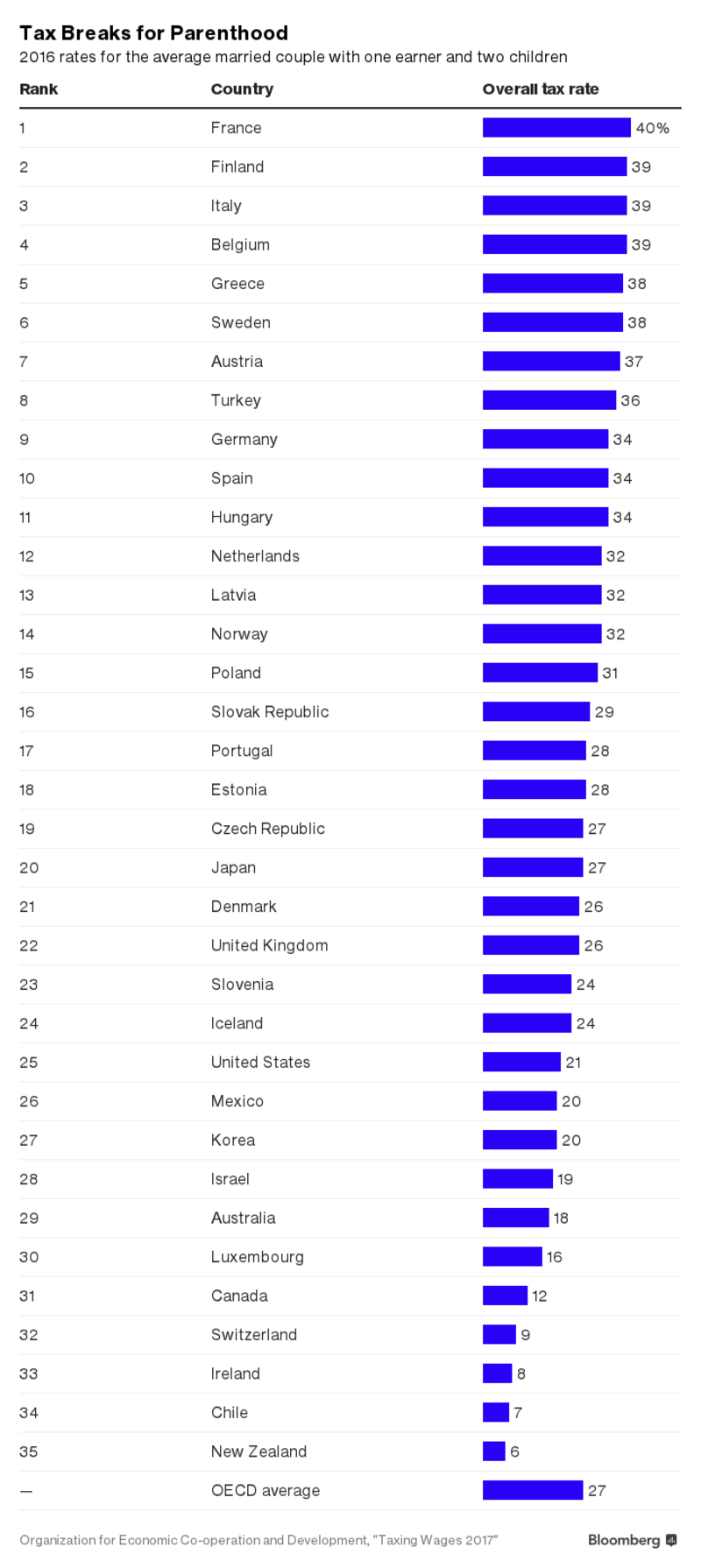
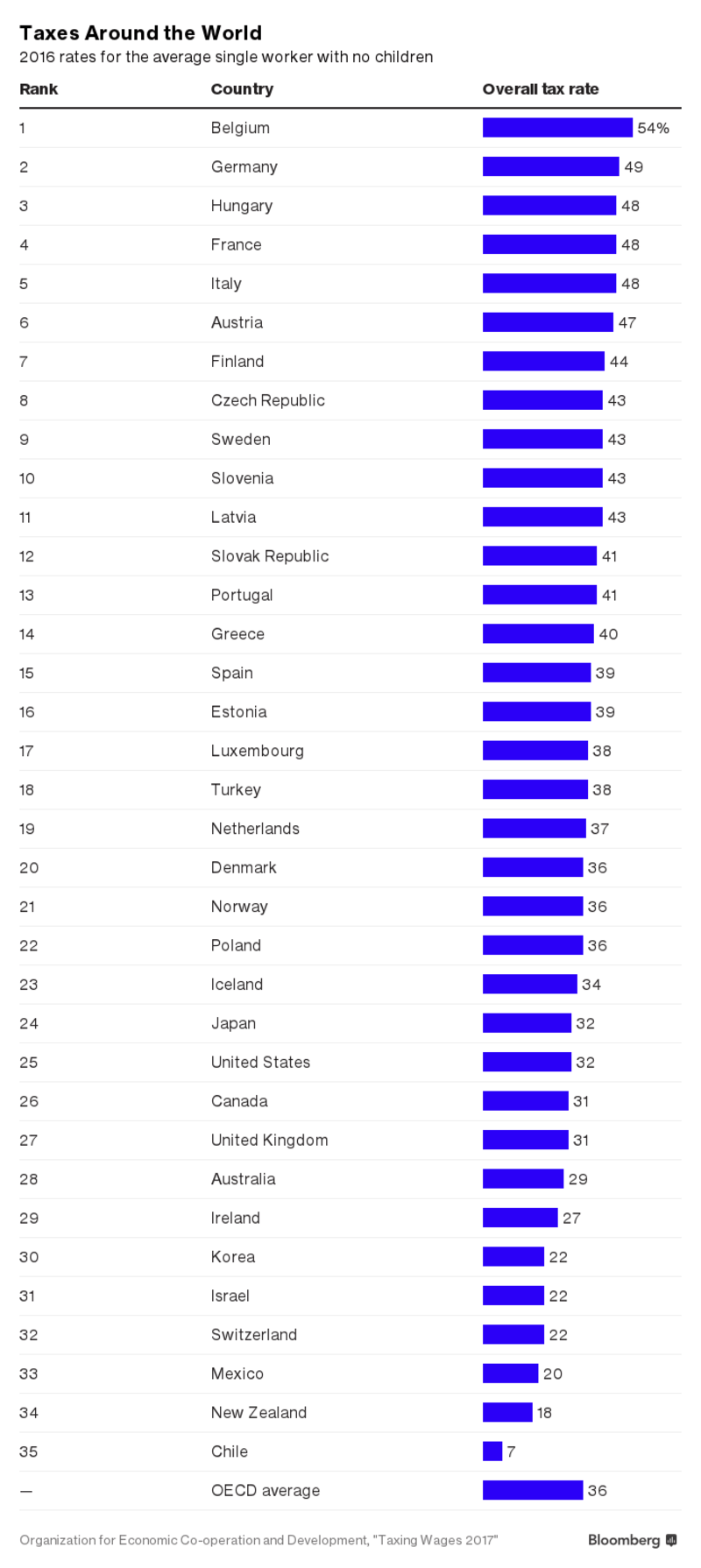
Tax  rate comparison across countries is interesting to review. According to OECD data, the US tax rate is lower than other developed countries and OECD average.

a. 2016 Tax Rates for A Single Worker Couple by Country

Click to enlarge

b. 2016 Tax Rates for A Couple with one earner and two children by Country

Source: Sorry America, Your Taxes Aren’t High, Bloomberg, April 11, 2017

Ideal Placement Location for Investments: Taxable vs. Non-Taxable Accounts

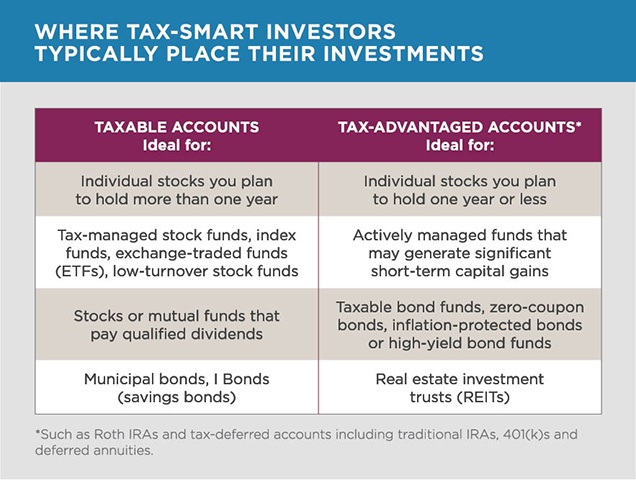
One of the annual rituals that American taxpayers go through around this time of the year is the filing of taxes. So now is a good time to consider investment assets and their tax implications. For equity investors, it is very important to understand the tax consequences of investments since various asset classes are taxed differently based on where the assets are held.

For instance, taxable accounts such as regular brokerage accounts are best suited for some type of investments like foreign stocks(excluding some), stocks to be held for the long-term, ETFs, etc. Non-taxable accounts such as retirement accounts are ideal for holding instruments like REITs, short-term stock investments, etc. Since most REITs pay high dividends holding them in non-taxable accounts avoid taxes.If they are held in taxable accounts, then dividends will be taxed especially at the rate of ordinary income taxes and not the favorable qualified or non-qualified dividend tax rates.

Owners of foreign stocks have to pay careful attention to foreign dividend taxes and their impacts. Stocks from high tax countries such as Switzerland should not be held in non-taxable accounts since the taxes paid cannot be recovered. So a big chunk of dividends will be lost of taxes. Canada does not deduct this tax for stocks (excluding REITs) held in qualified US retirement accounts. So Canadian stocks are good candidates to hold for the long-term in non-taxable accounts like an IRA or 401-K account.

The table below shows the best placement location for various asset types:


Click to enlarge

Source:  The Importance of Tax-Efficient Investing by By Rande Spiegelman, April 3, 2017, Charles Schwab

Indian Stock Market Is Expensive Based On Valuation

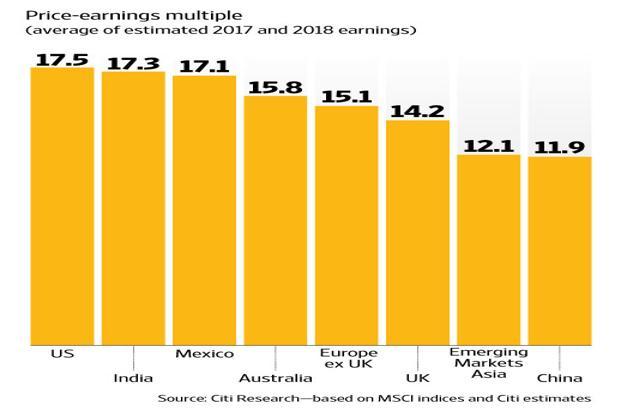
The Indian equity market is one of the top performing emerging markets so far this year. The benchmark S&P BSE Sensex crossed the 30,000 mark for the first time in many months. The index closed yesterday at 29575 for a gain of over 11% this year.

Though Indian stocks have the potential for further growth, on a valuation basis they are second most expensive in the world according to a report by Citi. The current forward P/E ratio of 17.3 is well above its mean. Incidentally the US is the most expensive market based on this ratio.

Click to enlarge

Source:India is one of world’s most expensive stock markets, Live Mint, Apr 10, 2017

Also see: