Should You Hold Emerging Market Stocks For The Long-Term ?

Emerging market equities can offer substantially higher returns than developed equities due to many reasons. For instance, the economies of developing countries grow much higher and faster than developed countries.While firms in the developed world may struggle to grow their market share in the domestic market companies in the emerging world may continue to expand as the growth potential is huge. Products like consumer goods, healthcare items, household goods, food products, etc. have yet to reach many consumers in the developing world unlike in the developed world where people take these things for granted.

From an investment point of view, many investors own emerging market stocks for their price appreciation potential. This makes sense since they are basically trying t profit from the higher economic growth common in these markets. Not many investors go to emerging markets for safety, higher dividend yield, etc. Compared to the developed markets, emerging market equities are more risky in general and they are also more volatile. Many emerging markets are more volatile because of many factors including low retail and domestic investor participation, political risk, currency risk, state intervention in industries, etc. While political risk is rarely an issue in the developed countries, in emerging markets it is a huge risk.

So one of the questions that emerging market investors may have is this: Should I hold my emerging stocks for the long-term as measured by years  and decades?  This is a valid question since emerging economies tend to have uneven growth. Periods of strong economic expansions are followed by severe contractions and the cycle repeats. Due to this roller-coaster ride, investors may wonder if it is a good idea to sell emerging stocks at the peak and then buy back at the trough and then sell again at the next peak and perform these actions over and over again. To put it another way: Can market timing work in emerging markets?

Though developing economies experience for boom and busts, research suggests that investors are better off holding emerging stocks for the long-term as opposed to engaging in market timing, Despite the ups-and-downs of emerging markets, higher returns are possible when investors stay put even during market volatility. This makes sense since one invests in these markets to capture the profits from higher economic growth over the years and not in weeks or months. Hence pulling out of emerging stocks during market crashes is not a wise strategy.

From a Morgan Stanley research report on this topic:

Trying to get the timing right in a volatile asset class like this is nearly impossible,” he says. Instead, investors comfortable with the higher risks of emerging markets versus developed markets, should consider strategies that seek to generate more consistent returns, while staying invested during the asset class’s ups and downs.

“Investors have to stop thinking about EM in terms of piling in when it’s rallying and rushing out again when things go bad,” Sinha argues.

His team’s analysis of MSCI EM index returns since 1988 suggests that a $10,000 investment made back then would now be valued at about $80,000. On the other hand, investors who hopped in and out of the market wouldn’t have seen anywhere near that return for the same time period.

Sinha is not suggesting that EM stocks need to be held for 28 years. Rather, the analysis of the index’s returns over time demonstrates that even missing out on upside a few months every year can defeat the purpose of buying EM stocks for return potential.

Source: Emerging Markets: It;s How, Not When, Morgan Stanley

To check the importance of holding emerging equities for the long-term, I tested the returns of three randomly-selected stocks. Below are the returns of these stocks over different time periods.

1.Banco de Chile (BCH)

YTD Return: 4%

5-Year Return: -21%

10-Year Return: 46%

Long-Term Return: 297%

2.ICICI Bank Ltd (IBN)

YTD Return: 14%

5-Year Return: 29%

10-Year Return: -4%

Long-Term Return: 193%

3. Itau Unibanco Holding SA (ITUB)

YTD Return: 20%

5-Year Return: -14%

10-Year Return: -86%

Long-Term Return: 14%

Until late last year, Chile was hurt deeply by the collapse in copper prices. So the five year return is negative for BCH. But over the 10-year and long-term the returns are positive and decent. Though the stock has seen its share of volatility over the years, it would be unwise to sell and buy back at a lower price. It should be noted that the bank pays solid dividends and those are not included in the above returns. So if the dividends received are included the returns would be much higher. This example proves that holding emerging stocks for the long-term is not a bad idea. Similarly the Indian equity market has experienced bull and bear markets over the past few decades. In the 5-year period IBN yielded a 29% return. But over the year 10-year period the return was a loss of 4%. However since April 2000 the stock has had a return of 193%.

In summary, investors can hold emerging stocks for the long-run provided they are high-quality stocks. Holding an internet dot-com stock from China or a small-cap gold miner in South Africa for the long-term is foolish. Instead just like developed markets, investors need to identify good companies in emerging markets and can hold them for years ignoring short-term volatility that seem to hallmark of these markets.

Note: Returns shown above are price returns only (excluding dividends)

Data Source: Google Finance

Disclosure: Long BCH and ITUB
Dividends: How Much Do They Contribute to Total Returns ?

Dividends form an important source of return when calculating the overall total return of an equity investment. While price appreciation is not guaranteed dividends can continue to paid out by firms. Though dividends can be suspended or cut, mature high-quality companies large-cap companies do not take such actions other than in extreme circumstances. For investors looking to each a higher total return over the long run, it is important that they reinvest the dividends received instead of spending them. Compounding of reinvested dividends over many years can boost returns further.

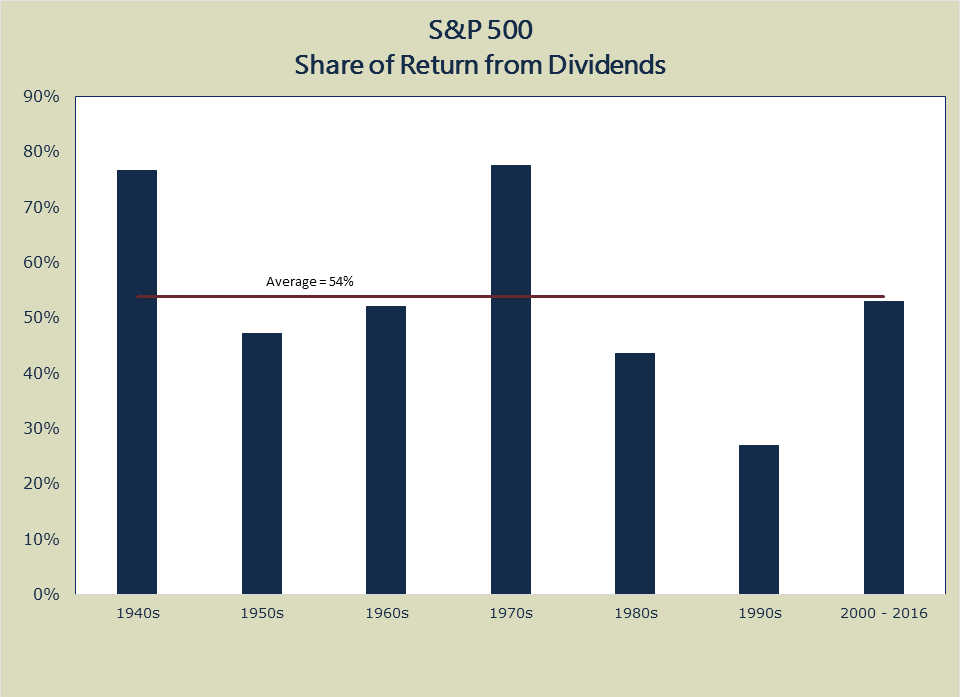
Dividends are very important even in a low dividend-paying market like the US. This is because dividends can act as a cushion during down market and yield higher overall returns and the compounding effect over the long-term. According to an article by Matthew A. Young of Richard C. Young & Co dividends accounted for about 54% of the US stock market returns since the 1940s. The following chart shows the dividend contribution to returns on the S&P by decades:

Click to enlarge

Source: Client Letter – February 2017, Richard C. Young & Co

An excerpt from the piece:

Dividends can play an especially important role when valuations are elevated (as we would argue is the case today) and appreciation potential is limited. In the first 15 years of this century, the ultra-low dividend-paying Nasdaq Composite Index didn’t gain a single point. However, an investment in high-dividend-paying stocks compounded investors’ money at 7% per year. And during the 16 years from 1965 to 1981 when the Dow delivered nothing in the way of capital gains, high-dividend-yielding stocks gained 8.1% annually.

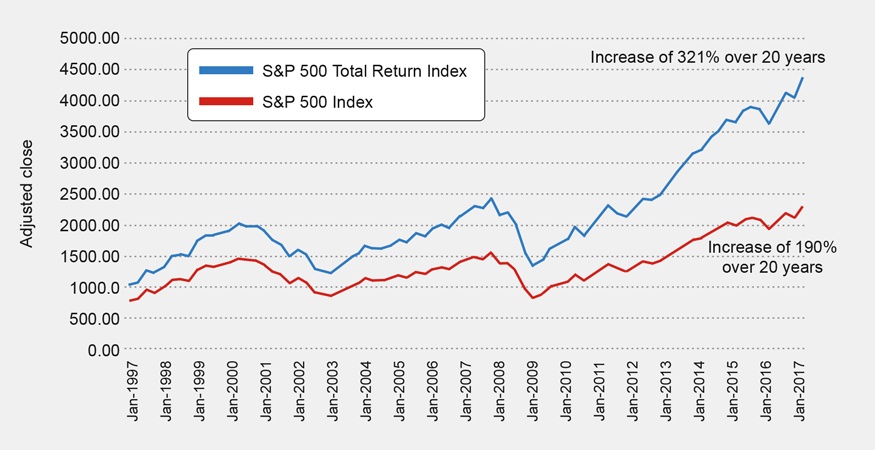
The importance of dividends cannot be overstated. While much of the media focus on the S&P Price Index, the correct index to pay attention to for most retail investors is the S&P 500 Total Return Index which includes returns with dividends reinvested. The following chart from a recent Fidelity article shows the huge gap in returns between the S&P 500 Index and the  S&P 500 Total Return Index.

Click to enlarge

Source: Dividends: not just for income, Fidelity

From the article:

Consider this example: between 1997 and 2017, the price of the S&P 500® index was up about 190%, but if you look at the S&P 500 Total Return Index, which includes the reinvestment of dividends and other distributions, the index increased by 321%. That shows the power of reinvesting dividends over time. It works out to a compound annual growth rate of 7.45% compared to 5.47% for the price-only index.

Also checkout:

Related ETF:

  • SPDR S&P 500 ETF (SPY)
  • SPDR S&P Dividend ETF (SDY)
  • Vanguard Dividend Appreciation ETF (VIG)

Disclosure: No Positions

Knowledge is Power: Auto Industry Disruption, Democracy for Sale, Fundamental Thinking Edition

Click to enlarge

A Beach in Mazatlan, Mexico

US Stocks Are Highly Valued Relative to Historical Average: Chart

US stocks continue to remain elevated since the beginning of the year and the elections. Stocks in certain sectors such as financials have soared substantially since the elections.This week the tech-heavy NASDAQ crossed the record 6,000 mark. Despite the superb performance of US equities, investors need to be cautious since the P/E ratio of US stocks look steep relative to historical average and when compared to other markets.

From an article at Allianz Global Investors:

Click to enlarge

The US Equity Market Is Highly Valued

The current price-to-earnings ratio of the US market is significantly higher than its 30-year average

Source: Datastream, MSCI, Shiller, AllianzGI as at 1 March 2017

The eight-year US equity bull market has time and again confounded its many detractors, helping US stocks remain among the top performers since the global financial crisis began. With such a history of strong results, it is easy to argue why many long-term investors should continue holding this asset class in their portfolios.

At the same time, the US equity market is highly valued – the current Case-Shiller price-to-earnings ratio of 29.8 is almost double its long-term average – leaving other investors to question whether this is currently the place to pursue growth potential and protect purchasing power.

Source: Six pressure points for US stocks, Allianz

These 10 Companies Pay Half of all UK Dividends

The British equity market is an excellent hunting ground for yield-seeking investors. British firms have a strong dividend culture and have high dividend yields on their equities. For American investors, an added advantage is that there is no withholding taxes on dividends (excluding REITs).

Despite the pros, the British stock market has a structural issue according to a study Henderson Global Investors. From an article quoting the study:

The top ten companies pay half of all UK dividends, with the top 20 companies paying 70% of all UK dividends.

Source: Seven out of 10 UK equity income funds hold these 10 companies, MoneyWise, April 21, 2017

Hence investors seeking to gain exposure to British income stocks may want to consider adding the top ten companies. These stocks are listed below their current dividend yield on the US market:

1.Company: AstraZeneca PLC (AZN)
Current Dividend Yield: 4.70%
Sector: Pharmaceuticals

2.Company: Vodafone Group PLC (VOD)
Current Dividend Yield: 5.93%
Sector: Wireless Telecom

3.Company: British American Tobacco PLC (BTI)
Current Dividend Yield: 3.21%
Sector:Tobacco

4.Company: GlaxoSmithKline (GSK)
Current Dividend Yield: 4.92%
Sector: Drugs

5.Company: HSBC Holdings PLC (HBSC)
Current Dividend Yield: 6.38%
Sector: Banking

6.Company: BP PLC (BP)
Current Dividend Yield: 7.06%
Country: UK

7.Company: Royal Dutch Shell PLC (RDS.A)
Current Dividend Yield: 7.31%
Sector: Oil, Gas & Consumable Fuels

8.Company: Legal & General PLC (LGGNY)
Current Dividend Yield: 9.80%
Sector: Insurance

9.Company: Aviva PLC

10.Company: Imperial Brands PLC (IMBBY)
Current Dividend Yield: 4.02%
Sector:Tobacco

Note: Dividend yields noted above are as of April 24, 2017. Data is known to be accurate from sources used.Please use your own due diligence before making any investment decisions.

Disclosure: No Positions