The Top German Companies By Revenue 2016

Germany is the economic powerhouse of Europe. Unlike the consumption-driven economy of many countries such as the US, the Germany economy is export-driven. Some of the world’s largest companies are based in Germany. One way to identify the largest German companies in terms of revenue is to review the Fortune Global 500 list. The latest list for this year was published by Fortune last month. The table below shows the German companies that made it to the prestigious Fortune Global 500 list:

Global RankCompany Name2016 Revenue (in millions)
6Volkswagen$240,264
16Daimler$169,483
34Allianz$122,196
52BMW Group$104,130
66Siemens$88,419
76Robert Bosch$80,869
77Deutsche Telekom$80,832
91Uniper$74,407
109Munch Re Group$68,700
117Deutsche Post DHL Group$65,787
123Metro$64,853
126BASF$63,641
174Bayer$52,569
189Deustche Bank$48,876
195RWE$48,204
212Deutsche Bahn$44,850
213Continental$44,842
224ThyssenKrupp$43,589
231E.ON$42,213
263ZF Friedrichshafen$38,888
302Talannz$35,101
303Lufthansa Group$35,011
309Edeka Zentrale$34,193
327DZ Bank$32,636
335Fresenius$32,161
403Phoenix Pharmahandel$26,976
443SAP$24,397
457Heraeus Holding$23,793
499TUI$21,655

Source: Fortune

Download: The largest German companies based on revenue in 2016 (in Excel)

A few observations:

  • A total of 29 German firms are in this years Fortune Global 500 list.
  • The highest ranked company is the auto-maker Volkwage(VLKAY) with a revenue of over $240 billion in 2016. To put this in perspective, the world’s largest company by sales Walmart(WMT) had a revenue of over $485 billion.
  • Other major auto-makers BMW Group(BMWYY) and Daimler are also on this list.
  • E.ON(EONGY) and RWE(RWEOY) are two of the largest utilities. However their stocks have collapsed in the past few years but are slowly recovering.
  • TUI is one of the world’s largest travel company.
  • Some of the companies from that above table that trade on the US markets are chemical giant BASF(BASFY), automation leader Siemens(SIEGY), tire market Continental(CTTAY), SAP(SAP) and Fresenius (FMS).

Disclosure: Long CTTAY, EONGY, RWEOY

Earlier: The 32 Largest German Companies By Revenue 2012 (TFS)
What Do US Corporations Really Pay in Taxes?

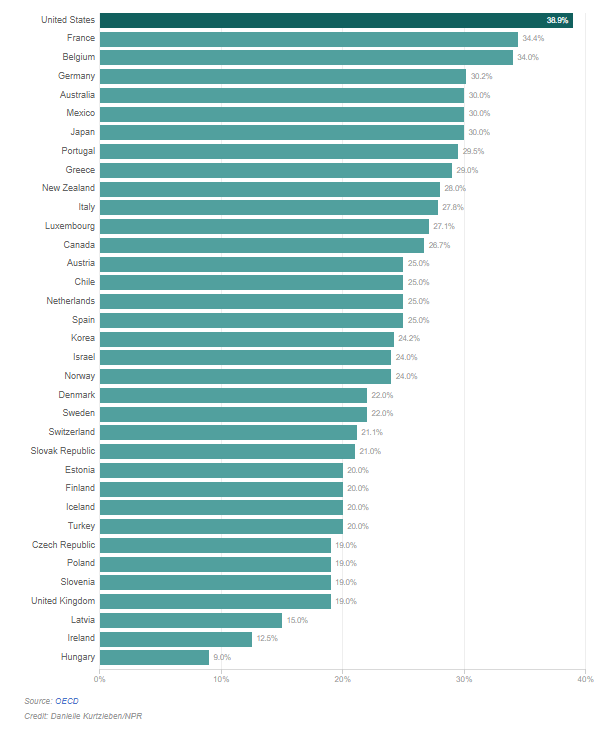
The US has the highest corporate taxes in the world. The current official rate of 35% is higher than even other developed socialist countries such as Scandinavian countries and France. The chart below shows the official corporate taxes by country according to OECD data:

Click to enlarge

Source: FACT CHECK: Does The U.S. Have The Highest Corporate Tax Rate In The World?, NPR

However the real tax rate that US companies pay is much lower based on analysis by various institutions. This is because corporations have a multitude of legal loopholes to avoid paying taxes. One such loophole is that profits earned overseas by US multinationals are not taxable as long as they are stashed overseas. So billions of dollars hoarded by multinationals abroad magically become non-taxable.

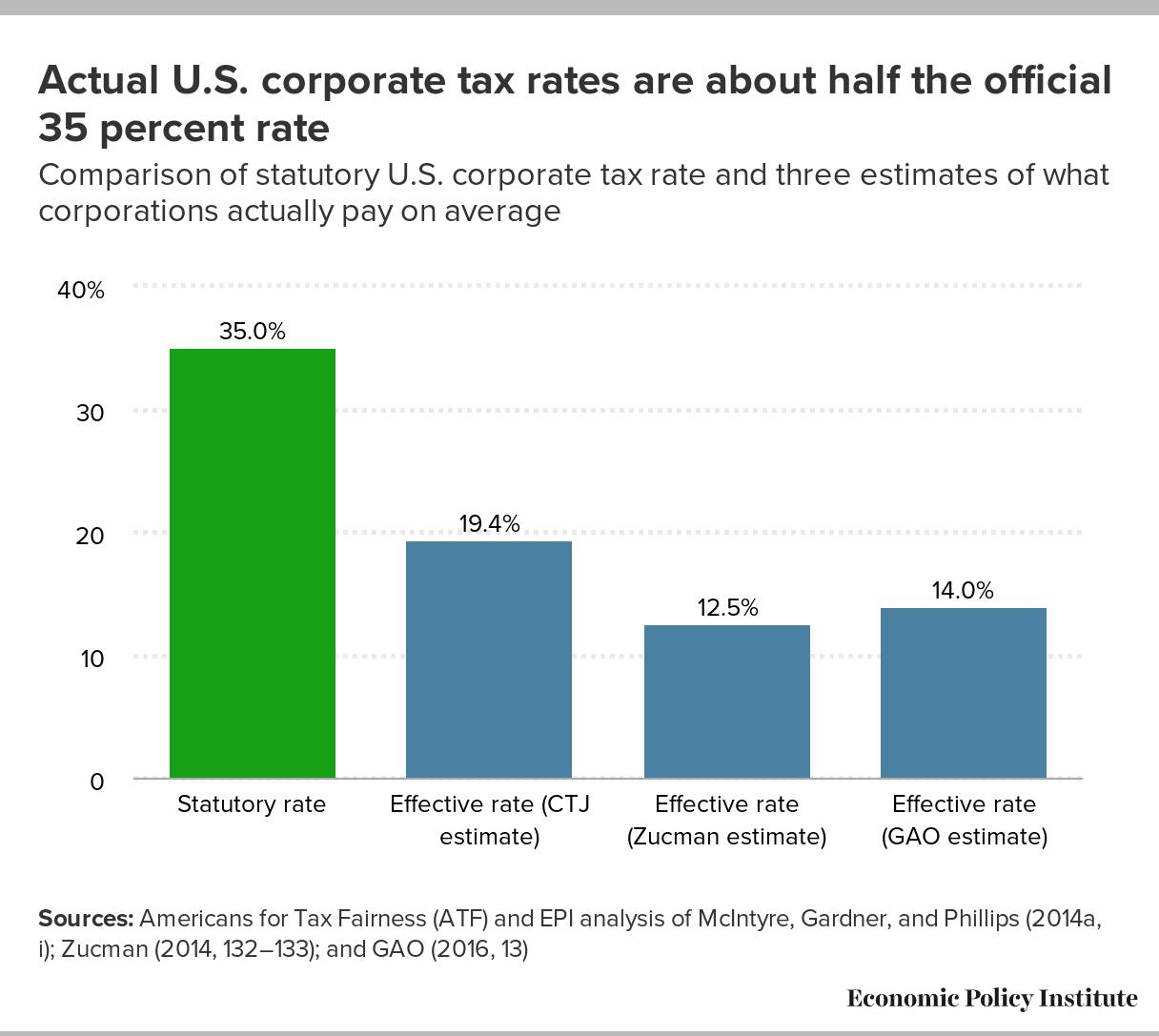
A report by EPI notes that the real US corporate tax rate that firms actually pay is somewhere between 13% and 19%.


Source: Corporations pay between 13 and 19 percent in federal taxes—far less than the 35 percent statutory tax rate, EPI

Three Concentration Risks In The British Stock Market

Concentration risk is one of the risks that investors in the British equity market must be aware of.  Though the UK is one of the largest economies in Europe and in the developed world, its equity market is highly concentrated with select sectors and companies dominating the market. So British investors are wise to diversify holding equities from other countries to alleviate the risks of domestic market.

Sector Risk:

The UK stock market is concentrated in some sectors. For example, financials and natural resources are two of the largest sectors in the FTSE 100. Financials (banks, financial services and insurance) account for about 23% of the index and natural resources (oil, energy, basic materials) contribute about 17% of the index. Compared to these two sectors’ weighting the tech sector’s contribution is tiny at about 1%. This is in sharp contrast to the US market where the technology sector plays a major role in benchmark indices and the economy.

Stock-specific Risk:

According to an article by Jamie Black, partner & head of private clients at Sarasin & Partners in Money Observer, the 10 biggest companies listed on the London Stock Exchange represent more than one third of its total value. These 10 firms include British giants like HSBC Holdings(HSBC), British American Tobacco(BTI), BP(BP), Royal Dutch Shell-A(RDS-A), etc.

Income Risk:

Two thirds of all UK dividends is currently being paid by just 20 companies. So income risk is also significant. When banks slashed their dividends during the Global Financial Crisis(GFC), Shell and BP ended up paying an astonishing 24% of all UK dividends.

Related ETF:

  • iShares MSCI United Kingdom ETF (EWU)

Source: Are your investments stuck in a UK rut?, Money Observer

Disclosure: No Positions

15 Dividend Heros of the FTSE 100 Index

The UK equity market is a fertile ground for investors looking to unearth dividend-paying stocks. Traditionally UK has had high dividend yields compared to other developed markets especially the US.

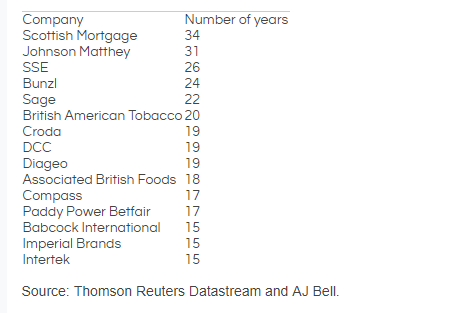
An article published last month at The Money Observer discussed the Dividend Heros of the benchmark FTSE-100 index. Research by the stock broker AJ Bell found that just 15 FTSE-100 companies have increased their dividends for at least 15 years. These 15 Dividend Heros are listed in the table below:

Click to enlarge

SourceThe 15 FTSE 100 dividend heroes revealed, The Money Observer

Some of the above trading on the US markets are utility SSE (SSEZY), British American Tobacco(BTI), Diageo(DEO), Imperial Brands(ITYBY) and Bunzl(BZLFY).

Also seeDividend Stock Lists for US, Canada, Europe and UK: Links, TFS

Disclosure: No Positions