Craft Breweries And Their Owners: Chart

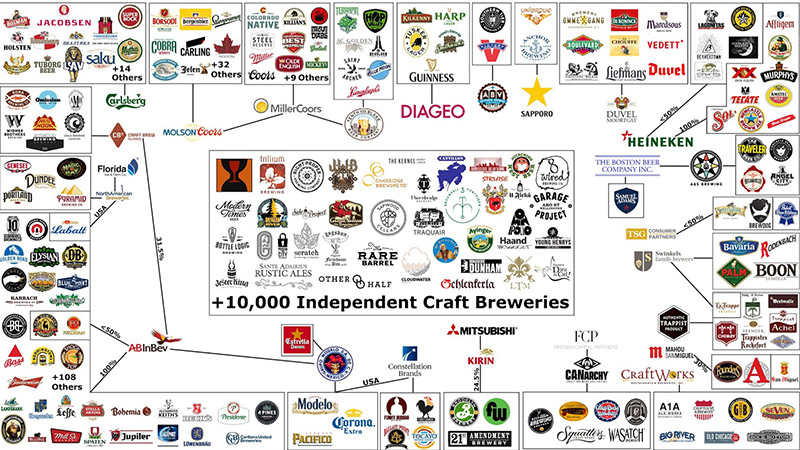
Craft beers were all the rage among beer drinkers a while ago. The craze for craft beers seems to have waned recently. When craft beer was at its peak it seemed every millennial with a beard started a craft brewery to brew beers with some wacky names like coconut-peachy mango ale, blue moon shine, barking dog, arrogant moron ale, etc. With that said, the majority of the craft beers on the grocery store shelves today are owned by the big beer companies and not by some small independent local beer aficionado.

The chart below shows the top craft beers and their owners:

Click to enlarge
 

Source: The Mad Fermentationist
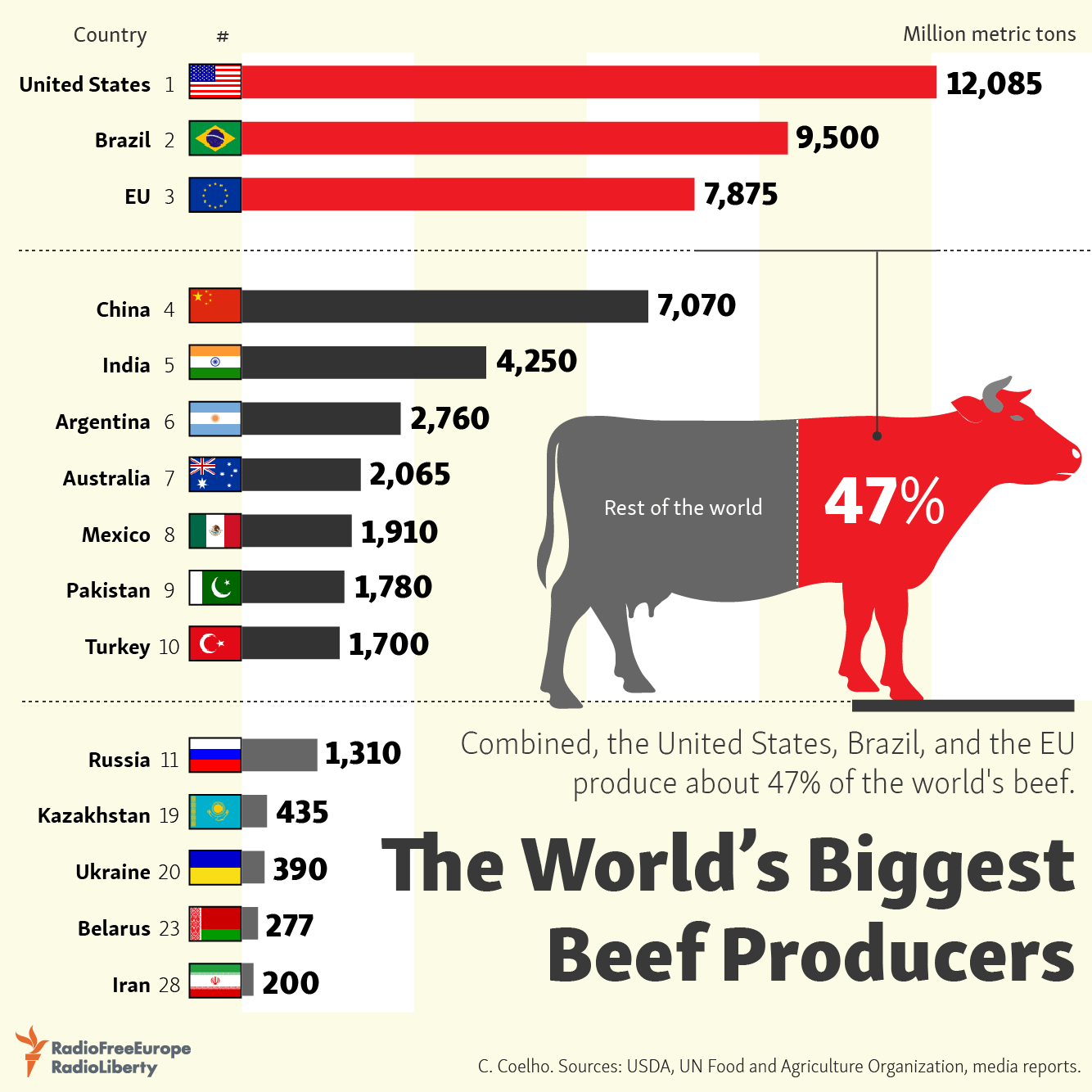
The World’s Biggest Beef Producers: Chart

The three largest beef producers in the world are the US, Brazil and the EU. Together they account about half of the global beef production. Australia and Argentina are also some of the world’s top beef producing countries as shown in the chart below:

Click to enlarge


Source: RFE/RL

Updated 2/3/19:

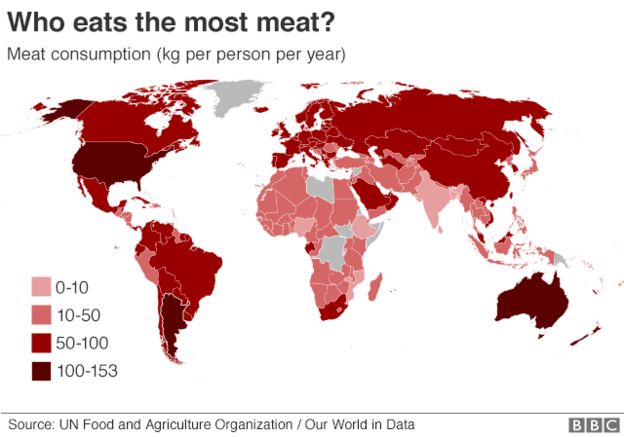
Who eats the most Meat

Click to enlarge

Source: Which countries eat the most meat?, The BBC

Corporate Tax Rates Have Been Declining in Major Developed Countries for Years

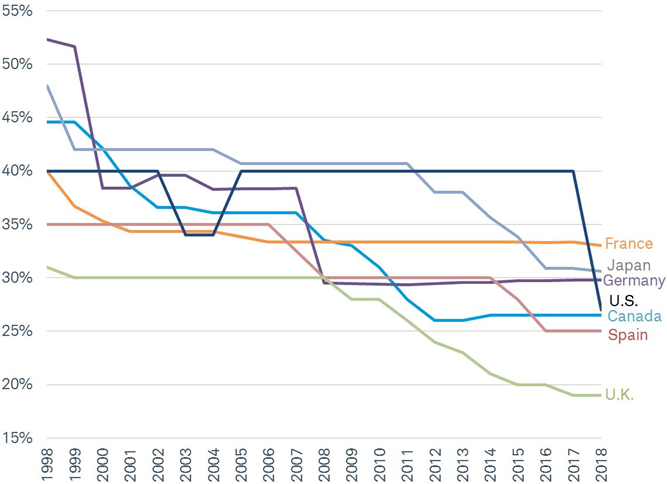
The Corporate Tax Rates have been on a downward slope in many developed countries for some years now. The Global Financial Crisis (GFC) gave another boost to further reduction in rates as countries struggled to stimulate their economies. The UK has the lowest corporate tax rate at 19% and politicians are considering to cut it to 17% by 2020 as a result of the Brexit debacle.

Click to enlarge

Source: Charles Schwab, KPMG data as of 1/17/2019.

Source: Tax War: Will Global Competition to Lower Taxes Lift Growth? by Jeffrey Kleintop, Charles Schwab

Lowering tax rates for corporations is not necessarily good for a country all the time. For example, one unintended consequence of low tax rates for companies leads to higher tax rates for individuals as governments look to fill the tax revenue gap. This situation may look like robbing Peter to pay Paul. So the key for regulators and politicians is to find the optimal rate that is fairer to both corporations and individuals.

Which Stocks Are Attractive Now: U.S. or Europe?

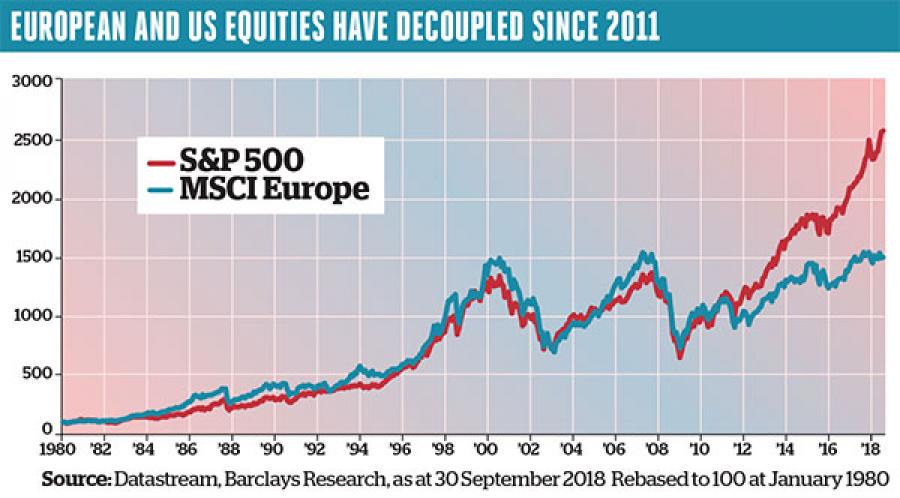
European stocks have under-performed their American peers for many years now. However after years of under-performance European stocks could outperform American stocks this year. According to John Bennett of Henderson European Focus Trust, European stocks offer a bet better bet especially in the value and growth category. Before we get to his reasons, the below chart shows that European equities decoupled from US equities from 2011.

Click to enlarge

The following is an excerpt from the article by Mr.John Bennett:

No gorging in Europe

Further, unlike the US, Europe has never been infused with – nor enthused by – the equity culture, and thus share buybacks as a means of earnings-per-share or share-price support have never been that popular. In contrast, emboldened by executive compensation schemes and plentiful supplies of low-cost debt, corporate America has gorged itself at the buyback feast. Add to that the bottom-line boost from president Trump’s tax reforms and maybe, just maybe, America’s stock market boom isn’t all down to vastly superior operating models.

In other words, sufficient evidence exists to suggest that the age-old inputs – and potential nemeses for investors – of investor crowding (fashion) and artificially boosted earnings (cheap money, leverage, buybacks, tax breaks) are at work. As sure as night follows day, those factors will not always be in investors’ favour. For example, one ingredient that would turn things in the investment world upside down, and catalyse a resurgence of value stocks, would be the return of inflation.

What we are really saying is that one doesn’t need to be a diehard mean reversionist to question the zeitgeist. A combination of investor positioning, the human tendency to extrapolate from share prices, growth rates or market share gains, a late-stage bull market in US equities and the US economy, not to mention valuation (it never matters until it does) all suggest that now is not the time to give up on Europe – nor indeed her equities. Now is not the time to abandon a selection of so-called “value” stocks in favour of an all-out “growth” (or momentum) portfolio. Happily, Europe offers an ample selection of both.

Source: John Bennett: Europe or US? Europe is a surer bet for value and growth stocks, Money Observer

How to invest in Europe?

Some of the ETFs available for Europe are:

  • SPDR EURO STOXX 50 ETF (FEZ)
  • SPDR STOXX Europe 50 ETF (FEU)
  • Vanguard FTSE Europe ETF (VGK)

Disclosure: No Positions

Will Germany’s DAX Outperform Other Developed World Indices This Year?

The DAX Index of Germany was one of the worst performers in 2018 with a loss of over 18%. As the Germany cooled and global trade war fear escalated the DAX plunged heavily. The German GDP in was just 1.5% last year relative to 2.2% in 2017.

Unlike the consumption-based US economy, Germany is an export-oriented economy. So German firms are impacted more when the global economy is volatile and countries such as China start reducing their imports. More specifically, most of the components in the DAX are global exporters and depend on other countries for their revenue than the domestic economy.

Relative to the poor performance last year , the DAX index has shot up nicely this year with a rise of 6.1% so far those year. Yesterday it rose 2.63% as news emerged about a possible resolution to the US-China trade fight.

I came across a short piece on DAX index performance in MoneyWeek recently. The following is an excerpt from that piece:

Meanwhile, the eurozone as a whole is slowing too while the sugar rush from the Trump administration’s tax cuts has worn off, says David Smith in The Times.

No wonder the latest Bank of America Merrill Lynch survey of global fund managers showed 60% expect weaker global growth this year – the highest proportion since 2008.

Still, as The Economist notes, there is a more optimistic scenario. The discussions between the US and China could disperse the “trade war clouds”. Furthermore, “tax cuts and looser monetary policy in China could stimulate spending in the private sector”. This would bolster other Asian economies, and increase demand for European exports once again, which would “buck up activity in the eurozone”.

What’s more, European stocks are “cheap”, following the latest market slide, according to Jens Ehrhardt of DJE Kapital in Wirtschaftswoche, while Austria Boersenbrief points out the DAX companies remain on track to pay out a record sum in dividends in 2019. So the index could mount a strong recovery. There is a chance that in stark contrast to last year, it could be one of the year’s best-performing stockmarkets in 2019.

Source:Will the DAX dive further in 2019? by marina Gerner, MoneyWeek

Two key points to remember about the DAX Index:

1.The DAX index is a total return index – meaning dividends are included in its calculation. So a higher dividend payout should boost DAX returns further.

2.The CAPE ratio for Germany at the end of 2018 was 16.4 compared to 26.8% for the US. So the German market is cheaper. In addition, the Dividend Yield for German stocks were 3.2% relative 2.1% for US stocks (Data Source: Star Capital).

Note: Dividend withholding taxes for US residents would reduce that 3.2% yield.

Since Germany is the economic powerhouse and is one of the largest economies of the world, it worth watching how German equities perform this year. It might be possible Germany may be a winner this year. Considering German stocks have had a strong start they may be able to maintain that momentum and outperform other developed markets this year.

Related ETF:

  • iShares MSCI Germany Index Fund (EWG)

Earlier:

Disclosure: No positions