Checking on Australian Bank Stocks

Australian banks are going through some of the worst crises they have ever faced. Billions of dollars in shareholder equity has been wiped out due to recent scandals. More recently Westpac(WBK) is under investigation for money laundering charges. Total fines imposed on the bank may exceed $1.0 billion, With that intro, let’s take a look at how they have performed in recent years.

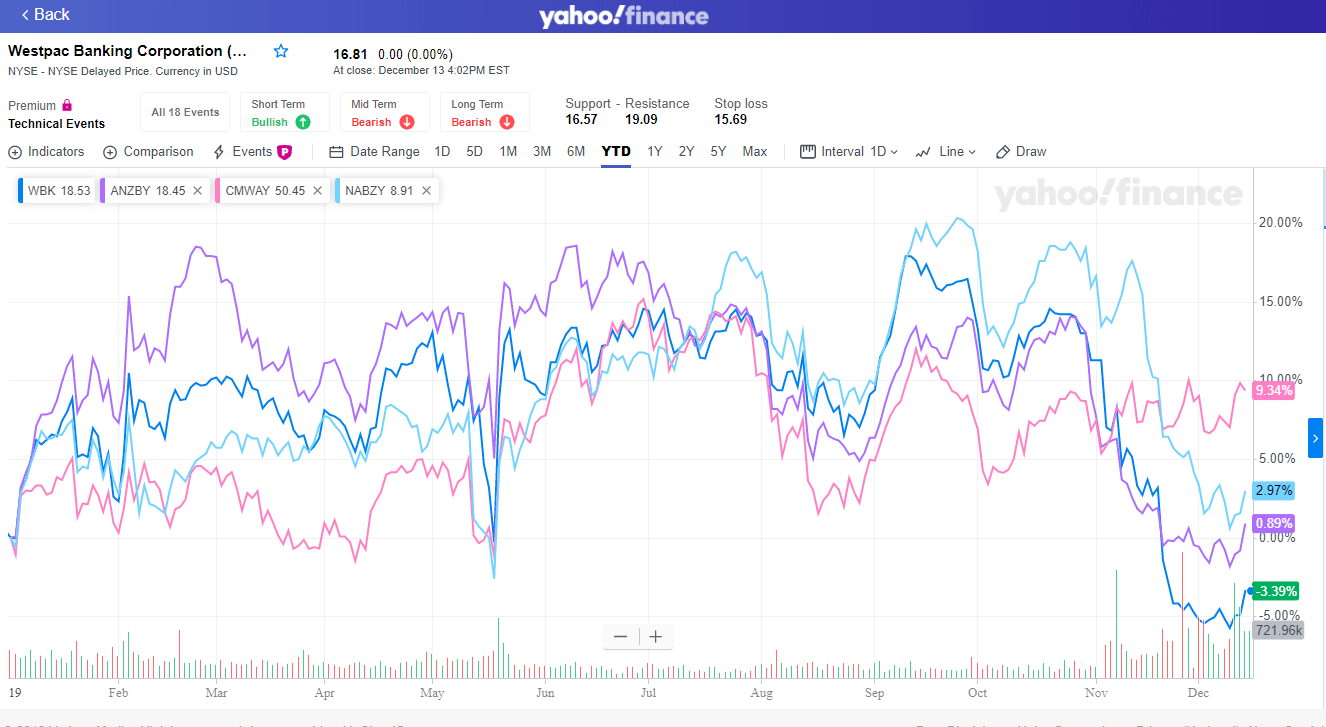
Australian Bank stocks year-to-date return:
Australian Bank stocks 5-year return:
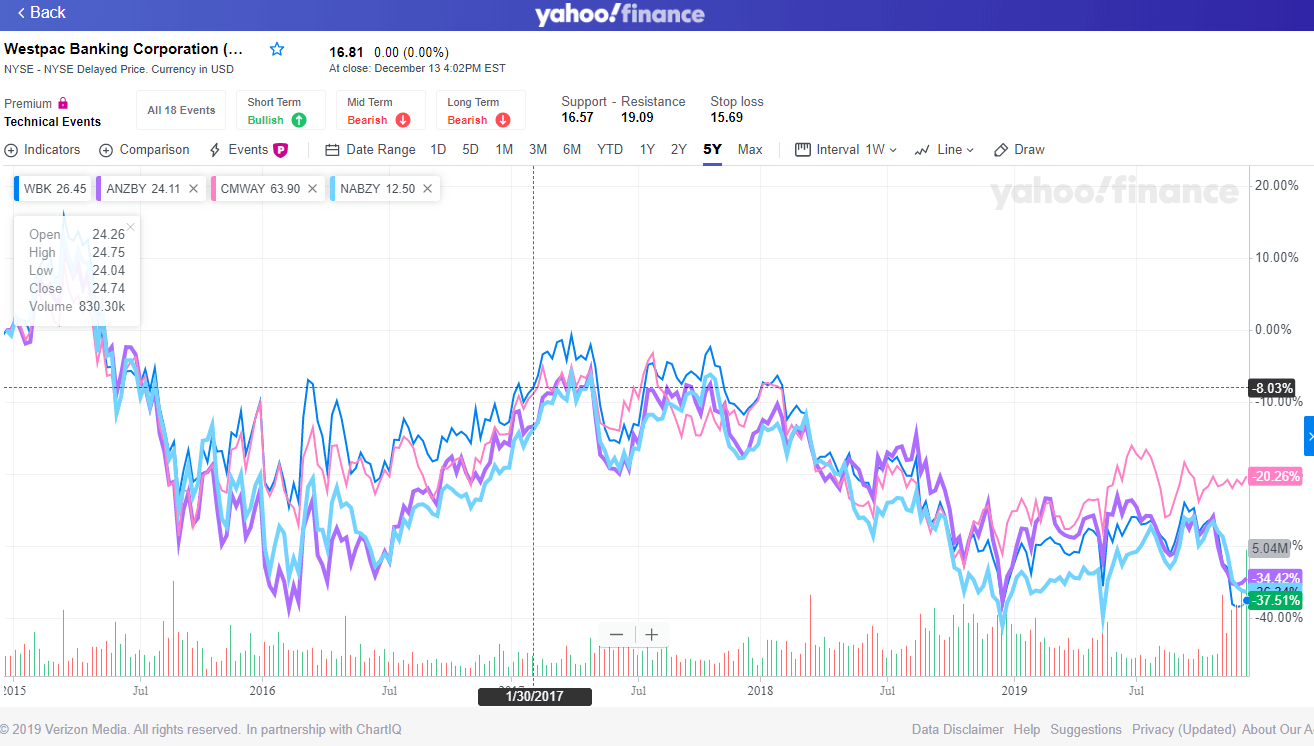
Note: The above returns show only price returns (excluding dividends)

Source: Yahoo Finance

Clearly of all the four major banks, CommonWealth Bank has been the best performer.

Related stocks:

1.Company: Australia & New Zealand Banking Group Limited (ANZBY) 
2.Company: Commonwealth Bank of Australia (CMWAY)
3.Company: National Australia Bank Limited (NABZY)
4.Company: Westpac Banking Corp (WBK)

Disclosure: Long NAZBY and WBK
Netflix Could Have a Tough Time Ahead

Streaming giant Netflix(NFLX) is often touted as one of the success stories in the past few years. It is part of the FANG group of superstar firms. Currently the company has a market cap of over $130.0 billion. Netflix stock does not pay a dividend and the P/E ratio is about 95. After reach a high of over $385 the stock has fallen recently and currently goes for about $298 a share.

While Netflix dominates the streaming market, competition is heating up. More recently Disney launched its Disney+ streaming service and is widely hailed as a success. After years of failing to understand the future of streaming Disney(DIS) is finally waking up and trying to compete against established players more specifically Netflix. I see more online and tv ads promoting Disney+ and the the marketing power of this entertainment leader cannot be understated.With that said, investors may be better off taking a wait and watch approach now as opposed to initiating any new positions. Going forward, Netflix could have a time time ahead as some consumers find the competition more interesting. Moreover any further price increases to fund more high-cost shows will hurt Netflix.

A $10K investment five years ago in Netflix stock would be worth over $62,000 today. However past performance is no guarantee of future performance. So with competition heating up, Netflix is unlikely to produce such awesome returns over the next 5 years and beyond.

I had bookmarked an an article by Matthew a while ago with a different take on Netflix. He notes that the success of the company was not due to its own amazing strategy but rather the failure of its competitors to move fast into streaming. Below is an excerpt from the piece:

Getting Lucky With Netflix

Take Netflix by example. Over recent years, some investors have earned exceptional returns by “investing” in companies like Netflix. Over the last decade, Netflix shares have compounded at almost 45%. Any investor who bought and held shares of Netflix for the last decade (easier said than done) has likely done well. But how much risk was taken to earn those returns?

In 2009 Netflix was just getting into streaming, and it still had a big DVD-by-mail business. Netflix generated no original content to speak of and was up against formidable competitors such as Comcast in distribution and Disney and HBO in content creation. If streaming was Netflix’s future, a prudent investor might have reasoned the company would have a tough row to hoe.

Netflix circa 2009 was essentially a nice-looking user interface and some licensing agreements. What’s more, even if Netflix was successful, it would be faced with a wholesale transfer-pricing problem. What is a wholesale transfer-pricing problem? In the case of Netflix, the problem has to do with licensed content. Content creators hold all the cards. As soon as Netflix started to earn profits, content creators could take substantially all of those profits by increasing the price to license content.

Of course, as we know now, things turned out much better for Netflix than they could have. The problem is that there is no reliable or repeatable strategy for identifying the source of Netflix’s success. Gross incompetence from cable providers and an extremely slow move into streaming from content creators were perhaps more responsible for Netflix’s success than the company’s own strategy and execution.

Disney Will Make Life Tough for Netflix

And not for nothing, but many of the issues Netflix faced in 2009 still lurk as major risks for the company today. Content providers are pulling their top shows off Netflix, and Disney, HBO, Apple, and Comcast all have competing streaming services that start rolling out next month. The Disney+ service launches November 12 for $6.99 per month and will be free for a year to many Verizon customers. Free will be hard for Netflix to compete against.

Betting that a company with almost no competitive advantage will succeed because of poor strategic decisions on the part of competitors probably isn’t a prudent strategy.

Source: The Royal Road to Riches: Blue-Chip Dividend-Paying Stocks by Matthew A. Young, Young Investments

The key takeaway from this post is that one should not invest in a company hoping that its competitors won’t compete fiercely. Instead investment in  company’s stock should be made based on its own fundamentals and competitive advantages over others in the field.

Disclosure: No Positions

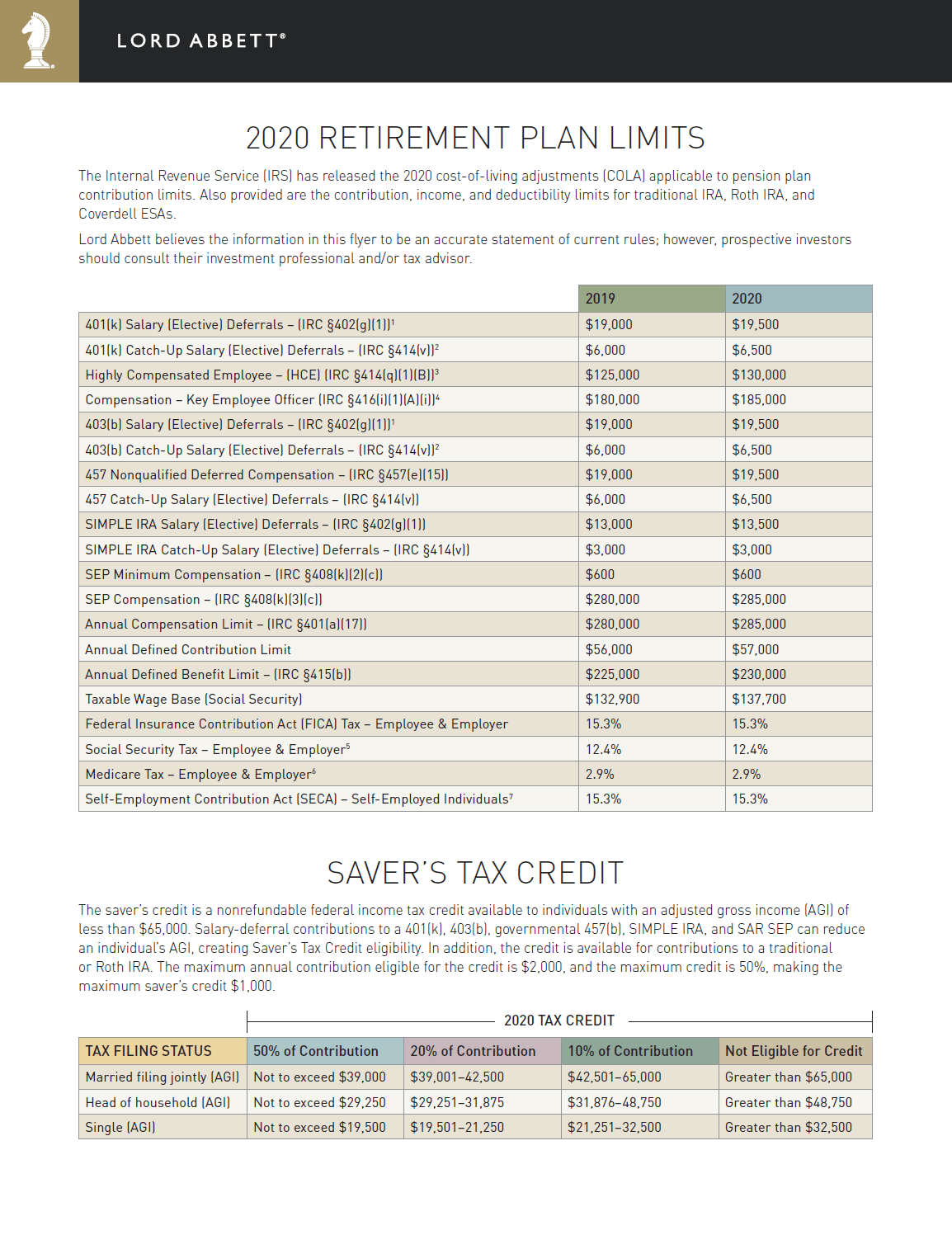
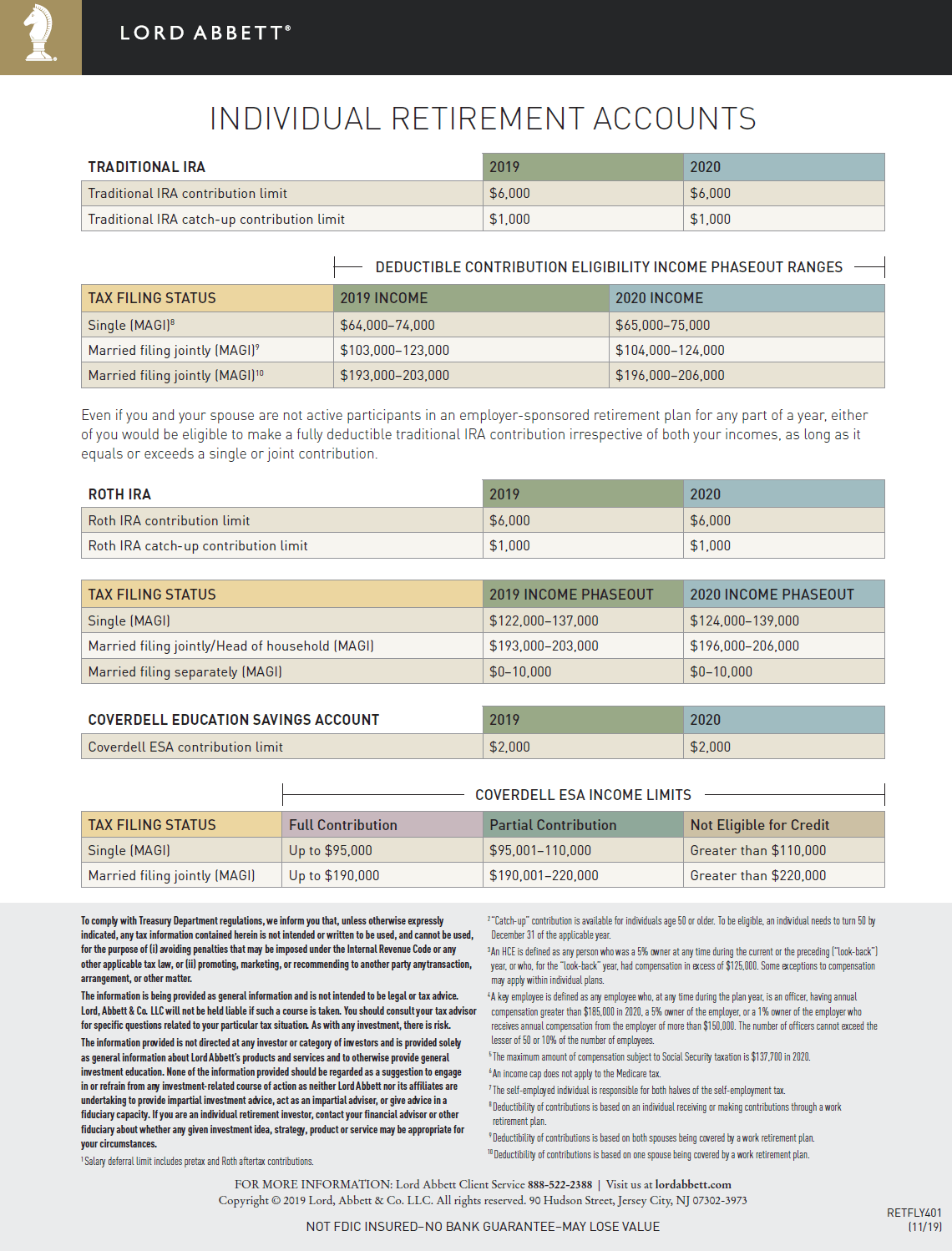
Retirement Plan Contribution Limits For Year 2020: Chart

With 2019 coming to end soon, some investors may be working at topping out their contribution limits for their 2019 retirement plans and planning their strategy for next year. The IRS has recently published the contribution limits for various retirement plans for the year 2020. The IRS adjusts these limits based on cost of living adjustments(COLA) each year.

How to use this chart?

If you are looking to contribute to a Roth IRA account in 2020, the maximum you can contribute is $6,000. This amount stays the same as in 2019.

If you are looking to save for retirement in your company’s 401-K plan, the contribution limit jumps to $19,500 in 2020 from $19,000 in 2019.

Similarly you can find the limits for other types of accounts like SEP IRA, SIMPLE IRA, Coverdell ESA, etc. in the tables below:

Click to enlarge

Source: Lord & Abbett

Download:

Note: This post is applicable to US residents only.

Foreign Stock Indices are Highly Concentrated in Low-Growth Sectors

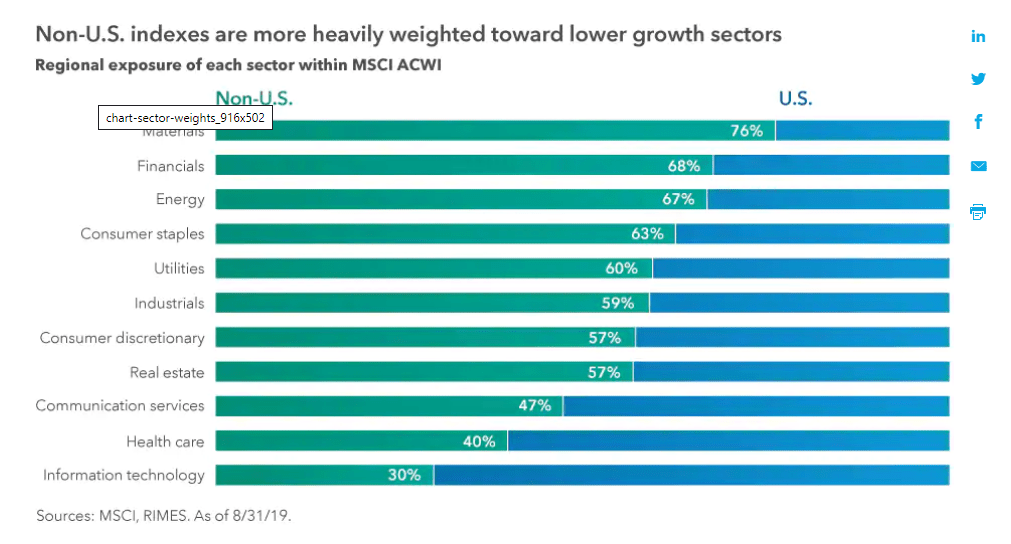
US equities have performed extremely well over the past decade relative to other developed markets. Even this year, US stocks have soared by nearly 20% so far this year. The reason for the out-performance is that the main US indices are dominated by high-growth sectors such as technology, health care and consumer tech. On the other hand, many of the foreign indices are highly concentrated in low-growth sectors like financials, materials and energy. As a result, American stocks have easily beaten their overseas peers over the years.

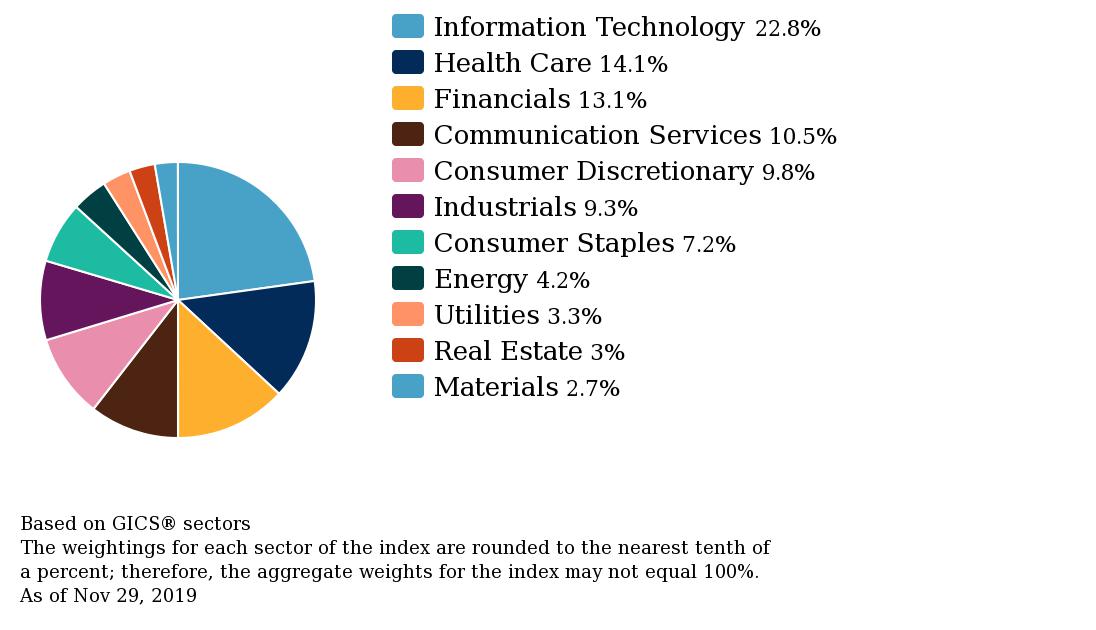
For example, the IT sector has a significant allocation in the S&P 500. This sector accounts for about 23% as shown in the chart below. Since tech firms like Facebook(FB), Amazon(AMZN), Alphabet(GOOG), Netflix(NFLX), Microsoft(MSFT), etc. are experiencing amazing growth these days the index as whole benefits from this leading to double digit returns.

Click to enlarge

Source: S&P

In many developed markets, tech sector is mostly non-existent or account for only a tiny portion of the market. For example, financials and energy are big sectors in the TSX Composite Index of Canada. In emerging countries, the tech sector is insignificant to say the least. There is no a Brazilian Apple or Microsoft for example to propel the Bovespa Index to astonishing record highs. Instead Brazil is more of a commodity-based market with oil major Petrobras(PBR) playing a major in the equity markets.

Below is an excerpt from a recent article at The Captial Group:

4. High-growth sectors are a smaller component of non-U.S. indexes

There are many reasons for lackluster non-U.S. returns over the last decade: a strong U.S. dollar, political turmoil and trade tariffs — just to name a few. But another factor is the way in which we typically measure international markets.

International indexes generally have a greater concentration of value-oriented stocks in “old economy” sectors such as materials, financials and energy. Contrast that with the U.S., where technology, health care and consumer tech dominate local indexes. That alone accounts for much of the decade-long return disparity between U.S. and non-U.S. stocks.

That’s not to say that growth can’t be found in international markets. It just requires more work to uncover promising companies that may be hidden within indexes. And that’s where company-by-company analysis becomes so critical. The average stock in Europe may be growing slower than one in the U.S., but growth can still be found by those who look past index averages and examine each opportunity based on its individual characteristics.

Source International investing in 2020: Your comprehensive guide by Rob Lovelace and David Polak, Capital Group

Related ETFs:

  • SPDR S&P 500 ETF (SPY)
  • Vanguard MSCI Emerging Markets ETF (VWO)
  • iShares MSCI Emerging Markets ETF (EEM)
  • iShares MSCI Germany Index Fund (EWG)
  • iShares MSCI Canada Index Fund (EWC)
  • iShares MSCI Australia Index Fund (EWA)
  • iShares MSCI United Kingdom Index (EWU)
  • iShares MSCI Singapore Index (EWS)

Disclosure: Long PBR