Top Five US Utility Stocks


Utilities are a favorite among investors during good times and volatile market conditions. Many utility stocks tend to be relatively stable long-term value plays as they pay decent dividends. For the most part, utilities have a solid business model and enjoy monopoly in the territory they operate due to state regulations. While prices they charge are also highly regulated they usually get approvals for rate increases. So far this year, the utility components in the S&P 500 Index is down 17.33% while the S&P is off 16.54% as of market close yesterday.

The following is a brief overview of the top 5 US utilities based on market cap today:

1. Exelon Corp (EXC) is one of the largest utility companies in the US with customers in Northern Illinois, Chicago, Southeastern Pennsylvania including Philadelphia. With a market of $29B, the stock has an yield of 4.86% and a P/E of 1.73. Average annual earnings growth over the past 5 years is about 25%.

2.As the name implies, Southern Co(SO) supplies electricity to customers in the states of Alabama, Georgia, Florida, and Mississippi. Currently Southern pays a 7.95% dividend. In the last 52 weeks, So is down 18%. The 5 year annual earnings growth is a low 2.10%.

3.Florida-based FPL Group Inc (FPL) is “engaged primarily in the generation, transmission, distribution and sale of electric energy”. Compared to Southern Co, earnings have grown at 100% annually in the last 5 years. Dividend growth rate in the same period is 8%. The dividend yield is 4.05%.

4. Dominion Resources Inc (D) is a producer and distributor of both electricity and natural gas. Last year Dominion had $16B in revenue. With a dividend rate of 5.79% and a P/E of just 9.5, Dominion is attractive at current levels. Dominion’s annual dividend growth rate is 4.10%.

5. Charlotte,NC-based Duke Energy(DUK) operates in the mid-western states. Duke bought a Cincinnati,Ohio utility called Cinergy a few years ago. The gains promised by Duke as a result of this merger did not materialize. The current yield of DUK is 6.99%. Duke’s profit margin is about 10%.

Disclosure: Long FPL, DUK

Knowledge is Power: Zombie Theory Edition

1. General Motors is preparing a fresh barrage of discounts and other promotions to coax Americans into buying more cars after an upcoming US government decision on further financial aid to the Detroit motor industry. The incentives will be designed to counter a slump in sales and GM’s market share, amid signs on both sides of the Atlantic that its financial woes are beginning to drive away customers. GM to cut prices to lure back US buyers

2.What exactly is wrong with the banks? A year and a half after the credit crisis started, this may seem a bizarre question. But there is actually still a lot of confusion about what’s the matter. Indeed, that confusion – displayed on endless television programmes and around countless dinner tables – is adding to the sense of crisis.Bank crisis: It’s confidence, stupid


3.China‘s economic growth will plunge in 2009. The United States is in severe recession. For the world’s economy to recover, these two economic powerhouses must cooperate and become the engine for the Group of 20. Without a strong G-2, the G-20 will disappoint.Recovery Rides on The ‘G-2’


4. n his testimony before the US Senate Committee on Banking, Housing and Urban Affairs on February 24, Federal Reserve chairman Ben Bernanke depicted a deepening economic recession with real output contracting at an annual 6.2% in 2008Q4 and unemployment rising to 7.6%.Time for prayer


5.Author Margaret Atwood suggests debt forgiveness could be one way to restart the world economy.Lenders should forgive debt

Many Japan ADRs Are Up This Month Despite Export Plunge

The Japanese economy is a heavily export-drive economy. Japan imports raw materials such as iron ore, copper and other resources and makes many finished products using them for export. This was highly profitable to the Japanese as the world loved their products. however the demand for many Japanese products such as automobiles, consumer electronics, etc. have collapsed in the past few months.

In January Japan’s exports plunged 46%. During the first three quarters of 2008, the economy contracted by almost 13% from the same period last year. Echoing the problems , on March we learned that “Toyota Motor Corp.’s U.S. sales plunged 40 percent, while Honda Motor Co.’s sales dropped 38 percent and Nissan Motor Co.’s fell 37 percent.”

Despite the facts mentioned above, many of the Japanese ADR stocks are up this month. These stocks are being lifted by the overall market’s “irrational exuberance” with the news of Citibank(C) and Bank of America(BAC) making a profit after getting billions in tax payer money.

The following are some of the well known Japanese companies with the month-to-date performance:

1. Sony (SNE) – 17.03%

2. Nissan Motor (NSANY) – 16.50%

3. TDK (TDK) – 14.53%

4.Kyocera (KYO) – 12.11%

5.Fujifilm (FUJI) – 6.29%

6. Hitachi (HIT) – 6.26%

7. Canon (CAJ) – 2.27%

Honda (HMC) and Toyota (TM) are down less than 5%.

Knowledge is Power: Boom to Bust Edition

1. While oil prices skyrocketed, Russia was flooded with cash. But with sinking prices and the economic crisis, hopes are diminishing and tensions are rising in this recently robust industrial city that finds itself grinding to a halt.A Russian City Goes from Boom to Gloom

2.Can 1,000 professors be wrong? That’s how many were asked for their estimate of the equity premium in a January survey by Pablo Fernández, a professor at the University of Navarra in Spain.On expected stock returns

3. Australia will close the gate on thousands of foreign workers this year to protect the nation’s jobs.Australian jobs protected by freeze on foreign workers

4. Latest figures from China suggest great strength in demand for copper, iron ore and steel in particular, but bankers Macquarie’s research suggests that all may not be as it seems. Strong copper, steel and iron ore data from China – are they sustainable? – Macquarie

5. Escalating cost of jet fuel in 2008 pushed up ticket prices while recession delivered a further blow to the air travel market. Air passengers fall for first time in 17 years

6. Diversion:

maldives

Maldives Beach from http://www.oursurprisingworld.com

The Callan Periodic Table of Investment Returns for 2008

Callan Associates, famous for its Periodic Table of Investment Returns also called the Callan Charts, has published the chart for 2008.

Some key points from last year’s chart:

  • The US markets performed better than the international developed markets
  • While the S&P was down 37%, the MSCI EAFE Index which measures the developed markets of Europe, Australasia and the Far East was off 43.38%
  • The BC Agg (Barclays Aggregate Bond Index) which includes US Government and Corporate with maturities of at least 1 year was up by 5.24%
  • Small Cap value (-28.92%) performed better than large cap stocks
  • After double digit growth in the past 5 years, developed market equities fell in 2008 with a loss of 43.38%

You can download the complete pdf version of “The Callan Periodic Table of Investment Returns (Key Indices: 1989-2008)” by clicking here.

For “The Callan – Equity Return of Developed Markets Chart” which gives returns by individual countries upto 2007, go here.

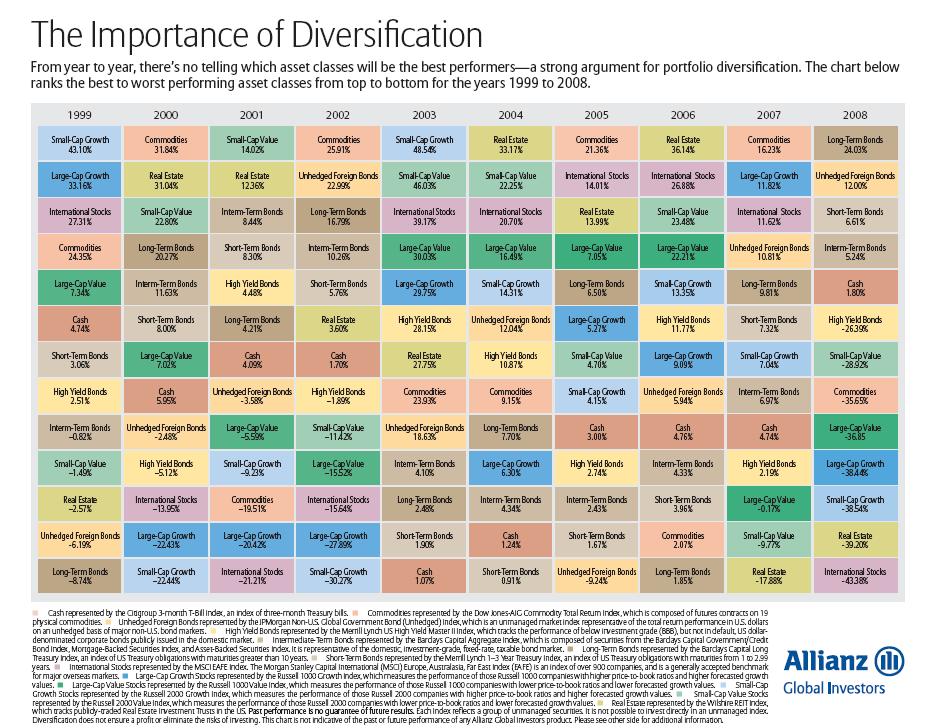
Considering the collapse of equity markets worldwide since 2008 many investors are wondering if diversification is dead. According to a research paper released by Allianz Global Investors, diversification is still important. However diversification has to be done among various asset classes such as stocks, bonds and includes cash.

“The Importance of Diversification” Chart (click to enlarge):

The Importance of Diversification Chart

Source: Allianz Global Investors

Some observations from the chart:

  • In 2008, long-term bonds were the best performers with a return of 24%
  • Commodities fell about 36% and Real Estate was off 39%
  • While long-term bonds did well, high-yield bonds fell by about 26%

Related: The Callan Periodic Table of Investment Returns 2016: A Review