Taking the Pulse of Brazil’s Economy

Emerging markets are performing better this year than developed markets.Investors’ appetite for risk has increased and many of the emerging market indices have rebounded nicely this year. One of main developing countries that is attracting investor attention this this year is Brazil. The iShares MSCI Brazil Index Fund (EWZ) ETF is up by 10.45% as of the end of first quarter.

In order to take the pulse of the economy of Brazil, I was researching the site of the Banco Central Do Brasil, the central bank of Brazil. The following are excerpts from a presentation made by the chief of the bank Henrique de Campos Meirelles in New York last month. The title of his presentation was “Brazil: How the Country is Overcoming the Current Turmoil”.

  • At the start of the current economic crisis, Brazil had low leveraged banking system
  • The international reserves stood at US$ 205 B
  • The country enjoyed a robust domestic demand-led growth
  • Average household credit grew by 32% since January,2004
  • The risk-based capital adequacy of banks are well above the regulatory minimum of 11%
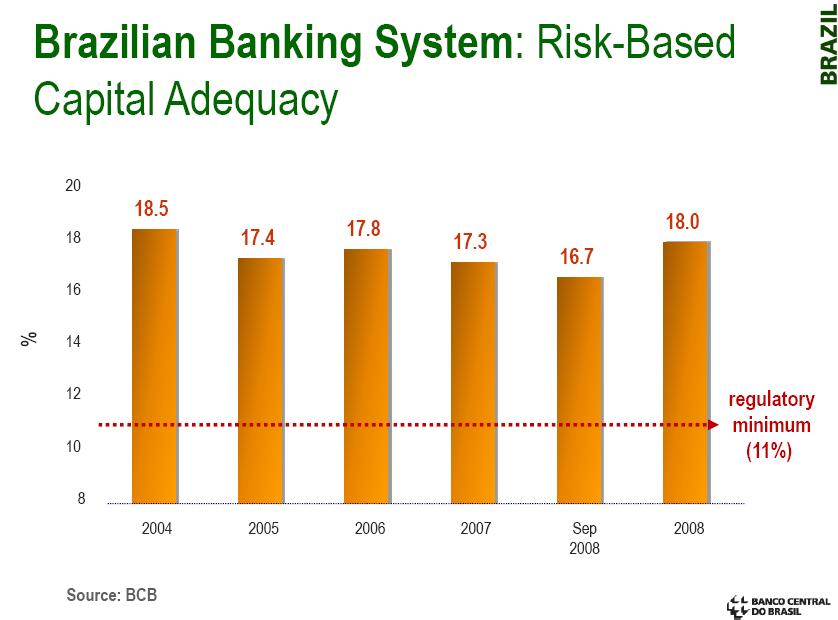
1-capital-risk.JPG

  • Non-Performing Assets (NPAs) stood at 6.4% of total loans at end of last year
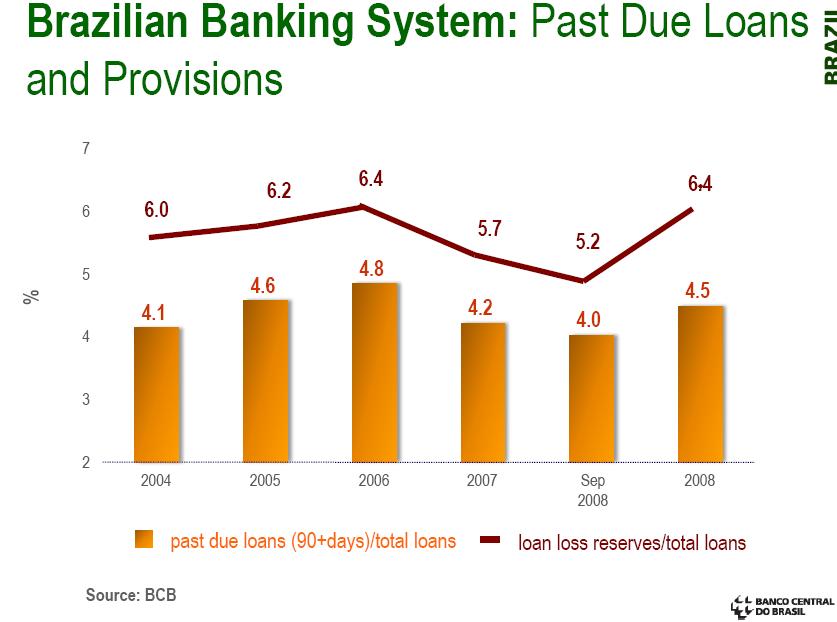
2-npas.JPG

  • In January of this year seasonally adjusted retail sales increased by 4.4% over December
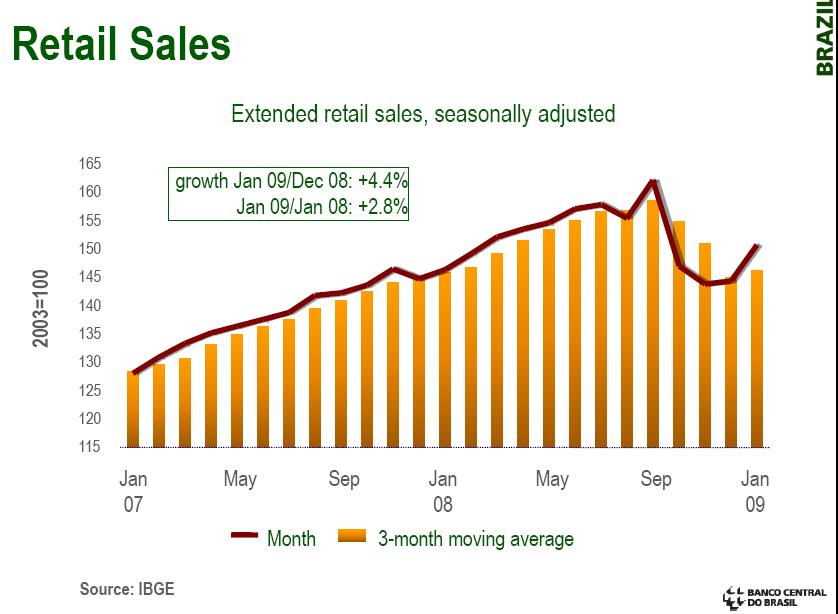
3-retail-sales.JPG

  • Auto Sales numbers has picked up since the beginning of the year

4-auto-sales.JPG

To download the full presentation, click here.

Will the US start a Car Scrapping Incentive Program?

In a recent Washington Post article titled “Too Many Cars, and They’re Not on the Road“,the author says that 57,000 unsold cars are piled up at the Port of Baltimore and many more are stored at the Baltimore-Washington International Marshall Airport. The big three US automakers – Ford Motor Co (F), General Motors(GM) and Chrysler Holdings LLC – posted on an average over 40% sales decline in March compared to the same month last year.In addition to the cars parked at ports, dealerships across the country are sitting on millions of new cars that are waiting for buyers.

In order to  provide a jolt to auto sales and to kick-start the automotive industry many European countries started incentive programs to help new car buyers. People were offered cash in order to exchange their old cars for new cars.In Germany this program was a big hit with the government receiving over one million applications. Due to this success the German government extended the program this week and increased the funding to five billions euros. (Source: Deutsche Welle)

Brazil enacted a similar program last December and this program was successful. Due to this tax incentive, auto sales spiked in March to 36.2% compared to February. A total of 271,400 cars were sold in March as per the the National Association of Motor Vehicles Producers (Anfavea). The government’s program led to a reduction of 5% to 7% in retail car prices. Hence similar to Germany, the Brazilian government has extended the tax incentive to another three months. Companies leading last month’s sales were Italy’s Fiat, Germany’s Volkswagen AG and the American automakers Ford Motor Co (F) and General Motors(GM).

Now the US government is considering two similar proposals. This is a step in the right direction that will help investors, consumers and the economy in general. According to  Deutsche Welle, the two proposals are:

“The first, put forward by a Democrat representative, would pay consumers up to $5,000 (3,800 euros) if they trade in models from 2001 or earlier and buy a new vehicle assembled in the US, Canada or Mexico.

The second proposal, drafted by a team of Democrat and Republican senators, would involve payments of $2,500 to $4,000 linked to tight efficiency controls. The plan would not discriminate against foreign car manufacturers, and is therefore likely to face tough opposition from union leaders.”

In my opinion, if our lawmakers approve one of the above proposals and implement the program it would be helpful for the economy especially the beaten down automotive sector. What are your thoughts on this issue?. Please leave your suggestions/ideas in the comments section.

Update: On April 12th, the New York Times reported that the Treasury Department has asked GM to prepare the groundwork for bankruptcy filing by June 1st.

The Top 50 Banks of Brazil by Assets

The Top 50 Banks of Brazil based on assets held as of December 31,2008 are listed below. The source of the data is Banco Central Do Brasil which is the Central Bank of Brazil.

The largest 50 Brazilian banks based on Assets held in R$ thousands (as of December 31,2008):

[TABLE=147]

Source: Banco Central Do Brasil

The largest bank in Brazil is the private-sector bank Itau Unibanco Banco Multiplo S.A. (ITU). This bank, former by the merger of Banco Itau and Unibanco, has over hundred thousand employees and 3,718 branches. After reaching a low of $6.70 the stock has nearly doubled to close at $13.63 on April 10th.

The second largest bank is Bank of Brazil (aka Banco Do Brasil) which is state-owned.Though it has more branches its asset size is smaller.Last week, its CEO Antonio Francisco Lima Neto was fired by the President of Brazil Luiz Inacio Lula da Silva. The reason for his firing was that the bank was charging high interest on loans to consumers. Banco Do Brasil shares do not trade on the US markets. It must be noted that the Brazilian’s central bank name is similar sounding but is called Banco Central Do Brasil.

The third largest bank by assets is Banco Bradesco(BBD), one of the top private-sector banks and is the main competitor for Itau bank.BBD reached the 52-week low of $7.40 late last year and closed at $12.25 on April 10th.

Three foreign-owned banks appear in the top ten positions.These banks are the Spain-based Banco Santander(STD), HSBC Bank (HBC) of UK and the US-based Citibank(C).

Knowledge is Power: Failed Banksters Edition

1.  BEIJING, April 11 — China’s government has pledged to create 1 million jobs for college graduates in the service outsourcing industry in five years.China to create 1 mln service outsourcing jobs for graduates

2. Obama Stakes His Fortunes on Failed Banksters Now that we have a rough idea how President Barack Obama and his lieutenants plan to prop up insolvent financial institutions using taxpayers’ money, we’re left with a more difficult question: Why?

3. The employment picture still looks bleak.U.S. markets: What recovery?

4.South American real estate: Sun spots Real estate may be cooling here, but it’s heating up way south. Despite plummeting real estate prices worldwide, not everyone’s willing to give up on this traditional investment. Some are setting their sights down south, buying up properties in popular hot spots such as the Dominican Republic and Saint Lucia.

5.Is this the real thing, or just another Bear Market rally? So far, we’ve had 4 runs of about 20% each.Bear Market Rally ?

6.While US and European banks went into meltdown, India’s banks reported healthy profits. Many applaud the country’s liquidity policy for helping avoid the West’s pitfalls, but does this hamper the country’s capital requirements?India avoids financial meltdown

7.As US lawmakers discuss the creation of their own system of auto trade-in subsidies, critics of the scheme here in Germany are questioning the motivations of decision-makers in Berlin.US considers adopting German-style car-scrapping subsidy

8. LONDON–How bad are things in Britain?

Not long ago, the Church of England put out two new prayers to provide solace for those who have been laid off. “Hear me as I cry out in confusion” is a line from the “Prayer on Being Made Redundant” offered to the country’s two million unemployed. Britain’s boom now a bust

Update: The Callan Periodic Table

The Callan Periodic Table of Investment Returns from Callan Associates is widely used by investors to compare performance of various market indices. Recently I found the Callan Chart that lists the Best and Worst Performing Indices from 1985 to 2004. To access this chart click on the image below:Callan Chart Annual Returns – The Best and Worst Performing Indices from 1985 to 2004:

Click to Enlarge

Callan Chart Annual Returns 1985 to 2004

Related Charts:
1. For Top 10 Emerging Markets in 2008,
The Top 5 Best and Worst Performing Countries Chart
Go here.

2. For The Callan Periodic Table of Investment Returns for 2008 click here.

3. For The Callan Period Table of Investment Returns (1988-2007),
Callan’s – Equity Return of Developed Markets Chart
Go here.

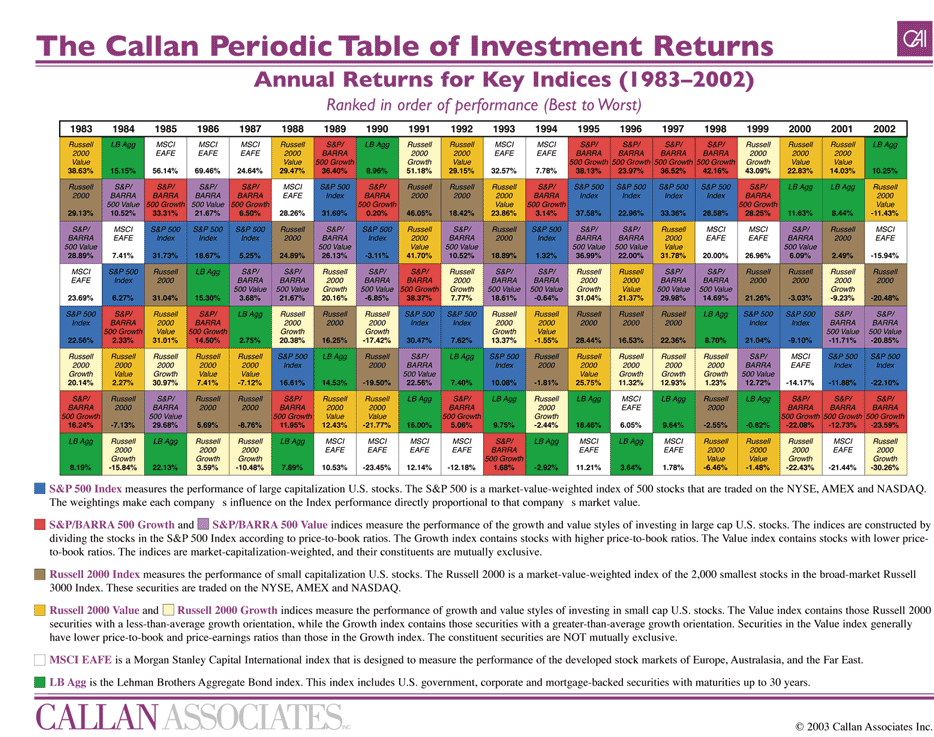
4. The Callan Period Table of Investment Returns (1983-2002)

Click to Enlarge

Callan-Chart-1983-2002

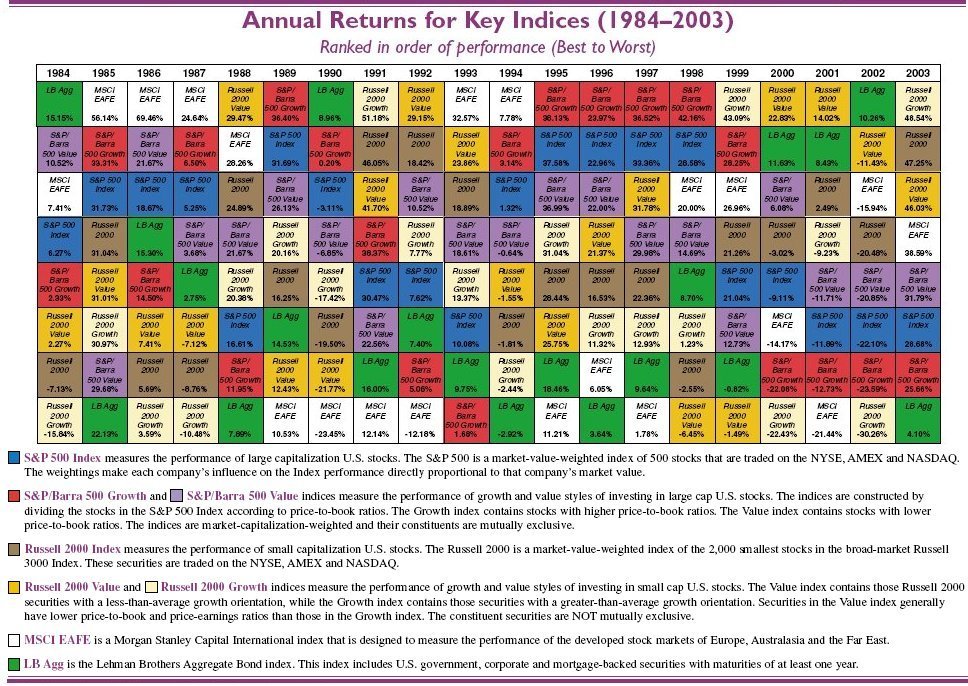
5. The Callan Period Table of Investment Returns (1984-2003)

Click to Enlarge

Callan-Chart-1984-2003