A Review of the Current Global Steel Market

Steel RollThe global demand for steel has fallen sharply except China. Due to the crash in residential and commercial real estate, demand for steel is low. Another reason is the slump in automobile production in developed world. China continues to show strong demand for steel due to the many public infrastructure projects under construction there. However China also is a major producer of steel as well. Overall production capacity continues to rise while demand shows no sign of revival.

This post contains a few interesting charts from a presentation at the OECD 66th Steel Committee Meeting, Paris, in June  this year and PowerPoint decks presented by participants from Latin America, Japan, North America, China and the EU.

Global Steel Output Growth

Global-Steel-Output-Growth

Global Steel Demand

Global-Steel-Demand

Steel Consumption – U.S. Vs. China

Steel Consumption- U.S.-Vs.-China

Global Steel Production

Global-Steel-Production

Source:  OECD – Trends in the global steel market, 66thSteel Committee Meeting, Paris, June 2009

The consumption of steel in China is  strong which confirms the infrastructure spending by the economic stimulus program. Despite the U.S. stimulus allocating a sizable portion to infrastructure improvement it has not translated into higher demand for steel.

Download:

Worlds Top Steel Producers From 1970 To 2011 (pdf)

Click on the following links to download the appropriate presentation in pdf:

Trends in the Global Steel Market

The Recent Development of Steel Industry in China

Current Situation of Steel Supply and Demand in Japan

North American Steel Industry – Recent Market Developments, Future Prospects and Key Challenges
EU Economic and Steel Market Outlook

Latin American Steel Market

Weekend Wisdom: American Dream Edition

Like a latter-day Tom Joad, one of America’s last Okies ponders a question that… Has anyone seen the American Dream?

German discounting pioneer Aldi is using the economic crisis to expand its presence in the US. The move could help mitigate the company’s troubles on its home turf.Aldi advances on Wal-Mart’s home turf

Many SMEs across China’s most prosperous province are currently locked in a struggle for survival. With a US recovery still in the balance and most European Union countries forecast to go through an economic contraction this year, many analysts say export orders are likely to…No quick-fix in Guangdong crisis

The financial panic of 2007-08 and the ensuing great recession have changed the balance of wealth in the global financial arena. The big question is whether Asian institutions can take advantage of the change and step up into a leadership role – or hold back and further delay parity between East and West.Historic moment for Asian finance

Chocolate is just as much a part of Switzerland as the Alps. Now, global market leader Barry Callebaut has developed the product that competitors have been hopelessly puzzling over for 60 years — chocolate that doesn’t melt and is low in calories.Chocolate Company Promises Melt-Free Revolution

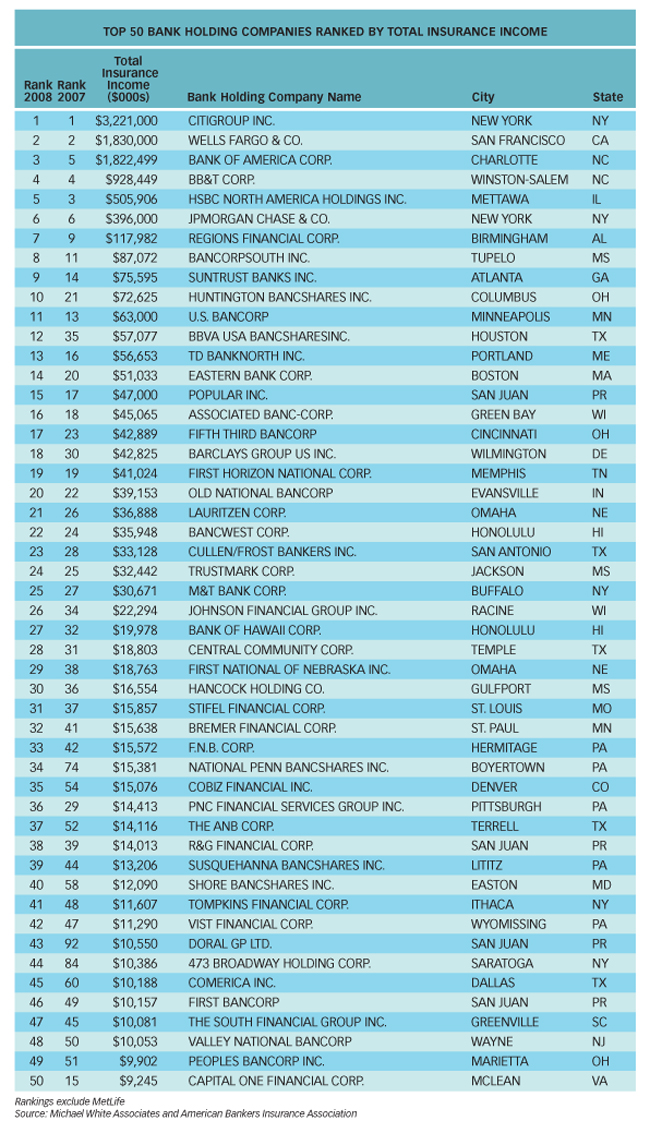
The Top 50 U.S. Bank Holding Companies Ranked by Total Insurance Income for 2008

Many of the U.S. banks diversified in the past few years to get into the insurance field. Some started their insurance operations while the majority of them acquired insurance companies or agencies.

Today large banks such as Well Fargo (WFC) derive a large amount of income from their insurance divisions. The following chart lists the Top 50 U.S. Bank Holding Companies Ranked by their Total Insurance Income for year 2008:

Click to Enlarge

Top-50-US-Bank-Holding-Companies-By-Insurance-Income-2008

Source: Michael White Associates and American Bankers Insurance Association

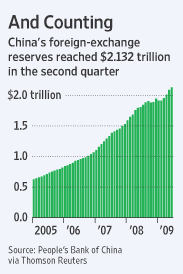
China’s Foreign Exchange Reserves Cross $2 Trillion

China’s foreign-exchange reserves exceeded $2 Trillion for the first time as per the data released this week.

China-Foreign-Exchange-Reserves

Source: The Wall Street Journal

From the WSJ:

The stockpile — the world’s largest currency reserves — grew by $177.87 billion in the quarter to $2.132 trillion, the largest quarterly rise on record. In May, China also increased its importance for U.S. policy makers, lifting its Treasury holdings by $38 billion to a total of $801.5 billion.

While Japan and Russia cut their Treasury holdings in May, China ramped up its purchases, posting the biggest one-month increase since October. China now has more than 20% of total Treasury holdings among foreign central banks and nearly matches the total amount Japan and Russia hold together.”