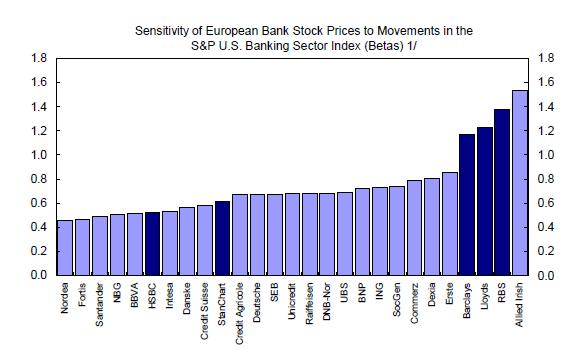
Lost Value of Equities in U.S. State and Local Government Pension Plans = $1 Trillion

In the U.S., the pension plans of state and local governments have a large portion of their assets in equities. Due to this high exposure to equities, the plans suffered severe losses as the markets fell hard until March this year.

The average asset allocation of U.S. Define Benefit (DB) plan has 60% in equities, 30% fixed income and 10% in other assets.

“Public pension plans of U.S. State and local authorities also suffered severe losses due to high equity exposure and substantial leverage. The financial crisis has reduced the value of equities in State and local authorities’ DB plans by about US$1 trillion. These changes will become evident over time because State and local authority plans smooth both gains and losses by averaging the market value of assets over a five year period. However, they will be large as public plans in the United States have on average 60 percent of assets in equities. In addition, they leveraged themselves to fund liabilities. In general, state and local plans had an average funding ratio of 87 percent in 2007 which, by October 2008 would have declined to 65 percent if assets were valued at market values (Munnell et al. (2008)) (the impact of smoothing is shown in Figure 13. In the optimistic scenario that assets level return to the 2007 values, funding ratios are projected to increase to 75 percent in 2013. Under the pessimistic scenario that asset values remain at the level of end 2008, funding ratios are expected to further decrease to 59 percent. In both scenarios, liabilities are assumed to grow at 5.7 percent per year.”
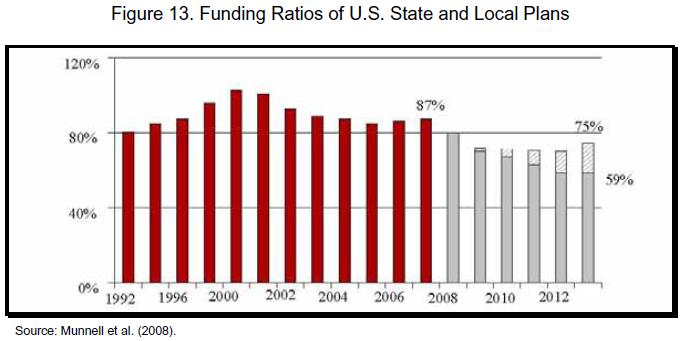
US-Pension-Plans

Source: How the Financial Crisis Affects Pensions and Insurance and Why the Impacts Matter by
Gregorio Impavido and Ian Tower, IMF Working Paper

To download the full paper, click Pension-Plan-Impact-Crisis
IMF: Outlook for the UK Economy is Highly Uncertain

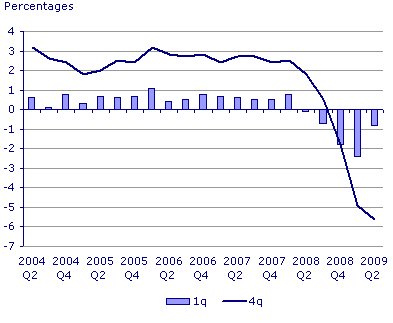
Today the Office for National Statistics announced that GDP shrank at a rate of 0.8% between in the second quarter. This is higher than the 0.3% economists had predicted.The GDP has contracted for the fifth consecutive quarter and is approaching the levels of 1980s recession.

Uk-GDP

On July 16th, IMF released the Staff Report for UK. The following is a summary of some of the key points from the report:

  • The UK economy was hit hard in this crisis because of the large size of its financial sector
  • The outlook is highly uncertain and deleveraging  of financial institutions and households’ balance sheets is needed
  • The unemployment rate is projected to be 7.6% in 2009 and 9.2% in 2010
  • Dramatic deterioration in public finances with the net public sector debt expected to reach 67.9% of GDP next year and double in the next five years
  • Though British banks reported record write-downs in 2008, substantial further write-downs are expected this year and next
  • Housing sector collapse is still not complete despite the foreclosure rate was only 0.35% compared to 4.25% in the U.S.
  • Since the five largest British owned banks have significant international operations, their recovery is strongly related to the economies the U.S. , Western Europe and some Asian countries

UK-Banks-Foreign-Exposures

Source: IMF

  • The economic recovery is projected to be gradual

The Best Banks of Russia for 2009

The Best Banks of Russia in different categories for 2009 as per Global Finance magazine are as follows:

Domestic -    VTB
Foreign -    Citi (C)
Regional -    UralSib
Domestic Investment –     Troika Dialog
Foreign Investment –     Credit Suisse (CS)
Commercial -    Sberbank
Consumer -    Raiffeisen (RAIFF.PK)
Foreign Exchange -    VTB
Domestic Trade Finance -    VTB
International Trade Finance -    Deutsche Bank (DB)
Asset Manager – Troika Dialog
Fixed Income Sales & Distribution -    Zao Standard Bank
Syndicated Loans -    J.P. Morgan (JPM)
Book Runner Primary Equities -    Morgan Stanley (MS)
International M&A Arranger -    Morgan Stanley (MS)
Equity Research -    Troika Dialog
Domestic Bond Reseach -    Troika Dialog
Eurobond Research -    Deutsche Bank (DB)

None of the Russian banks trade on the organized exchanges in the U.S.  The tickers for foreign-owned banks are listed above

Daily Wisdom: Is Britain Bankrupt? Edition

Bank declares recession over
Bank of Canada forecasting economic growth of 1.3 per cent on an annualized basis in the third quarter

Commodities investing is back in fashion
Expect volatility to remain a key factor in prices throughout the rest of the year, says Deutsche’s Asia head of commodities, but look for growth in the carbon credit market and freight futures.

For 300 years our best minds have fretted over the threat of national bankruptcy. As government debt surges upwards, they are doing so again. How worried should we be? Is Britain bust?

Recovery risk for government borrowing Whenever I find myself in any gathering of bankers, business people or politicians, the question they ask more than any other is whether the government will be able to borrow all it needs from markets – or whether at some point big investors will lose their appetite for gilt-edged stock, the exchequer’s IOUs.

US Vice President Joe Biden is now telling citizens that the government has to spend an added fortune on healthcare to avoid going bankrupt. When it is already running a US$2 trillion deficit? At least he seems to know that he sounds ridiculous. Biden, oh Biden!

The 10 Most Traded European ADRs

Of the hundreds of European stocks that are listed in the US markets, some stocks are traded heavily on a daily basis. The following are the ten European ADRs that have the most daily trading volume as of today:

Nokia – NOK
Alcatel-Lucent – ALU
Vimpel Communications – VIP
Banco Santander S.A – STD
Mechel Steel – MTL
Ericsson – ERIC
ArcelorMittal – MT
ABB – ABB
Unilever – UN
ASML – ASML

All the above stocks have daily volumes of over 3 million. Nokia (NOK) has the highest daily volume at about 50 million. The Finland-based maker of mobile phones, Nokia is one of the world’s most respected brands. Nokia makes cheap, quality phones for the emerging markets and is highly successful in marketing its phones in those markets. The stock is down about 17% YTD and it pays a 4.08% dividend. It is a long-term value play since it has an incredible brand and the company is very innovative compared to other mobile makers like Motorola, Samsung, etc. Ericsson of Sweden is a much smaller company compared to Nokia and does not have a huge market share in the cell phone manufacturing industry.

Alcatel-Lucent(ALU) was formed by the merger of Alcatel of France and Lucent of U.S. These two companies used to be hi-fliers during the dot com era. After the end of the dot com boom, the merged company still survives but hardly is an investor favorite. The Netherlands-based ASML Holding NV is a semiconductor company which survived the tech crash and continues to operate independently.

Vimpel Communications is a large Russian mobile operator with operations in Russia, Kazakhstan, Ukraine, Uzbekistan, Armenia, Tajikistan and Georgia as well as in the Socialist Republic of Vietnam and the Kingdom of Cambodia. After an strong run, Vimpel fell hard last year when the Russian markets collapsed. From the lows the stock has doubled to close at nearly $13 today. Vimpel is a high beta stock. The company still has room to grow due to its presence in the emerging markets of Central Asia.

Among the other companies listed above, Swiss-based ABB (ABB) is a world leader in industrial automation technologies. ABB looks cheap at current levels since the company has strong potential to grow its business in growing markets such as China, Brazil, India, etc. Developing countries need many of the technologies that ABB can offer such as making their electric grids smarter.

Spanish banking giant Banco Santander, S.A. (STD) has a 5.89% yield and has presence in many countries of the world. It is especially a major player in the Latin American banking market. The stock is up about 39% but still well off its 52-weeks. Santander is in a much stronger position than its peers due to its prudent management. Though the company has high exposure to the real estate market in Spain, Santander’s Latin American operations offer it a cushion against losses in the domestic market and other losses.

Disclosure: Long ABB, STD