Why are U.S. Households’ Finance So Shaky?

Households in the U.S. are more vulnerable to financial shocks than households in other developed countries. The current recession has clearly shown that most American households are not prepared to deal with bad economic conditions. Some of the recent headlines include:

1.9 MILLION FORECLOSURE FILINGS REPORTED ON MORE THAN 1.5 MILLION U.S. PROPERTIES IN FIRST HALF OF 2009. U.S. Foreclosure Activity Up 11 Percent in Q2 to Highest Quarterly Total on Record

ABI: Personal Bankruptcy Filings up 34.3 Percent compared to July 2008

Credit card delinquencies at record high

In researching  to understand the reasons behind the shaky foundations of U.S. households I  found a Bank for International Settlements Paper “A note on Japanese household debt: international
comparison and implications for financial stability” by Shinobu Nakagawa and Yosuke Yasui that provides some answers. In this post lets review some of key points from this paper.

Click to Expand

US-Other-Countries-Household-Wealth

From the above table, we can see that Japanese prefer savings. 51% of their financial assets are in the form of bank deposits earning less than 1% interest. 3% is in bonds,5% in mutual funds and 26% in life and pension insurance. Just 11% of their total financial assets are in stocks. Hence the balance sheets of Japanese household are very conservative. With more than 50% in banks they prefer safety over risk.

Compared to the Japanese, American households have just 16% in bank deposits. The French, German and the British hold 1/4th to 1/3rd of their assets in safe,liquid cash and bank deposits. The Germans and French have over 51% of assets in savings and insurance products.Just 9% of British households’ assets  and 16% of French and German households’ assets are in stocks. So Americans take on much more risk in the hopes of earning higher returns.

Of the countries mentioned, the U.S. households has the largest exposure to consumer credit  at 6%. Home mortgages and consumer credit in Japan account for just 12% and 2% of households balance sheet. This contrasts sharply with the US where it is 23% and 6% respectively. Many years of low interest rates under the Maestro Alan Greenspan made Americans to save less and spend more resulting in higher mortgage debt and consumer debt. Artificially kept lower interest rates also forced peoples to invest their heard-earned money into stocks to earn higher returns.

Why do Japanese households prefer deposits so much over more risky financial assets?

After all, other financial instruments are well developed and heavily traded in Japan, unlike in some other Asian markets. Several reasons could apply, among them (1) a representative Japanese household needs a significant down payment to purchase a house and thus would like to avoid investing in risky financial assets such as stocks, (2) most elderly people, who hold a majority of retail deposits in Japan, were educated to believe – and still believe, to some extent – that saving (such as through bank deposits) is a virtue and that the indirect finance system works, and (3) there has been no rational reason to invest in risky assets in the deflationary or disinflationary environment that has enveloped the Japanese economy for many years.”

Since 2001 housing market experienced an incredible boom in many developed countries especially in the U.K. and U.S. How were the booms created?  Why were the busts that followed so severe in UK and US? The following graph shows the answer:

Household-Debt-to-GDP

The household leverlage rose sharply in the boom period. The ratio of household debt to nominal GDP increased over 100%  in recent years in the US and UK. The Japanese,  Germans and French do not have such high ratios. Even during the 90s the Japanese did take on large mortgage debt and also did not extract the equity accumulated in the house like in the US. Americans used homes as a personal ATM during the bubble times and now that window has been closed. The authors of BIS paper also mention that because Japanese are conservative with their savings, Japan did not experience high bankruptcies in the so-called lost decade.

Since Americans take on much more risk than others, when the economy sours they lose heavily. For example, American families lost $11 Trillion  in 2008 alone. Last October, we learned that $2 Trillion was wiped out of retirement accounts affecting millions of Americans as their 401(K)  and other retirement vehicles were demolished by the bear market.

To download the full BIS paper by Shinobu Nakagawa and Yosuke Yasui titled “A note on Japanese household debt: international comparison and implications for financial stability” click here.
Top 15 Oil Exporting Countries to the U.S.

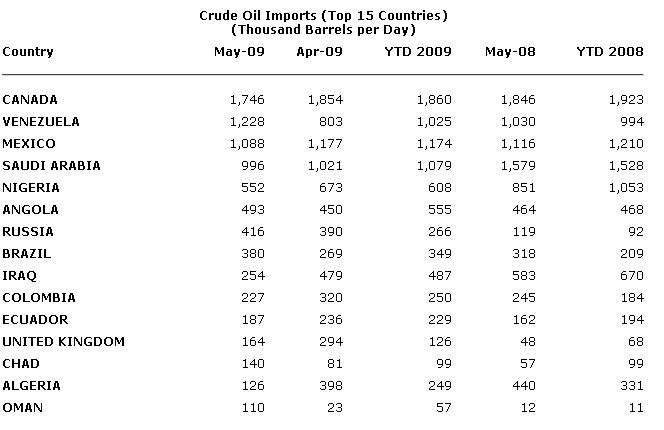
The Top 15 crude oil exporters to the U.S. for the month of May has been published by the Energy Information Administration, Department of Energy. The following table shows the list of these countries:

Top-oil-exporters-to-US

Source: Energy Information Administration, Department of Energy

Contrary to popular wisdom, the middle eastern countries are the largest exporter of oil to the U.S. Our northern neighbor Canada takes that spot. Canada exported 1.7  million barrels per day. Venezuela came at second with 1.2 million and Mexico at 1.0 million barrels per day. All the top three countries are in the western hemisphere. The only middle eastern country in the top 5 was Saudi Arabia. The top 5 countries accounted for 63%  and the top 10 accounted for 83% of all crude oil imports in May.

The above list is interesting since none of the middle eastern countries took the top spot. The U.S. considers Canada as a strategic source of crude oil. Canada benefits tremendously due to the due to the this huge oil trade with us. None of the Mexican oil companies are listed in the U.S. However many Canadian oil companies and Canadian Royalty Trusts trade in the U.S markets. Some of the Canadian companies available as inter-listed stocks in the U.S. include Encana(ECA), Suncor (SU), Canadian Natural Resources Limited (CNQ),  Imperial Oil Ltd. (IMO).

Knowledge is Power: German Exports Jump Edition

Syntactical corrections for government mandated bailouts are usually required because such programs usually say one thing and deliver something quite the opposite. That notion is true for the “Cash for Clunkers” program in the US government, which has had the effect instead of delivering Clunkers for Cash.Clunkers for cash

However the US government intends to pay for the numerous “stimulus” measures, bailouts, rescues, wars and all the other expenses it is totting up, it is becoming harder by the day, with tax receipts on pace to drop 18% this year. 18%! We are so, so doomed!!!Disappearing taxes

Merrill Lynch says a consumer boom would likely benefit growth and asset prices in Asia far more than anywhere else.Asian consumption story will bring more benefit to local economies

Struggling US store says it will attempt to educate customers in the ways of healthy eating.We sell a bunch of junk, says Whole Foods boss John Mackey

German’s Federal Statistics Office released export figures for June on Friday, and they have a lot of people smiling. Exports grew to 68.5 billion euros, a 7 percent rise over May’s figure. The data is the latest in a string of positive economic news being released around the world.Export Jump Brings Hope for End of Crisis

The U.S. economy may be just as sluggish during the next 20 years as Japan’s economy was in the last 20, according to Comstock Partners, a money manager founded and run by Charles Minter.  `Lost Couple of Decades’ Looming for U.S. Economy: Chart of the Day

The stockmarket rally in the second quarter this year has sparked debate regarding its longevity. Some believe it is merely a liquidity-induced rise in prices which will soon settle. Some contend it is a technical rally which will resume into a bear run.A Spot of Shares

Colombia’s state-owned gas producer Ecopetrol attracted $9bn for a jumbo $1.5bn 10 year debut this week, the latest sign of strong investor appetite for high grade Latin credits.Ecopetrol ignites investor interest with $1.5bn 10 year debut

What drives housing prices? Is there a bubble forming? As the property industry concerns the life of ordinary people and directly affects the national economy, these questions concern us all.Real estate: bubble or boom? – special

ONCE in a while, we have good reason to feel unhappy with the US dollar. Not only did the United States bring down the global economy, whatever wealth there was left in the dollar was subject to significant diminution.The international monetary system is in need of real reform

How Many Jobs Will the U.S. Infrastructure Spending Create?

The Obama administration has announced that $27B are to be spent on critical repairs to the country’s crumbling roads and infrastructure under the American Recovery and Reinvestment Act (ARRA) of 2009. In total, the government plans to spend $111B in Infrastructure and Science according to the site Recovery.gov.  How many jobs will this infrastructure spending create?.  I am not sure if any estimate has been made just for the infrastructure spending. The government site states the overall jobs expected to be created/saved over the next 2 years by state. For example, it states that 396,000 jobs would be created/saved in California.

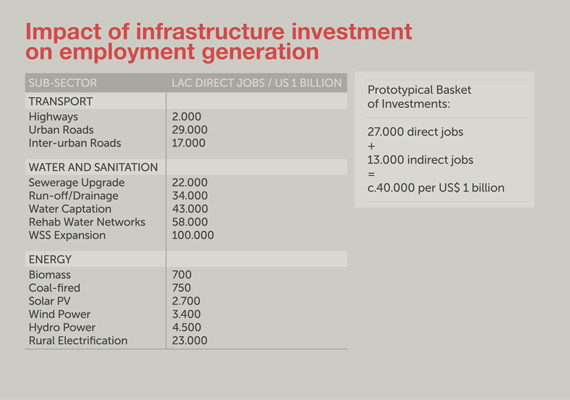
However The World Bank has done a study on the impact of infrastructure spending in Latin American and Caribbean countries. The following chart shows that a total of 40,000 new jobs may be created for each $1B invested in infrastructure:

Latin-America-Infrastructure

 Source: The World Bank

The World Bank estimates that at least 2 Million jobs would be created for the $25 economic stimulus packages announced by countries in the region. Total commitments to public works projects this year is $125B.

Of course $1B invested here in infrastructure will not create 40,000 new jobs due to wage and other reasons. It would be interesting to see the number of jobs that will be created for the  $27B  to be spent on fixing our roads and bridges.

ANZ Bank Expands Presence in Asia

Australia & New Zealand Banking Group Ltd.(OTC: ANZBY) is expanding in Asia with the purchase of Asian assets from the Royal Bank of Scotland (RBS) yesterday. According to Bloomberg “ANZ Bank, Australia’s fourth-biggest lender, will pay $550 million for the RBS businesses in Singapore, Taiwan, Indonesia, Hong Kong, the Philippines and Vietnam, the Melbourne-based bank said in a statement to the stock exchange.”

ANZ Bank is already a major leader in New Zealand and has a significant presence in many Asian countries including India, China. With this acquisition, the bank would be able to effectively compete against giants like Citibank(C) and HSBC(HBC). “The RBS businesses represent 54 branches with $3.2 billion in loans and $7.1 billion in deposits serving about 2 million clients, ANZ Bank said in the statement.” The Tier 1 ratio of the bank would be 9.5% after the deal.

ANZBY currently pays a 4.43% dividend and the stock has more than doubled from recent lows. The bank has a higher profit margin than its competitor National Australia Bank (NABZY).

Similar to Canadian banks, Australian banks have to seek growth in markets outside of the saturated market of Australia. Naturally they prefer to expand in Asia due to strong cultural and regional ties.

In a recent article, the Journal noted:
“Home values have started rising again, after falling in 2008, and are slightly above their record high reached in February last year.

One reason that Australia’s housing market is comparatively tight right now is that it didn’t get too out of control during flush years. Although Australia had its property boom between 1997 and 2003, policy makers were able to prevent prices from getting too far out of whack with underlying economic fundamentals in part by raising interest rates. That made homes less affordable and cooled the market earlier than in other parts of the world, including the U.S. Eventually, prices fell in several cities but not nearly as much as in some developed countries.

Now, the excess housing left over from the last boom has been worked off. Demand for new homes has grown to an estimated 190,000 units a year, while current construction trails at 130,000 a year, according to Australia’s Housing Industry Association. For the most part, Australian banks have remained healthier than their counterparts in the U.S. and Europe, allowing them to keep extending home loans throughout the downturn.”

The two other Australian banks listed in the U.S. National Australia Bank Ltd(OTC:NABZY) and Westpac Banking Corp (WBK) have dividend yields of 5.10% and 4.73% respectively.