Top 15 Oil Exporting Countries to the U.S.

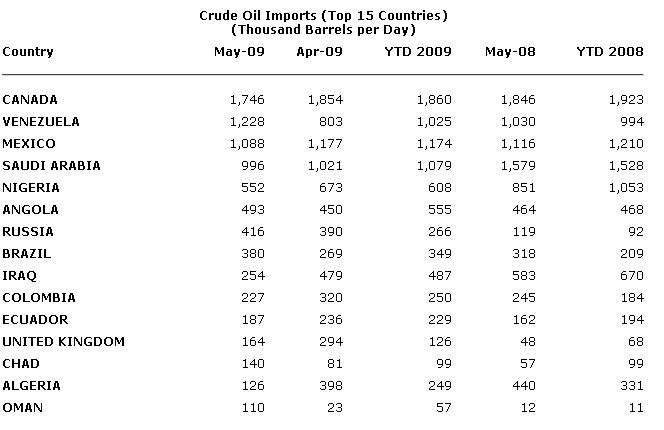
The Top 15 crude oil exporters to the U.S. for the month of May has been published by the Energy Information Administration, Department of Energy. The following table shows the list of these countries:
Top-oil-exporters-to-US

Source: Energy Information Administration, Department of Energy

Contrary to popular wisdom, the middle eastern countries are the largest exporter of oil to the U.S. Our northern neighbor Canada takes that spot. Canada exported 1.7  million barrels per day. Venezuela came at second with 1.2 million and Mexico at 1.0 million barrels per day. All the top three countries are in the western hemisphere. The only middle eastern country in the top 5 was Saudi Arabia. The top 5 countries accounted for 63%  and the top 10 accounted for 83% of all crude oil imports in May.

The above list is interesting since none of the middle eastern countries took the top spot. The U.S. considers Canada as a strategic source of crude oil. Canada benefits tremendously due to the due to the this huge oil trade with us. None of the Mexican oil companies are listed in the U.S. However many Canadian oil companies and Canadian Royalty Trusts trade in the U.S markets. Some of the Canadian companies available as inter-listed stocks in the U.S. include Encana(ECA), Suncor (SU), Canadian Natural Resources Limited (CNQ),  Imperial Oil Ltd. (IMO).
Knowledge is Power: German Exports Jump Edition

Syntactical corrections for government mandated bailouts are usually required because such programs usually say one thing and deliver something quite the opposite. That notion is true for the “Cash for Clunkers” program in the US government, which has had the effect instead of delivering Clunkers for Cash.Clunkers for cash

However the US government intends to pay for the numerous “stimulus” measures, bailouts, rescues, wars and all the other expenses it is totting up, it is becoming harder by the day, with tax receipts on pace to drop 18% this year. 18%! We are so, so doomed!!!Disappearing taxes

Merrill Lynch says a consumer boom would likely benefit growth and asset prices in Asia far more than anywhere else.Asian consumption story will bring more benefit to local economies

Struggling US store says it will attempt to educate customers in the ways of healthy eating.We sell a bunch of junk, says Whole Foods boss John Mackey

German’s Federal Statistics Office released export figures for June on Friday, and they have a lot of people smiling. Exports grew to 68.5 billion euros, a 7 percent rise over May’s figure. The data is the latest in a string of positive economic news being released around the world.Export Jump Brings Hope for End of Crisis

The U.S. economy may be just as sluggish during the next 20 years as Japan’s economy was in the last 20, according to Comstock Partners, a money manager founded and run by Charles Minter.  `Lost Couple of Decades’ Looming for U.S. Economy: Chart of the Day

The stockmarket rally in the second quarter this year has sparked debate regarding its longevity. Some believe it is merely a liquidity-induced rise in prices which will soon settle. Some contend it is a technical rally which will resume into a bear run.A Spot of Shares

Colombia’s state-owned gas producer Ecopetrol attracted $9bn for a jumbo $1.5bn 10 year debut this week, the latest sign of strong investor appetite for high grade Latin credits.Ecopetrol ignites investor interest with $1.5bn 10 year debut

What drives housing prices? Is there a bubble forming? As the property industry concerns the life of ordinary people and directly affects the national economy, these questions concern us all.Real estate: bubble or boom? – special

ONCE in a while, we have good reason to feel unhappy with the US dollar. Not only did the United States bring down the global economy, whatever wealth there was left in the dollar was subject to significant diminution.The international monetary system is in need of real reform

How Many Jobs Will the U.S. Infrastructure Spending Create?

The Obama administration has announced that $27B are to be spent on critical repairs to the country’s crumbling roads and infrastructure under the American Recovery and Reinvestment Act (ARRA) of 2009. In total, the government plans to spend $111B in Infrastructure and Science according to the site Recovery.gov.  How many jobs will this infrastructure spending create?.  I am not sure if any estimate has been made just for the infrastructure spending. The government site states the overall jobs expected to be created/saved over the next 2 years by state. For example, it states that 396,000 jobs would be created/saved in California.

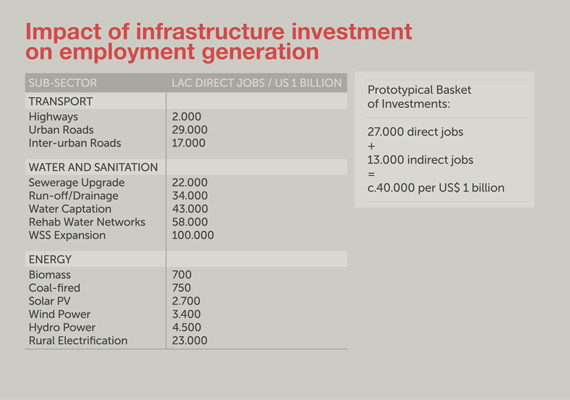
However The World Bank has done a study on the impact of infrastructure spending in Latin American and Caribbean countries. The following chart shows that a total of 40,000 new jobs may be created for each $1B invested in infrastructure:

Latin-America-Infrastructure

 Source: The World Bank

The World Bank estimates that at least 2 Million jobs would be created for the $25 economic stimulus packages announced by countries in the region. Total commitments to public works projects this year is $125B.

Of course $1B invested here in infrastructure will not create 40,000 new jobs due to wage and other reasons. It would be interesting to see the number of jobs that will be created for the  $27B  to be spent on fixing our roads and bridges.

ANZ Bank Expands Presence in Asia

Australia & New Zealand Banking Group Ltd.(OTC: ANZBY) is expanding in Asia with the purchase of Asian assets from the Royal Bank of Scotland (RBS) yesterday. According to Bloomberg “ANZ Bank, Australia’s fourth-biggest lender, will pay $550 million for the RBS businesses in Singapore, Taiwan, Indonesia, Hong Kong, the Philippines and Vietnam, the Melbourne-based bank said in a statement to the stock exchange.”

ANZ Bank is already a major leader in New Zealand and has a significant presence in many Asian countries including India, China. With this acquisition, the bank would be able to effectively compete against giants like Citibank(C) and HSBC(HBC). “The RBS businesses represent 54 branches with $3.2 billion in loans and $7.1 billion in deposits serving about 2 million clients, ANZ Bank said in the statement.” The Tier 1 ratio of the bank would be 9.5% after the deal.

ANZBY currently pays a 4.43% dividend and the stock has more than doubled from recent lows. The bank has a higher profit margin than its competitor National Australia Bank (NABZY).

Similar to Canadian banks, Australian banks have to seek growth in markets outside of the saturated market of Australia. Naturally they prefer to expand in Asia due to strong cultural and regional ties.

In a recent article, the Journal noted:
“Home values have started rising again, after falling in 2008, and are slightly above their record high reached in February last year.

One reason that Australia’s housing market is comparatively tight right now is that it didn’t get too out of control during flush years. Although Australia had its property boom between 1997 and 2003, policy makers were able to prevent prices from getting too far out of whack with underlying economic fundamentals in part by raising interest rates. That made homes less affordable and cooled the market earlier than in other parts of the world, including the U.S. Eventually, prices fell in several cities but not nearly as much as in some developed countries.

Now, the excess housing left over from the last boom has been worked off. Demand for new homes has grown to an estimated 190,000 units a year, while current construction trails at 130,000 a year, according to Australia’s Housing Industry Association. For the most part, Australian banks have remained healthier than their counterparts in the U.S. and Europe, allowing them to keep extending home loans throughout the downturn.”

The two other Australian banks listed in the U.S. National Australia Bank Ltd(OTC:NABZY) and Westpac Banking Corp (WBK) have dividend yields of 5.10% and 4.73% respectively.

Knowledge is Power: Frothy Commodities, Jittery Bulls Edition

The world recession that began in the U.S. is hitting Germany much harder than us, due to a collapse in world trade that has damaged an economy that Germans constantly refer to as “the World Export Champion.” Their economy will have shrunk by about 8% by the time it bottoms, whereas America’s GDP should fall less than 4% from its peak. Intriguingly, the German public and elites feel much better about their situation than Americans do about ours. The key question is whether this represents: a justified faith in a system that works well for them; government measures that delay the pain; German complacency; or some combination of these factors. Germany’s Recession vs. America’s: Doing Worse, but Feeling Better

Vital signs  Stock markets brighten, but is it a real recovery?

JP Morgan and Citigroup are most sympathetic in altering terms, but Bank of America modifies only 4% of eligible loans .US banks show ‘uneven’ progress in implementing mortgage rescue scheme

Although they remain bullish on long-run prospects, two veteran optimists on China recently turned pessimistic on the country’s short-term prospects. Jittery bulls in the China shop

COMMODITY markets have become too frothy, which could lead to greater price volatility in the coming months, Mick Davis, the chief executive of Xstrata, has warned.Commodity prices too frothy, says Xstrata CEO Mick Davis

Even waves of factory closures, bankruptcies and a stock-market crash cannot hold back the Chinese miracle, with wages now growing faster than the country’s economy. It is so amazing that even state media are starting to say something doesn’t add up.China works pay miracle

Forget about the beauty of space. The goal of “rocket scientists” in the United States in the 21st century is to develop market-data machines tuned to the microsecond, to help Goldman Sachs dominate the world of finance – and to avoid, if possible, the long arm of the Federal Bureau of Investigation. Has investment that benefits only the few ever been so esoteric and glorious?.Goldman Sachs, the lords of time

European equities are an attractive long-term opportunity for Canadian investors.High yields make Europe attractive