Top 100 Consumer Brands in China

With a population of 1.3 billion, China is the fastest growing economy in the world especially for consumer goods. In China, the sales of all kinds of consumer goods are rising. For example, demand for household goods such as refrigerators, washing machines is increasing due to a subsidy program initiated by the government to help poor and middle-income families afford those goods.

Here are a few recent headlines on China’s consumer goods sales and the economy:

China Auto Sales Surge
Recovering Economy and Small-Car Push Lift Vehicle Demand

China Cosmetics & Toiletries Industry Continue to Flourish

Dell Says Strong Sales Growth to Drive China Share

Mobile phones ring in growth in emerging markets‎

To cash in on the explosive growth in the consumer goods sector, many foreign companies are investing heavily in China. Those companies that have established presence since as Coca Cola, Pepsi, Nestle, etc. are increasing their investments building new factories.

Which foreign companies will benefit from the growth of China’s economy?.

One way to identify the answer to the above question is to analyze the top consumer brands in China. Foreign companies that have strong brands in China will have higher sales growth as the domestic consumption increases.

The Top 100 Consumer Brands in China
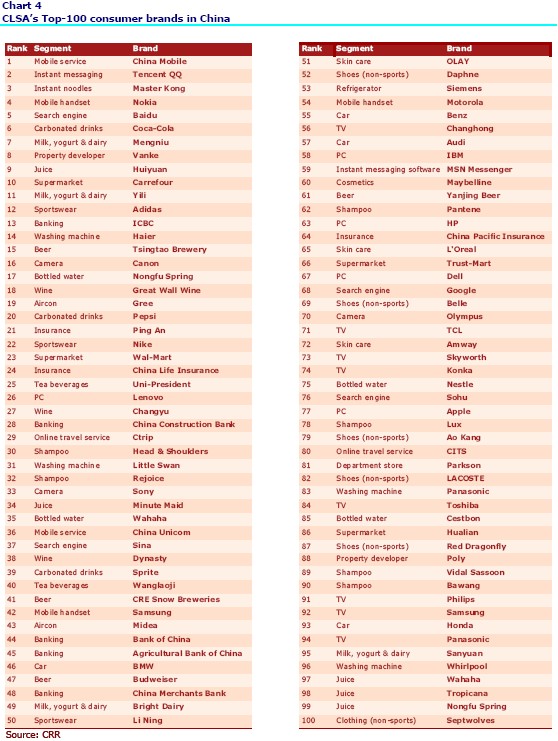
Top-100-Brands-in-China

Source: CLSA launches inaugural China Brands Index and reveals China’s top 100 brands, CLSA Asia-Pacific Markets

CLSA compiled the above list based on a comprehensive survey of Chinese consumers. From the report:

“In terms of preference, domestic Chinese brands make up more than 50% of the Top-100 brands preferred by our respondents, with seven of the top ten being Chinese. First in terms of preference is China Mobile – mobile services (No.1); followed by Tencent QQ – mobile services (No.2); Master Kong – instant noodles (No.3); Nokia – mobile handset (No.4); Baidu – search engine (No.5); Coca-Cola – carbonated drinks (No.6); Mengniu – milk, yoghurt and dairy (No.7); Vanke – property developer (No.8); Huiyuan – juice (No.9) and Carrefour – supermarket (No. 10) (Appendix chart 4)

Domestic brands dominate the apparel, home appliances, food and beverage sectors where catering to local tastes is critical, and internet services, where regulators support easier to control home-grown providers. Domestic brands also feature overwhelmingly in the state-dominated industries of banking, insurance and telecoms. For example, seventy-six percent of respondents are current China Mobile subscribers and 92.5% said they would not consider switching to a different operator.

Domestic brands underperform in areas reliant on innovation and design, such as high-end consumer electronics and cosmetics and luxury fashion where R&D and technical know-how is critical. In these sectors, brand value as a share of the retail cost of the product is higher.”

Among the foreign brands in the top 100, American brands include Coca Cola (KO), Pepsi(PEP), IBM(IBM), Dell (DELL), Google (GOOG), Apple (APPL). Some of European brands in the list are Adidas(ADDYY), Siemens (SI), Nestle (NSRGY), Philips (PHI) etc. As the US consumer will no longer be the engine for global growth, these foreign companies would depend more on emerging markets particularly China and India to maintain their earnings growth.

While Google(GOOG) is the top search engine in the US, local firm Baidu (BIDU) is the most popular search engine in China. After its IPO on the Nasdaq in mid-2005, BIDU has become a traders dream stock and has had a wild run reaching over $400 in late-2007. After falling to nearly $100 last year the stock back over $400 again.

US Brands Dominate The Best Global Brands List 2009

Recently the BusinessWeek magazine published The 100 Best Global Brands 2009 list. The brands of US companies dominate this list as the US continues to be number one in innovation, marketing, technological leadership, etc.

The Top 10 Best Global Brands in 2009 listed by their ranking are:

1. Coca Cola (KO)
2. IBM (IBM)
3. Microsoft (MSFT)
4. GE (GE)
5. Nokia (NOK)
6. McDonald’s (MCD)
7. Google (GOOG)
8. Toyota (TM)
9. Intel (INTC)
10. Disney (DIS)

In addition to being market leaders in their domestic markets, all of the brands have high brand power in overseas markets especially in the emerging markets. As of result of this, they are strong revenue generators from emerging markets for their owners. For example, Nokia(NOK) is synonymous with cell phones in many developing countries as it makes cheap, durable cell phones catering to the needs of the population in those countries. Coca Cola (KO) continues to the leader in the soft drink market worldwide. Due to its global presence and strong, stable growth and decent dividend yield, it is a favorite among long-term investors.

While Microsoft(MSFT) seemed to loose its brand power a few years with many unsuccessful products, recently it has had success with new products such as the Bing search engine and penetrating the high-growth online advertising world. In the high tech area, IBM, Intel, Microsoft, Google continue to thrive in all economic conditions by investing in R&D and introducing new products. Though new search engines such as Bing and others, try to gain main more market share Google still remains the undisputed leader in the search engine and online ad marketplace. As a stock for long-term investment, GE has lost its magic many years ago. Currently GE is a company that lacks clear direction. As a conglomerate that operates in too many areas from making airplane engines to medical devices, home appliances in addition offering to many financial products such as credit cards, consumer loans, etc. GE probably needs to be split into many small nimble companies that will benefit shareholders and are easier to manage.

Only two foreign brands Nokia and Toyota are in the top 10 list above. Similar to Nokia, Toyota is known globally for making affordable cars that offer quality and value. However Toyota also competes in the luxury market against German auto makers like BMW, Mercedes Benz with its Lexus brand which took the 96th rank.

Some of top the financial brands included in the list are: Goldman Sachs(GS), HSBC bank (HBC), American Express(AXP), Citibank(C), JPMorgan Chase(JPM) and UBS (UBS).

Knowledge is Power: Emerging Markets Edition

Investor Mark Mobius said he expects emerging markets to surpass previous records, predicting a continued rally with “corrections along the way.”Mobius Says Emerging Markets Will Beat Previous Highs

Morgan Stanley Asia chairman Stephen Roach argues that the only way to put Asian growth models on a sustainable footing is to introduce social safety nets.Chinese welfare reform key to stability, says Roach

Conditions are ripe for a six-month bull run, but investors need quality to avoid a slip-up in 2010, says Tom Becket, of PSigma, in his monthly view…This bull can run, but invest in quality

Taleeb“I’d rather have socialism than this brand of vicious capitalism (in the United States),” declares Nassim Nicholas Taleb, author of The New York Times bestseller, The Black Swan: The Impact of the Highly Improbable. In a talk at the annual dinner of the Asia Society last night in Hong Kong, Taleb, who is known for his controversial views, did not disappoint as he criticized the response of the US government to the global crisis.‘I’d rather have socialism.’

A continued fall in Sweden’s industrial production and new orders indicates a slow recovery of the economy.Fall in Swedish industry hampers recovery

Latvian crisis-plan heavy blow to Swedish banks Latvia’s plan to limit what banks in the Baltic state can collect from mortgage-holders may be a heavy blow to Swedish banks.

Throughout the global crisis, China defied recessionary pressures and continued to grow. Although the pace cooled from double-digit rates, many forecasters now predict that China may be the first major economy to recover. Even if it does rebound in the last half of 2009, spurred by the government’s $586 billion stimulus package, the storm is far from over. Consumer products makers and retailers are confronting a more complex and brutally competitive landscape. Growth in a Slower-Growth China

Two reports released today indicate the Toronto housing market remains strong, with housing starts up 25 per cent, but low supply is leading to bidding wars.Toronto housing market stays hot

Gold stocks watchlist as bullion roars to dollar record
But listed gold equities remain well below levels seen in early 2008, and conservative analysts see a weak dollar as gold’s booster, for now.


Ten DJ Euro STOXX Select Dividend Index Components

One of the dividend ETFs for European stocks is the iShares DJ Euro STOXX Select Dividend. This ETF offers exposure to European companies that have historically paid out high dividends.

The Top 10 holdings in the iShares DJ Euro STOXX Select Dividend ETF are listed below together with the current dividend yields and ticker if listed in the US markets as ADRs:

1.Banco Santander (STD)
Current Yield: 4.32%
Country: Spain

2.Erste Bank(EBKDY)
Current Yield: 2.13%
Country: Austria

3.Banco Popular Espanol
Country: Spain

4.Vallourec
Country: France

5.Metso Oyj (MXCYY)
Current Yield: 3.29%
Country: Finland

6.Enel Spa(ENLAY)
Current Yield: 4.71%
Country: Italy

7.WERELDHAVE NV
Country: The Netherlands

8.RWE AG (RWEOY)
Current Yield: 6.32%
Country: Germany

9.WARTSILA
Country: Finland

10.DEUTSCHE POST
Country: Germany

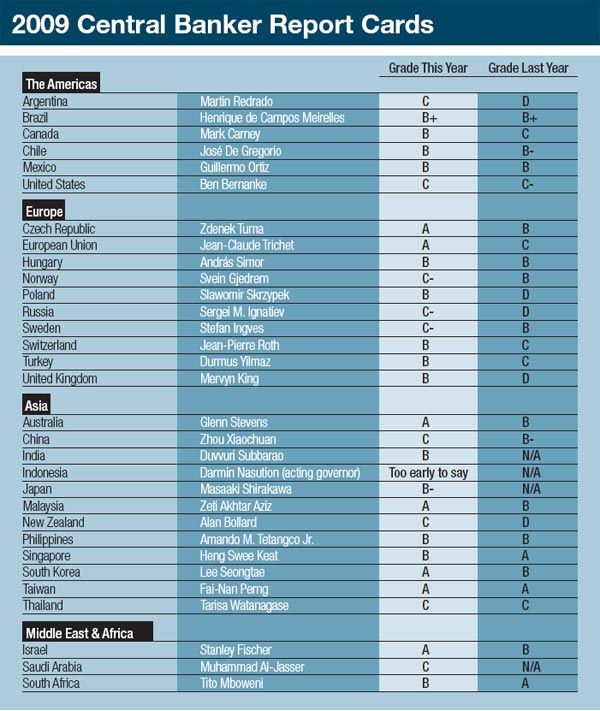
Ben Bernanke gets Grade C

US  Federal Reserve Chairman Ben Bernanke received Grade C for preventing a global economic disaster but failing to see it coming. He also shares the blame for plating the seeds of the next crisis due to the growing massive US debt. In the Central Banker Report Cards 2009 by Global Finance, there was a handful of central bankers who got Grade A.

Central-banker-Ranks

Source: Global Finance

Grade A was awarded to:
Zdenek Tuma of Czech Republic
Jean-Claude Trichet of European Union
Glenn Stevens of Australia
Zeti Akhtar Aziz of Malaysia
Lee Seongtae of South Korea
Fai-Nan Peng of Taiwan
Stanley Fischer of Israel

Incidentally Reserve Bank of Australia today  raised the interest rate to 3.25% from 3% , the first developed country to do so. Asian countries of Malaysia, South Korea and Taiwan weathered the credit crisis better due to the effective policies implemented by their central banks.