Knowledge is Power: China, Australia, Recession Edition

As investors return to the market, big companies in Europe are finding it easier to raise money via bonds, equities and even IPOs. The Big Thaw

MSM Reporting as Propaganda (No One Minds Our New Financial Masters Edition)
I’m of two minds about taking up this theme, since stating what ought to be obvious but is nevertheless unpleasant and inconvenient is apt to get one branded as lunatic fringe.

Access journalism has created what is in many respects a controlled press. And that matters because people are far more suggestible than most of us wants to admit to ourselves.

Western makers of luxury products are enjoying a sales boom in China, as the number of rich Chinese continues to grow while the rest of the world struggles amid the continuing downturn.China’s rich throw lifeline to the West

Canada is leaving the dark days of the recession behind and is poised to move forward with moderately strong and steady growth over the next two years…Economy set for strong growth, board says

Cash is no longer king for asset allocators, but investors are mixed on which Asian countries they favour, according to Bank of America Merrill Lynch’s monthly fund manager poll. Investors more upbeat on China, but underweight Korea

Australia could become victim of its own fortune

Manufacturing surveys, considered reputable early signals on the economy, show emerging markets leading the way out of the downturn.By Some Reliable Measures, Recession Is Over
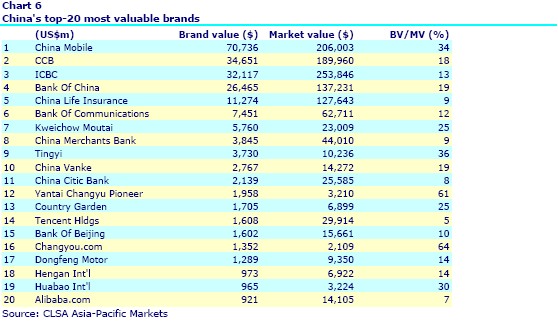
The 20 Most Valuable Brands in China

Recently we reviewed the Top 100 Consumer Brands in China. Today lets look at The 20 Most Valuable Brands brands in China.

CLSA compiled this list “by reviewing both the brand strength and the market conditions of the industry. The number of Chinese companies with positive brand equity is increasing, particularly in the Banks, Consumer Electronics, Food and Beverage, Internet Services, Retail and Apparel sectors. A list of the top-20 companies is led again by China Mobile, and the major financial institutions.”

The 20 Most Valuable Brands brands in China

Most-valuable-brands-China

Source: CLSA Asia-Pacific Markets

Some of the above companies that trade in the US markets are:

1. China Mobile Ltd. (CHL)
2. Bank of China Ltd (OTC: BACHY)
3. China Life Insurance Co. Ltd. (LFC)
4. China Merchants Bank (OTC: CIHKF)
5. Changyou.com Limited (CYOU)
6. Alibaba.com (OTC: ALBCF)

Top 10 stocks in the DJ Canada Select Dividend Index

The Dow Jones Select Dividend Index family of indices measures contain the top dividend paying stocks at the regional, country and global levels. One of the country-specific dividend index in this family is the DJ Canada Select Dividend Index. The main features of this index are:

  • Thirty stocks are selected to the index annually based on dividend yield, subject to screening and buffering criteria.
  • Components are weighted by indicated annual dividend.

In 2008, this index was down 30.80%. As of September 30th, the index has gained nearly 34%. The 5-year average annual total return is around 8%. The current dividend yield is 4.52%. The index is heavily concentrated with financials making up for nearly 72% of the portfolio.

The Top 10 holdings in the DJ Canada Select Dividend Index are:

1. National Bank of Canada
2. Bank of Montreal – BMO
3. Canadian Imperial Bank of Commerce – CM
4. Toronto-Dominion Bank – TD
5. Royal bank of Canada – RY
6. Bank of Novo Scotia – BNS
7. IGM Financial
8. Manitoba Telecom Services
9. TMX Group Inc
10.A.G.F. Management Ltd. Cl B NV

Related ETF: The iShares CDN Dividend Index Fund (XDV.TO) replicates the performance of Dow Jones Canada Select Dividend Index(SM). This ETF has an asset base of C$ 388M.

Country Risk Ratings

The Economist Intelligence Unit publishes Sovereign Ratings on 120 countries. The ratings for developed countries are updated bi-annually while the ratings for emerging countries are updated monthly. This rating “measures the risk of a build-up in arrears of principal and/or interest on foreign- and/or local-currency debt that is the direct obligation of the sovereign or guaranteed by the Sovereign.”

The Latest Sovereign Ratings

[TABLE=181]

Norway is the safest country in terms of sovereign debt. Since Norway has no deficits and has an abundance of oil resources, it is ranked the highest rating AAA. The US was given the AA rating. Other countries that received the AA ranking include Canada,Switzerland, The Netherlands and the Scandinavian countries.

Zimbabwe is the only country with D which implies very weak payment capacity and is currently in default. India, China and Brazil were ranked BB. Russia’s outlook is negative.

Top 10 Reasons to Invest In Asia

Many stock market indices in Asia have performed very well this year compared to developed markets. For example, China’s Shanghai Composite Index is up 59%, India’s Sensex is up 76.5%, Taiwan’s Weighted Index is up 65.5%, Singapore’s Straits Times Index is up 52.2% YTD as of Oct 12th. European indices have risen about 20-30% this year. The S&P 500 has increased 21% YTD. As growth continues to be sluggish in the developed world investors are flocking to Asia for higher returns.

So should you invest in Asia?

The answer to the above question is a resounding Yes. The following 10 reasons were identified by CLSA Asia-Pacific Markets in the CLSA Quarterly, Autumn 2008 report on why one should invest in Asian markets.

1.Asia’s billion boomers – People, Money and Aspirations.

Asian countries are growing and creating middle-class and upper-middle class people with plenty of money and the willingness to spend. The growth in domestic consumption will much be much bigger than the post-World War II growth in the U.S. By 2020, more than 1.2 billion people are projected to have a per-capita GDP of more than $5,000 as the chart shows below:

Asians-GDP-per-capita

2. China’s consumers will lead Asian and possibly global recovery as the credit markets are loosened and consumer spending increases. The Chinese middle-class is already spending heavily to improve their standard of living.

3. Asia’s economic size relative to the US is growing fast. Since the 1990s low, its economic size has doubled relative to the US economy. As countries like China, India grow Asia’s economic power will rise.

4. Asia has the money – lots of it. Many Asian countries have current account surpluses while most developed countries have deficits. Countries such as USA, UK have high deficits.

5. Asians have plenty of money at the bank. Unlike American consumers who are deep in debt due to the credit bubble, Asian consumers have money to spend. The chart below shows the loan-deposit ratio of US and Asian banks:

Asia-US-Banks-Loan-to-Deposit-Ratio

6. Asia is at the start of a demographically driven boost to domestic investment. Hence Asians will take a large role in their own markets as opposed to foreign investors.

7. Countries in Asia are urbanizing rapidly. More and more people are moving from rural areas into urban cities and towns in search of better life. This urbanization process will lead to higher incomes, better educational opportunities and higher spending on the comforts of modern life.

8. Chindia will lead the way.In just 12 years, the combined economies of India and China will equal about 60% of the US economy. As of this result of this, the political and economic power will shift towards the East.

9. In addition to money, Asians are leading the way in the study of hard sciences which include math, engineering, etc. A country needs strong and bright thinkers in hard sciences in order to build a better future. More Asian students enroll in hard science programs in universities than American students.

10.Growing Prominence of Asian markets. In September, FTSE promoted South Korea to Developed Country status. China’s A shares and Taiwan may be added next. Also “Asia ex-Japan’s weight in the global MSCI has climbed from 3.7% to 6.8% during the past 12 years.”

With high savings rate and the strong confidence and eagerness to grow and prosper, Asia presents a multitude of opportunities for foreign investors seeking diversification and growth.