32 Foreign Large Caps Paying Over 5% Dividends

U.S. stocks generally have lower dividend yields than foreign stocks. For example, the current yield of the S&P 500 is 2.14%. Compared to this many foreign markets have much higher yields. In 2009, U.S. stocks paid 1.93%. Among the large 20 countries by market capitalization only Russia, India and Korea had lower yields than the US. Australian stocks on the other hand paid 3.73%. Despite taking into consideration factors such as foreign taxes, currency exchange fluctuations, etc. one can earn higher yields going overseas.

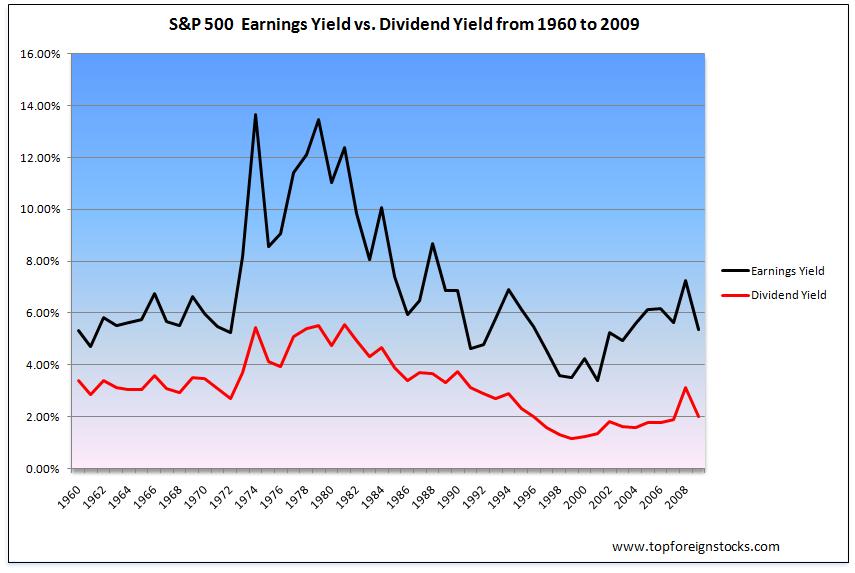
Historically the last time the dividend yield of the S&P 500 exceeded 3% was in 1991. Since 1991,the dividend yield of the S&P 500 remained under 2% with the lowest yield of 1.14% reached during the dot com bubble in 1999. The 2008 yield was 3.11% due to fall in share prices and not due to increase in dividend payments.Last year the yield was 2%.

The following chart shows the historical comparison of the Earnings Yield and Dividend Yield of the S&P 500 Index:

Click to Enlarge
SP500-Dividend-History-Chart

For U.S. investors looking for high yields, foreign stocks that trade on the U.S. markets offer great opportunities to earn dividends in excess of 2%. I ran the stock screener to identify large cap foreign stocks having market caps of over $10B  and dividend yields of over 5%. Thirty two stocks that met the condition are listed below:

[TABLE=503]

Note: Data shown is known to be accurate from sources used. Please do your own research before making any investment decisions.

Canadian companies included in this list are Sun Life Financial Inc(SLF), Telus Corporation (TU) and BCE Inc(BCE).

Comparison of Dividend Yields Across 20 Country Indices

The chart below shows the dividend yield across twenty country indices.These countries represent the largest countries based on market capitalization as of 12/31/2009:

Click to Enlarge

Dividend-Yields-by-Country-2003-2009

Source: Skloff Financial Group

The dividend yield of U.S. stocks remained less than a paltry 2% since 2003. For the years shown, Australian stocks have consistently paid dividends in excess of 3%. Among the BRIC countries, Brazilian stocks have the highest dividend yields. Overall U.S. stocks pay lower dividends than Australian and European stocks. This is one reason for U.S. investors to diversify their portfolio with foreign stocks.

Related Post: Review: The Callan Periodic Table of Investment Returns 2009

The 100 Most Profitable U.S. Companies

The 25 most profitable publicly-listed American companies that appear in the Forbes Global 2000 list for 2010 are listed below:

[TABLE=502]

The oil giant ExxonMobil(XOM) made the highest profits at over $19B on sales of $275B. The second and third spots were taken by software maker Microsoft(MSFT) and the world’s largest retailer Wal-Mart Stores(WMT). Among the banks in the top 100 companies, Citibank(C) is notably absent. Though PepsiCo(PEP) has higher sales than Coca Cola(KO) its profit margin is less. Seven tech firms are in the top 25 underscoring the strength and profitability of this sector.

The full list of the 100 most profitable U.S. companies can be found here.

Related:

The 57 Most Profitable German Companies

The 10 Most Profitable Indian Companies

The 10 Most Profitable Brazilian Companies

The 10 Most Profitable Chinese Companies

The 10 Most Profitable Italian Companies

The 10 Most Profitable Spanish Companies

The 10 Most Profitable Canadian Companies

The 10 Most Profitable Australian Companies


The 10 Most Profitable British Companies

The ten most profitable publicly-listed British companies that made it to the Forbes Global 2000 list for 2010 are listed below.

[TABLE=500]

All the firms noted above are also part of the FTSE 100 index. The oil giant BP plc (BP) is the most profitable British company. The current yield on the BP ADR is 7.54%. After the oil spill in the Gulf of Mexico BP’s stock has taken a hit falling from over $60 to $43.86 today. Oil and Gas company BG Group plc (BRGYY) and Rolls Royce Group (RYCEY) trade on the OTC markets.The three banking stocks in the list can be avoided now due to many uncertainties in that sector.

Drug firms AstraZeneca (AZN) and GlaxoSmithKline (GSK) are excellent long term high yield plays. Currently they pay 8.34% and 5.52% dividends respectively due in part to lower stock prices. British American Tobacco(BTI) revenue totaled about $23B last year. Similar to US tobacco giant Altria Group (MO), BTI also offers a high dividend yield that currently stands at 7.66%. Telecom services provider Vodafone (VOD) has a strong presence in many emerging markets.

More European Companies Delist from the NYSE

The exodus of European firms from delisting their stocks on the New York Stock Exchange continue to climb. On Friday German auto maker Daimler AG(DAI) became the latest company to announce plans to delist from the NYSE. This follows the announcement of Deutsche Telekom AG (DT) two weeks ago to delist from the exchange. After these two delistings, just four of the large German companies will trade on the NYSE.

French insurer AXA SA already trades on the OTC markets. Hellenic Telecom(OTE) of Greece has also announced plans to delist from the Big Board.

According to a Wall Street Journal article, some of the reasons for the delistings from the NYSE include:

  • Many European firms view US listing as a liability
  • Foreign investors are able to invest directly via electronic trading platforms in their domestic markets
  • Listing requirements have risen on overseas markets
  • Cost of complying to U.S. regulations such as the Sarbanes-Oxley Act has become burdensome
  • The prestige of a US listing has faded since Enron and the financial crisis
  • The daily trading volume of stock relative to global trading volume is lower for some companies

With the removal of Daimler and Deutsche Telekom, the only four German companies that will continue to trade on the NYSE are Siemens (SI), Deutsche Bank(DB), Fresenius Medical Care(FMS) and SAP AG(SAP).

Other European firms that have already delisted their stock from the NYSE are:

  • Allianz (OTC: AZSEY)
  • Infineon Technologies (OTC: IFFNY)
  • Qimonda (OTC: QMNDQ)
  • Altana
  • Epcos
  • Bayer (OTC: BAYRY)
  • Pfeiffer Vacuum Technology
  • E.ON AG (OTC: EONGY)
  • BASF Group (OTC: BASFY)
  • SGL Carbon

However some firms such as E.ON continue to trade on the OTC markets as noted above.

The full list of German stocks that trade on the US markets can be found here.