Which is Better for Investment – Russia or China?

China has been the preferred destination for emerging market investors for many years now.However this year Chinese equities have not performed well. The Shanghai Composite Index fell 27% in the first six months. Despite Chinese stocks rallying in recent weeks, the index is still down 19.5% year-to-date. In terms of performance over a ten year period many other countries have easily beat China.

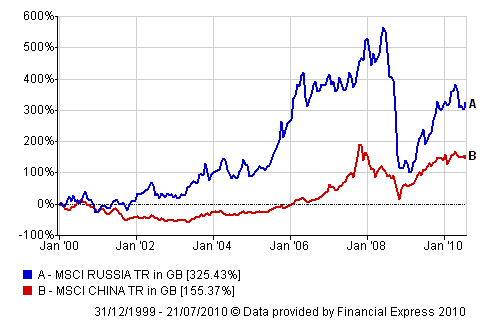
The chart below shows the performance of MSCI Russia vs. MSCI China over 10 years:

Russia-China-Chart-10-year

Source: Trustnet
Note: The Total Return shown is in British Pounds

Hence Russian equities have performed better than Chinese equities over a decade.

The two country-specific ETFs available for Russia are SPDR S&P Russia ETF(RBL) and Market Vectors Russia ETF(RSX). Since its launch in 2007, RSX has been highly successful. The fund has an asset base of $1.8B and the gross expense ratio is 0.80%. The energy sector accounts for about half of the fund portfolio with holdings in oil companies totaling 39.5%. The fund’s share price is down about 10% YTD. Since its inception in March this year, the Russia ETF(RBL) from State Street has not been successful in attracting assets. The total net assets of the fund is just $4.36M. Similar to RSX, this fund is also heavily weighted in the energy sector.

Despite the better performance, investors must be cautious in putting their money in Russian stocks as they can be highly volatile. Among global indices, the Russian market fell heavily during the global credit crisis. As a commodity-based economy, the Russian market is highly dependent on the prices of commodities especially oil.

Some of the ETFs that offer exposure to Chinese stocks are: FTSE/Xinhua China 25 Index Fund (FXI), SPDR S&P China ETF (GXC) PowerShares Golden Dragon Halter USX China Portfolio (PGJ), Claymore/AlphaShares China Small Cap Index ETF (HAO), Claymore/AlphaShares China All-Cap ETF (YAO), Global X China Financials ETF (CHIX). The FTSE/Xinhua China 25 Index Fund  (FXI) from ishares is the largest China-specific ETF with an asset base of about $8.2B. The ETF tracks the 25 large-cap Chinese companies in the FTSE/Xinhua China 25 Index. Financials account for about 48% of the fund’s portfolio.

Knowledge is Power: Stock Picks,German Miracle, Double Dip Edition

It’s A Big World After All: IBD 100’s Top 5 Foreign Stocks

Foreign ETFs That Speak The Language

A Keynesian Success Story Germany’s New Economic Miracle

Canada Stocks – Roseman: Here are the best stocks for dividend growth

Four cheap, high-yielding defensive stocks

Poland is laying the foundation for a sustainable long-term recovery.  Pole Position

The world’s new fuel guzzler

Blog for Sri Lanka Stock Pickshttp://srilankastockpicks.blogspot.com/

Emerging East Asia’s V-Shaped Recovery Firmly on Track – ADB Report

Double-dip looks doubly certain

Emerging-Market-Returns-Chart

Source: Global Financial Stability Report, IMF

Review of Capital Levels of European Banks

On July 23rd European regulators will release the results of the stress tests which measures the ability of Europe’s bank to withstand future economic shocks. In the U.S.,  similar stress tests were conducted last year and for the most part the results were positive.

Some of the Eurozone banks with strong capital levels and exposure to markets outside of Europe include Spain’s Banco Santander (STD), Dutch banking giant ING Group (ING) and France’s BNP Paribas (BNPQY).These banks have been hit hard like other banks as investors fled European bank stocks due to many uncertainties. If the EU stress test results are good, then European banks may rally as the results may provide a boost to the market.

The latest edition of IMF’s Global Financial Stability Report contains the Bank Capital as a percentage of Assets for most of the countries. Hence higher ratio is good. The chart below shows the bank capital to asset ratio for the major Euro zone countries:

Click to Enlarge

European-banks-capital-levels

Data Source: IMF

Note: U.S. is included in the chart for comparison purposes; 2009 data for some countries is not available

US banks have higher capital than most European banks. This is because unlike Europe, banks in the U.S. raised their capital levels last year with the help of TARP funds, issuance of new equity and other ways.European companies have traditionally been reluctant to raise capital by issuing new equity.