Knowledge is Power: Government Benefits, China and India, Middle Class Edition

Brace yourself: markets have further to fall

The middle classes died a long time ago

The questionable benefit of benefits

Do stocks even matter anymore?

Are Investors Unfair to U.S. Stock Funds?

Meet the ‘Nifty 50/50’

The Stock Market Slide Is Over

Obama’s Misguided Approach –America Has Become Too European

A Safety Net for Global Capitalism –Inside Munich Re, the World’s Risk Center

China and India: Contest of the century

church-gorge-colobia.jpg

Sanctuario de las Lajas Church, Colombia

The Importance of Dividends

Recently fellow blogger Random Roger wrote a post an on how to construct a portfolio with one high yielding stock and one ETF for each sector. In the post Roger listed a few of the high yielding stocks current available in the market.

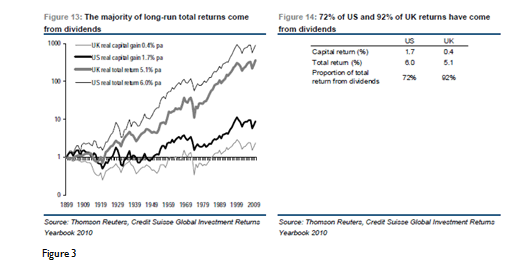
Dividends are an important component of total returns especially in the long-run. The following chart from a study by Credit Suisse shows that 72% of US returns and 92% of UK returns since 1900 have come from dividends:

Click to Enlarge

Dividend-Returns-since-1900

The graph below from  GMO’s recent newsletter also shows the importance of dividend yields in the U.S. and overseas markets.

Dividend-Returns-SP500

“Exhibit 3 shows the contribution that dividends have made to total returns over various periods. On average, over the very long term, dividends have accounted for some 90% of total return.”

Dividend-Global-Returns

“The importance of dividends over the long term isn’t just a U.S. phenomenon. The same patterns hold true across a wide variety of global equity markets. For instance, in
Europe, 80% to 100% of the total returns achieved since 1970 have come from dividends (combining yield and real dividend growth).”

According to FT market data, the current yield of the US market is just 2.0% while the yield of the UK market is 3.1%. Other countries such as New Zealand, Australia, Israel, Finland,  etc. have yields exceeding 3%. Hence investors looking for high yields have a wide variety of choice from foreign markets.

Update: From Bloomberg BusinessWeek

The-Importance-of-Dividend-Payouts

The Top 50 U.S. Banks and Thrifts

This week SNL Financial released the list of the biggest 50 U.S. banks and thrifts based on assets as of 2Q, 2010. The list is shown below with tickers included for banks that are public traded:

[TABLE=525]

Some of the key points from the rankings are:

1. First Niagara Financial Group Inc jumped to 38th position after its recent takeover of NewAlliance Bancshares Inc.

2. Bank of America(BAC) and JPMorgan & Chase(JPM) are the only banks with assets of over $2 Trillion each.

3. TD Bank US Holding Co and RBC BanCorp are US subsidiaries of Canadian banks Toronto-Dominion Bank(TD) and Royal Bank of Canada(RY) respectively.

4. Other US subsidiaries of foreign banks in the list are: HSBC North America Holdings Inc. of HSBC Holdings (HBC) of UK,
ING Bank FSB of ING Groep(ING) of The Netherlands, Santander Holdings USA Inc of Banco Santander (STD) of Spain and BBVA USA Bancshares Inc. of Banco Bilbao Vizcaya Argentaria (BBVA) of Spain.

Was TARP a Success to the US?

The Troubled Asset Recovery Program (TARP) was started by the U.S. government in 2008 to purchase assets and equity from troubled financial institutions and strengthen the sector at the height of the credit crisis. Billions of tax payer funds were loaned to banks and other lenders thru this program.

According to a report in The Banker magazine, it seems that the TARP was successful to the US in terms of return on investment and the stated goal of the program. The following are some of the key points quoted by the magazine based on the July report from SIGTARP, the body monitoring the various programs under the umbrella of the TARP:

  • 87 TARP recipients had repaid all or a portion of their principal or repurchased shares, for a total of $201.5B.
  • A total of just $182.5B of disbursed TARP funds is outstanding.
  • By July, the US government had received $22.7B in interest, dividends, sale of warrants, stocks and other income.

Click to Enlarge

figure1_us-capital-purchase-programme.jpg

Source: The Banker

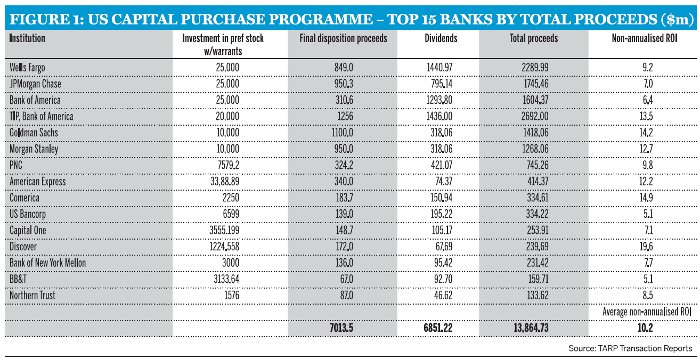
  • Of the 707 banks that received almost $205B in TARP funds through the Capital Purchase Program (CPP), 76 have fully repaid their funds to a total of $138.4B. Hence the US has recovered 67.5% of the funds invested in banks.
  • Of the remaining banks that owe money to the US, 580 of them owe less than $100M.
  • The US government reaped a high rate of return on the TARP funds that have been fully repaid already.The top 15 by total proceeds yielded an average non-annualized return of 10.2%.
  • Some examples of individual returns include Discover Financial Services(DFS), Comerica(CMA) and Goldman Sachs(GS) with 19.6%, 14.9% and 14.2% on an non-annualized return basis respectively.
  • In addition to TARP funds, Bank of America(BAC) and Citigroup(C) each received an additional $20B thru the Targeted Investment Program(TIP). Including this loan, the  interim, non-annualized return on investment based on the amount repaid by Citigroup so far is 15.91%.

When the TARP program was implemented there was much outcry from the general public. However the data above shows that the program not only achieved its stated objective but also yielded an excellent return to the US government.

Related:

As TARP Fades, a Look at Its Flaws and Its Success

TARP Didn’t Bust the Bank

The Best Asian Banks by Country 2010

This week FinanceAsia announced the winning banks for many Asian countries for 2010. These banks were selected based on many factors. From the news report:

“The selection of the winning bank is a highly quantitative one, with each bank scored on a number of key performance metrics. Public Bank scored the highest of the 11 shortlisted banks.

The Best Asian Bank award is given to the bank that ranks the highest among the 11 banks that have individually won our Best Bank award for each country. We ranked the banks by a series of metrics and also by their scores in Standard & Poor’s Bank Fundamental Strength Ratings. The metrics used include: return on assets, return on equity, profit per employee, total assets, percentage of net income derived from fee business, gross NPL ratio, the compound annual growth rate, price-to-book ratio and net interest margin.

The best-ranked bank for each metric got 11 points and the lowest-ranked got 1 point.”

The selection process short-listed 11 banks. The country winners for this year are listed below:

  1. China Construction Bank (China)
  2. HDFC Bank (India)
  3. Bank Mandiri (Indonesia)
  4. Public Bank (Malaysia)
  5. Banco de oro Unibank (Philippines)
  6. DBS (Singapore)
  7. Shinhan Bank (South Korea)
  8. Commercial Bank of Ceylon (Sri Lanka)
  9. Chinatrust Commercial Bank (Taiwan)
  10. Kasikornbank (Thailand)
  11. Asia Commercial Bank (Vietnam)

HSBC(HBC) won the Best Bank award for Hong Kong but was excluded as it is really a global bank.

Public Bank of Malaysia won the award for the Best Asian Bank for this year. From the bank’s website:
“Public Bank is a top-tier bank in Malaysia, well-reputed for its prudent management, superior customer service, uncompromising service delivery standards and strong corporate governance and corporate culture. Public Bank remains untouched by the global financial crisis which wrecked havoc in major financial centres around the world.

Public Bank has paid a dividend every year since 1970.

China Construction Bank (OTC: CICHY) is one of China’s “big four” banks. Currently it pays a 3.52% dividend. HDFC Bank(HDB) is one of the largest private sector banks in India.Among the BRIC countries, Indian stocks have become expensive after a strong run up in recent months.HDB’s P/E ratio is over 41 and the stock yields a tiny 0.45% dividend at current levels. Public Bank(OTC: PBLOF) has a 4.49% yield.