Some Reasons to Invest in Emerging Market Small-Caps

One of the asset classes that investors often overlook is international small-caps. This is understandable since investing in any small cap is often considered to be extremely risky because of the volatility and other risks associated with them. Compared to domestic small caps, foreign small caps pose additional risks such as the lack of liquidity, access to information, etc. However investors would be missing some great opportunities if they completely ignore foreign small caps. Emerging market(EM) small-cap stocks offer many excellent opportunities for investors willing to explore this area of the market. A recent research report by Pyramis Global Advisors makes some compelling arguments to invest in this class of equities.

Some of the reasons for investing  in EM small cap stocks based on the report are noted below:

  • The emergence of a robust middle-class in emerging markets may boost the return on EM small-caps just like the large-caps. For example, while China’s middle-class of 157 million is lower than the size of the US middle-class population, China has the largest cell phone market in the world with a total subscriber base of 700 million.
  • The strong economic growth projected in EM countries will benefit EM small-caps.
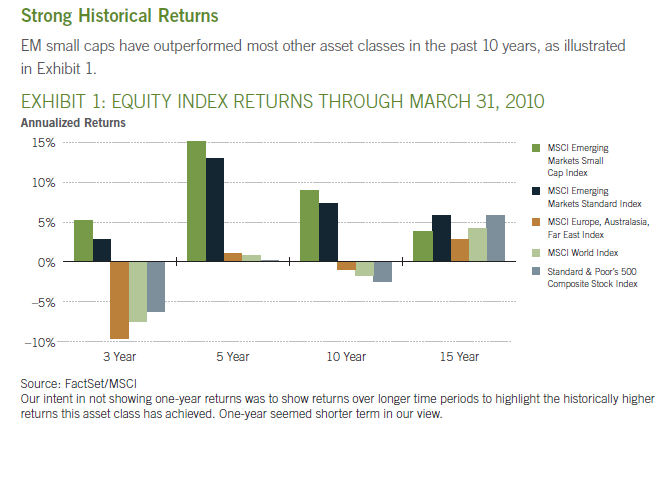
  • Historically EM Small-caps have had high returns compared to other asset classes as shown below:
  • Unlike large-cap companies small-cap companies are mostly focused on the local markets which are projected to experience significant growth.
  • Due to the rapid economic growth in emerging markets, demand for consumer products and services will increase exponentially. Some examples include the demand for tires in India due to the strong growth in automobile sales, insurance business in China, property companies in Brazil, etc.
  • EM small-caps have a 12% lower co-relation with the S&P 500.

Many ETFs are available that cover the small-cap space in emerging markets. The following are some of them:

SPDR S&P Emerging Markets Small Cap ETF (EWX)
Market Vectors Brazil Small-Cap ETF (BRF)
Claymore/AlphaShares China Small Cap Index ETF (HAO)
India Small-Cap Index ETF (SCIF)
Latin America Small-Cap Index ETF (LATM)

Knowledge is Power: India IT, Banks, Economy Edition

IT future looks hazy as US cos turn wary of offshoring

The Global Economy ‘Still Has Deep-Seated Structural Problems’

China Shifts From Emphasis on Low-Cost Factories

Why Do We Keep Indulging the Fiction That Banks Are Private Enterprises?

Jobs and recovery in the Great Depression

Slowdown in European economy not affecting equities 

Special dividends find new fans

Cash in on the resilience of tourism

American Falls, New York State, USA

What to Invest In During a Period of Protracted Economic Malaise?

The official U.S. unemployment rate stood at 9.6% last month. The number of unemployed persons according to to government data totaled 14.9 million. 42% of those unemployed in August were long-term unemployed (27 weeks or more). Many of the other economic figures published nowadays are also negative. While some talk of a double-dip recession, others are even more pessimistic. For example David Rosenberg, chief economist of Gluskin Sheff recently outlined 13 reasons to suggest that this so-called recovery is actually a depression.

In an related note Matthew D. McCormick, Portfolio Manager at Bahl & Gaynor Investment Counsel said:

“Many people believe the U.S. economy is out of the recession or close to it. At Bahl & Gaynor, we think this recession is like no other since the Great Depression and the subsequent recovery will be longer – and weaker – than most expect. Thus, an extended period of tepid economic and earnings growth is a distinct possibility. Such a recovery could be similar to the 1974 to 1982 economic “malaise.””

If a protracted economic stagnation similar to 1974 to 1982 repeats, then investors may want invest in dividend paying stocks. The S&P’s price return during this period was an annualized 4.14%. However the total return (including dividends) for this period was an annualized 9.39%. Hence dividends accounted for 55.09% of the S&P 500’s total return.

Source: Bahl & Gaynor Investment Counsel

Ned Davis Research analyzed the S&P data for the same period and found that dividend paying stocks also outperformed non-dividend payers by an annualized 3.89%.

Hence instead of worrying about whether we may have a double-dip recession or not, investors looking to select some stocks for their portfolio may want to consider adding dividend paying stocks.

The SPDR S&P 500 ETF (SPY) has a 1.90% dividend yield and the iShares Dow Jones Select Dividend ETF (DVY) has a 12-Month Yield of 3.77%.

Some foreign stocks have much higher yields at current levels. A few of the high yielding foreign stocks include French utility giant Veolia Environnement (VE) paying 5.75%, Italian oil major Eni Spa(E) yielding 6.14%, Brazilian electric utility CEMIG (CIG) with an yield of 5.17%, National Australia Bank Ltd (OTC: NABZY) paying 5.67% and Philippine Long Distance Telephone Co (PHI) with a dividend yield of 6.22%.

Nokia and Colgate Among India’s Most Trusted Brands

The ‘Most Trusted Brands’ in India for 2010 based on The Economic Times-Brand Equity’s survey of 300 brands in the consumer products and services category are listed below:

[TABLE=539]

Finnish mobile phone maker Nokia(NOK) tops the ranking. Nokia has held the top spot for three years in a row confirming the strength of its brand power in one of the largest growing cell phone market in the world.

US-based Colgate-Palmolive’s (CL) brand Colgate was ranked number two. Colgate has had a presence in India since the 1930s.

Hindustan Unilever’s Lux soap brand took the third rank followed by Reckitt Benckiser’s Dettol disinfectant. Hindustan Unilever is the Indian subsidiary of Anglo-Dutch consumer products giant Unilever (UN, UL). In addition to the Lux brand, other Hindustan Unilver’s brands also took the rankings from six thru ten. Reckitt Benckiser is a UK-based firm whose stock trades on the London Exchange. The fifth most trusted brand is Britannia owned by the domestic food company Britannia.

Related: The Best 50 Chinese Brands 2010Â