Time To Consider Swedish Bank Stocks

Some of the Swedish bank stocks fell hard during the credit crisis due to their large exposures to the former Soviet states in the Baltic region. However in the past few months these banks have rebounded nicely.

Sweden’s fourth largest bank Swedbank (OTC: SWDBY) is also the biggest bank in Estonia, Latvia and Lithuania. In the domestic market Swedbank’s shares have risen six fold since the March 2009 lows according to a Bloomberg report last month. The ADR price is up over 20% YTD.

Christer Gardell, a local businessman invested heavily in Swedbank recently saying that the bank’s current share prices do not reflect the long-term potential of the company. He now controls 4.64% of Swedbank. US-based billionaire activist investor Carl Icahn holds a 1.06% stake in the bank.

Sweden-based SEB is the second largest lender in the Baltic countries. Its share price in the local market has more than tripled in market value during the same period.

From the Bloomberg report:
“Both banks are seen as a recovery story,” Kimmo Rama, a financial analyst at Evli Bank in Helsinki, told Bloomberg. “In the Baltic countries, credit quality has improved more rapidly than previously expected, and as a result loan losses have decreased strongly.

“Credit quality remains strong in Sweden,” Kimmo Rama told the newswire. “This, combined with a good economic outlook, will provide a good growth platform for the Swedish banks.”Handelsbanken, Sweden’s second-biggest bank by market capitalization, Swedbank and SEB all reported better than expected earnings for the second quarter.

The other Swedish banks Nordea Bank AB (OTC:NDBAY) and Svenska Handelsbanken AB (OTC:SVNLY) currently have dividend yields of 3.56% and 3.97% respectively.

Investors with a long-term horizon can consider adding some of the Swedish banks at current levels for the reasons discussed above.

The World’s Safest Banks by Region 2010

In an earlier post we looked at the The World’s 50 Safest Banks based on rankings by the Global Finance magazine. In this post lets take a quick look at the safest banks for 2010 by region.

a) The World’s Safest Banks in Asia 2010

[TABLE=527]

b) The World’s Safest Banks in Australasia 2010

[TABLE=528]

c) The World’s Safest Banks in Middle East 2010

[TABLE=531]

d) The World’s Safest Banks in Latin America 2010

[TABLE=530]

e) The World’s Safest Banks in North America 2010

[TABLE=532]

f) The World’s Safest Banks in Central & Eastern Europe 2010

[TABLE=529]

g) The World’s Safest Banks in Western Europe 2010

[TABLE=533]

Some interesting points from the above lists:

  • JPMorgan Chase (JPM), Wells Fargo (WFC) and U.S. Bancorp (USB) have dividend yields of less than 1%.
  • CorpBanca SA(BCA) and Banco De Chile(BCH) have high yields of 5.91% and 4.85% at current prices.
  • Based on Friday’s close, National Australia Bank(NABZY) and Westpac Banking Corporation (WBK) have dividend yields of over 5% while Commonwealth Bank of Australia (CMWAY) pays a 6.53% dividend.


The World’s 50 Safest Banks 2010

The Global Finance magazine has published its list of the world’s 50 safest banks for this year. These banks were selected “through a comparison of the long-term credit ratings and total assets of the 500 largest banks around the world. Ratings from Moody’s, Standard & Poor’s and Fitch were used.” The magazine has published this annual listing for 19 years.

The World’s 50 Safest Banks 2010:

[TABLE=526]

Source: Global Finance

Some notable points from the ranking are:

  1. Of the six major Canadian banks, five are in this list.
  2. The “four pillar” banks of Australia – National Australia Bank (NABZY), Westpac Banking Corporation(WBK), Commonwealth Bank of Australia(CMWAY) and Australia and New Zealand Banking Group (ANZBY) have made it to the top 50.
  3. The tiny city state of Singapore is represented by three banks confirming the strength of the Singapore’s banking system.
  4. Some of the major British banks such as Llyods Group (LYG), Royal Bank of Scotland(RBS) and Standard Chartered did not make it to the list.
  5. Among the “Too-Big-To-Fail” US banks, Bank of America(BAC) and Citigroup(C) are also absent in the table above.
  6. Overall most of the safest banks are from developed countries.Despite the growth of many emerging market banks as global players such as the Chinese banks, none of them appear in the ranking.

Knowledge is Power: Government Benefits, China and India, Middle Class Edition

Brace yourself: markets have further to fall

The middle classes died a long time ago

The questionable benefit of benefits

Do stocks even matter anymore?

Are Investors Unfair to U.S. Stock Funds?

Meet the ‘Nifty 50/50’

The Stock Market Slide Is Over

Obama’s Misguided Approach –America Has Become Too European

A Safety Net for Global Capitalism –Inside Munich Re, the World’s Risk Center

China and India: Contest of the century

church-gorge-colobia.jpg

Sanctuario de las Lajas Church, Colombia

The Importance of Dividends

Recently fellow blogger Random Roger wrote a post an on how to construct a portfolio with one high yielding stock and one ETF for each sector. In the post Roger listed a few of the high yielding stocks current available in the market.

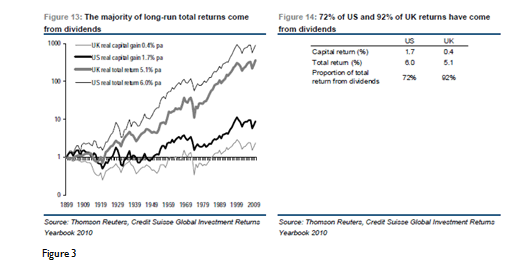
Dividends are an important component of total returns especially in the long-run. The following chart from a study by Credit Suisse shows that 72% of US returns and 92% of UK returns since 1900 have come from dividends:

Click to Enlarge

Dividend-Returns-since-1900

The graph below from  GMO’s recent newsletter also shows the importance of dividend yields in the U.S. and overseas markets.

Dividend-Returns-SP500

“Exhibit 3 shows the contribution that dividends have made to total returns over various periods. On average, over the very long term, dividends have accounted for some 90% of total return.”

Dividend-Global-Returns

“The importance of dividends over the long term isn’t just a U.S. phenomenon. The same patterns hold true across a wide variety of global equity markets. For instance, in
Europe, 80% to 100% of the total returns achieved since 1970 have come from dividends (combining yield and real dividend growth).”

According to FT market data, the current yield of the US market is just 2.0% while the yield of the UK market is 3.1%. Other countries such as New Zealand, Australia, Israel, Finland,  etc. have yields exceeding 3%. Hence investors looking for high yields have a wide variety of choice from foreign markets.

Update: From Bloomberg BusinessWeek

The-Importance-of-Dividend-Payouts