Will Investors Get Back into U.S. Bank Stocks?

During the credit crisis many U.S. banks suspended dividend payments entirely or reduced them significantly. Currently most of the banks pay dividends. But the yields on them is so small that investors are not attracted to them. For example, the current yields of the big four superbanks are follows:

1. JPMorgan Chase (JPM)
Current Dividend Yield: 0.50%

2.Bank of America Corp (BAC)
Current Dividend Yield: 0.33%

3. Wells Fargo (WFC)
Current Dividend Yield: 0.73%

4. Citigroup (C)
Current Dividend Yield: No dividends paid

Compared to the U.S. banks noted above, many foreign banks have high dividend yields. Banco Santander (STD) of Spain pays 5.66%, Deutsche Bank(DB) of Germany yields 1.41% and Westpac Banking Corp(WBK) pays 6.07%. U.S. banks are unable to pay higher dividends due to regulatory restrictions placed on them despite shoring up their capital and rising earnings.But those restrictions are to be lifted according to an article in the Wall Street Journal.

From the article:

“Dividend payments are especially important for banks now that the financial industry’s outlook is clouded by the sluggish economy, toughened regulation and looming capital requirements. But as profits have rebounded, a big-bank stock index from Keefe, Bruyette & Woods Inc. is up 11.6% so far this year after Thursday’s rally, surpassing the Dow Jones Industrial Average’s gain of 9.7%.

While the banks were waiting for the green light to restore their payouts, other companies have been boosting dividends in recent months, making their shares more attractive, especially given the slow growth in the economy. Financials on average yielded 4.4% in 2008, making them one of the highest-yielding sectors, according to Standard & Poor’s. Now they yield 1.1%, making them the second-lowest yielding sector in the market, according to S&P.

Only a handful of banks are expected to meet the Fed’s test, said Frederick Cannon, co-director of research at KBW. Among those with strong enough capital ratios are J.P. Morgan Chase, US Bancorp, State Street Corp. and Bank of New York Mellon Corp., he said.”
 

US-Bank-Dividends-Relative-To-Sp-Yields

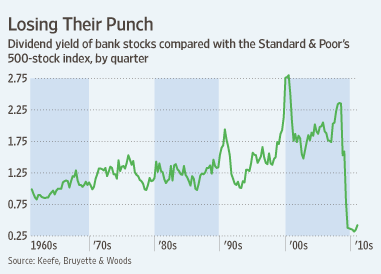
The chart above shows the depth of the fall in bank dividend yields. Like utilities, banks traditionally paid high dividends before the financial crisis and were a core holding in income investors’ portfolios. Those investors got burned when these stocks crashed. When banks increase dividends some investors who bailed out may get back in. However there many factors that still make these stocks scary to hold. Hence it is better to keep an eye on this sector and be very selective in any new investments if one wants to add to their portfolio.

Disclosure: Long STD, USB
Four Chinese Healthcare Stocks To Consider

In an article back in July I discussed about some of the reasons to invest in the Chinese healthcare market and mentioned five foreign healthcare companies as potential investment options. In this post lets take a quick look at four Chinese healthcare stocks that trade on the U.S. markets.

1. Mindray Medical International Ltd (MR) is a leading developer, manufacturer and marketer of medical devices worldwide. Mindray operates in three segments: Patient Monitoring and Life Support Products, In-Vitro Diagnostic Products and Medical Imaging Systems.The stock is down about 12% YTD. Last year the company had a total revenue of $665 M. Mindray is experiencing strong international growth as well. In 2Q, 2010 the company’s overseas sales was about $107M.

2. Concord Medical Services (CCM) operates a network of radiotherapy and diagnostic imaging centers in China. At the end of last year, the Company’s network comprised of 88 centers based in 57 hospitals, spanning 36 cities in China. This is a small-sized company with a market cap of about $350 M.In the second quarter the company added 11 centers bring the total number of centers to 100.

3. China Medical Technologies Inc (CMED) is engaged in the commercialization, manufacture and sale of medical devices and supplies to customers primarily in China. The ADR is down 13% YTD.

4. China Kanghui Holdings (KH) is a developer, manufacturer and marketer of orthopedic implants in China. Kanghui offers a wide array of proprietary orthopedic implant products in trauma and spine. Since its mid-August listing, the stock has performed well. From an IPO price of $10.25 the stock price has grown to close at $18.95 today. The third quarter financial results will be released on Monday, November 8, 2010, before the market opens.

Is Canada a Play on China?

Earlier this year Murray Leith of Odlum Brown, a British Columbia,Canada-based financial services firm made a presentation in which he suggested the theory that Canada is a play on China. He stated that”the Canadian stock market really hangs on China’s fortunes.” I wondered if his theory is indeed correct.

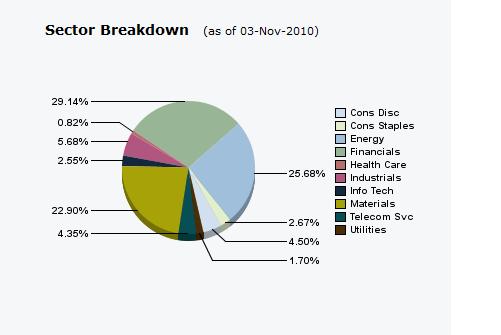
Murray noted that the Canadian stock market is not well diversified like the U.S. markets. The composition of the S&P/TSX Composite Index is shown below:

sp-tsx-composite-makeup.jpg

About 49% of the index is made of the resources sector and 29% is concentrated in financials.Together they makeup more than three-quarters of the Canadian markets. So when compared to the US S&P 500, the Canadian market is highly concentrated on just two sectors.

Murray said that “Financials are not directly tied to China like Resources, but they are from an indirect perspective considering that China’s resource demand has a major influence on the overall health of our country.”  The Canadian financial sector has more exposure to Latin America, the Caribbean and the U.S. than China. Hence even if China imports a large amount of Canadian resources, the financial system is more likely to be impacted by the economic situation in Latin America and the U.S.

It is a well known fact that Canada is the largest trade partner of U.S. Thru August this year trade between Canada and the U.S. exceeded $346 billion while trade between U.S. and China totaled  $285 billion.In 2009, total trade between U.S. and Canada was $429 billion.

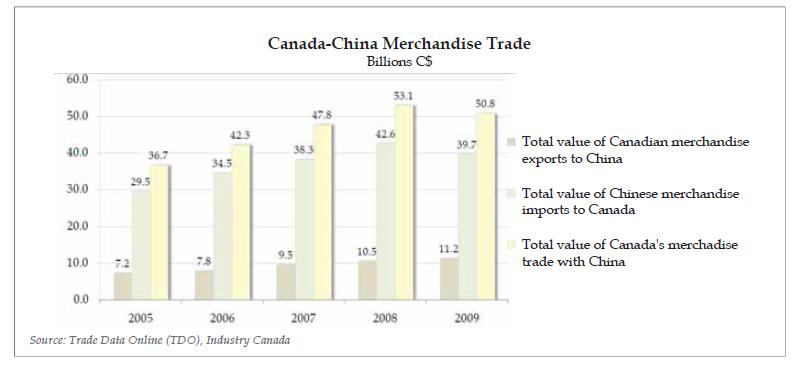
Last year Canada exported just over C$10 billion to China but imported goods worth C$39 billion from China. The majority of the exports were oil seeds, fruit, grain, woodpulp, paper or paperboard scraps, ores, slag and ash. In the first half of this year Canadian exports to China exceeded C$5.5 billion.

From The Canadian Chamber of Commerce report titled “Canada–China: Building a strong economic partnership”:

“Two-way trade between Canada and China continues to expand, albeit at a slower pace following the 2008 financial crisis; the total value of two-way trade was C$50.8 billion in 2009 versus C$47.8 billion in 2007. A 2009 Fraser Institute study found that despite this growth,Canada’s two-way trade with China remains well below potential.

Indeed, while China is Canada’s third-largest trade partner and third-largest export market, Canada’s trade with China still represents only seven per cent of our country’s overall merchandise trade. Only three per cent of Canada’s merchandise exports went to China last year, versus 75 per cent to the United States. It is clear there is room to achieve substantial growth in Canada’s commercial exchanges with China.”

Click to Enlarge

china-canada-trade.jpg

Hence based on the analysis noted above I do not agree with the view that Canada is a play on China. China is dependent on Australia and other economies in Asia for trade and economic growth than Canada. Despite the Chinese demand for many commodities that Canada has, our northern neighbor’s fortune is still dependent on the U.S. economy.

Sources: Asia Pacific Foundation of Canada, U.S. Census Bureau and others

A Review of Nordic Blue-Chips

nordiske-flag.jpgInvestors are attracted to the Nordic countries for many reasons some of which include low to zero budget deficits, strong social and political systems, tradition of research and innovation, advancement in green technologies, sound banking systems, etc. Norwegian firms are leaders in crude oil exploration and drilling, Danish companies excel in the wind power and healthcare sectors and Swedish firms are known for their strong positions in the retail, telecom and automotive industries.

The STOXX Nordic 30 Index contains 30 Blue-Chip stocks in the Nordic region that includes Denmark, Finland, Iceland, Norway and Sweden. These bluechips are listed below together with their ADR ticker:

[TABLE=655]

Some points about the Nordic stocks noted above:

  • After many strategic missteps mobile phone maker Nokia(NOK) is trying to take market share in the smartphone market.
  • Among the Nordic banks, banks from Sweden were heavily exposed to the former Baltic countries such as Lativa, Lithuania, Estonia etc. that almost went bankrupt a few years ago.Now banks such as Swedbank(SWDBY)[not in the table], Nordea Bank (NDBAY) have wrote off most of the losses and have stronger balance sheets.
  • Finnish insurance company Sampo and utility firm Fortum have traditionally paid high dividends.
  • Oslo,Norway-based Yara(YARIY) is the world’s largest supplier of mineral fertilizers with operations in more than 50 countries. As corn, wheat and soybean prices rallied last month the stock price of Yara reached a two-year high.

Five Foreign Electric Utility Stocks

Some of the foreign electric utilities trade on the OTC market. Ten such stocks are listed below together with their current dividend yields:

1. Verbund (OEZVY)
Austria
Current Dividend Yield: 3.30%

2. EDP Energias de Portugal SA (EDPFY)
Portgual
Current Dividend Yield: 5.03%

3. Aes Tiete SA (AESAY)
Brazil
Current Dividend Yield: 8.41%

4. Scottish & Southern Energy PLC (SSEZY)
U.K.
Current Dividend Yield: 8.27%

5. Hongkong Electric Holdings Ltd (HGKGY)
Hong Kong
Curret Dividend Yield: 2.50%