Can Obama Transition the Democratic Party To An Economic-Growth Party?

The mid-term elections are finally over. According to the latest news, the Republican party has seized the House of Representatives winning at least 60 seats from the Democrats. This is a major blow to Obama and his democratic party. Republicans primarily won because of voters’ unease on the current state of the U.S. economy.

From the BBC:

“Up for election were all 435 seats in the House (the lower chamber of Congress), 37 of the 100 seats in the Senate, governorships of 37 of the 50 states and all but four state legislatures.

With some counts still to be completed, projections suggested the Republicans had obtained a net gain of 60 seats in the House, more than the 54 they won in the landmark 1994 mid-terms, and the biggest exchange of seats since the Democrats won 75 in 1948.”

In the swing state of Ohio, Republican John Kasich defeated the current governor Ted Strickland. Despite the major setback the Democratic party still retains control of the Senate.

Gerald Seib had an interesting piece titled “Lessons of Reagan’s Rebound“ in The Wall Street Journal yesterday analyzing the impact of economic growth that brought Reagan back from a difficult situation and how the lessons democrats can learn from that time.A  graphic comparing the current economy to the one during Reagan’s time is shown below:
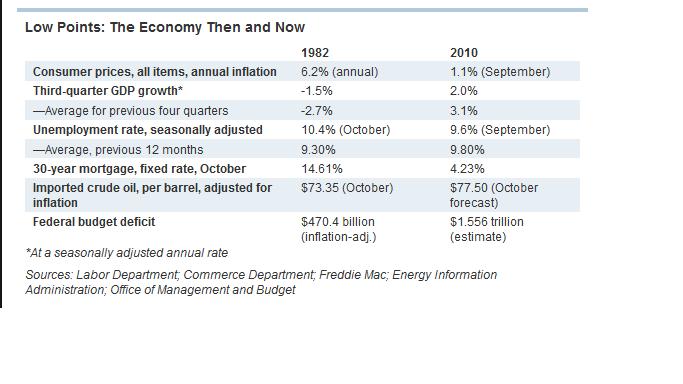
reagon-obama-eocnomics.jpg

Source: The Wall Street Journal

From the Journal article:

“By 1984, the darkness of the 1982 economy had turned into the “Morning in America” theme on which Mr. Reagan ran for re-election.

Some Democrats think that, in a similar way, political recovery for their party requires an intense focus on economic growth.

“My view is that when you have an election like this, even when Democrats manage to squeeze by, you have to really take stock of yourself and question your long-term relevance if you don’t change,” says Jim Kessler, vice president for policy at Third Way, a think tank that advances the ideas of moderate Democrats. “Democrats have to transition from being an economic-security party to an economic-growth party.”

Mr. Kessler argues that “the 80-year mission to fashion a strong safety net is basically over with the passage of health care, and a new mission must take its place. And that mission has to be growth.”

Most of the voters believe that current administration has wasted the past two years from implementing policies that would have put the economy back on track. Right from the beginning the economic team put together by the President has been incompetent. The team consisted of academic people such as Christina Romer who are best in academic teaching of economic theories but do not have much understanding of practical approaches to solving economic problems. Christina Romer, the chair of the White House Council of Economic Advisers, resigned her post in in September to return to her old job as an economics professor at the University of California at Berkeley. Budget director Peter Orszag also left the team.

Larry Summer, the head of the National Economic Council and a chief architect of failed economic policy also resigned in September.He plans to return to return to teaching at Harvard University by the end of the year.

Many believe that the resignations of the advisers mentioned above is actually good for the country and that it is high time that Mr.Obama completely reshuffles the team and fills it with better candidates. While it is a long shot there is a still chance for the current administration to fix the economic issues such as high unemployment  and stimulate growth.If Mr.Obama can accomplish this in the remaining time of his presidency by convincing Americans that the Democratic party favors economic-growth, them they may re-elect him for a second-term in office.

Knowledge is Power: American Dream, Frontier Markets, Wages Edition

Roubini sees ‘disaster’ if house prices drop

Investors should consider South Eastern Asian frontier markets

Investing in Thailand? Opt for riskier stocks – here’s why

Another bubble beginning in emerging market shares

The US economic policy mix is a threat to the world 

Wages in America, Most of Us are Have Nots

Democrats Face Biggest House Midterm Defeat in Years

Buy emerging-markets consumers

Is the American Dream Over?

The Tragedy of the Obama Administration

 rod_fishing.jpg

 Fishermen in Sri Lanka

Are Emerging-Markets Stocks Cheap?

Due to sluggish economic growth in the developed world and strong growth in emerging countries, investors are betting that emerging market equities will yield better returns. According to a story in the Journal:

“In a recent report, Standard & Poor’s said that almost $50 billion flowed into emerging-markets equity funds this year through September, while $78 billion flowed out of developed-market funds, based on data from fund-flow tracker EPFR Global. In the week ended Oct. 6, emerging-markets equity funds attracted $6 billion, the largest weekly inflow in about three years.”

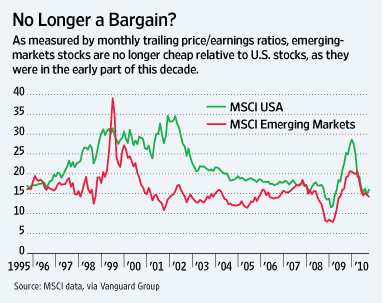
Based on the trailing P/E ratio emerging market stocks are no longer cheap compared to U.S.  stocks.

Emerging-Developed-markets-PE-Correlation

Source: The Wall Street Journal

“Vanguard analysts sometimes look at the price/earnings ratio for the MSCI Emerging Markets Index on a trailing basis. It suggests that valuations for U.S. and emerging-markets stocks have moved much more closely into alignment recently, compared with much lower relative valuations for emerging-markets stocks early in the decade.”

As ETFs have become very popular, emerging market ETFs are attracting a large portion of the funds that investors are pouring into emerging stocks. Hence the asset base of two of the biggest emerging market ETFs continues to grow. In October alone, the Vanguard MSCI Emerging Markets ETF (VWO) attracted $3.22 billion in new assets. The iShares MSCI Emerging Markets Index Fund (EEM) collected $1.57 billion. The iShares ETF retains its position as the largest emerging-market fund with total assets of $48.0 billion as of November 1, 2010.

Ten Highly Liquid British Stocks

In order to identify some of the highly liquid British stocks I used the S&P; United Kingdom Index. This index is a subset of the S&P; Europe 350 and tracks the performance of highly-liquid equities in different sectors.

The median market cap of constituents in the index is about 4.81 £ Billion. The top 10 holdings account for about half of the market cap of the index.

The Top 10 highly-liquid constituents are noted below with their current dividend yields:

1.HSBC Holdings Plc (HBC)
Current Dividend Yield: 3.07%

2.Vodafone Group (VOD)
Current Dividend Yield: 6.33%

3.BP Plc (BP)
Current Dividend Yield: N/A

4.Royal Dutch Shell PLC (RDS.A)
Current Dividend Yield: 5.17%

5.GlaxoSmithKline (GSK)
Current Dividend Yield: 5.20%

6.Rio Tinto Plc (RIO)
Current Dividend Yield: 1.33%

7.Royal Dutch Shell PLC (RDS.A)
Current Dividend Yield: 5.22%

8.BHP Billiton Plc (BBL)
Current Dividend Yield: 2.54%

9.British American Tobacco Plc (BTI)
Current Dividend Yield: 2.75%

10.AstraZeneca Plc (AZN)
Current Dividend Yield: 2.77%

Ten Reasons Why India’s Stock Market is a Bubble

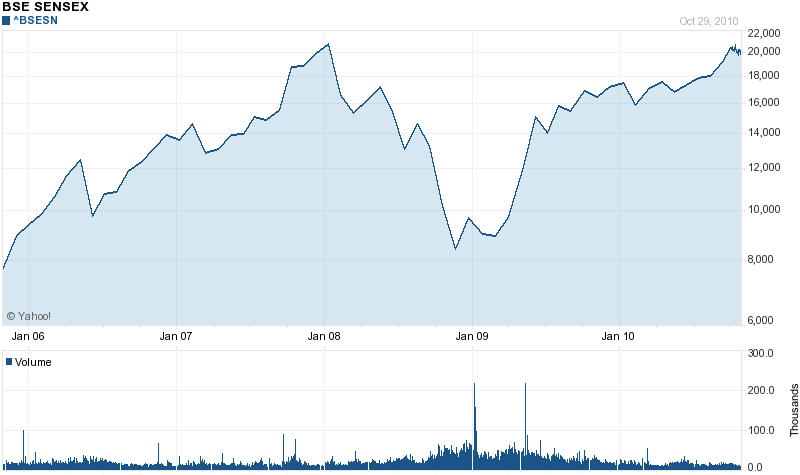
India’s Sensex closed at 20,032 on Friday.This is not far from the all-time high of 20.873 reached in January 2008. During the credit crisis, the index reached a low of 8.160. In just over 18 months the index has rebounded sharply gaining over 150%. This dramatic rise is mostly based on the assumption that the economy will grow at over 8% consistently. However there are many external and internal factors that may put this growth rate into jeopardy. As the hot money continues to flow into the Indian markets, I believe investors need to cautious as the risks for downward movement are higher than the rewards for further rise from current levels.

Sensex Performance – 5 Years:

bse-sensex-5-years.png

The following are some of the reasons investors may want to consider before jumping into the Indian markets:

1. Indian equities have become very expensive compared to other emerging markets. For example, the PE of the Nifty index is about 25. India trades at a PE of 23.9 while Brazil and China have P/Es of 12.5 and 14.2 respectively based on Financial Times market data.

2. Foreign investors are pouring money into the markets. They pulled out $14.84 billion during 2008 which led to the crash of the Sensex. But thru September of this year they have plowed back over $15.62B in the markets. Foreign portfolio investment which is highly short-term focused reached over $32.0B in 2009-10 period .

3. Relatively speaking only a few shares of the major companies that are actively are available for trading. Hence large amount of capital chasing a few free-float shares in select companies leads to huge rise in stock prices.

4. Inflation runs at double digits and may rise further if policy makers do not increase interest rates.Inflation remains stubbornly high primarily due to food prices.

5. Some of global commodity prices have risen over 10% this year. This will put pressure on manufacturers to raise prices as their input costs rise.Further increase in prices will lead to higher inflation.

6. Rupee, the Indian currency has appreciated significantly this year against the dollar hurting exports of goods such as textiles, machinery, etc.

7. Unlike Brazil and other countries policy makers have not implemented regulations such as doubling of taxes on foreign capital inflows to slow the flow of capital.Instead regulators and politicians are encouraging the boom of all asset prices continuing the India growth story.

8. While the savings rate in India is one of the highest in the world, domestic investors’ investment in the equity market is very low. The majority of the savings lie in banks earning lower returns adjusted for inflation. This shows the lack of conviction in the markets among the majority of the local population.

9. The corporate debt market is almost non-existent in India. Hence companies have to raise funds either thru the equity markets or banks. The lack of bond markets causes distortion in the channeling of funds from investors to companies.

10. India is a debtor country and the external debt continue to rise due to lavish subsidies offered by politicians.As of October this year, external debt stood at $273.1 billion.

Overall the run-up in equity prices is not justified based on fundamentals and earnings growth. Some experts are predicting a rise of another 10% in the markets due to the upcoming Diwali – the “Festival of Lights” season, liquidity and other factors. However it still does that change the fact that Indian stocks are expensive. “Irrational exuberance” is rampant in the markets which will lead to a painful correction.