Is Canada a Play on China?

Earlier this year Murray Leith of Odlum Brown, a British Columbia,Canada-based financial services firm made a presentation in which he suggested the theory that Canada is a play on China. He stated that”the Canadian stock market really hangs on China’s fortunes.” I wondered if his theory is indeed correct.

Murray noted that the Canadian stock market is not well diversified like the U.S. markets. The composition of the S&P/TSX Composite Index is shown below:
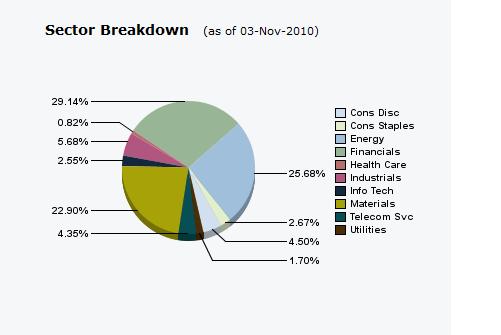
sp-tsx-composite-makeup.jpg

About 49% of the index is made of the resources sector and 29% is concentrated in financials.Together they makeup more than three-quarters of the Canadian markets. So when compared to the US S&P 500, the Canadian market is highly concentrated on just two sectors.

Murray said that “Financials are not directly tied to China like Resources, but they are from an indirect perspective considering that China’s resource demand has a major influence on the overall health of our country.”  The Canadian financial sector has more exposure to Latin America, the Caribbean and the U.S. than China. Hence even if China imports a large amount of Canadian resources, the financial system is more likely to be impacted by the economic situation in Latin America and the U.S.

It is a well known fact that Canada is the largest trade partner of U.S. Thru August this year trade between Canada and the U.S. exceeded $346 billion while trade between U.S. and China totaled  $285 billion.In 2009, total trade between U.S. and Canada was $429 billion.

Last year Canada exported just over C$10 billion to China but imported goods worth C$39 billion from China. The majority of the exports were oil seeds, fruit, grain, woodpulp, paper or paperboard scraps, ores, slag and ash. In the first half of this year Canadian exports to China exceeded C$5.5 billion.

From The Canadian Chamber of Commerce report titled “Canada–China: Building a strong economic partnership”:

“Two-way trade between Canada and China continues to expand, albeit at a slower pace following the 2008 financial crisis; the total value of two-way trade was C$50.8 billion in 2009 versus C$47.8 billion in 2007. A 2009 Fraser Institute study found that despite this growth,Canada’s two-way trade with China remains well below potential.

Indeed, while China is Canada’s third-largest trade partner and third-largest export market, Canada’s trade with China still represents only seven per cent of our country’s overall merchandise trade. Only three per cent of Canada’s merchandise exports went to China last year, versus 75 per cent to the United States. It is clear there is room to achieve substantial growth in Canada’s commercial exchanges with China.”

Click to Enlarge
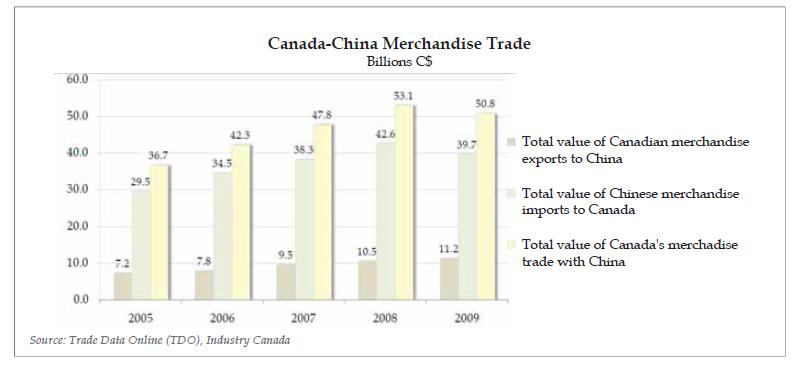
china-canada-trade.jpg

Hence based on the analysis noted above I do not agree with the view that Canada is a play on China. China is dependent on Australia and other economies in Asia for trade and economic growth than Canada. Despite the Chinese demand for many commodities that Canada has, our northern neighbor’s fortune is still dependent on the U.S. economy.

Sources: Asia Pacific Foundation of Canada, U.S. Census Bureau and others
A Review of Nordic Blue-Chips

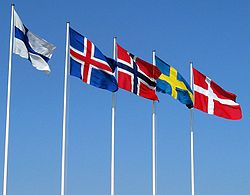
nordiske-flag.jpgInvestors are attracted to the Nordic countries for many reasons some of which include low to zero budget deficits, strong social and political systems, tradition of research and innovation, advancement in green technologies, sound banking systems, etc. Norwegian firms are leaders in crude oil exploration and drilling, Danish companies excel in the wind power and healthcare sectors and Swedish firms are known for their strong positions in the retail, telecom and automotive industries.

The STOXX Nordic 30 Index contains 30 Blue-Chip stocks in the Nordic region that includes Denmark, Finland, Iceland, Norway and Sweden. These bluechips are listed below together with their ADR ticker:

[TABLE=655]

Some points about the Nordic stocks noted above:

  • After many strategic missteps mobile phone maker Nokia(NOK) is trying to take market share in the smartphone market.
  • Among the Nordic banks, banks from Sweden were heavily exposed to the former Baltic countries such as Lativa, Lithuania, Estonia etc. that almost went bankrupt a few years ago.Now banks such as Swedbank(SWDBY)[not in the table], Nordea Bank (NDBAY) have wrote off most of the losses and have stronger balance sheets.
  • Finnish insurance company Sampo and utility firm Fortum have traditionally paid high dividends.
  • Oslo,Norway-based Yara(YARIY) is the world’s largest supplier of mineral fertilizers with operations in more than 50 countries. As corn, wheat and soybean prices rallied last month the stock price of Yara reached a two-year high.

Five Foreign Electric Utility Stocks

Some of the foreign electric utilities trade on the OTC market. Ten such stocks are listed below together with their current dividend yields:

1. Verbund (OEZVY)
Austria
Current Dividend Yield: 3.30%

2. EDP Energias de Portugal SA (EDPFY)
Portgual
Current Dividend Yield: 5.03%

3. Aes Tiete SA (AESAY)
Brazil
Current Dividend Yield: 8.41%

4. Scottish & Southern Energy PLC (SSEZY)
U.K.
Current Dividend Yield: 8.27%

5. Hongkong Electric Holdings Ltd (HGKGY)
Hong Kong
Curret Dividend Yield: 2.50%

Can Obama Transition the Democratic Party To An Economic-Growth Party?

The mid-term elections are finally over. According to the latest news, the Republican party has seized the House of Representatives winning at least 60 seats from the Democrats. This is a major blow to Obama and his democratic party. Republicans primarily won because of voters’ unease on the current state of the U.S. economy.

From the BBC:

“Up for election were all 435 seats in the House (the lower chamber of Congress), 37 of the 100 seats in the Senate, governorships of 37 of the 50 states and all but four state legislatures.

With some counts still to be completed, projections suggested the Republicans had obtained a net gain of 60 seats in the House, more than the 54 they won in the landmark 1994 mid-terms, and the biggest exchange of seats since the Democrats won 75 in 1948.”

In the swing state of Ohio, Republican John Kasich defeated the current governor Ted Strickland. Despite the major setback the Democratic party still retains control of the Senate.

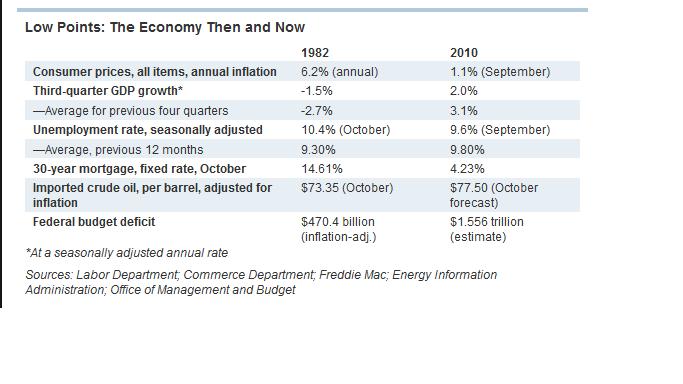
Gerald Seib had an interesting piece titled Lessons of Reagan’s Rebound in The Wall Street Journal yesterday analyzing the impact of economic growth that brought Reagan back from a difficult situation and how the lessons democrats can learn from that time.A  graphic comparing the current economy to the one during Reagan’s time is shown below:

reagon-obama-eocnomics.jpg

Source: The Wall Street Journal

From the Journal article:

“By 1984, the darkness of the 1982 economy had turned into the “Morning in America” theme on which Mr. Reagan ran for re-election.

Some Democrats think that, in a similar way, political recovery for their party requires an intense focus on economic growth.

“My view is that when you have an election like this, even when Democrats manage to squeeze by, you have to really take stock of yourself and question your long-term relevance if you don’t change,” says Jim Kessler, vice president for policy at Third Way, a think tank that advances the ideas of moderate Democrats. “Democrats have to transition from being an economic-security party to an economic-growth party.”

Mr. Kessler argues that “the 80-year mission to fashion a strong safety net is basically over with the passage of health care, and a new mission must take its place. And that mission has to be growth.”

Most of the voters believe that current administration has wasted the past two years from implementing policies that would have put the economy back on track. Right from the beginning the economic team put together by the President has been incompetent. The team consisted of academic people such as Christina Romer who are best in academic teaching of economic theories but do not have much understanding of practical approaches to solving economic problems. Christina Romer, the chair of the White House Council of Economic Advisers, resigned her post in in September to return to her old job as an economics professor at the University of California at Berkeley. Budget director Peter Orszag also left the team.

Larry Summer, the head of the National Economic Council and a chief architect of failed economic policy also resigned in September.He plans to return to return to teaching at Harvard University by the end of the year.

Many believe that the resignations of the advisers mentioned above is actually good for the country and that it is high time that Mr.Obama completely reshuffles the team and fills it with better candidates. While it is a long shot there is a still chance for the current administration to fix the economic issues such as high unemployment  and stimulate growth.If Mr.Obama can accomplish this in the remaining time of his presidency by convincing Americans that the Democratic party favors economic-growth, them they may re-elect him for a second-term in office.

Knowledge is Power: American Dream, Frontier Markets, Wages Edition

Roubini sees ‘disaster’ if house prices drop

Investors should consider South Eastern Asian frontier markets

Investing in Thailand? Opt for riskier stocks – here’s why

Another bubble beginning in emerging market shares

The US economic policy mix is a threat to the world 

Wages in America, Most of Us are Have Nots

Democrats Face Biggest House Midterm Defeat in Years

Buy emerging-markets consumers

Is the American Dream Over?

The Tragedy of the Obama Administration

 rod_fishing.jpg

 Fishermen in Sri Lanka