Emerging Markets: Correlation Between Economic Growth and Stock Market Returns

The MSCI Emerging Market(EM) Index has posted an annualized return of 10.2% over the past 10 years thru the end of 2009. Due to this solid performance and other factors investors are increasingly attracted to EM equities. However many studies have proven that economic growth does not automatically translate into higher stock market returns.

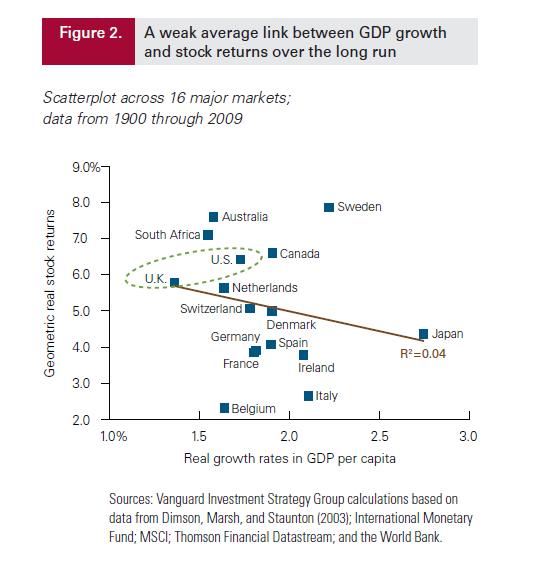
In a study of 16 major markets by the Vanguard group, the correlation  between economic growth as measured by GDP per capita and long run stock returns since the 1900 was effectively zero. In the last decade, EM stocks performed well not because of economic growth per se but because of low valuations in early 2000s.  Globalization also plays an important factor impacting the relationship between economic growth rates and market returns. For example, U.S. corporate profits from direct investments abroad jumped from 20% in 1999 to 40% in 2008. Hence multinational firms contribute to the economic growth of emerging markets.

From the Vanguard research paper:
devloped-mkts-gdp-stock-returns.jpg

“Since 1900, the correlation between long-run economic growth (as measured by real GDP growth per capita, a standard proxy for a country’s productivity growth) and long-run stock returns across 16 major markets has been effectively zero.The slope of the line in Figure 2 is actually slightly negative.”  The study observed a similar relationship for emerging markets as well.

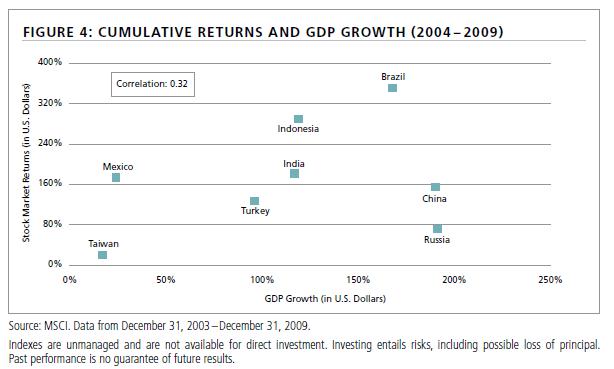
Another study by Neuberger Berman confirms that GDP growth does not necessarily translate to high equity returns. The chart below shows “the disparity between GDP growth rates and five-year cumulative returns for select emerging market countries.
em-gdp-markt-returns-select-countries.jpg

In U.S. dollar terms, the highest nominal GDP growth countries, China and Russia, did not produce the best stock market returns. Mexico, however, outperformed both countries with only about a sixth of their GDP growth. ”

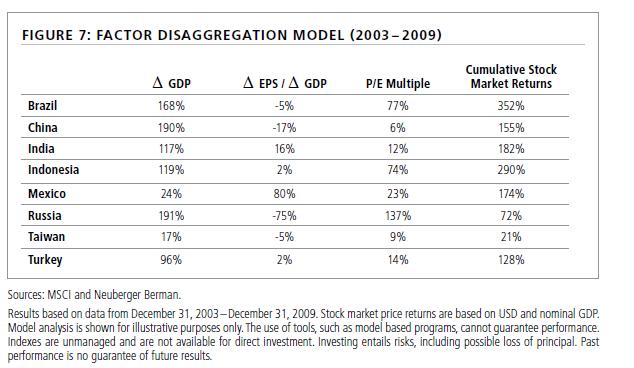
The study further analyzed the MSCI Emerging Markets Index data over a six-year time period from 2003 thru 2009 which coincided with one of the biggest bull markets in emerging markets history. This showed that “the impact of EPS growth (earnings to shareholders) and re-valuation (the price investors are willing to pay) had much larger impact on stock market returns than GDP growth”.
em-mkt-retunrs-analysis.jpg

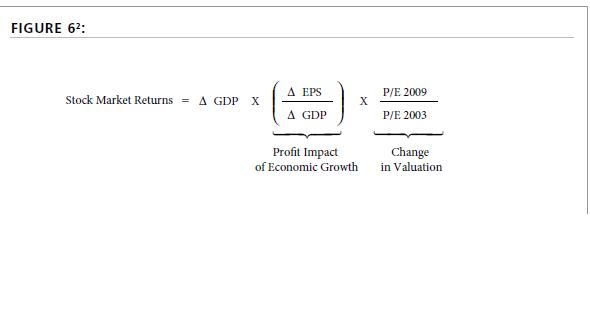
In the above chart, stock market returns was calculated by using the following formula:
em-forumal.jpg

Brazil and Indonesia were the best performing markets in the period studied. They achieved this growth by greater P/E expansion than their peers.Part of this P/E expansion can be attributed to the great run experienced by commodities.

China enjoyed a strong GDP growth but the stock market returns were mediocre.On the other hand Mexico had a much lesser economic growth but the stock return was higher. Similarly Russia had a strong GDP growth and P/E expansion but stock returns suffered due to the increased state ownership component within the benchmark. Despite strong economic growth in terms of market returns Russia was an underperformer.

Hence investors must focus on fundamentals of individual firms, profitability, valuation, etc. and follow a bottom-up strategy when investing in emerging markets as opposed to just looking at economic growth.

Related ETFs:
iShares Emerging Markets ETF (EEM)
iShares Brazil ETF (EWZ)
Market Vectors Russia ETF (RSX)
iShares Mexico ETF (EWW)

Sources:
Investing in emerging markets: Evaluating the allure of rapid economic growth, The Vanguard Group
Does Economic Growth in Emerging Markets Drive Equity Returns? , Neuberger Berman

Disclosure: No positions

Which is the World’s Best Stock?

The world’s best stock in terms of returns is not a U.S.-based company stock. Many people assume that Warren Buffet’s Berskhire Hathaway is the world’s best stock. However that is not true.

kornhamn_372_hogre.gifAccording to the Swedish business daily Dagens Industri’s stock market expert  and author Björn Wilke, Sweden’s Handelsbanken is the best stock in the world. The company first listed on the Stockholm Stock Exchange in 1873. Since 1900 the stock has gained unimaginable 1.9 million percent thru September last year. That amounts to 10 percent a year not including dividends. A $10 investment made in the stock in 1900 would be worth about  20 million dollars as of September 2009.

Compared to the performance of  Handelsbanken, Warren Buffett’s Berkshire Hathaway(BRK.A, BRK.B) has gained just 362,300% since Buffett’s takeover in 1964. And General Electric (GE) stock has grown 843,000% from 1900 to the peak of 2007. These findings were confirmed by researchers at the London Business School.

While past performance is not a predictor of future performance, it gives us an opportunity to analyze why and how some companies thrive against all odds while others perform poorly or yield mediocre returns.

Source: The Swedish Wire

A brief note on Handelsbanken:

The bank was founded in the spring of 1871 when a number of prominent companies and individuals in Stockholm’s business world founded “Stockholms Handelsbank”. At the outset, the bank proclaimed that it would pursue “true banking activities” with deposits and loans and that it would focus on the domestic banking market. Today the bank aims to be a universal bank with 460 branches in Sweden and operations in other Nordic countries and the U.K. Over the years Handelsbanken has followed a very conservative banking model which has led to its success.

Despite the recent financial crisis, the company has paid dividends to shareholders without a break in the past four years. Handelsbanken’s dividend policy is that the dividend should be competitive relative to other listed Nordic banks.  The bank’s ADR (SVNLY) is very thinly traded. Currently the stock pays a 3.11% dividend. The iShares Sweden ETF (EWD) provides exposure to this bank with an allocation of about 5% total assets.

Disclosure: No positions

Update:

Why Country ETFs Are Not the Best Way to Invest in Emerging Markets

ETFs offer one of the simplest and easiest ways to gain exposure to emerging markets.Investors have poured billions of dollars in emerging market funds making them some of the largest in the fund universe.However investing in emerging markets via ETFs or an index fund is not the best way to capture the growth of these economies. In this post let me explain this theory using two examples.

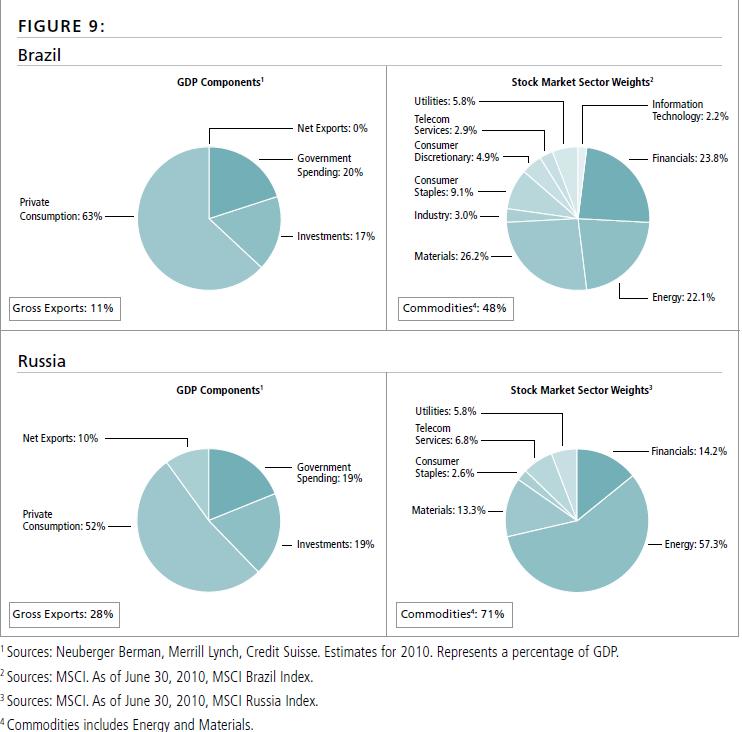
The graphic below shows the comparison of GDP composition and the respective MSCI Indices for Brazil and China:

Click to Enlarge

Brazil-Russai-GDp_MSCi-Index-Comparison

Source: Does Economic Growth in Emerging Markets Drive Equity Returns?, Neuberger Berman

P.S: The MSCI data shown above are as of June 30, 2010.

1. Brazil
Private consumption accounts for 63% of the domestic economy. But the Materials and Energy sector comprise 48% of MSCI Brazil Index. The allocation for consumer sector is very less especially when excluding Financials. As the iShares Brazil ETF (EWZ) tracks the performance of the  MSCI Brazil Index, the ETF does not offer a complete representation of the local economy. Sales of consumer goods such as household appliances, cars, etc. are growing strongly in Brazil. However as of September end, the iShares Brazil ETF has about 14% assigned to the consumer sector. Hence instead of picking up this ETF, investors looking to gain exposure to the Brazilian market may want to do a bottom-up approach and select individual companies.

2. Russia
Similar to Brazil, disconnect exists between the composition of the Russian economy and the underlying index. Private consumption is about 52% of the GDP. But commodities(Energy and Materials) constitute about 70% of the MSCI Russia index. The two country-specific ETFs available for Russia do not track the MSCI Russia Index. The SPDR S&P Russia ETF (RBL) tracks the S&P Russia Capped BMI Index  and allocates about 64% to commodities. Consumer sector accounts for just over 4% in this ETF. Van Eck’s Market Vectors Russia ETF (RSX) which replicates the DAXglobal® Russia+ Index also invests the most of the assets in the commodity sector. So investing in Russia via these two ETFs may not be the best way either.

Disclosure: No positions

Top 10 Gold and Forex Holding Countries

Gold prices have continued to rise since the July low of $1,160 an ounce. After the Fed’s meeting on Thursday, prices rose sharply and continued to go even higher on Friday and closed at $1,393.21. A Reuters article says that gold prices should continue for at least another six months.

From the article:

“Gold’s record-breaking climb should continue for at least six months, corresponding to the planned duration of the Federal Reserve’s monetary stimulus, according to a Reuters poll conducted on Thursday and Friday.

Two out of three respondents see  gold prices topping out between $1,400 and $1,500 an ounce on an interim basis, with most analysts surveyed expecting prices to peak during the first or second quarter of next year.

Thirteen of the 20 analysts, traders and fund managers polled by Reuters said the price of bullion will remain in an uptrend well into the first half of 2011, after the Fed on Wednesday unleashed a program to buy $600 billion of government bonds in a new round of quantitative easing (QE).

The Fed’s QE package has reinforced the argument for holding gold, as it pushes the dollar firmly onto a downward path and raises the risk of inflation.

“QE devaluates the currency, so gold…and almost all commodities will be beneficiaries as people start to switch from financial assets to commodities, something they feel more tangible as the money printing continues,” said Standard & Poor’s Equities and Metals analyst Leo Larkin.”

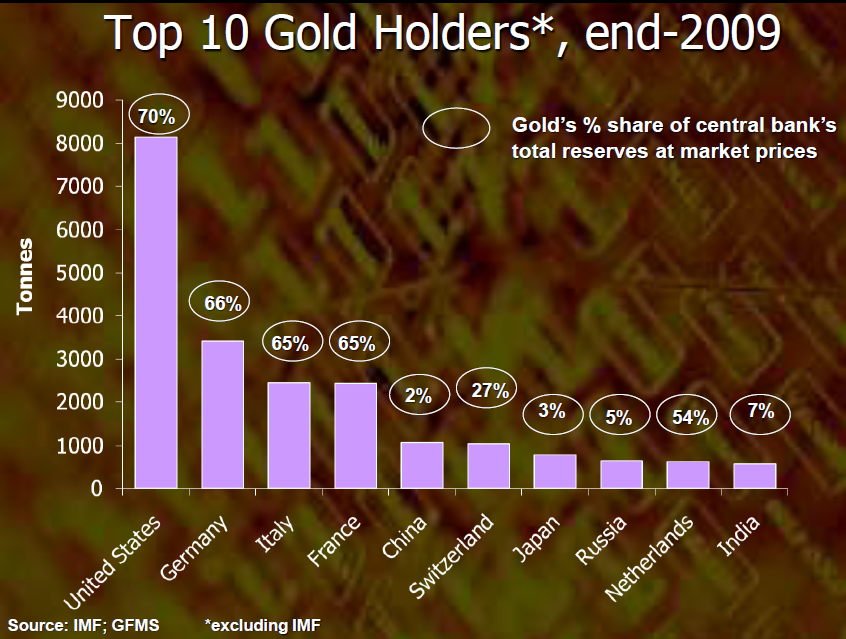
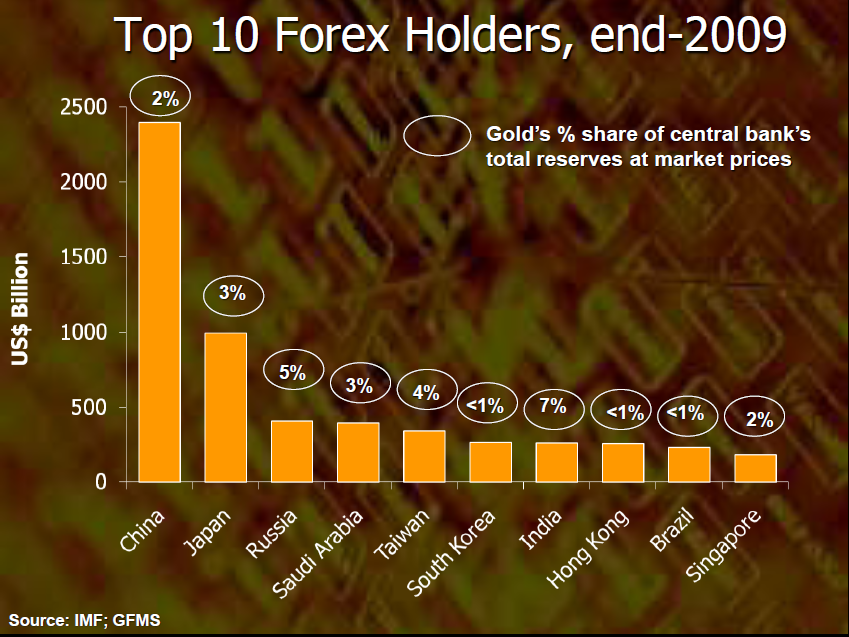
According to London-based GFMS, the world’s foremost precious metals consultancy, specializing in research into the global gold, silver, platinum and palladium markets, the total officially declared gold holdings at the end of 2009 was 30,623 tonnes with the IMF,US and China holding  10%, 27% and 3% respectively.

1) The Top 10 Gold Holders

Click to Enlarge

Top-10-Gold-Holders

2) The Top 10 Forex Holders

Top-10-Forex-Holders

Source:  The Official Sector: Gold Rehabilitated?, A presentation by Philip Klapwijk, GFMS Ltd.

Some of the key predictions made by Philip in the presentation are:

  • “Sovereign debt crisis will not last forever
  • Alternative investments may be attractive, e.g. Chinese government bonds
  • Gold price will eventually change direction
  • US sales unlikely but cannot be entirely ruled out over next decade
  • Off-market purchases may facilitate ‘transfer’ of bullion from West to East “

Will Investors Get Back into U.S. Bank Stocks?

During the credit crisis many U.S. banks suspended dividend payments entirely or reduced them significantly. Currently most of the banks pay dividends. But the yields on them is so small that investors are not attracted to them. For example, the current yields of the big four superbanks are follows:

1. JPMorgan Chase (JPM)
Current Dividend Yield: 0.50%

2.Bank of America Corp (BAC)
Current Dividend Yield: 0.33%

3. Wells Fargo (WFC)
Current Dividend Yield: 0.73%

4. Citigroup (C)
Current Dividend Yield: No dividends paid

Compared to the U.S. banks noted above, many foreign banks have high dividend yields. Banco Santander (STD) of Spain pays 5.66%, Deutsche Bank(DB) of Germany yields 1.41% and Westpac Banking Corp(WBK) pays 6.07%. U.S. banks are unable to pay higher dividends due to regulatory restrictions placed on them despite shoring up their capital and rising earnings.But those restrictions are to be lifted according to an article in the Wall Street Journal.

From the article:

“Dividend payments are especially important for banks now that the financial industry’s outlook is clouded by the sluggish economy, toughened regulation and looming capital requirements. But as profits have rebounded, a big-bank stock index from Keefe, Bruyette & Woods Inc. is up 11.6% so far this year after Thursday’s rally, surpassing the Dow Jones Industrial Average’s gain of 9.7%.

While the banks were waiting for the green light to restore their payouts, other companies have been boosting dividends in recent months, making their shares more attractive, especially given the slow growth in the economy. Financials on average yielded 4.4% in 2008, making them one of the highest-yielding sectors, according to Standard & Poor’s. Now they yield 1.1%, making them the second-lowest yielding sector in the market, according to S&P.

Only a handful of banks are expected to meet the Fed’s test, said Frederick Cannon, co-director of research at KBW. Among those with strong enough capital ratios are J.P. Morgan Chase, US Bancorp, State Street Corp. and Bank of New York Mellon Corp., he said.”


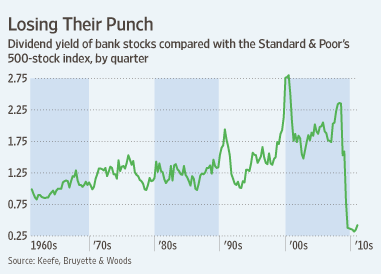
US-Bank-Dividends-Relative-To-Sp-Yields

The chart above shows the depth of the fall in bank dividend yields. Like utilities, banks traditionally paid high dividends before the financial crisis and were a core holding in income investors’ portfolios. Those investors got burned when these stocks crashed. When banks increase dividends some investors who bailed out may get back in. However there many factors that still make these stocks scary to hold. Hence it is better to keep an eye on this sector and be very selective in any new investments if one wants to add to their portfolio.

Disclosure: Long STD, USB