MSCI Index 10-Year Performance: U.S. vs. Select Developed, Emerging Markets

In a post titled “The Magic of Buy & Hold vs Trend” fellow blogger Barry Ritholtz noted the following interesting fact yesterday:

“On December 31, 1998, the last trading day of the year, the SPX closed at 1229.23. That is within 10 points (not 10 percent, but 10 points!) of where it is today.

Over the course of these dozen years, we have seen a 68% rally (to the 2000 top), a 50% sell off (March ’03 lows), a 104% rally (October ’07 top), a 58% drop (March ’09), and an 83% move up (April 2010 highs).”

I wanted to check how U.S. stocks performed relative to foreign developed and emerging markets in the last 10 years. So I reviewed the performance of the MSCI indices of the respective countries.

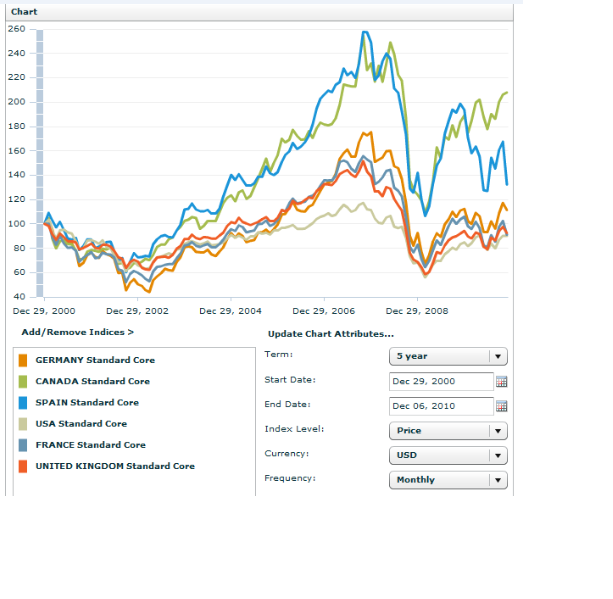
1. MSCI Index Performance – U.S. vs. Select Developed Markets:

Click to enlarge
us-dev-mkts.png

In the above chart, US stocks performed the worst in the past 10 years. Canadian stocks performed better easily beating US, France, Spain, Germany and UK. Despite the recent fall in European markets, European stocks are well ahead of US stocks in terms of returns.Spanish stocks are also better performers compared to US stocks in spite of the recent debt crisis there. This chart shows how US investors can amplify their returns by investing in foreign stocks. Even investing in companies north of the border yields higher returns.

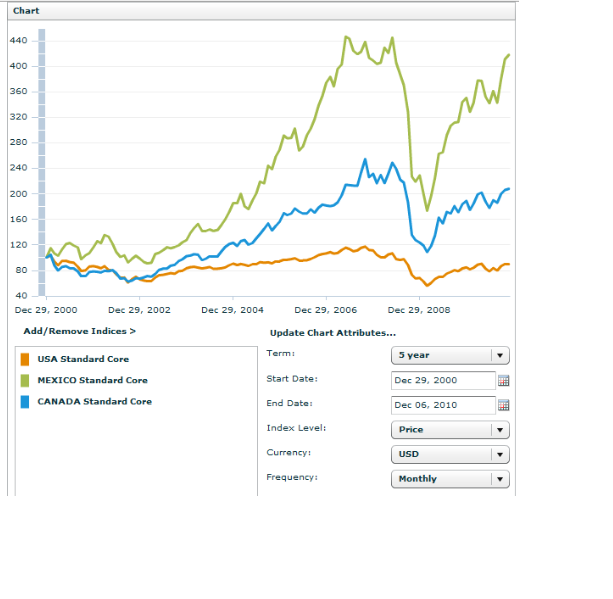
2.  MSCI Index Performance – U.S. vs. Mexico, Canada:
us-mex-can.png

While Canada performed better than US in the last 10 years, Mexican stocks yielded even higher returns as shown in the chart above.

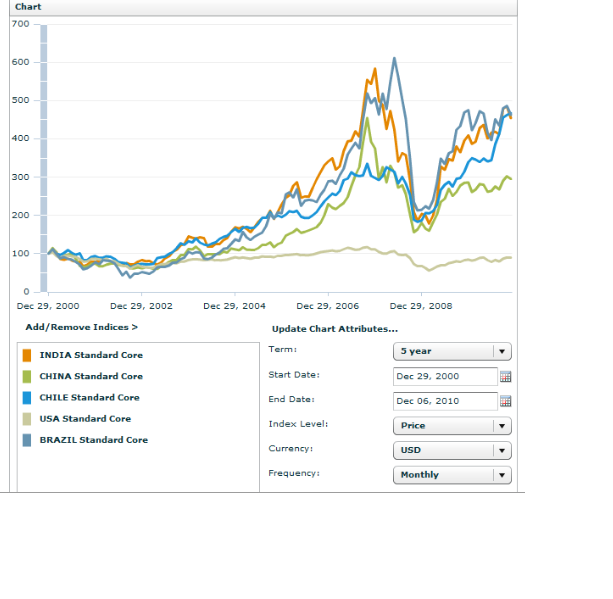
3. MSCI Index Performance – U.S. vs. Select Emerging Markets:
us-emerging-mkts.png

Source: MSCI Barra

This chart shows that the U.S. has lagged emerging markets such as Brazil, India, China and Chile in the past decade. US stocks (shown in grey line) have practically gone nowhere in this time period whereas emerging stocks have yielded incredible return to investors. Based on the returns of MSCI indices, Chile and Brazil have been better performers than China and India.

The above three charts clearly show that investors seeking higher returns have to look beyond the shores of the U.S. Hence instead of merely sticking to U.S. companies as in the past investors may want to expand their horizon and explore some of the high quality stocks elsewhere in the world.

Related ETFs:
Vanguard Emerging Markets ETF (VWO)
iShares MSCI Emerging Markets Index ETF (EEM)
iShares S&P 500 Index Fund (IVV)
iShares MSCI Canada ETF (EWC)
iShares MSCI UK ETF (EWU)
iShares MSCI Spain ETF (EWP)
iShares MSCI Germany ETF (EWG)
iShares MSCI Chile ETF (ECH)
iShares MSCI Brazil ETF (EWZ)

Disclosure: No positions
25 Foreign Stocks Paying More than 5% Dividends

Most U.S. investors have low exposure to foreign stocks. Despite the rising importance of foreign countries in the global economy, many investors have the “home-bias” problem and continue to gravitate towards American companies. While it is true that a quarter of the revenues of the S&P 500 firms come from abroad, in order to gain full exposure to foreign investors investors have to jump into foreign stocks. In addition, domestic companies in foreign countries know the local market, culture, traditions, etc. and hence have an edge over US firms. Unlike the U.S., many countries are projected to have stronger economic growth next year and in the future. Hence investors may want to review their portfolios now and change their asset allocations to better position themselves and profit from growth overseas.

There are many advantages in owing foreign stocks. One of them is high dividend payouts. Foreign companies generally pay much higher dividends than U.S. companies.One way to identify some foreign stocks is to select stocks that pay high dividends. Investors can use the following list of high dividend-paying foreign stocks as a starting point for further research. As 2010 is coming to an end this is also a good time to dump some of the losers in the portfolio and add high-quality foreign stocks.

Some foreign stocks yielding over 5% dividends as of market close December 8, 2010 are listed below:

1.Company: Telecom Argentina (TEO)
Current Dividend Yield:
Sector: Telecom
Country: Argentina

2.Company: Eni Societa per Azioni (E)
Current Dividend Yield: 6.28%
Sector: Oil & Gas
Country: Italy

3.Company: BBVA Banco Frances (BFR)
Current Dividend Yield:
Sector: Banking
Country: Argentina

4.Company:Westpac Banking Corp (WBK)
Current Dividend Yield: 6.84%
Sector: Banking
Country: Australia

5.Company: Australia And New Zealand Banking Group Ltd (ANZBY)
Current Dividend Yield: 6.21%
Sector: Banking
Country: Australia

6.Company: Petrobras Energia (PZE)
Current Dividend Yield:
Sector: Oil & Gas
Country: Argentina

7.Company: Telecom Corp Of New Zealand Ltd (NZTCY)
Current Dividend Yield: 6.51%
Sector: Telecom
Country: New Zealand

8.Company: Philippine Long Distance Telephone Co (PHI)
Current Dividend Yield: 6.45%
Sector: Telecom
Country: Philippines

9.Company: E.ON AG (EONGY)
Current Dividend Yield: 6.40%
Sector: Electric Utilities
Country: Germany

10.Company: EDP Energias de Portugal SA  (EDPFY)
Current Dividend Yield: 5.72%
Sector: Electric Utilities
Country: Portugal

11.Company: YPF SA (YPF)
Current Dividend Yield: 6.93%
Sector: Oil & Gas
Country: Argentina

12.Company: Imperial Tobacco Group PLC (ITYBY)
Current Dividend Yield: 6.46%
Sector: Tobacco
Country: UK

13.Company: Zurich Financial Services (ZFSVY)
Current Dividend Yield: 6.28%
Sector: Financial Services
Country: Switzerland

14.Company: CPFL Energia S.A (CPL)
Current Dividend Yield: 7.74%
Sector: Electric Utilities
Country: Brazil

15.Company: Total (TOT)
Current Dividend Yield: 5.96%
Sector: Oil & Gas
Country: France

16.Company: Repsol YPF (REP)
Current Dividend Yield: 5.11%
Sector: Oil & Gas
Country: Spain

17.Company: BCE Inc. (BCE)
Current Dividend Yield: 5.21%
Sector: Telecom
Country: Canada

18.Company: France Telecom SA (FTE)
Current Dividend Yield: 7.31%
Sector: Telecom
Country: France

19.Company: GlaxoSmithKline plc (GSK)
Current Dividend Yield: 5.16%
Sector: Healthcare
Country: UK

20.Company: Huaneng Power International, Inc. (HNP)
Current Dividend Yield: 5.49%
Sector: Electric Utilities
Country: China

21.Company: Companhia Siderurgica Nacional (SID)
Current Dividend Yield: 6.94%
Sector:Basic Materials
Country: Brazil

22.Company:     Telecomunicacoes de Sao Paulo SA (TSP)
Current Dividend Yield: 7.00%
Sector: Telecom
Country: Brazil

23.Company: Chunghwa Telecom Co., Ltd (CHT)
Current Dividend Yield: 5.25%
Sector: Telecom
Country: Taiwan

24.Company: RWE AG (RWEOY)
Current Dividend Yield: 7.32%
Sector: Electric Utilities
Country: Germany

25.Company: Telstra Corporation Ltd (TLSYY)
Current Dividend Yield: 9.67%
Sector: Telecom
Country: Australia

Disclosure: Long EONGY

You may also like:

14 NYSE-Listed Foreign Stocks Paying More Than 5% Dividends

11 Foreign Stocks Yielding Over 5% Dividends

12 Emerging Markets Dividend Stocks For Income

25 European Companies with High Emerging Market Exposure

Seven Foreign Stocks Paying More Than 7% Dividends

The Importance of Dividends

17 High-Yielding Foreign Stocks in the OTC Markets

12 Canadian Dividend Stocks Traded in NYSE

25 U.S. Stocks With High Emerging Market Exposure

MSCI Index Performance: Poland vs. Ireland

An article in The New York Times recently compared the economies of Poland and Ireland. From the article:

WARSAW — With its drab, Soviet-era boulevards and standard-issue glass-and-steel office buildings, Warsaw does not look much like green, elegant Dublin. But there are some striking similarities between Poland today and Ireland in the 1990s.

Like the Irish a couple of decades ago, the Poles are a hardy people battered by history but on the verge of prosperity. Foreign capital is pouring in and investment banks are opening offices, lured by resilient growth and 38.5 million people who are close to shedding the “emerging market” label.

And Poland now, like Ireland then, has its own currency. Being outside the euro zone is working to Poland’s economic advantage.

That is not the only reason Poland is currently that rare species: a financially vibrant member of the European Union. But it is to Poland’s benefit not to be bound by a common currency, at a time when euro zone countries like Ireland will have trouble using cheap exports to grow their way out of trouble.

The author noted that unlike Ireland, Poland is a much larger country with a population of about 38.5 million. The article added:

But Poland was also lucky that, in contrast to Ireland, its banking industry was still small compared with the total size of the economy, with less potential to do damage. Household debt is relatively modest. Poland also benefited from the strong economy in neighboring Germany, which accounts for a quarter of exports.

Output is expected to rise 4 percent or more in 2011, after an estimated 3.6 percent this year. Commercial real estate prices in Warsaw are rising at a 10 percent annual clip. Foreign direct investment is expected to be up 28 percent this year, drawn by the country’s status as one of the few growth stories in Europe. And hardly anybody is complaining about the influx of foreign money.

Poland has one of the most successful economies in Eastern Europe. The Warsaw Stock Exchange has the highest number IPO listings in Eastern Europe last year and it is leading this year also in raising investment capital. Last month when the Warsaw Stock Exchange listed its own shares on the exchange, shares gained 25 percent on the first day of trading.

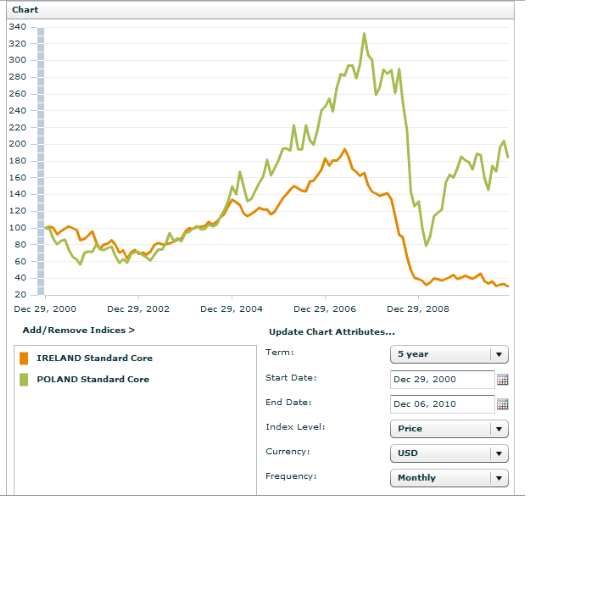
The chart below shows the comparative performance of MSCI indices for Poland and Ireland over the past 10 years:

MSCI-Poland-ireland

Source: MSCI Barra

The MSCI Ireland index attained its peak in 2007 and has since been on a downward spiral mirroring the collapse of the Irish economy. As the Polish index recovered from the March 2009 lows, the Irish index declined further after some minor uplift.The gap between the Poland and Irish indices is so wide now compared to 2003 when it was almost non-existent.Investors looking to gain some exposure to Eastern European equities may want to invest in Poland now. Unlike Ireland which will take many years to recovers the Polish economy holds lot of potential for further growth as the country fully integrates into the global marketplace.

Related ETFs:

iShares MSCI Ireland Capped Investable Market Index Fund (EIRL)
Market Vectors Poland ETF (PLND)
iShares MSCI Poland Investable Market Index Fund (EPOL)

Disclosure: No positions

Citigroup: Emerging Market Stocks to Buy and Sell

The MSCI global emerging markets fell 2.7% in November due to monetary tightening in China, tensions on the Korean peninsula and the continuing European Union fiscal crisis. Despite this pullback, Citigroup’s global emerging markets equity strategist, Geoffrey Dennis stated in a research report that it is a healthy sign of long-running bull market and that such pullbacks are typical for a bull market. According to him, none of the causes of the November decline are long-term threats to emerging markets (EM).

Dennis ran the screener to identify stocks to ride the next wave of the bull market in two categories: laggards with attractive growth rates and valuations & dividend-payers with strong balance sheets and attractive valuations. He also identified some stocks that investors can sell at current levels due to unattractive valuations and/or poor earnings outlooks.

Shares of Brazilian oil-giant Petrobras (PBR) has lagged in recent months despite the rise in crude oil prices. Petrobras had a successful record share offering of some $70 billion at the end of September which increased the total number of outstanding shares substantially.Hon Hai Precision Industry Co. Ltd. (HNHPF) of Taiwan is better known as Foxconn (FXCNY) around the world. Foxconn is a contract manufacturer of computer equipment and other electronic gear for Dell, Apple and others. Foxconn was in the news earlier this year when a few of its factory workers in China committed suicide allegedly due to job stress. Taiwan-based telecom services provider Chunghwa Telecom Co. Ltd. (CHT) has a dividend yield of over 4.0%.

Disclosure: Long PBR

Food Stocks Look Attractive for 2011 and Beyond

One of the industries that typically pays out high dividends is the food products industry. According to an October research report by Credit Suisse, three factors make dividend payments in this industry reasonably secure for the foreseeable future.

1. Sound and strong operating cash flows:  Companies in the industry generate high cash flows because of relatively high and stable EBITDA-margins, amount of profit converted into cash and cash flow return on investments.

2. High surplus cash available: Over the last few years, most companies in the industry have restructured, partially disposed businesses and substantially deleveraged their balance sheets leading to high amounts of surplus cash.

3. Lack of M&A opportunities: Credit Suisse does not see any transformational M&A activity in this sector due to anti-trust considerations. The industry is already highly concentrated globally. So despite being cash-rich companies are unlikely to spend excess cash on insensible acquisitions. However small  round-up acquisitions whereby companies buy parts of a competitor’s business are possible. Nestle recently bought Kraft’s frozen food business.

As companies in the sector have relatively low levels of debt and there is limited scope for large increases in capital expenditures, companies may consider raising their cash payouts to shareholders in the coming years. Hence investors looking to add some stable and potentially rising dividend payers may want to pick up some stocks in this sector.

Some of the U.S. and foreign food stocks are listed below with their current dividend yields:

a) U.S. Companies
1. Heinz(HNZ)
Current Dividend Yield: 3.69%

2. Kraft Foods (KFT)
Current Dividend Yield: 3.83%

3. Kellogg (K)
Current Dividend Yield: 3.27%

4. General Mills (GIS)
Current Dividend Yield: 3.15%

5. Campbell Soup (CPB)
Current Dividend Yield: 3.41%

6. The J.M. Smucker Company (SJM)
Current Dividend Yield: 2.46%

7. Sara Lee Corp.(SLE)
Current Dividend Yield: 3.02%

b) Foreign Companies:
1. Danone (DANOY)
Current Dividend Yield: 2.38%

2. Nestle (NSRGY)
Current Dividend Yield: 2.43%

3. Unilever plc (UL)
Current Dividend Yield: 3.97%

4. Unilever NV (UN)
Current Dividend Yield: 3.89%

Disclosure: Long GIS