Knowledge is Power: Germany, Income Funds, Metal Stocks Edition

Chinese I.P.O. Frenzy Raises Talk of a Bubble

Iceland’s recovery makes case for allowing banks to fail

UK: Top ten funds for income investors

‘Before you uncork the champagne,’ here’s Rosenberg’s predictions

Why the big move from bonds to stocks is just getting started

Why Germany Needs Europe

Three top 2010 sectors to own in 2011

Inequality

Share buy-backs highlight low corporate confidence

Buy-and-hold: the ‘boring’ way to healthy profits

Emerging Markets Focus: Latin America

10 metal stocks likely to outperform in a rally

srilanks-elephants.jpg

Elephants in Sri Lanka

Some Tech Stocks Are Dead Money

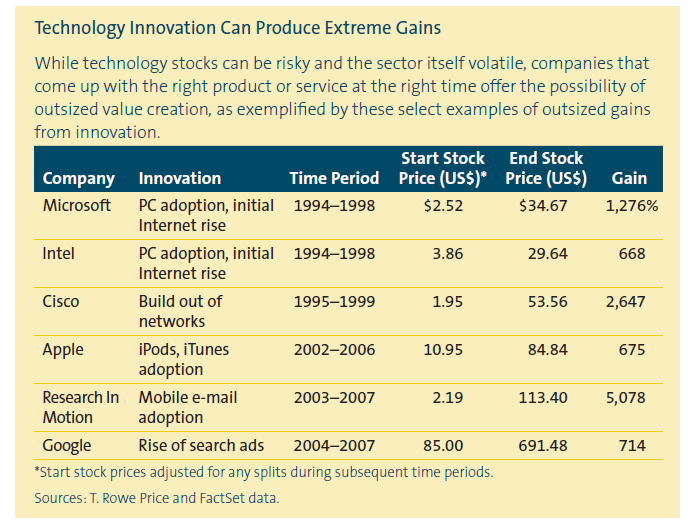
During the 1990s investing in tech stocks was fashionable and extremely profitable as the dot-com boom was in full swing. Though most tech stocks did not pay any dividends, investors bet on them for their growth prospects.That strategy worked out well until the party ended.

The following graphic shows how six tech stocks produced phenomenal returns during each company’s exponential growth periods:

Click to enlarge

tech-stocks.png

Source: T.Rowe Price

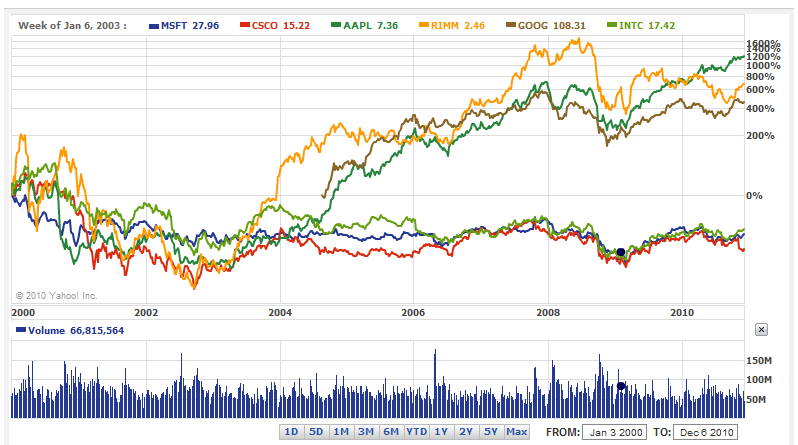
The chart below shows the performance of the same tech stocks from 2000 when the dot-com bubble burst:

tech-stocks-compare.png

Note: Google went public in August 2004

Among the six stocks shown Apple is the best performer. However Apple(AAPL) is an exceptionally unique firm noted for its world-class innovation and marketing capabilities. The T.Rowe Price report noted the following observation on Apple:

Despite its stock gains the last five years, Apple’s decades-long record of inventing novel consumer products didn’t always pay off. As recently as 2004, for example, its stock price languished below its price in 2000.

Canada-based Research in Motion (RIMM) has had its strong growth period in the past and is now facing tough competition from other players in the market. Internet giant Google (GOOG) continues to be the undisputed king of the search engine world.

Shares of former tech darlings Intel (INTC), Cisco Systems (CSCO) and Microsoft (MSFT) have gone nowhere since 2000. Money invested in these stocks have been dead money for many years now and may probably remain so for the foreseeable future. Since their golden years, these firms have not yet invented a ground-breaking product that consumers want.Hence they have become more of slumbering giants in the technology industry primarily existing on their past successes.

With about $40.0 billion Cisco Systems holds the largest amount of cash among tech companies. In September the company announced that it will start paying a dividend yielding between 1% and 2% in the current fiscal year which ends in July 2011. Microsoft (MSFT) and Intel(INTC) hold about $37.0 billion and  $18.0 billion in cash respectively. It must be noted that Microsoft and Intel already pay a small dividend to their shareholders.

Disclosure: No positions

Canadian Banks Are Worse Than U.S. Banks Based On Borrower Concentration Ratio

In an article earlier this year, I wrote that Canadian banks’ equity is the third worst in the world based on assets to equity ratio quoting a McKinsey Global Institute study.

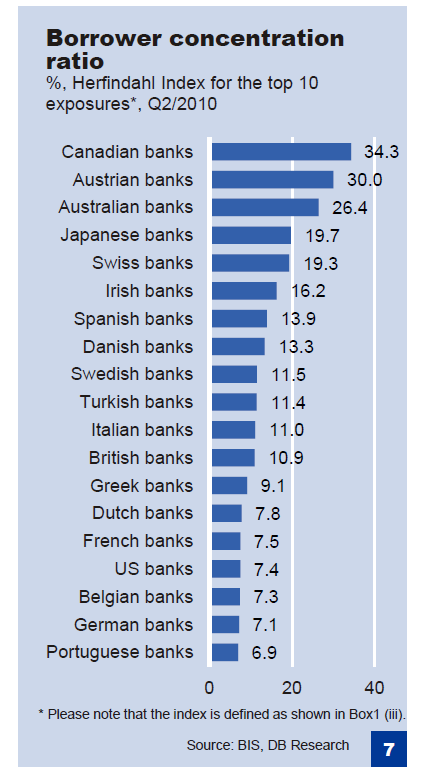
A new research report by Deutsche Bank Research shows that Canadian banks are in worse shape compared to other developed markets’ banks based on the Borrower Concentration ratio.This ratio measures the diversification of banks’ foreign exposure across other countries. Put another way, this measure identifies those countries that have concentrated their lending on specific regions or countries. Usually countries tend to have high exposures to neighboring countries.The Borrower Concentration ratio is calculated using the Herfindahl Index, which measures the concentration of a country’s top ten borrowers. This index is a valuable tool to analyze banks’ vulnerability for first-round contagion effects. For a banking sector that is highly exposed to a single country or very few foreign countries, contagion risk may be stronger than for a country whose banking sector is well diversified in its overseas lending exposure.

The graphic below shows the Borrower Concentration Ratios of developed countries:

Banks-Borrower-Concentration-Ratios

Source: Monitoring cross-border exposure, Deutsche Bank Research

Canada tops the list due its heavy exposure to the U.S. Compared to Canada, U.S. is in much better position since U.S. banks have well diversified foreign lending exposures. Unlike Canadian banks, U.S. banks have not concentrated solely on a specific country or a region. Austria and Australia take the second and third spots since Austria lends heavily to Germany and Czech Republic while Australia lends to New Zealand. Canadian banks have large exposures to US due to many factors such as limited growth opportunities in the domestic market, strict regulations preventing domestic mergers, trade between the countries, geographical proximity, cultural similarities, etc.

Among the big five Canadian banks, Toronto-Dominion Bank (TD) has the largest presence in the US market. With the acquisition of Cherry Hill (N.J.)-based Commerce Bancorp in March 2008, TD now has more branches in the US than in Canada. The bank has about 1,300 branches in 16 states from Maine to Florida where 24,000 employees provide excellent customer service. In the most recent quarter, profits from US operations amounted to about a quarter of the bank’s profits of C$1.18 billion.

Domestic competitors Royal Bank of Canada (RY) and Bank of Montreal (BMO)have not had success so far in their US ventures like TD. Royal Bank has not earned a profit in its international division which includes operations in North Carolina and Alabama. Bank of Montreal owns the Chicago-based Harris bank. BMO’s profit from its U.S. unit accounted for just 6% of net income in the last quarter.

Disclosure: Long TD, BMO & RY

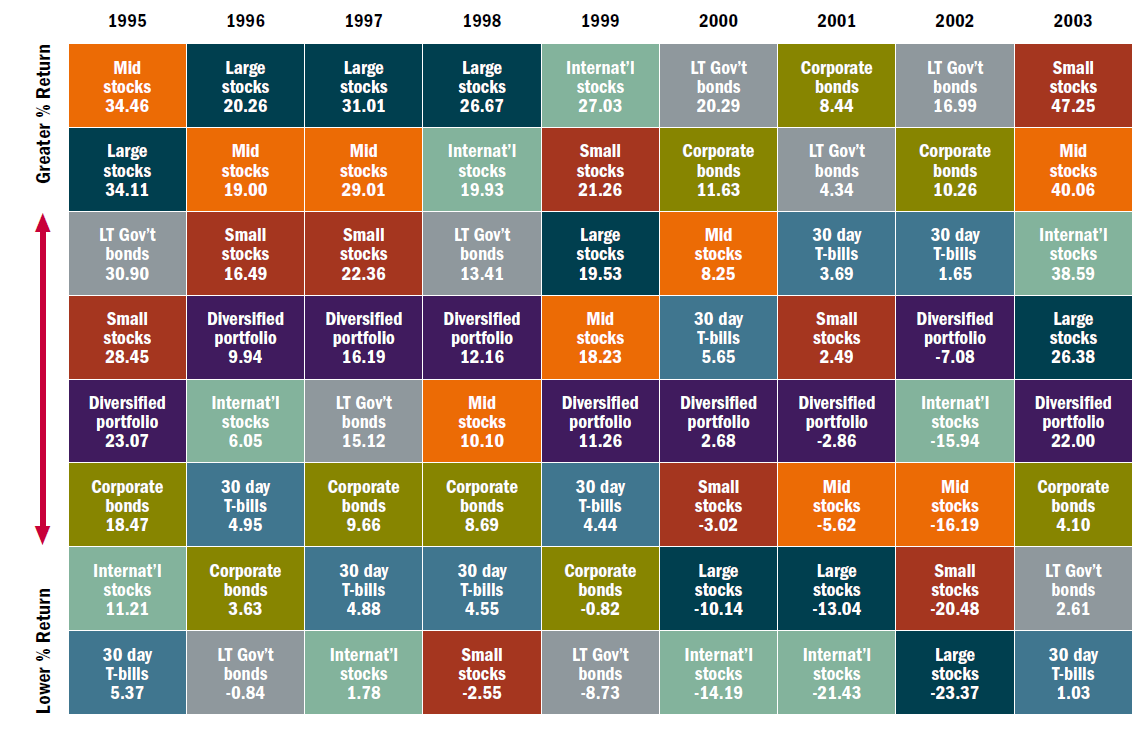
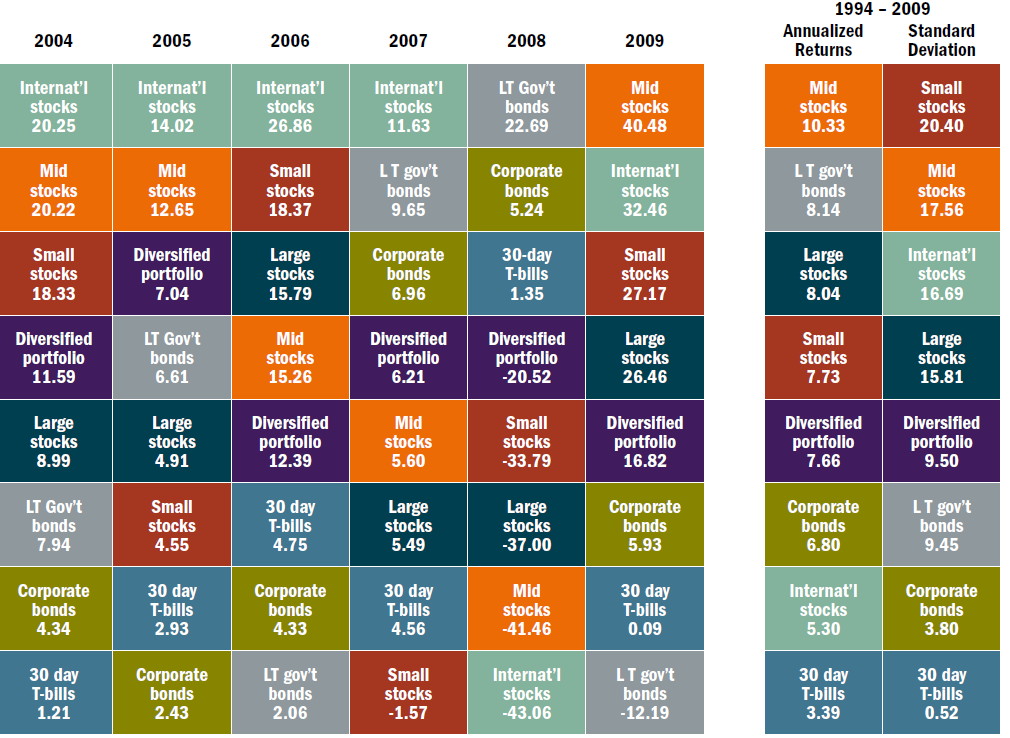
Chart: Asset Class Returns from 1995 to 2009

The charts below the returns on different types of asset classes from 1995 thru 2009:

callan-asset-class-returns-chart-1.png

callan-asset-class-returns-chart-2.png

Some takeaways from the charts:

  • For four years since 2004 foreign stocks were the best performers.
  • In the 2008 credit crisis foreign stocks were the worst performers with a loss of about 43%.
  • Last year they yielded the second best returns after US mid-cap stocks.
  • Since 2003 international stocks have yielded double-digit returns each year except 2008.

The Top 5 Banks of Chile

The top five banks of Chile based on assets held at the end of 2009 are noted below in descending order:

1. Banco Santander Chile (SAN)
Current Dividend Yield: 2.91%

2. Banco de Chile (BCH)
Current Dividend Yield: 4.53%

3. BCI
BCI does not trade on the U.S. markets.

4. BBVA – Chile
BBVA-Chile does not trade on the U.S. markets.

5. CorpBanca (BCA)
Current Dividend Yield: 3.93%

Note: Dividend yield is as of Dec 10, 2010

Chile has been one of the best performing markets this year primarily due to rising commodity prices especially copper and also fluctuations of the peso against the dollar. As of December 9, 2010 Chile is up over 35.0% compared to about 10% for the S&P 500.

Among the three Chilean bank ADRs listed above, CorpBanca has been the best performer in terms of returns over the last five years. A $10K in BCA 5 years ago would have been worth about $42,000 with dividends reinvested as of this month. All the three banks have had strong runs this year and are now trading near their 52-week highs. Hence from an investment standpoint it is better to wait for some pullbacks and add new positions in small increments.

Disclosure: Long BCH