14 NYSE-Listed Foreign Stocks Paying More Than 5% Dividends

The table below lists large-cap foreign stocks trading on the NYSE that have dividend yields of over 5% as of January 6, 2011:

[TABLE=870]

Some observations:

  • Not surprisingly, the majority of the stocks in this list are in the utility sector with Telefonica(TEF) of Spain paying about 8% in dividends.
  • Bell Canada Enterprises(BCE) is the largest telecom services provider in Canada.
  • Brazil’s biggest private utility recently reported 3Q profits rose 34% relative to the same quarter last year on increased sales.
  • UK-based pharmaceutical company GlaxoSmithKline plc (GSK) is the owner of many well-known brands such as Levitra, Avandia , Valtrex , Advair, etc. in the drugs category and consumer healthcare products such as Aquafresh, Nicorette, Tums, Breathe Right, etc.Originally founded in 1715, the company operates globally with a strong presence in emerging markets. For example, in 2009 GlaxoSmithKline shipped 1.9 billion vaccine doses globally out of which about 1 billion were shipped to emerging countries.

Disclosure: Long SAN
Impact of Tax Rate Changes on Capital Gains Realizations

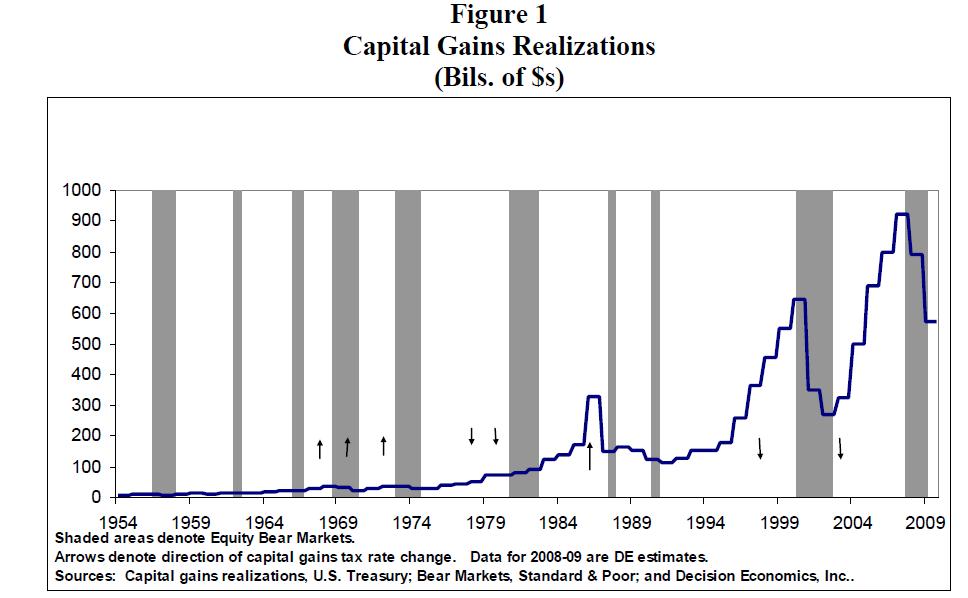
The chart below shows the history of capital gains realizations since 1954:

Click to enlarge

tax-rate-change-impact-capital-gains-realized.jpg

Capital gains realizations significantly move up-or-down depending on bull or bear markets. They also rise or decline significantly after changes in capital gains tax rates.Strong rises or declines in capital gains realizations have often occurred not long after the tax rate has been changed.

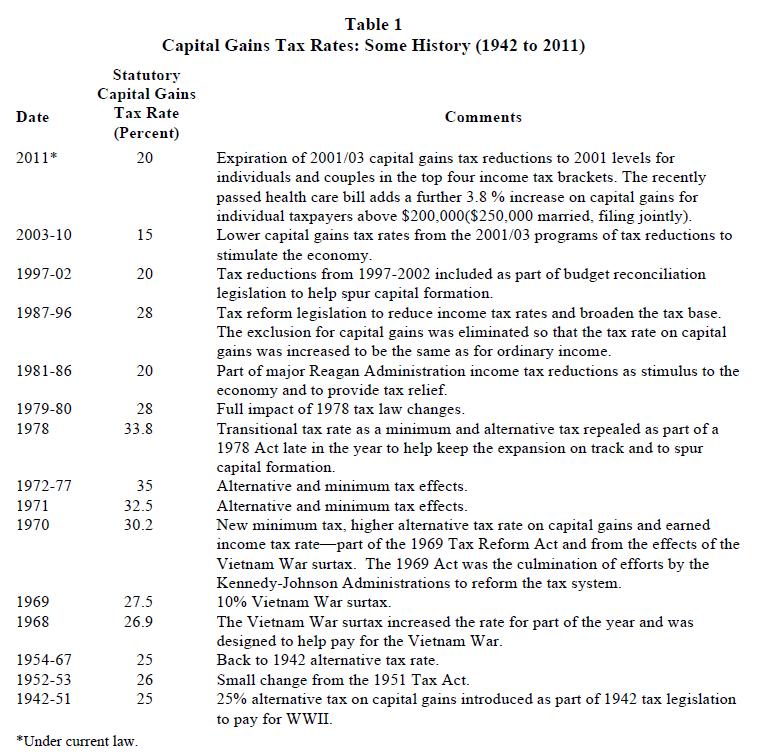
The table below shows the history of changes in US statutory capital gains taxes from 1942 to 2011. The statutory tax rate has varied between 15% and 45% during the period.

Click to enlarge

US-Capital-Gains-Taxes-Historical

Source: Capital Gains Taxes and the Economy, ACCF

According to a research paper titled “Capital Gains Taxes and the Economy” prepared by Decision Economics, Inc for the American Council for Capital Formation: Center for Policy Research:

Reducing the capital gains tax rate to 0% increases growth in real GDP by a little over 0.23 percentage points per year. Jobs increase by an average of 1,322,000 per annum.The unemployment rate drops 0.7 percent at its lowest point. And, productivity growth improves 0.5 percentage points a year.(emphasis added)

11 Foreign Stocks Yielding Over 5% Dividends

Some foreign large-cap companies trade on the OTC market instead of the organized exchanges. Investors can find well-established companies paying high dividends on these markets. Though trading volumes may be thin, for the average buy-and-hold long-term investor this should not be an issue.

To identify some of the high-yielding large cap foreign stocks, I ran the screener with the following criteria:

1. Stocks must trade on the OTC market
2. Market cap must be >= $5B
3. Dividend yield must be at least 5%

The screener returned the following 11 stocks:

[TABLE=867]

European companies dominate the above list. German electric utilities E.ON (EONGY) and RWE AG (RWEOY) are two of the largest utilities in Germany and have yields in excess of 6%. After reaching a peak of over $70, EONGY fell under $25 and now trades just below $30. Similarly RWEOY trades at less than half the price of its peak of over $140. Both these companies have operations in several other European countries as well. In the U.S., E.ON has operations in the state of Kentucky.

Despite the ongoing debt issues faced by Portgual and the risks involved in investing in the country, Energias de Portugal, S.A(EDPFY) is one of the few Portuguese companies that investors can consider adding now since it is an electric utility and offers an excellent yield.

Australian banking giants Australia and New Zealand Banking (ANZBY) and National Australia Bank Ltd. (NABZY) were not heavily affected by the credit crisis and are growing in the domestic market and abroad. Australia’s increased trade with other Asian countries is helping them also.

Advanced Info Service PCL (ADVFY)  is the largest mobile phone services operator in Thailand in terms of subscribers and revenues. The company maintains market leadership in both urban and rural areas. AIS has a low debt profile and a strong dividend payment history. AIS aims to pay at least 100%  of net profits as dividends.Like most European firms, AIS pays an interim and a final dividend each year. The ADR for Advanced Info Service has been trading on the OTC market since 1992 under the ticker ADVFY.

Disclosure: Long E.ON AG

Top 10 Foreign and U.S. Companies by Market Cap on the NYSE

The table below lists the top 10 foreign companies by market cap trading on the New York Stock Exchange:

[TABLE=865]

Some observations:

  • 8 of out of the 10 companies are in the natural resources sector. This shows the growing importance of the commodity sector.
  • The only foreign banking group in this list is the UK-based HSBC Holdings (HBC).
  • Despite talks of going under (or) taken over after the gulf oil spill disaster last year, BP plc (BP) not only survived intact but now has a market cap of $144.0 billion.

The table below lists the top 10 foreign companies by market cap trading on the New York Stock Exchange:

[TABLE=866]

Some observations:

  • US oil giant Exxon Mobil (XOM) has the largest market cap on the NYSE.
  • Telecom services provider AT&T (T) pays a high dividend of 5.76%.
  • The only bank in this list is JPMorgan Chase(JPM). JPM has a low dividend yield of just 0.45%.
  • Among the many drug makers, Johnson & Johnson(JNJ) is a long-time highly valued company.

Note: Hi-tech firm Apple(AAPL) has a market of $306 billion, next only to Exxon Mobil but is not in the list above since Apple trades on the NASDAQ.

Disclosure: No Positions

What Can We Learn From the 2010 Performance of Global Stock Markets

The following are some of the key takeaways from a review of the 2010 performance of equity markets around the world:

1. Stock markets can rise despite low or poor economic growth. The U.S. market was a perfect example of this scenario. While the US economy continued to struggle last year with high unemployment rates, slowing demand, more bank failures and other negative events, corporate profits rose and equities took off ending the year with double-digit returns for the S&P 500.

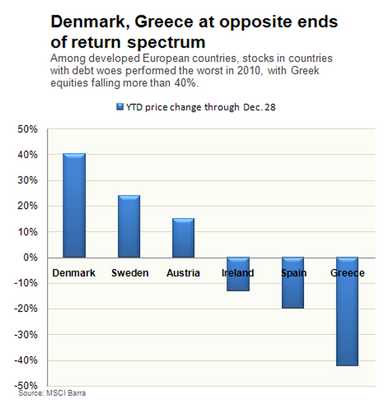
2. Equity markets of countries with low or no debt woes performed well when compared to countries with significant debt problems as confirmed by the chart below:

best-worst-performers.png

Source:Pensions & Investments

3. Despite the constant focus towards all things China, Chinese stocks actually ended the year in the red. The Shanghai Composite Index fell 14% for the year while other emerging markets like India and Russia were up by double digits. So investors have to be cautious investing in red-hot destinations like China even though on the surface all analysis provided a convincing story.

4. While the Japanese economy is one of the biggest in the world and the country is home to many world-class companies, any investments in the equity market there is not a wise strategy.  Japanese stocks have gained no traction since the collapse from their peaks attained many years ago.

5. Among the BRIC countries, Brazil was the second worst performer after China with a return of just 1% on the Bovespa Index.

6. All the PIIGS countries yielded negative returns for the year.

7. Small countries with medium-size markets such as Chile, Argentina, Philippines, Colombia, Malaysia, etc. produced higher returns than countries like India and China.