Why Invest in Dividend-Paying Stocks

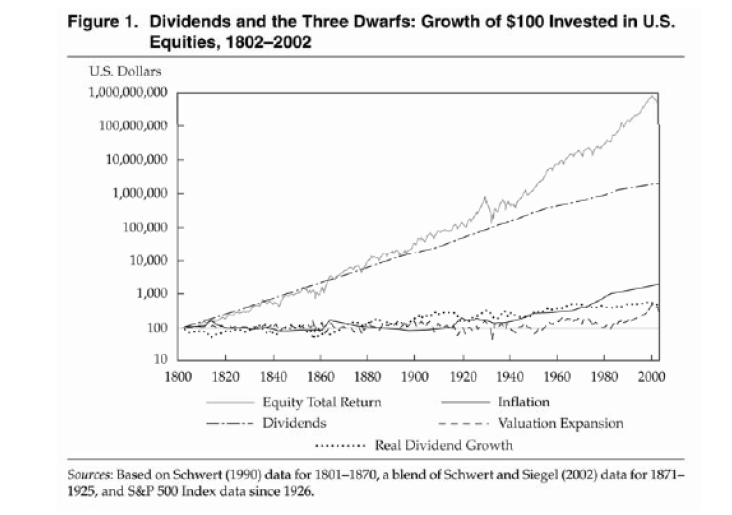
There are many reasons to invest in dividend-paying stocks.One of reasons is dividends form the largest portion of the total return on an investment. This is especially true when stocks are held for the long-term. The following chart shows that “the contribution to total return for each of the components of equity returns for the period 1802 to 2002. The total annualized return for the period of 7.9% consisted of a 5% return from dividends, a 1.4% return from inflation, a 0.6% return from rising valuation levels, and a 0.8% return from real growth in dividends.”

Click to enlarge
Dividends-Total-Return-Long-Term

Which sectors have the highest dividend yields?
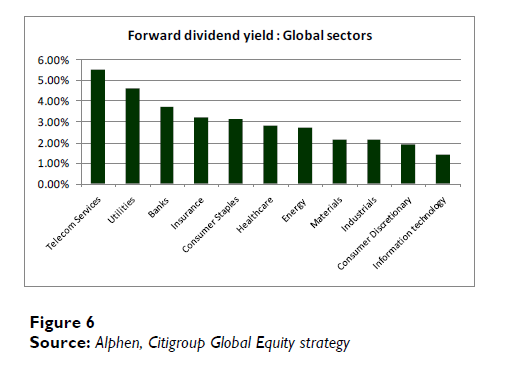
div-yield-by-sector.png

Source: Alphen Angle,  PSG Alphen Asset Manangement

Ten dividend-paying high quality stocks to consider are listed below:

1.Company: Westpac Banking Corp (WBK)
Current Dividend Yield: 6.07%
Sector: Banking
Country: Australia

2.Company: Royal Bank Of Canada (RY)
Current Dividend Yield: 3.48%
Sector: Banking
Country: Canada

3.Company:National Grid PLC (NGG)
Current Dividend Yield: 4.41%
Sector: Electric Utilities
Country: UK

4.Company: Nextera Energy Inc (NEE)
Current Dividend Yield: 4.02%
Sector: Electric Utilities
Country: USA

5.Company: Telecom Italia SpA (TI)
Current Dividend Yield: 4.06
Sector: Telecom
Country: Italy

6.Company: Banco Santander Chile (SAN)
Current Dividend Yield: Banking
Sector: 3.25%
Country: Chile

7.Company: Telefonica SA (TEF)
Current Dividend Yield: 7.17%
Sector: Telecom
Country:Spain

8.Company: RWE AG (RWEOY)
Current Dividend Yield: 6.89%
Sector: Electric Utilities
Country: Germany

9.Company: CPFL Energia SA (CPL)
Current Dividend Yield: 7.28%
Sector: Electric Utilities
Country: Brazil

10.Company: Gdf Suez SA (GDFZY)
Current Dividend Yield: 5.53%
Sector: Gas Utilities
Country: France

Note: Dividend yield noted is as of market close Feb 25, 2011

Disclosure: Long NEE, RY, GDFZY
Economic Growth Does Not Always Lead to Higher Stock Returns

Some investors believe that economic growth always leads to higher stock market returns. However this is not always the case. A recent report in The Wall Street Journal by Peter Stein confirms this point again quoting research by Nomura and Professor Jay R.Ritter of the University of Florida.

From the report titled “Growth Doesn’t Always Boost Stocks“:

Investors buying stocks in China should be able to rack up gains comparable to growth in the broader economy. Right?

Wrong. Between 1993 and 2010, China’s gross domestic product expanded by an inflation-adjusted compounded annualized rate of 9.5%, while the real return on its domestic stocks clocked in at a far more modest 2.2%, according to a report by Nomura Holdings Ltd., even taking into account blowout years like 2009, when the Shanghai Composite index surged 80%.

So far, 2011 hasn’t been a great year for investors betting on growth in world’s fastest-growing economies. The Standard & Poor’s 500-stock index, for example, has outperformed the MSCI Asia Pacific Ex-Japan index by nearly eight percentage points since the end of last year, and 12 percentage points since the beginning of October.

Yes, that is likely a short-term phenomenon. Research suggests, though, that long-term, revved-up GDP growth doesn’t translate into outsize gains in a country’s stocks.

Many of the emerging markets such as India, Brazil, China, etc. are lagging in terms of equity market performance so far this year relative to continuing economic growth. So investors have to take into factors other than just economic growth in evaluating countries for investment opportunities.

Tech Stocks Rally May Continue

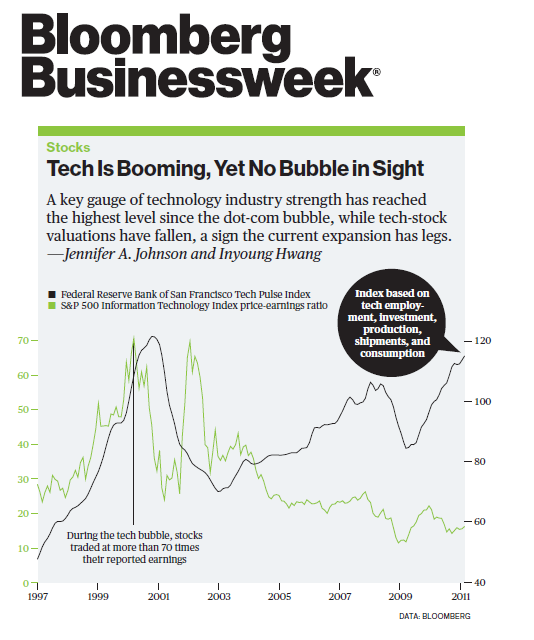
Tech stocks have rallied strongly so far this year mirroring the broader U.S. market. While the S&P 500 is up 5.29% YTD, the technology sector in the index is up 5.89%. After the energy sector, the tech sector is the best performing sector YTD. Unlike financials and others, the tech industry has continues to rebound since the credit crisis. Strong demand for their products and services in emerging markets drives the earnings of technology companies despite slumping demand in the domestic and other developed markets.While most investors abandoned this sector after the dot-com bubble, in the current environment adding a few technology stocks to one’s portfolio is a wise strategy. Based one measure quoted by Bloomberg BusinessWeek the current tech rally has legs.

tech-no-bubble.png

Some of the large-cap technology stocks to consider are:

  1. Intel Corp (INTC)
  2. Microsoft Corp (MSFT)
  3. Cisco Systems (CSCO)
  4. Apple Inc (AAPL)
  5. International Business Machines Corp. (IBM)
  6. Oracle (ORCL)
  7. Google (GOOG)
  8. Dell Inc (DELL)
  9. Nvidia Corp (NVDA)
  10. Applied Materials (AMAT)

Disclosure: No Positions

Poland: Europe’s Exciting Investment Destination

Poland is one of the top performing markets among the emerging markets in Europe. Since the March-lows of 2009, the WIG index, the main index on the Warsaw Stock Exchange, has soared to close at 46,874 on Friday. The all-time high is about 67,500 which was reached in mid 2007.

Poland has a highly-skilled and educated workforce. The country is host to some of the major German and other European manufacturing firms. In fact, European powerhouse Germany is the largest trading partner of Poland. In addition to the manufacturing sector,  Poland has a competitive edge in the service sector too. Proximity to the EU, a strong domestic consumer market, cheap labor are some of the major attractions for foreign firms investing in the country. In some sectors, Poland is a better alternative to India and China.

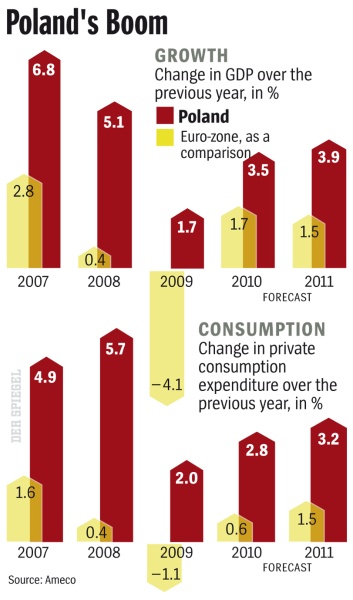
The Polish economy is projected to grow by more than double that of the estimated forecast GDP for Euro-zone this year according to a recent report in the Der Speigel. From the article:

poland-economy.jpg

The country has benefited from its accession to the European Union and globalization more than almost any other. Twenty years ago, the deeply Catholic country was largely agricultural and considered backward and provincial, a millstone around Europe’s neck. Since then, however, Poland has experienced an almost nonstop boom.

Even when the rest of Europe was suffering through a recession in 2009, Poland’s economy grew by 1.7 percent. Thanks to its accession to the EU in 2004, unemployment fell from more than 20 percent to about 8 percent today.

The boom has been most evident in the cities. Warsaw and Poznan, for example, have full employment. According to surveys, Poles are among Europe’s most optimistic people. They have never had it as good as they do today.

Warsaw is also at peace with itself politically. Prime Minister Donald Tusk runs the government with a stabile majority, while nationalist extremists on the left and right are no longer represented in Poland’s parliament, the Sejm. Poland is now on excellent terms with Berlin and has toned down its rhetoric toward Moscow; the country is also no longer seen as an unpredictable obstructionist in Brussels. Almost a quarter century after the collapse of the Soviet bloc, the country of 38 million has become a respected regional power.

How to invest in Poland?

None of the Polish firms are listed on the organized exchanges in the U.S. The majority of the Polish ADRs that trade on the OTC markets are unsponsored. Hence a simple way to gain exposure to the Poland for US-based investors is via the Market Vectors Poland ETF (PLND). This ETF has a small asset base of about $64.0 million. More than half of the fund’s assets are in the top 10 holdings. Financials account for 40% of the portfolio.

Libya and Oil

Crude oil prices rallied today reaching $100 a barrel in New York before settling the day for April delivery at $98.10. Oil prices have steadily increased since the political turmoil in the Middle East started a few weeks ago. “Oil prices may surge to $220 a barrel if political unrest in North Africa halts exports from Libya and Algeria.” according to Nomura Holdings quoted by Bloomberg. As Libya’s regime fights to quash the rebellion, oil prices may continue to rise further.Though media reports talk of oil exports disruption in Algeria, it seems unlikely. The Algerian government has not only banned protests but has also reduced the prices of essential food items.

The following are some interesting facts about the oil industry of Libya:

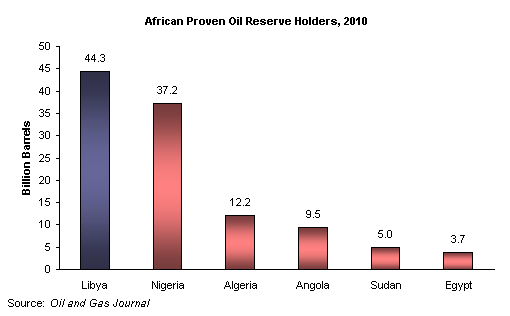
  • Libya has the largest proven oil reserves in Africa followed by Nigeria and Algeria.

2010-african-oil-reserves.gif

  • Despite the huge reserves Libya oil production has been on the decline since the 1960s.
  • In 2009, crude oil production was 1.65 million barrels per day.
  • Libya is a net exporter of oil with the vast majority of exports going to Italy, Germany, France and Spain.
  • Some of the major foreign oil firms involved in the Libyan oil industry are: Eni (E), StatoilHydro (STO), Occidental (OXY), OMV (OMVKY), Repsol (REP), Wintershall, ConocoPhillips (COP), Hess (HES), Marathon (MRO), Shell (RDS.A, RDS.B), BP (BP) and ExxonMobil (XOM).

Source: U.S. EIA , FT

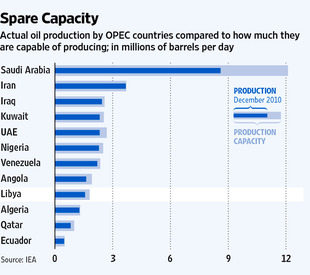
Comparison of production capacity to actual daily oil production by OPEC countries:

opec-spare-capacity.jpg

Source: The Wall Street Journal

Update: Why the Disruption of Libyan Oil Has Led to a Price Spike

Libya produces less than 2 percent of the world’s oil and exports little to the United States. But the quality of its reserves magnifies its importance, causing a spike in both American and European oil price benchmarks despite assurances from Saudi Arabia that it was ready to pump more oil to calm markets.

In New York West Texas Intermediate Benchmark crude for April delivery briefly touched $100 on Tuesday for the first time in more than two years, before easing moderately. In London, Brent crude for April delivery rose $5.47 to $111.25 a barrel.

Libya’s sweet crude cannot be easily replaced for the production of gasoline, diesel and jet fuel, particularly by the many European and Asian refineries that are not equipped to refine heavier grades of oil. Saudi Arabia may have more than 4 million barrels of spare capacity, but it includes heavier grades of crude that are higher in sulfur content and more expensive to refine.

“Quality matters more than quantity,” Larry Goldstein, a director of the Energy Policy Research Foundation, an organization partly financed by the oil industry.

Source: The New York Times