Latin America’s Long-Term Growth Remains Intact

Before the credit crisis struck Latin American markets were the hottest destination for foreign investors. However in recent months Latin American countries such as Brazil, Argentina, Mexico, etc. have been lagging other emerging markets in terms of equity market performance. The economies of Latin American countries were relatively unscathed by the recent financial crisis and rebounded strongly from the depth of the crisis as shown in the graphic below:
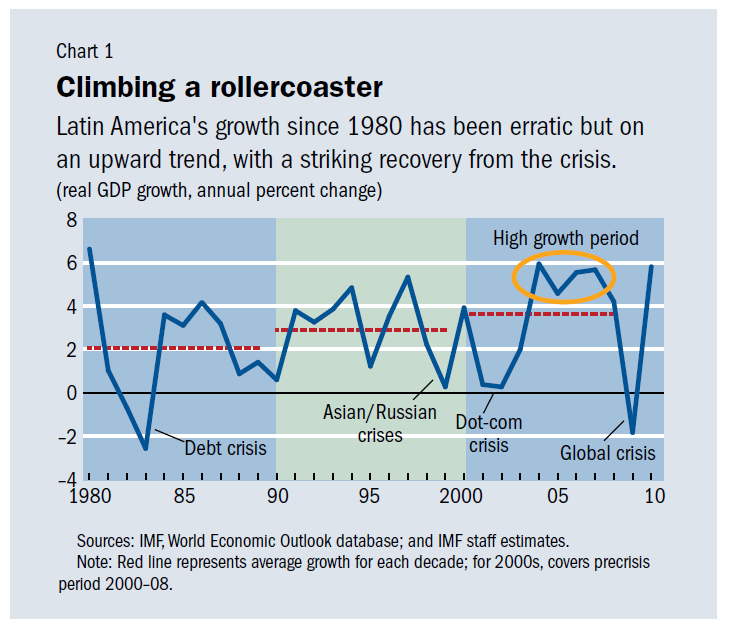
latam-econ-growth.png

Source: Finance & Development, March 2011, IMF

In the past, Latin America has gone thru many boom and busts. But overall the economic growth remains intact and is heading in the right direction. In recent years, the soaring global demand for commodities and low interest rates worldwide have tremendously helped the export-driven countries such as Brazil. As a result of the growing exports and rising domestic consumer market, the long-term potential for the region’s economic success is promising. Some of the reasons for this optimism include improved government finances, reduced external debt, higher international reserves and strengthened financial regulation in the past few years. In addition, income distribution has improved and poverty rates have fallen across the region leading to the creation of millions of new middle-class consumers.

Ten stock picks to profit from Latin America’s surging growth:

1.Company: Ecopetrol (EC)
Current Dividend Yield: 2.90%
Sector: Oil
Country: Colombia

2.Company: Vale SA (VALE)
Current Dividend Yield: N/A
Sector: Mining
Country: Brazil

3.Company: Itau Unibanco (ITUB)
Current Dividend Yield: 0.40%
Sector: Banking
Country: Brazil

4.Company: Pampa Anergia (PAM)
Current Dividend Yield: 0.53%
Sector: Electric Utility
Country: Argentina

5.Company: Enersis (ENI)
Current Dividend Yield: 14.18%
Sector: Electric Utility
Country: Chile

6.Company: Compania de Minas Buenaventura (BVN)
Current Dividend Yield: 0.74%
Sector: Mining
Country: Peru

7.Company: Coca-Cola Femsa (KOF)
Current Dividend Yield: 1.48%
Sector: Beverages
Country: Mexico

8.Company: Banco Santander Chile (SAN)
Current Dividend Yield: 3.40%
Sector: Banking
Country: Chile

9.Company: Creditcorp (BAP)
Current Dividend Yield: 1.82%
Sector: Banking
Country: Peru

10.Company: Gafisa (GFA)
Current Dividend Yield: N/A
Sector: Household Goods and Home Construction
Country: Brazil

Disclosure: Long ITUB
Is the U.S. Corporate Tax System A Major Barrier to Economic Growth?

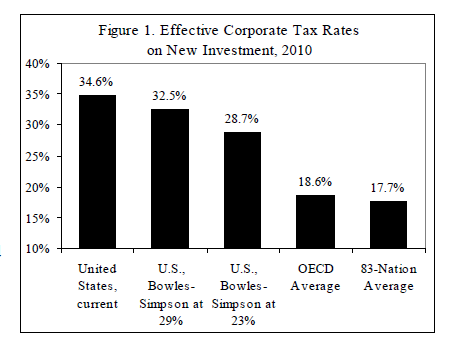
The U.S. has one of the highest corporate tax rates in the world. Only Brazil, Uzbekistan, Chad and Argentina have higher corporate tax rates than the U.S. According to a research study by the Cato Institute, the effective U.S. corporate tax on new investment was 34.6% in 2010. This was higher than the average OECD rate of 18.6% and the average rate for 83 countries at 17.7% as shown in the chart below:

US-OECD-Effective-Corp-tax-Rate

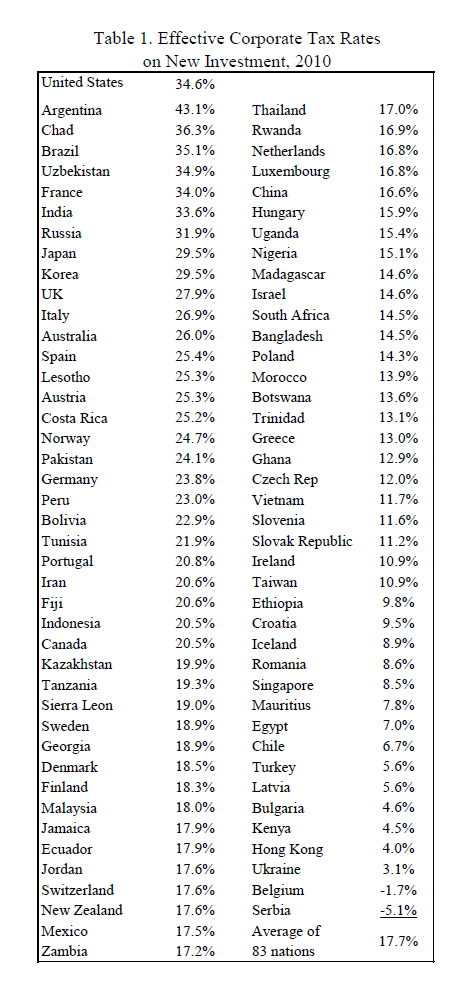
The table below lists the corporate tax rates on new investments by country:

Corporate-tax-Rates-by-Country-2010

From the research report:

Many industrial and emerging countries have reduced their corporate tax rates over the last decade or so. The largest rate cuts were in Austria, Bulgaria, Canada, the Czech Republic, Germany, Greece, Iceland, Ireland, Italy, Netherlands, Poland, Slovakia, Turkey, Egypt, Georgia,Kazakhstan, Lesotho, Mauritius, and Singapore. America’s largest trading partner, Canada, cut its statutory corporate rate from 43 percent to 29 percent, which helped to bring down its effective rate from 44 percent to 21 percent,  according to our calculations. Substantial cuts were also achieved in Australia, Belgium, China, Denmark, Finland, Korea, Luxembourg, Mexico, New Zealand, Taiwan, and the United Kingdom. Taiwan cut its statutory rate from 25 percent to 17 percent in 2010, and now has an effective rate of just 10.9 percent.

The authors of the report propose that the current U.S. corporate tax rate must be reduced by at least 10% or even higher in order to be in-line with the OECD average. New academic study suggests that reducing corporate tax rates in high-rate countries will not cause significant revenue losses. In addition, lower tax rates will encourage U.S. companies to repatriate their profits stashed abroad and subsequently will lead to higher tax revenue collection for the government and stimulate more investment.

In conclusion, the authors suggest that the goal of tax reforms should be to make the U.S. corporate tax rate competitive relative to other countries. Hence a sharp reduction in the federal corporate tax rate of 10% of more would generate higher economic growth and ultimately more jobs and income.

Source: New Estimates of Effective Corporate Tax Rates on Business Investment, by Duanjie Chen and Jack Mintz, School of Public Policy, University of Calgary 

22 Foreign Companies With High Exposure To The U.S. Market

Last December I wrote an article on U.S. companies with high exposure to emerging markets. In this post lets take a look at foreign firms that have high exposure to the U.S. market.Despite sluggish economic growth, the U.S. remains the world’s largest consumer market and is the world’s top destination for foreign direct investment (FDI). Hence hundreds of foreign firms have operations in the U.S. to take advantage of this huge market. This process of foreign companies investing in the U.S. and creating jobs is called “Insourcing”.

During the last decade, FDI in the United States jumped by 82% from $179 billion to over $325 billion – resulting in the insourcing of 5.3 million American jobs, or 4.6% of the U.S. workforce.While most U.S. companies offshore work chasing the cheapest labor available on the planet even if the quality is poor, it is commendable that some foreign firms actually have confidence in the ability of the high-quality U.S. workforce. The U.S unemployment rate will also be higher if these overseas firms do not invest and create high-paying jobs in the country.

Some interesting facts about the contribution of insourcing companies to the U.S. economy:

Write $364.2 billion in paychecks – the average compensation per American worker at Insourcing companies is $68,317, which is 32% higher than compensation at all U.S. companies.

Re-invest profits earned in the U.S. back into American operations – Insourcing companies reinvested $68.5 billion of their U.S. profits back into their American operations.

Purchase from local suppliers and small businesses – Insourcing companies bought $1.5 trillion in intermediate inputs from U.S. suppliers, amounting to 76.8 cents for every dollar spent of their total input purchases of $1.96 trillion.

Conduct American-based Research & Development – Insourcing companies spent $34.3 billion in the United States on R&D – over 13.8% of all private-sector R&D.

Manufacture in America to export to the world – Thirty percent of American jobs at Insourcing companies are in manufacturing and products made by U.S. workers at these companies account for nearly 19%, or $195.3 billion, of all U.S. exports.

Make long-term and strategic investments in the U.S. – many Insourcing companies have been in the United States for decades; some have been here for almost a century, demonstrating their commitment to and confidence in the American workforce.

Pay U.S. taxes – Insourcing companies paid a record $50 billion in U.S. corporate taxes, over 14% of U.S. corporate taxes.

The following is a brief overview of the insourcing firms:

1. Alstom: France-based global transportation infrastructure and energy leader has operations in nearly all 50 states and employees about 6,000 American workers. Alstom trades as an unsponsored ADR with the ticker ALSMY.

2. EADS North America:  The U.S. operations of Netherlands-based global aerospace and defense giant EADS(EADSY), supports more than 200,000 high-paying American jobs coast to coast. As the largest international customer or U.S. aerospace exports, the company is committed to making America stronger and safer.

3. Areva (ARVCF): France-based nuclear power company Areva employs over 6,000 Americans.

4. BAE Systems (BAESY): The U.S. headquarters of this British Defense and Aerospace leader is based in Rockville, Maryland. The company employs over 45,000 workers across the country.

5. Nestle USA (NSRGY):  Switzerland-based Nestlé has been in America for over a century. Nestle USA operates 82 U.S. factories and employs over 42,000 American workers. In March 2009, Nestlé opened a new state-of-the-art factory in Anderson, Indiana, an area deeply impacted by the economic downturn. This factory created over 500 high-paying jobs in this poverty-stricken mid-western city where even minimum-wage service-sector jobs are hard to come by.

Other foreign firms with large U.S. operations are listed below together with the number workers employed:

  1. Dassault Falcon Jet (DASTY) -  3000
  2. T-Mobile USA (DTEGY) – Over 41,000
  3. Volvo Group North America (VOLVY) – Over 10,000
  4. Evonik Industries – Over 3,000
  5. Finmeccanica North America
  6. Novo Nordisk, Inc. (NVO) – 4,400
  7. Sanofi Pasteur (SNY) – 2,300
  8. BASF Corporation (BASFY) – 15,000
  9. SAP America (SAP)- Over 8,000
  10. SCHOTT Solar, Inc. – 2,500
  11. Sony Corporation of America (SNE) – 15,000
  12. Vestas American Wind Technologies (VWDRY) – 2,500
  13. Air Liquide USA (AIQUY) – 4,500
  14. Nokia, Inc. (NOK) – 6,000
  15. Solvay North America (SVYZY) – 3,400
  16. Sodexo, Inc. (SDXAY) – 110,000
  17. Thomson Reuters (TRI) – 26,000

Source: The Organization for International Investment

Disclosure: No Positions

Credit Suisse: U.S. Focus List Stocks

The table below lists 17 stocks from the U.S. Focus list published by Credit Suisse, US equity research division. Except 2008, the focus list has performed very well each year with double digit returns beating the S&P 500.

[TABLE=885]


Source: Credit Suisse

While McDonald’s and P&G are world-class companies with long-term growth potential, companies such as Sprint, Time Warner, International Game Technology, RIMM, etc. may offer short-term trading opportunities.

Disclosure: No Positions

15 U.S. Stocks To Hold For The Long-Term

The S&P Total Return Portfolio is designed for the long-term total return. It is comprised of stocks meeting the following criteria:

  • The current yield must be at least equal to or greater than that of the S&P 500
  • The company must not have cut its regular dividend in the past five years at the time of entry into the portfolio
  • The dividend must be secure in the opinion of the S&P analyst who follows the stock

15 stocks from the S&P Total Return Portfolio are shown below with their current dividend yields:

[TABLE=884]

Source: Standard & Poor’s The Outlook, March 2011

Disclosure: No Positions