Performance: One Small Bank vs. Four Super-Banks

The banking sector has been one of the worst performing sectors due to the recent financial crisis. Many small U.S. banks have been shutdown and many more are on the verge of extinction. However there are a few winning small banks. One such bank is Prosperity Bancshares Inc.(PRSP) based in Houston, Texas.

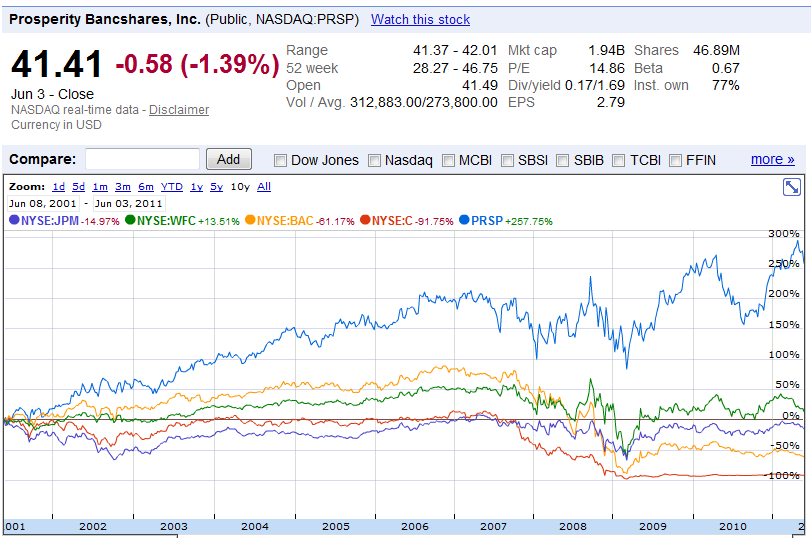
Prosperity’s performance vs. the four large super banks in the past 10 years is shown below:

Click to enlarge
banks.png

Citibank(C), Bank of America(BAC) and JPMorgan Chase (JPM) all have a negative return with Citibank faring the worst. The variance in returns between Prosperity Bancshares and the large banks is surprising since large banks were supposed to be better due to their massive size and scope of operations.

Disclosure: No positions
Asia: An Attractive Destination for Income Investors

Traditionally investors have preferred large cap companies in developed countries when it comes to investing for dividend income. This is because many of the large companies in Western Europe, Canada, the U.S. and other developed markets are established companies with defined dividend payout policies and have history of rewarding shareholders with cash in the form of dividends. Investors rarely considered emerging market equities for their dividend potential. However this view is slowly changing and smart investors are heading to the emerging markets of Latin America and Asia hunting for dividend stocks. Asia is increasingly becoming an attractive destination for dividend investors.

Some of the reasons for investing in Asian equities for dividend income are:

  • The dividend yield for Asian equities overall is about 3%.
  • More than 80% of Asian companies are paying out some form of dividends.
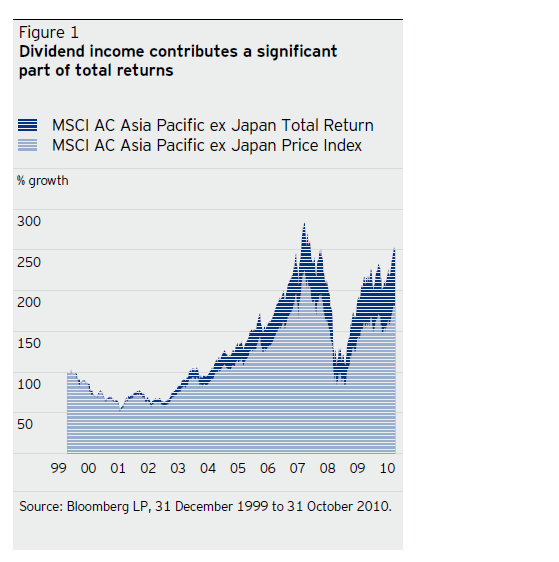
  • Dividends accounted for 37% of the total returns from Asian markets over the past two decades according to Goldman Sachs, Global Investment Research, October 2010.


asia-dividend-returns.png

  • Dividend levels are rising across Asia and the region offers extensive diversification across countries and sectors.
  • Corporate culture is changing as more companies are paying a higher portion of their earnings as dividends in order to attract both domestic and foreign investors.
  • Many Asian companies have dividend yields equivalent to or higher than those of their European and US peers.
  • The dividend culture in Asia began to change 10 years ago and is now well-established in Singapore, Thailand and Taiwan.
  • The average percentage of earnings paid out in dividends has now grown to 40% from 30% in the 1990s.

Source: Invesco Perpetual Asian Equity Income Fund and Trustnet of UK

Hundreds of Asian companies trade as ADR on the US markets. Ten randomly-selected ADRs from ten Asian countries are listed below with their current dividend yields:

1.Company:Chunghwa Telecom Ltd (CHT)
Current Dividend Yield: 4.86%
Sector: Telecom
Country: Taiwan

2.Company:United Overseas Bank Ltd (UOVEY)
Current Dividend Yield: 3.94%
Sector: Banking
Country: Singapore

3.Company:HDFC Bank Ltd (HDB)
Current Dividend Yield: 0.47%
Sector: Banking
Country: India

4.Company:Philippine Long Distance Telephone Co (PHI)
Current Dividend Yield: 6.64%
Sector: Telecom
Country: Philippines

5.Company:Woori Finance (WF)
Current Dividend Yield: 1.77%
Sector: Banking
Country: South Korea

6.Company:City Telecom (CTEL)
Current Dividend Yield: 5.38%
Sector: Telecom
Country: Hong Kong

7.Company:Telstra Corp Ltd (TLSYY)
Current Dividend Yield: 8.81%
Sector: Telecom
Country: Australia

8.Company:Telekomunikasi Indonesia (TLK)
Current Dividend Yield: 7.66%
Sector: Telecom
Country: Indonesia

9.Company:Telecom Corporation of New Zealand (NZTCY)
Current Dividend Yield: 5.60%
Sector: Telecom
Country: New Zealand

10.Company:Malayan Banking Bhd (MLYBY)
Current Dividend Yield: 8.22%
Sector: Banking
Country: Malaysia

Note: Dividend yields noted are as of June 1, 2011

Disclosure: No Positions

Why Invest In Foreign Small and Micro Cap Stocks

Many foreign markets have performed better than the US market in the past decade. When investing in international stocks most investors tend to stick with large caps. However foreign small and micro caps offer better investment opportunities over their large cap peers.

Six reasons to invest in foreign small and micro cap equities are listed below:

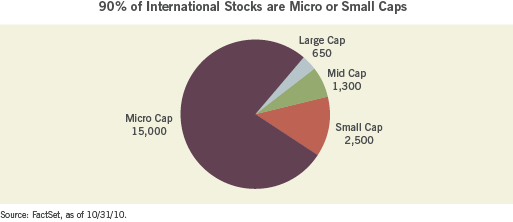
  • Small and micro cap publicly-listed foreign companies represent 90% of the  investing universe in foreign markets.


intl-small-caps.jpg

  • Similar to the U.S. market, small caps have historically performed better than large caps in overseas markets due to many factors such as their ability to respond to market changes quickly, leaner structures, etc. S&P projects foreign small and micro caps to outperform this year and next.
  • Most of the foreign small cap stocks are “undiscovered gems”since most Wall Street analysts and fund managers do not follow them.
  • Many small caps trade at attractive valuations and their earnings are projected to beat large caps for the next few years.
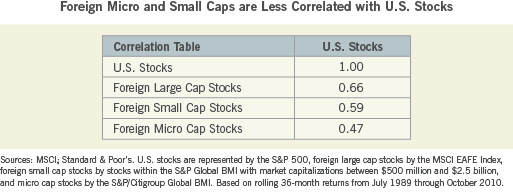
  • Despite their volatility, foreign small micro cap stocks can offer excellent diversification benefits to a portfolio due to their low correlation with the U.S. equities as shown in the graphic below:


intl-small-cap-correlation.jpg

  • Small caps generally yield higher returns than large caps. For the decade ending in 2009, international small and micro cap stocks generated average annual returns of more than 9% which is much higher than U.S. and foreign large cap stock returns.

Source: Think International, Think Small, Wasatch Funds

The best way to invest in overseas small and micro cap stocks is via ETFs. Some of the ETFs are listed below:

  1. Market Vectors Brazil Small Cap ETF (BRF)
  2. SPDR Russell/Nomura Small Cap Japan ETF (JSC)
  3. WisdomTree International SmallCap Dividend Fund (DLS)
  4. SPDR S&P Emerging Markets Small (EWX)
  5. SPDR S&P International Small Cap Fund (GWX)
  6. Vanguard FTSE All-World ex-US Small-Cap ETF (VSS)

Disclosure: Long GWX

Mark Mobius: Another Financial Crisis Is Inevitable

mark-mobius.jpgMark Mobius, the executive chairman of Templeton Asset Management’s emerging markets group has said that another financial crisis is inevitable since the causes of the previous one haven’t been resolved.

From a news report in the Financial Post:

“There is definitely going to be another financial crisis around the corner because we haven’t solved any of the things that caused the previous crisis,” Mobius said at the Foreign Correspondents’ Club of Japan in Tokyo today in response to a question about price swings. “Are the derivatives regulated? No. Are you still getting growth in derivatives? Yes.”

The total value of derivatives in the world exceeds total global gross domestic product by a factor of 10, said Mobius, who oversees more than $50 billion. With that volume of bets in different directions, volatility and equity market crises will occur, he said.

The global financial crisis three years ago was caused in part by the proliferation of derivative products tied to U.S. home loans that ceased performing, triggering hundreds of billions of dollars in writedowns and leading to the collapse of Lehman Brothers Holdings Inc. in September 2008. The MSCI AC World Index of developed and emerging market stocks tumbled 46 percent between Lehman’s downfall and the market bottom on March 9, 2009.

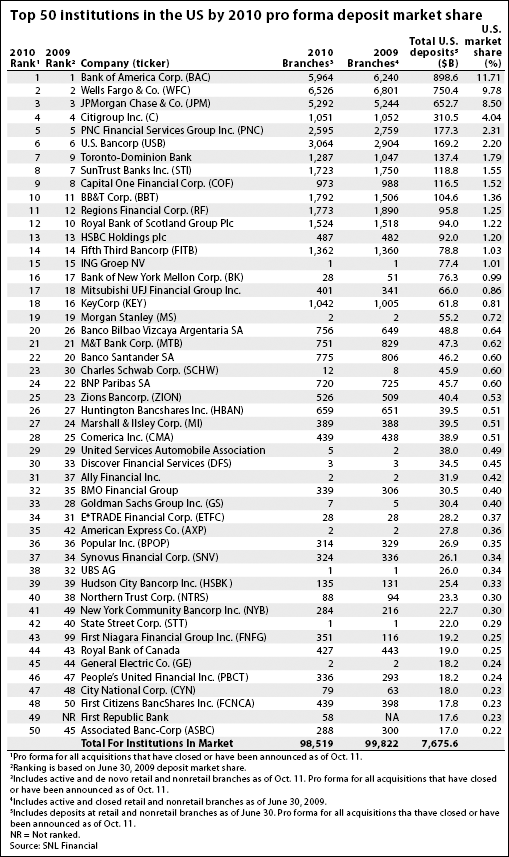
In the same speech Mark also warned that the “too-big-to-fail” banks have gotten bigger since the financial crisis.This is very true. More than 1/4th of all bank deposits in the U.S. are held by four “super banks” – Citibank (C), JPMorgan Chase (JPM), Bank of America (BAC) and Wells Fargo (WFC).The table below lists the Top 50 banks by deposit market share in 2010:

us-bank-deposits.gif

Source: The Wall Street Journal

In addition most of the banking assets in the country are held by the top 20 banks. As the banking industry becomes heavily concentration competition suffers. We can only hope that Mark’s predictions don’t become true as the country is still reeling from the effects of the previous crisis.

UN: Global Financial System at Risk if the Weakening of U.S. Dollar Continues

The United Nations (UN) warned of a crisis of confidence in the U.S. dollar should the weakening of the dollar continue and added that this would put the entire global financial system at risk.

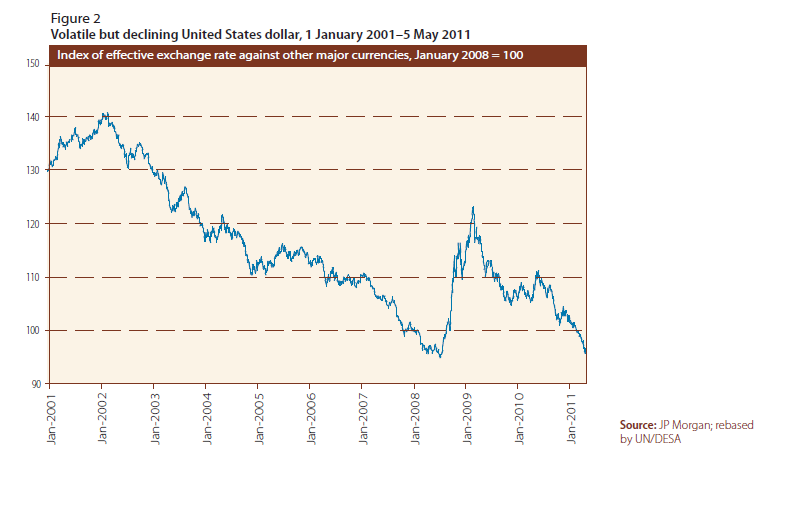
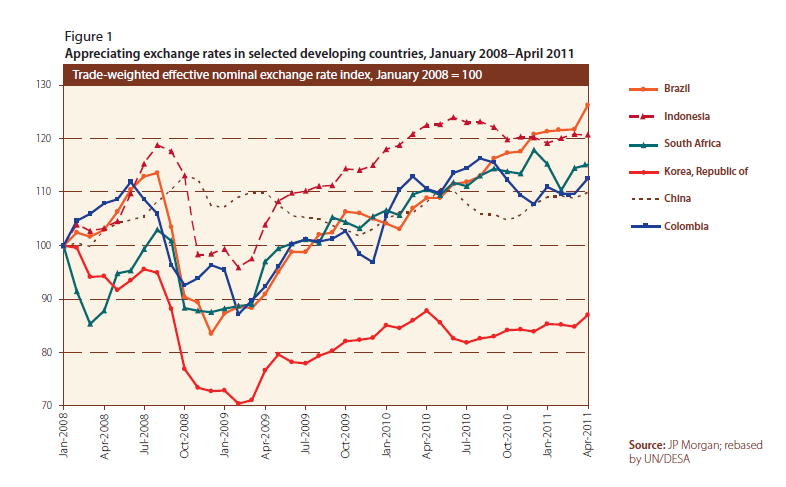
The U.S. dollar has continued its downward trend against other major currencies in the past decade as shown in the chart below:

Click to enlarge

decling-us-dollar.png

devloping-coutries-currency-appreciation.png

Source: World Economic Situation and Prospects 2011, UN

From the report:

The most recent wave of dollar devaluation has also been driven by other factors, including interest rate differentials between the United States and other economies, and growing concern about the sustainability of the public debt of the United States, half of which is held by foreigners. Measured by the exchange rate index of the dollar vis-à-vis the basket of other major currencies, the dollar has reached the lowest level since the 1970s. The depreciation of the dollar against the currencies of many emerging economies has also been significant. As a result, further (expected) losses of the book value of the vast foreign reserve holdings could trigger a crisis of confidence in the reserve currency, which would put the entire global financial system at risk.