Comparison of Personal Saving Rate in Germany vs. Other OECD Countries

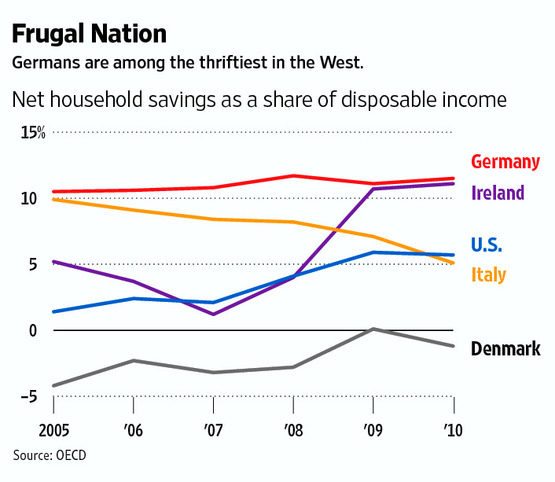
The personal household saving rate in Germany is one of the highest among developed countries. German households put aside a monthly average of Euro 190 per inhabitant in the first half of 2010, according to a report by De Statis.The following chart shows the comparison of personal saving rate in Germany against a select few OECD countries:
 

Source: Germans, Prizing Virtues of Saving, Find Euro Bailouts Hard to Swallow, The Wall Street Journal

From the journal article:

Germans’ deep-seated economic caution has roots in the ruinous wars and inflation of the last century. Many of today’s Germans are as frugal as ever, on average saving 11.5% of their incomes in 2010, according to the Organization for Economic Cooperation and Development. That compares with a savings rate of 5.7% in the U.S. last year.

In Ireland, one of the euro-zone countries that is getting a bailout, the average savings rate last year was 11.1%, near that of Germany—but the rate only rose after the shock of the global financial crisis, and follows years of much lower saving. Meanwhile, in Greece, residents on average spent 12% more than they earned in 2008, the latest year for which data is available from the OECD.

Despite having a high savings rate and one of the large equity markets in the world, Germans do not invest heavily in stocks. In fact, the majority of Germans put most of the money saved in bank deposits and to some extent in life insurance products.
Intesa Sanpaolo: An Italian Bank Worth a Look

Italian bank stocks fell heavily on Friday.Trading in some banks was suspended due to high volatility in the Milan Stock Exchange.

From Italian Banks Sidestep Debt Crisis, Not Vice Versa in The Wall Street Journal:

MILAN—With virtually no exposure to Greece and other peripheral euro-zone countries, Italian banks have seemed relatively immune to Europe’s debt crisis.

Yet Italian banks face a battle making profits on their core business—lending to companies and individuals across their homeland—as the euro-zone debt crisis pushes borrowing costs up faster than the prospects of Italian economic growth, which is expected to be a listless 1% this year.

Bank shares fell as much as 10% on the Milan stock exchange on Friday, as investors panicked in the wake of a warning by Moody’s Investor Service late on Thursday that it may downgrade the long-term debt and deposit ratings of 16 Italian banks, and changed the outlook on an additional 13 lenders to negative.

The predicament facing banks such as Intesa Sanpaolo, UniCredit SpA and others highlights a new kind of market dynamic, provoked by Europe’s continuing debt crisis, in which sovereign-debt concerns are increasingly dictating terms for the private sector.

“The market is experiencing a great anomaly,” said Antonio Guglielmi, an analyst at Mediobanca in London. “The cost of [bank] funding is now linked to sovereign risk and not to the higher capital of the banks.”

Not only have Italian banks not tapped Italy’s government—which already groans under public debt of 120% of gross domestic product—for funds, but they also have raised more than €10.5 billion, or about $15 billion, in fresh equity capital in a series of capital increases so far this year.

The article notes that one solution for Italian banks could be to raise fees since layoffs is not an option due to union’s demands.

In terms of market performance, the FTSE MIB index is down 5.1% YTD while the S&P 500 is up 0.9%. Germany’s DAX is the only index that is positive YTD among the major European economies.

A Review of Intesa Sanpaolo:
Intesa Sanpoalo is one of the largest Italian banking groups, formed by the merger of Banca Intesa and Sanpaolo IMI. The Group has a leadership position in the Italian market and has a strong presence in Central-Eastern European markets as well.

As of December, 2010 the bank’s core Tier 1 ratio stood at 7.9%, in line with Basel III requirements. In order to raise its core Tier 1 level ratio to 10%, Intesa announced a EUR 5 billion rights issue in April.

Some key facts from a company presentation:

  • Leader in all segments with a market share of 16% in customer loans and 17% in
    customer deposits.
  • Strong capital base and best in asset quality class.
  • Largest domestic network: nearly 5,700 branches, 17% market share and 11
    million clients.
  • Particular strength in the wealthiest areas of Italy: strong retail presence covering more
    than 70% of Italian household wealth.
  • Selected retail banking presence in Central and Eastern Europe and Middle Eastern and North African countries reaching 8.3 million clients in 13 countries through a network of over 1,700 branches.
  • International network with a presence in 29 countries in support of cross-border activities of corporate customers.

Intesa Sanpaolo SpA trades on the OTC market in the U.S. as a sponsored ADR under the ticker ISPNY. The stock currently has 4.78% dividend yield. In March 2009, Intesa ADR fell to as low as $10. After reaching a high of $29 in December of that year, the stock fell again to about $14 in June 2010. Almost a year later it closed at $14.47 on Friday.

More information on Intesa Sanpaolo SpA can be found at the Investor Relations site here.

Disclosure: No positions

Seven Defensive British Stocks To Buy Now

Equity markets worldwide have become more volatile in recent weeks due to the resurgence of the European debt crisis. Emerging markets are getting hit due to soaring inflation and rising interest rates. Fearing a collapse of the Euro and its impacts to European economies some investors are staying clear of European stocks. This need not be the case. Many of the world’s largest multinationals are based in Europe and earn a large portion of their revenues from outside the European Union.For example, many large British miners, healthcare and consumer companies have the majority of their operations outside of the UK and the European continent. Some of these companies have strong presence in emerging markets such as Brazil, India, Turkey, Indonesia, China, etc. Hence investors can add some of these companies at current levels to gain exposure to emerging markets.

CityWire recently published a list of seven defensive stocks held by UK fund managers in their selection list of investment recommendations. These stocks are listed below with their ADR tickers and current yields:

1.Company:Diageo PLC (DEO)
Current Dividend Yield: 2.51%
Sector:Beverages (Alcoholic)

2.Company:Reckitt Benckiser Group PLC (OTC:RBGPY)
Current Dividend Yield: 3.96%
Sector:Consumer goods

3.Company:AstraZeneca (AZN)
Current Dividend Yield: 7.55%
Sector: Drugs

4.Company:GlaxoSmithKline PLC (GSK)
Current Dividend Yield: 5.09%
Sector: Drugs

5.Company: Scottish and Southern Energy PLC (OTC:SSEZY)
Current Dividend Yield: 3.21%
Sector: Electric Utilities

6.Company:Unilever PLC(UL)
Current Dividend Yield: 4.17%
Sector: Consumer Goods

7.Company:British American Tobacco PLC (BTI)
Current Dividend Yield: 6.26%
Sector: Tobacco

Diageo is the world’s largest spirits group and the owner of many top global brands including Johnnie Walker, Smirnoff, Baileys, Captain Morgan, etc. GSK’s biggest product is the heavily-marketed Advair which generates 18% of its total revenues. Unilever has a strong presence in emerging markets with many popular consumer brands.

Disclosure: No positions

Stock Market Performance Post Major Crises

Many investors overreact during times of crises. Retail investors especially tend to panic and sell out at the bottom and then buy at the top when the market rebounds. The fear of losing out on a rally and recoup some of their losses forces them to act this way. This classic scenario occurred in the aftermath of the recent financial crisis.After seeing their portfolio values decline consistently for many months some investors threw in the towel and sold out right when the market was hitting the lows in March 2009. These investors couldn’t be more wrong. From the lows of March 10, 2009 the S&P 500 rallied a spectacular 80% by April of 2010. The moral of the story here is that investors should not panic and sell out when the market is already down significantly. The market rewards patient investors who hold investments for the long-term as opposed to trying to time the market in the short-term for a quick profit.

In general, how does the markets perform post major crises?

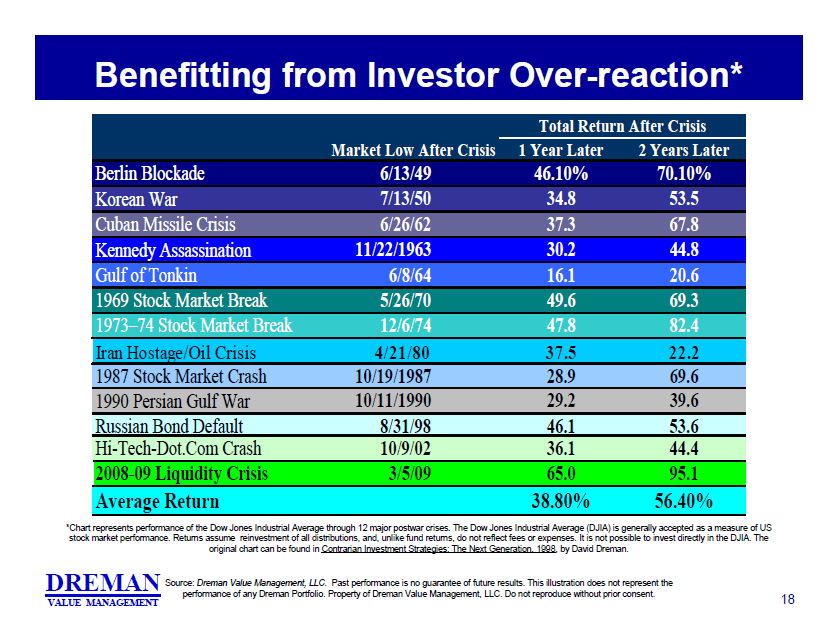
The chart below shows the 1-year and 2-year returns of Dow Jones Industrial Average(DJIA) after 12 major post-war crises:

Click to enlarge


Source: Dremen Value Management via CityWire, UK

The returns assume reinvestment of dividends and distributions. Similar to the S&P 500, the Dow Jones Index gained 65% and 95% in 1 year and 2 years respectively after the 2008-09 global financial crisis. Overall the index was up by double digits in the periods mentioned after each of the crises shown in the chart above.

Relative Importance of Banking Sector to the Overall Economy

The U.S. economy was mainly driven in the past few decades by the FIRE (Finance, Insurance and Real Estate) sector. Accordingly these sectors experienced explosive growth and formed a major portion of the overall economy. The banking industry especially evolved into one of the main pillars of the economic growth due to its loose lending and other activities. However after the recent financial crisis, the importance of the banking industry to the economy has diminished.

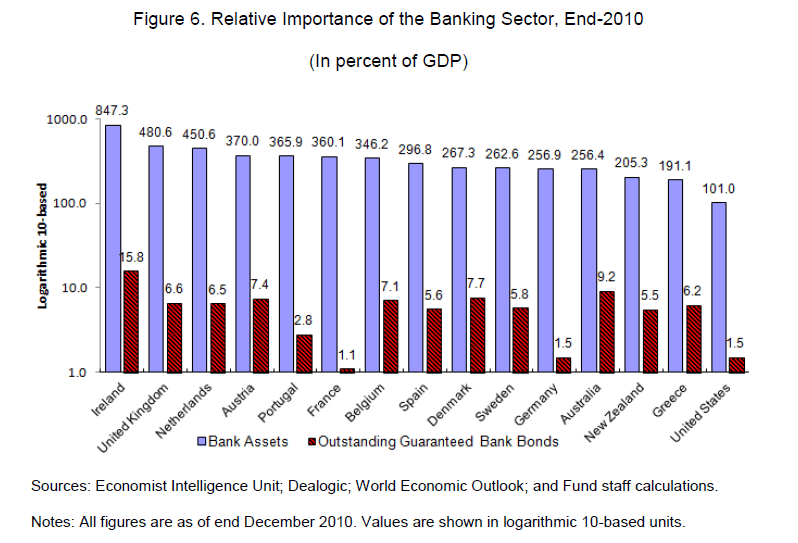
The chart below shows the relative importance of the banking sector for select developed countries at the end of 2010:

Click to enlarge


Source: Managing Sovereign Debt and Debt Markets through a Crisis – Practical Insights and
Policy Lessons, IMF

The experience of Iceland and Ireland shows the disastrous implications of the outsized growth of a country’s banking sector. In Iceland, financial sector assets expanded at an annual rate of over 100% in 2003 to over 1000% of GDP at the end of 2007. Similarly in Ireland, the assets of domestic amounted to five times that of the GDP at the height of the boom.