15 NYSE-listed Foreign Stocks Paying More Than 7% Dividends

To identify some of the high yielding large cap foreign stocks, I ran the screener with the following criteria:

1. Stocks must trade on the NYSE
2. Market cap must >= $5B
3. Dividend yield must be at least 7%

The above search resulted in the following 15 stocks:

1.Company: Tele Norte Leste Participacoes SA (TNE)
Current Dividend Yield: 14.53%
Sector: Telecom
Country: Brazil

2.Company: Telecomunicacoes de Sao Paulo SA (VIV)
Current Dividend Yield: 12.67%
Sector: Telecom
Country: Brazil

3.Company: Banco Santander, S.A.(SAN)
Current Dividend Yield: 12.06%
Sector: Banking
Country: Spain

4.Company: France Telecom SA (FTE)
Current Dividend Yield: 11.37%
Sector: Telecom
Country: France

5.Company: SK Telecom Co., Ltd. (SKM)
Current Dividend Yield: 9.82%
Sector: Telecom
Country: South Korea

6.Company: Nokia Corporation (NOK)
Current Dividend Yield: 9.77%
Sector: Telecom equipment
Country: Finland

7.Company: Portugal Telecom (PT)
Current Dividend Yield: 9.62%
Sector: Telecom
Country: Portugal

8.Company: Telefonica S.A. (TEF)
Current Dividend Yield: 9.15%
Sector: Telecom
Country: Spain

9.Company: PT Telekomunikasi Indonesia (TLK)
Current Dividend Yield: 8.51%
Sector: Telecom
Country: Indonesia

10.Company: YPF SA (YPF)
Current Dividend Yield: 8.17%
Sector: Oil & Gas
Country: Argentina

11.Company: National Grid plc (NGG)
Current Dividend Yield: 7.95%
Sector: Utility
Country: UK

12.Company: Banco Bilbao Vizcaya Argentaria SA (BBVA)
Current Dividend Yield: 7.60%
Sector: Banking
Country: Spain

13.Company: AstraZeneca plc (AZN)
Current Dividend Yield: 7.51%
Sector: Drugs
Country: UK

14.Company: Vodafone Group Plc (VOD)
Current Dividend Yield: 7.42%
Sector: Telecom
Country: UK

15.Company: Westpac Banking Corporation (WBK)
Current Dividend Yield: 7.24%
Sector: Banking
Country: Australia

Note: Dividend yields noted are as of June 21, 2011

The majority of the companies in the above list are in the telecom sector. Nokia’s yield is so high since its stock price fell heavily recently.

Disclosure: Long BBVA, STD
Six Latin American Telecom Stocks To Consider

The telecommunication market Latin America is set for excellent growth. With many countries in the region experiencing strong economic growth the penetration rate of mobile phones is especially set to go higher as the new middle class seek the modern necessities of life. In addition, new technology upgrades and the evolution of smartphones will drive growth in the coming years.

In an FT interview on June 12th, Carlos Slim, the telecom tycoon of Mexico said:

“Whether one should invest more in developed or emerging markets is a sterile debate,” he said. “What counts more is whether there are growth opportunities, not so much in the number of customers as in the applications they use.”

Mr Slim, who described Apple’s iPad and other tablet computers as “fantastic”, has until now focused primarily on the low end of the market, pioneering the high volume use of pay-as-you-go mobile phones.

But he said the best opportunities lay in the combination of the increasing purchasing power of Latin American families and ever-cheaper technology, such as smartphones, tablets, applications and content. He said he believed tablet use would become widespread “as volumes rose and prices fell”.

Carlos’ firm Telmex(TMX) serves 275 million customers in Mexico. America Movil controls 60% of the mobile market in Mexico. Spain’s Telefonica(TEF) is the largest competitor to America Movil (AMX).

An article in the Economist Intelligence Unit last month discussed the growth of smartphones Latin America. From the article:

The narrowing gap between smartphones and feature phones helped drive growth in Latin America’s mobile phone market in the first quarter of 2011, according to a press release from consultancy IDC.

IDC said smartphone shipments in the region were aided by carriers working to move customers to 3G networks, as well as the launch of new Android and Windows Phone devices in the market.

According to the consultancy, vendors in the region shipped more touchscreen and Qwerty models. Additionally, IDC said average selling prices declined due to aggressive Chinese vendor expansion.

AMX, Telefonica, Telecom Italia(TI) respectively controls about 30% of the Brazilian mobile market with the rest split between smaller players.

Five Latin American telecom stocks with more than 5% dividend yields are listed below for consideration:

1.Company:Telefonos De Mexico SAB De CV (TMX)
Current Dividend Yield: 5.74%
Sector: Telecom
Country: Mexico

2.Company:Telecom Argentina Sociedad Anonima (TEO)
Current Dividend Yield: 8.89%
Sector: Telecom
Country: Argentina

3.Company: Telecomunicacoes de Sao Paulo SA Telesp (VIV)
Current Dividend Yield: 12.67%
Sector: Telecom
Country: Brazil

4.Company: Tele Norte Leste Participacoes SA (TNE)
Current Dividend Yield: 14.53%
Sector: Telecom
Country: Brazil

5.Company: Telefonos De Mexico SAB De CV (TFONY)
Current Dividend Yield: 5.79%
Sector: Telecom
Country: Mexico

Nasdaq-traded NII Holdings, Inc (NIHD) offers wireless communication services under the Nextel brand in Mexico, Brazil, Argentina, Peru and Chile. NIHD does not pay a dividend but the total revenue last year was nearly $6.0 billion and the 5-year earnings growth is 13.50%.

Disclosure: No Positions

A Review of the World’s Second Largest Retailer

Carrefour SA of France is the second largest retailer in the world after Wal-Mart(WMT) and is also the largest retailer in Europe. The group operates four main grocery store formats: hypermarkets, supermarkets, hard discount and convenience stores. Carrefour currently has over 15,500 stores worldwide, either company-operated or franchises.

The major markets for Carrefour are: Asia, Latin American and Europe. While the company is present in over 34 countries, the majority of its revenues(about 57%) still come from France. Carrefour sees strong growth in many emerging markets such as China, Brazil, Indonesia, Poland and Turkey.

Carrefour was first listed on the Parix exchange in June 1970. Currently the stocks is a component of the CAC 40, SBF 120, FTSE 100, DJ Euro STOXX 50 indices.

Until May 30, 2011 Carrefour ADR traded as an unsponsored ADR on the OTC markets with the ticker CRERY. On May 31st, the ADR was converted into sponsored ADR. The stock currently trades under the symbol (CRRFY).

At the closing price of $7.72 on Friday, the ADR has a dividend yield of 3.350%.

For more information on Carrefour please visit their investor relations site.

Disclosure: No positions


Components of FTSE Multinationals Index

The FTSE Multinationals Index is comprised of companies which derive more than 30% of their revenue outside their region. The majority of the top 100 companies in this index are from the developed world.

Five components from the FTSE Multinationals Index are listed below:

1.Company:Danone SA (DANOY)
Current Dividend Yield: 2.56%
Sector:Food Processing
Country: France

2.Company:Diageo PLC (DEO)
Current Dividend Yield: 2.48%
Sector:Beverages (Alcoholic)
Country: UK

3.Company:BASF SE (BASFY)
Current Dividend Yield: 3.53%
Sector:Chemical Manufacturing
Country:Germany

4.Company:Nestle SA (NSRGY)
Current Dividend Yield: 3.39%
Sector:Food Processing
Country: Switzerland

5.Company:Emerson Electric Co (EMR)
Current Dividend Yield: 2.66%
Sector:Scientific & Technical Instruments
Country: USA

To download the fill list of companies please click here.

Disclosure: No positions

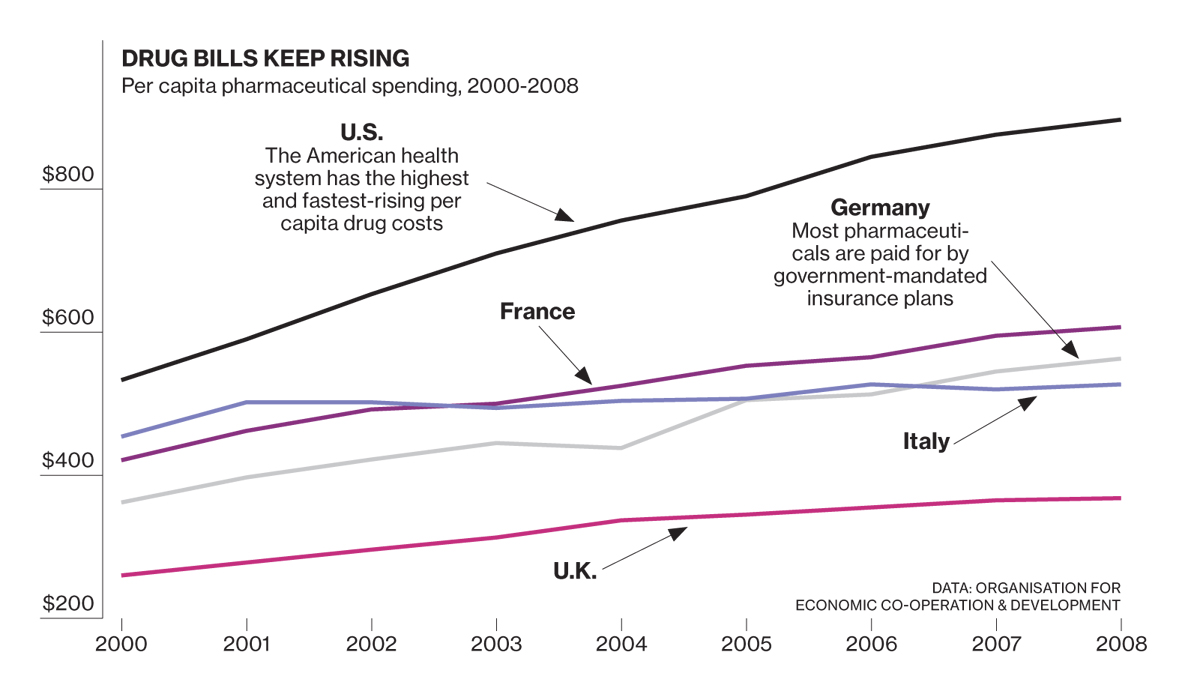
One More Reason Why Healthcare in U.S. is Expensive

I have written many times before comparing the healthcare system in the U.S. to systems in other developed countries. It is a well know fact that despite having the highest healthcare spending among developed countries Americans get the least bang for the buck. For example, the state-run Medicare program is on track to consume 7% of the GDP by 2035, double that of the current level according to Congressional Budget Office.

Compared to the costs for other services healthcare costs have been rising exponentially over many years. The causes for this runaway inflation in healthcare are many and an analysis of the reasons behind this tremendous surge in costs would require an exhaustive study to pinpoint the various causes and their impacts.The following chart from an Bloomberg BusinessWeek article shows the per capita spending on drugs by some developed countries:

Click to enlarge

drug-bills-compare.jpg

Source: Bloomberg BusinessWeek