The World’s 50 Safest Banks 2011

The Global Finance magazine recently announced its annual ranking of the World’s 50 Safest Banks for 2011. These top banks were selected based on an evaluation of long-term credit ratings—from Moody’s, Standard & Poor’s and Fitch—and total assets of the 500 largest banks worldwide.

From the magazine report:

The sovereign debt crisis is still raging in Europe and renewed fears of contagion from southern European countries is affecting banking and market outlooks throughout Europe.Global political instability is also in the spotlight—from the upheavals in the Middle East and Africa to the US debt downgrade by Standard & Poor’s, companies are watching closely to see how these events are affecting their counterparties.

With more than 40 of the top 50 banks from last year once again making the list, the Global Finance ranking shows that most of the top echelon of banks are truly worthy of the moniker World’s Safest Bank.

The table below lists the World’s 50 Safest Banks for this year together with the ticker if available:

[TABLE=1036]

Source: Global Finance

Some observations:

  • The five largest Canadian banks and Montreal-based Caisse centrale Desjardins have made it to this list.
  • Among the U.S. banks, Bank of America (BAC) and Citigroup (C) did not make the cut.
  • Denver-Colorado based CoBank is a $66 billion cooperative bank serving industries across rural America.
  • Despite fears of banking failures in Europe, the majority of the banks in this ranking are European banks.

Disclosure: Long USB, BNS, BMO, RY, TD, SCGLY, STD, BBVA
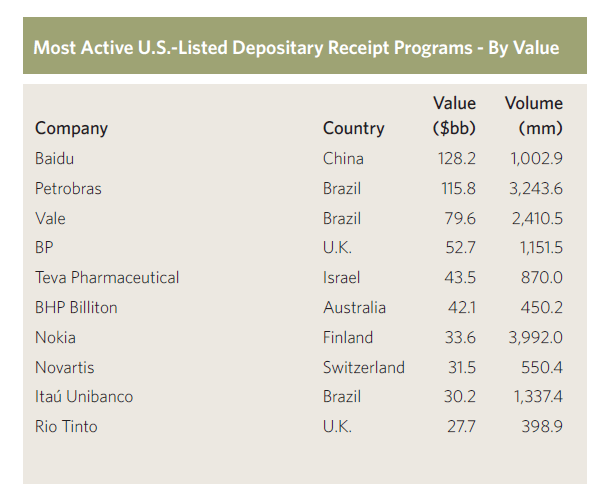
The 10 Most Actively Traded ADRs by Value

Volatile equity markets and divergent economic growth between the developed and emerging markets have driven trading in Global and American Depository Receipts to new records, according to a mid-year review report by BNY Mellon Depository Receipts. During the first half of this year, 80.5 billion DRs valued at an all-time high of $1.91 trillion, traded hands. The universe of DR programs available to investors has also expanded to 3,364 programs from 77 countries. NASDAQ and the NYSE remain the largest markets for DR trading.

The 10 most actively-traded DRs by value are listed below:

Click to enlarge

China’s Baidu(BIDU) tops the ranking followed by Brazil’s Petrobras(PBR), Vale(VALE), UK’s BP Plc (BP) and Israel’s Teva Pharmaceuticals (TEVA).

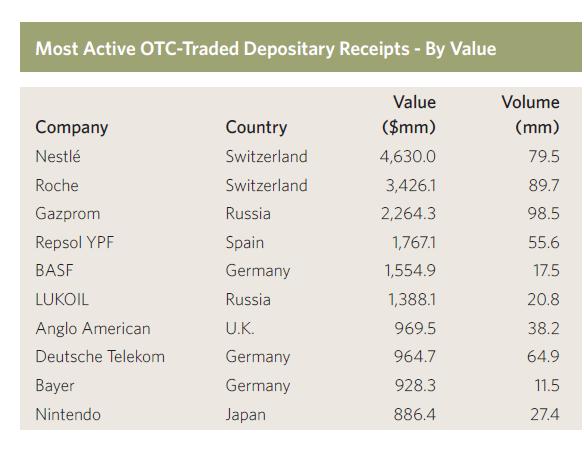
The 10 most active OTC-traded DRs by value are listed below:

Click to enlarge

Source: The Depositary Receipt Markets, 2011 Mid-Year Review, BNY Mellon

Despite the ongoing firestorm in the European equity markets, Switzerland-based Nestle SA(NSRGY) is holding up very well. The stock closed at $61.71 today relative to its 52-week high of $65.53. The other top four actively-traded ADRs include Roche (RHHBY), Gazprom(OGZPY), Repsol (REPYY) and German chemical giant BASF (BASFY).

Disclosure: Long ITUB, PBR

How Big Is The Global Financial Industry

Der Speigel has published an excellent report titled The Destructive Power of the Financial Markets discussing the size and power of various players on the global financial markets.

The graphic below shows the astonishing size of the global financial industry:

Click to enlarge


From the report:

The financial industry grew rapidly, as did the sums of money with which its players speculated on the prices of stocks, commodities and government bonds. The products they developed to turn money into even more money became more and more complex. At the same time, the risks they were willing to accept became incalculable.

The sector’s high salaries tend to attract the best and brightest university graduates. The members of this youthful elite don’t devise new products that make people’s lives better, nor do they found new companies that further progress. Instead, these young financial wizards invest a great deal of money and effort to develop sophisticated financial products, the sole purpose of which is to generate more profit for both their employers and, ultimately, for themselves — sometimes at the expense of other market players or even their customers.

Many things that happen on Wall Street and in London’s financial district are “socially useless,” says Lord Adair Turner, chairman of Britain’s Financial Services Authority (FSA). The values that are created there are often not real or of any use to society, Turner adds. Paul Volcker, the former chairman of the US Federal Reserve, once remarked that the only truly useful financial innovation in the past 20 years is the cash machine. (emphasis added)

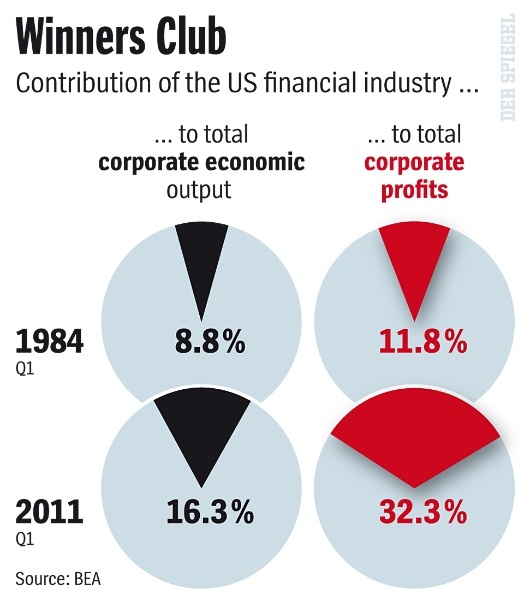
In the U.S. as the manufacturing industry was decimated in the past few decades, the financial industry gained prominence and started to account for a large portion of the economic output. By the first quarter of 2011, the industry accounted for about one-third of all corporate profits as shown in the graphic below:

Click to enlarge

Source: Der Speigel

The high reliance of the US economy on this one sector poses significant risks to the overall health of the economy. A strong economy should be diversified among many industries and not have over-concentration of just one industry.

Are U.S. Stocks Cheap Now?

The S&P 500 is down 10.7% YTD. Among the sectoral indices, the financials are the worst performers with the KBW Bank Index off 32% YTD.

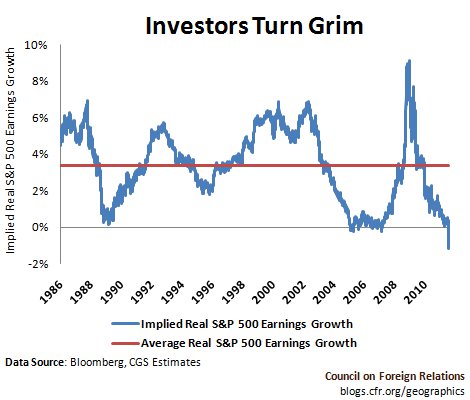
As U.S. equities continue their downward trend, some investors are wondering if they are cheap now. The following chart from a CFR report shows that stocks are either cheap or the market is assuming corporate earnings growth to be sluggish in the future:


Source: Are Stocks Cheap?, CFR

From the CFR report:

As the figure above shows, equity prices of late imply the worst earnings growth rate expectations in 25 years—such expectations even turned negative last week.  This dour outlook stems partly from renewed risk-aversion, which ironically redirected cash into downgraded U.S. debt, but it also reflects a sharp rise in concerns about where new profits will come from.  Operating margins and profits are near all-time highs, but revenues are still below their 2008 peak and real consumer spending has grown by only 2% over the past year.  Corporations currently have strong balance sheets and the lowest net debt-to-revenue ratio on record, but this is largely the result of cost-cutting which may have run its course.  In short, either stocks are very cheap or growth prospects very dim.

Currently the PE Ratio for S&P 500 stands at 19.39 and the Dividend Yield for the index is at 2.17%. While the U.S. and the developed world economies remain stuck in neutral or have negligible growth emerging markets are still growing at a robust pace. So investors looking to add some equities to their portfolios can consider adding U.S. companies which have high exposure to emerging markets and do not depend heavily on the domestic market. A list of 25 such companies can be found here.

Related ETF:

SPDR S&P 500 ETF (SPY)

Disclosure: No Positions

Which U.S. President Accumulated The Most Debt?

The current total outstanding U.S. public debt is over $14.0 Trillion. This huge mountain of debt was accumulated over many decades under the leadership of various presidents.

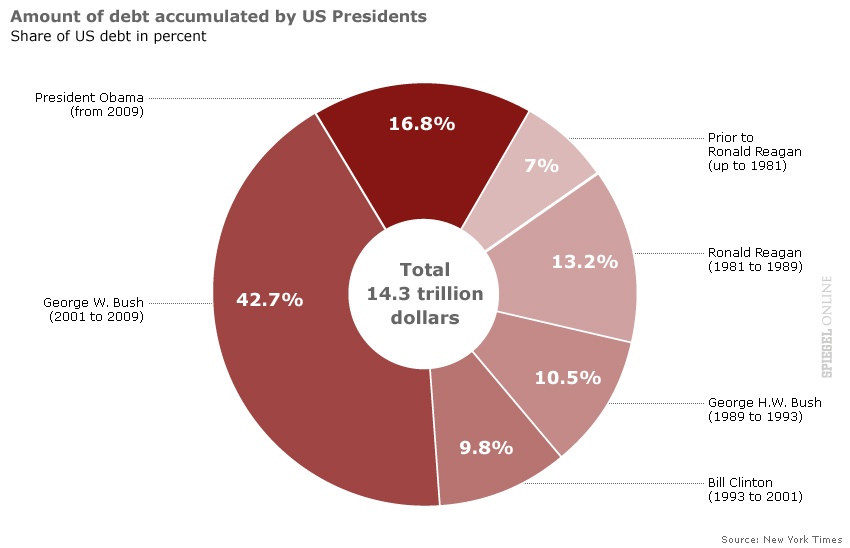
The graphic below shows the amount of debt accumulated by US presidents:

Click to enlarge

Source: Der Speigel

As shown above, the largest amount of debt was accumulated by the previous president George W.Bush during his term in office primarily due to big tax cuts for the rich and increasing government expenditures.

In early 2009, while attending a diamond-studded $800-a-plate crowd in New York Mr.Bush said:

“This is an impressive crowd – the haves and the have-mores,” quipped the GOP standard-bearer. “Some people call you the elites; I call you my base.

In May this year, the former Republican Vice Presidential Candidate and current Governor of Alaska Sarah Palin made the following claim in an interview to Fox News:

“Look at the debt that has been accumulated in the last two years,” Palin, a Republican, told Fox News’ Greta Van Susteren on May 31, 2011, as her bus rolled down the highway. “It’s more debt under this president than all those other presidents combined.”

This statement is factually incorrect. Hopefully the Republican party will be able to field a better vice-presidential candidate for the 2012 election.