Not All Dividend Stocks Are Worth Investing In

The Weekend Investor section of The Wall Street Journal had an interesting article on dividend stocks.

From the article:

Mutual funds specializing in dividend stocks have seen inflows of $12.6 billion so far this year, four times as much as in all of 2010—even as stock funds as a whole have posted outflows of nearly $25 billion, according to fund tracker Lipper.

But dividend stocks aren’t a panacea—and buying them willy-nilly can lead to disappointment down the road. Dividend stocks are notorious laggards during big rallies, which often start when investors are most averse to risk. And the market is full of “dividend traps”—troubled companies that pay hefty dividends merely to keep investors from bailing out, a risky gambit that usually isn’t sustainable.

Click to enlarge
Source: The Wall Street Journal

The best way to view dividends, say money managers, isn’t as an end in themselves but rather as a means to other goals such as reducing volatility or boosting (but not turbocharging) income. Used smartly, dividend stocks can even generate returns that match the overall market—with beefier income streams. But investors shouldn’t live on the div alone.

“A focus on dividend-yield strategies is an important part of an investor’s tool kit,” says Rob Arnott, chairman of money manager Research Affiliates in Newport Beach, Calif., which helps oversee $80 billion. “But they’re a little bit overrated today.”

The key to dividend investing, say strategists, is to be selective. That means avoiding the juiciest dividends and concentrating instead on companies that are boosting their payouts—and have the growth potential to keep those payments coming.

“You should never be taking shortcuts,” says Ben Inker, director of asset allocation at money manager GMO LLC in Boston. “Just because a stock pays a dividend doesn’t mean you don’t have to worry about the rest of the company.”

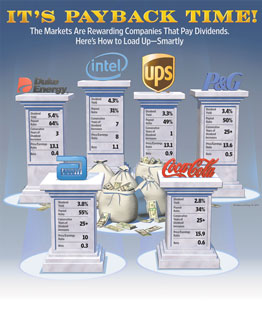
All the stocks mentioned in the above graphic have decent yields. But how did they perform in the past 10-years in terms of price appreciation?.

Click to enlarge
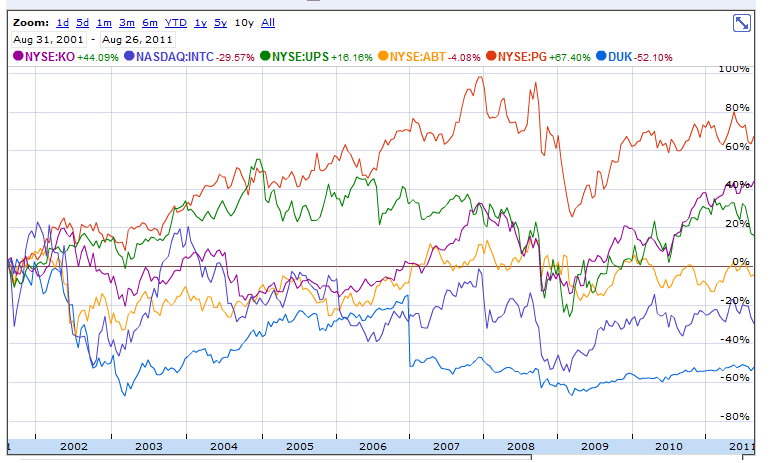
Of the six stocks, only Coca Cola(KO), UPS (UPS) and P&G (PG) had their stock prices rise by 44%, 16% and 67% respectively while Intel (INTC), Abbot Labs(ABT) and Duke Energy (DUK) actually lost 29%, 4% and 52% respectively. The returns of KO, UPS and PG have been average but not excellent.

Intel is a technology company and hence its stock will never be a dividend stock. Intel rode the technology wave of the 80s and 90s and its high growth period is long gone. Until a few years ago Intel did not pay a dividend. So despite its 4.3% yield now, its best to avoid Intel. Since January 13th 1978, Intel grew by over 16,000% easily beating the other five companies noted above. That type of performance is unlikely to repeat in the future.

Though the share price of Abbot Laboratories(ABT) has been pretty much flat in the past decade, it is still a good long-term investment. The company has increased dividends consistently over the past 25 years and with the health-care reform and millions of baby boomers retiring from workforce, demand for drugs and other healthcare services are projected to increase.

Duke Energy (DUK) is one of the worst run utilities in the U.S. The 5.4% dividend yield is not great considering that the stock price has plunged 52% in the past decade. Investors expect utilities to have decent dividend yields AND steady price appreciation. From Jan 13th, 1978 (as far back as Google Finance goes) thru Aug 26, 2011 Duke’s stock price has grown by a miserable 285%. In 2005, Duke bought Cincinnati-based Cinergy for $9.1 B in an all-stock deal. This year Duke announced to merge with Progress Energy. As part of this deal, Duke has set a revere stock split in the ratio of 1:3. All these acquisitions have not helped Duke earn respect from the market.

In summary, some of the dividend stocks can be traps and its best to stay clear off them. Like the Duke Energy example noted above, some stocks may pay good dividends but their stock prices may crash erasing any gains earned with dividends.

Disclosure: No Positions

Euromonitor: Amazon’s Long-Term Outlook Remains Positive, But More Competitive

The Internet retailer Amazon is one of the survivors of the great dot-com bubble of the 1990s. Unlike other retail companies like pets.com that disappeared when the bubble burst, Amazon not only survived but has thrived ever since. As the retail industry is highly competitive and has one of the lowest profits margins, it takes extraordinary effort and resources for a company to be successful. In this perspective, one has to appreciate the skills and perseverance of Mr.Jeff Bezos who started Amazon as a site selling for books back in 1994.

Euromonitor published a report recently on Amazon’s growth and analyzed the company’s future prospects. The following are some of the key takeaways from the report:

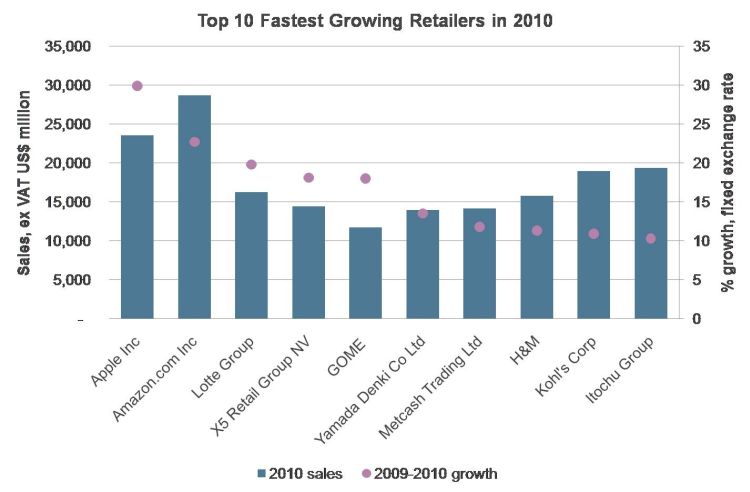
  • After Apple (AAPL), Amazon(AMZN) was the second fastest growing retailer in 2010. The Top 10 fastest growing retailers in the world last year are shown in the chart below:

Click to enlarge

Source: Euromonitor International

  • Amazon benefited strongly as direct competitors such as WalMart(WMT) and Tesco (TSCDY), pure-plays like Netflix (NFLX) and eBay(EBAY) failed to beat Amazon in the online retail business.
  • By acquiring Zappos, Quidsi, BuyVIP, LivingSocial and Lovefilm, Amazon has expanded its product offerings and the introduction of product-specific landing pages is extending the breadth of range.
  • The introduction of a grocery service in Germany and the UK in mid-2010 should benefit growth in those markets as consumers switch to Amazon from traditional high-cost retailers.
  • Amazon Prime, in which consumers pay an upfront fee (US$75 in the US, £49 in the UK) for free shipping and other deals, has been a big hit in the US and the UK creating loyal customers and higher sales per visit.
  • The launch of the Kindle 3 in 2010 made Amazon a competitor to Apple and other players in the e-reader market.
  • Amazon has been innovative with the introduction of high-margin private label products under many lines such as Pinzon (kitchen gadgets), AmazonBasics (electronics accessories), Denali (tools), Pike Street (bath and home products) and Strathwood (outdoor furniture).
  • With the November 2010 launch of a country-specific site for Italy, Amazon’s international operations now include Japan, the UK, France, Germany and China. Amazon plans to expand into the Spanish market this year.

Euronomitor noted that Amazon is taking the right steps to increase sales growth in the future. Increasing product offerings, internationalization, a growing loyal customer base, etc. should help the company in the medium to long term. However in the short to medium term Amazon is likely to face increased competition from other retailers.

Established retail giants like WalMarts and Tesco are refocusing their web sales strategies and plan to invest more to compete against Amazon. But since Amazon’s technology is already much better than the competition, it can continue to stay ahead of the game by further upgrading technology and offering a better experience for customers.

Disclosure: No positions

Benefits of International Diversification Declining

One of the main reasons to invest in foreign stocks is for portfolio diversification. In the past, the correlation U.S. markets and foreign markets were very low which lead to foreign stocks going higher when US stocks went down and vice versa. However in recent decades the benefits due to international diversification are declining.

According to a research study by Vanguard, one reason for the decline in benefits is that individual markets across the world have become more synchronized with the US markets. Accordingly correlations between countries have increased significantly from 0.35 in 1980s to 0.75 as of 2010. Hence investors who invest in non-US stocks for diversification are unable to escape losses when U.S. stocks decline.

This theory is evident in the current performance of global equity markets. For example, the S&P 500 is off 6.4%% YTD. Similarly other developed markets and emerging markets are also down in tandem as shown in the returns of a few sample indices:

  • France – CAC 40: -18.8%
  • UK – FTSE 100 : -13.1%
  • Germany – DAX: -19.9%
  • Brazil – Bovespa: -23.0%
  • China – Shanghai Composite: -7.0%
  • India – Bombay Sensex : -22.7%
  • Chile – Santiago IPSA: -16.4%

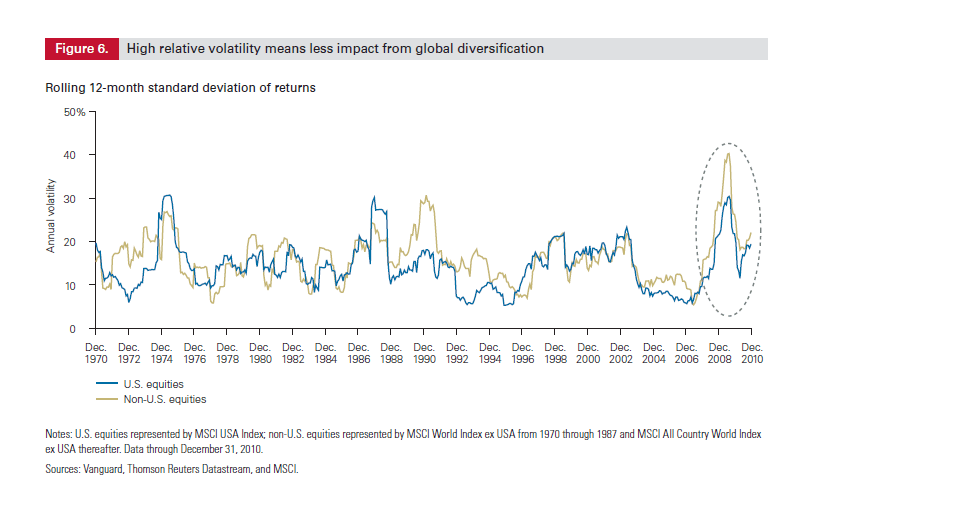
Another reason for the decline in diversification benefits is the spike in volatility in non-US stocks since 2007. The chart below shows the trailing 12-month standard deviation of returns for both U.S. and non-U.S. stocks:

Click to enlarge

Source: Consideration for investing in non-U.S. equities, Vanguard

The spike in volatility has increased the long-term average volatility of non-US markets by one full percentage point from 16.47% to 17.53%.

Hence the higher volatility combined with rising correlation between countries have attriuted to the reduction in international diversification benefits.

Related ETFs:

iShares MSCI Emerging Markets Indx (EEM)
Vanguard Emerging Markets ETF (VWO)
SPDR S&P 500 ETF (SPY)
SPDR STOXX Europe 50 ETF (FEU)
iShares MSCI Brazil Index (EWZ)
iShares FTSE/Xinhua China 25 Index Fund (FXI)
iShares MSCI Germany Index Fund (EWG)

Disclosure: No positions

Top 12 Banks in Insurance Brokerage Fee Income

One of the key figures to review in earnings reported by banks is the fee income. Unlike other types of incomes, income from various types of fees are somewhat predictable and stable. Many U.S. banks in recent decades have ventured into the insurance business and their insurance subsidiaries generate sizable revenues. In the first quarter of this year, banks earned the highest quarterly broker fee income of $3.98 billion according to  the Michael White-Prudential Bank Fee Income Report.

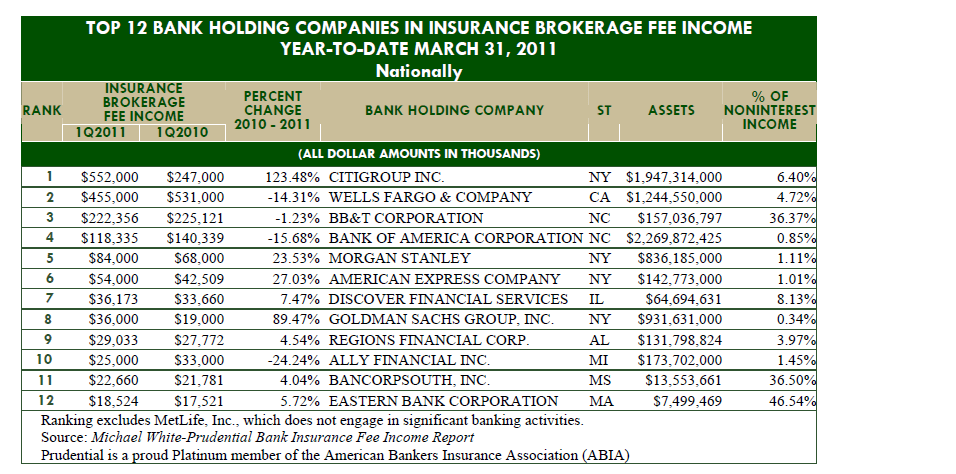
The table below shows the top 12 banks in insurance brokerage fee income thru the first quarter of 2011:

Click to enlarge

Source: Michael White Associates

Excluding life insurer MetLife, Citigroup Inc. (C) topped the ranking with insurance brokerage earnings of $552.0 million followed by Wells Fargo & Company (WFC) and BB&T Corporation (BBT).

Other winners:

Assets between $1 billion and $10 billion

Eastern Bank Corporation (MA), Stifel Financial Corp. (M0), Old National Bancorp (IN), Johnson Financial Group, Inc. (WI), and Trustmark Corporation (MS).

Assets between $500 million and $1 billion

Two Rivers Financial Group (IA), 473 Broadway Holding Corporation (NY), Evans Bancorp (NY), Texas Independent Bancshares (TX), and Northeast Bancorp (ME).

Assets under $500 million

Soy Capital Bank and Trust Company (IL), Industry State Bank (TX), Hoosac Bank (MA), First State Bank (IA), and Stoneham Savings Bank (MA).

Disclosure: Long BBT

The World’s 50 Safest Banks 2011

The Global Finance magazine recently announced its annual ranking of the World’s 50 Safest Banks for 2011. These top banks were selected based on an evaluation of long-term credit ratings—from Moody’s, Standard & Poor’s and Fitch—and total assets of the 500 largest banks worldwide.

From the magazine report:

The sovereign debt crisis is still raging in Europe and renewed fears of contagion from southern European countries is affecting banking and market outlooks throughout Europe.Global political instability is also in the spotlight—from the upheavals in the Middle East and Africa to the US debt downgrade by Standard & Poor’s, companies are watching closely to see how these events are affecting their counterparties.

With more than 40 of the top 50 banks from last year once again making the list, the Global Finance ranking shows that most of the top echelon of banks are truly worthy of the moniker World’s Safest Bank.

The table below lists the World’s 50 Safest Banks for this year together with the ticker if available:

[TABLE=1036]

Source: Global Finance

Some observations:

  • The five largest Canadian banks and Montreal-based Caisse centrale Desjardins have made it to this list.
  • Among the U.S. banks, Bank of America (BAC) and Citigroup (C) did not make the cut.
  • Denver-Colorado based CoBank is a $66 billion cooperative bank serving industries across rural America.
  • Despite fears of banking failures in Europe, the majority of the banks in this ranking are European banks.

Disclosure: Long USB, BNS, BMO, RY, TD, SCGLY, STD, BBVA