U.S. Economic Crises Since 1990

The following is an excerpt of the U.S. economy from the CIA’s The World Factbook site:

The US has the largest and most technologically powerful economy in the world, with a per capita GDP of $47,200. In this market-oriented economy, private individuals and business firms make most of the decisions, and the federal and state governments buy needed goods and services predominantly in the private marketplace. US business firms enjoy greater flexibility than their counterparts in Western Europe and Japan in decisions to expand capital plant, to lay off surplus workers, and to develop new products.

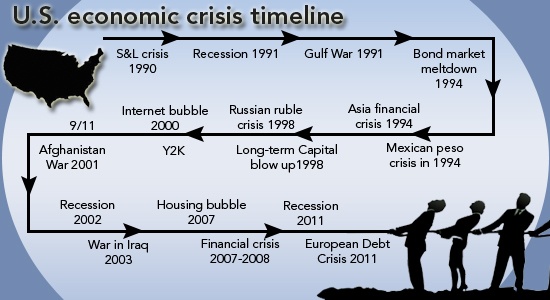
While the U.S. has the largest economy in the world, it is also vulnerable to economic crises of all forms and sizes. Due to structural and political setup, the U.S. economy follows a boom and bust cycle with expansion and contraction occurring every few years or so. Accordingly fortunes are made and lost.

The following graphic illustrates my point with all the major events faced by the U.S. economy since 1990:

Click to enlarge
Source: Time to reconsider stocks, Fidelity Viewpoints

Dr. Claus te Wildt, the author of the above report notes that the Dow Jones Industrials Average(DJIA) more than quadrupled from about 2,500 in September of 1990 to over 12,000 in February of this year. He says this performance shows the power of equities and the strength of the U.S. economy.

However he ignores to mention certain important facts in his report such as comparing the DJIA performance in shorter periods.The DJIA reached 10,000 for the first time in March 1999. At the start of 2000, it stood at 11,501.By the end of December,2010 it stood at just 11,577 which implies that the index basically went nowhere in a decade.Furthermore last Friday it closed at 11,240 which is lower than the 11,501 at the beginning of 2000. So we can conclude that a high number of economic crises in short time periods such as two decades adversely affects the performance of equities.
Impact of Rapid Reversal of Hot Money Flows from Emerging Countries

When hot money flows into an emerging country it can create spectacular rises in equity markets. However when the flow of hot money reverses course, the inevitable crashes will be terrifying as well.

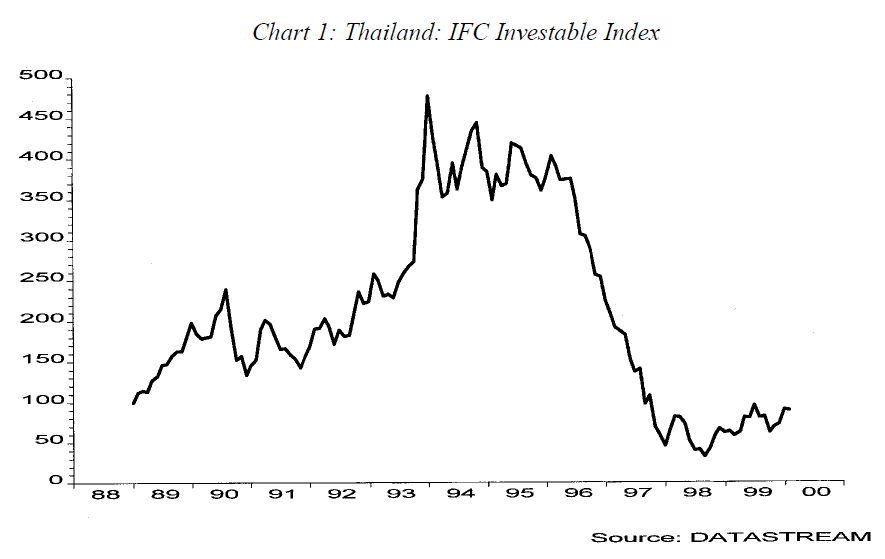
The following chart shows the performance of the Thailand IFC Investable Index from 1988 to 2000:

Click to enlarge

In the early 90s, due to high interest rates and strong growth, Thailand and other East Asian countries received large flows of hot money and experienced a dramatic boom in asset prices.

From Hot Money and Capital Controls in Thailand by Third World Network:

Fixed exchange rates also encouraged external borrowing and led to excessive exposure to foreign exchange risk in both the financial and corporate sectors. A fixed exchange rate regime, free capital mobility, inept regulatory authorities, a weak financial sector as well as reckless behaviour of both borrowers and lenders all combined to render the Thai economy extremely vulnerable to external financial shocks. In 1996, the global economic environment started to change. As the US economy recovered from a recession in the early 1990s, the Federal Reserve began to raise interest rates to head off inflation, making the United States relatively more attractive as an investment destination. At the same time, Thai export growth slowed down sharply, deteriorating its current account position. Loss of confidence in Thailand’s economic and financial system as well as the sustainability of the THB prompted speculators to attack the currency in 1996 and mid-1997.

Note: THB – Thai Bhat

When hot money reverses direction as is the case of Thailand, monetary authorities are caught off-guard and left with little time to respond. As a result, the Thai Bhat lost more than half of its value by January 1998. The stock market plunged by an incredible 75% in 1997 alone. The massive devaluation of the Bhat and hikes in interest rates that followed crushed the real economy as bankruptcies sky-rocketed and non-performing loans in the financial sector soared.

In summary, the Thai experience shows the extreme risk involved with investing in emerging and frontier markets. Asset prices can reach the stratosphere only to fall back to earth in no time. Investors venturing into these markets have to adjust their risk tolerance levels accordingly.

U.S. Companies Can Pay More Dividends Than Their European Peers

European companies generally tend to have higher dividend yields than U.S. companies. For example, currently the dividend yield on the S&P 500 is just 2.15% compared to 3.69% and 4.2% for UK’s FTSE 100 and Germany’s DAX.

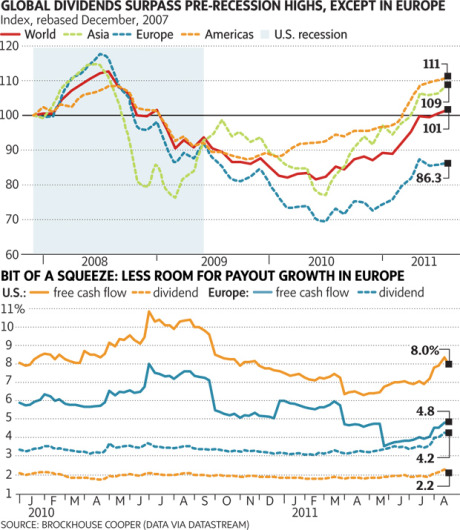
Though European dividend yields are high, the total dividend payouts are still lagging according to a research report by Pierre Lapointe and Alex Bellefleur of Brockhouse Cooper in Canada. In Asia and Europe, total dividends payouts are roughly about 10% above pre-2008 crisis levels compared to Europe where where the figures are still about 14% below pre-2008 levels.

Unlike Asian and North American firms, European companies simply do not have the cash to sustain and grow their dividend payments. From the report:

Click to enlarge

Mr. Lapointe and Mr. Bellefleur noted that the “free cash flow yield” (i.e. annual free cash flow per share as a percentage of share price) on the MSCI Europe stock index is 4.8 per cent, only slightly above the dividend yield of 4.2 per cent.

U.S. companies, on the other hand, have a free cash flow yield of 8 per cent – far above the 2.15-per-cent dividend yield on the S&P 500. “This means U.S. companies have much more room to pay and grow current dividends, while carrying out capital expenditures, than their European counterparts,” they wrote.

Source: Do juicy dividends have room to grow? Follow the cash , The Globe and Mail

Ten U.S. stocks from the S&P Dividend Aristocrats Index are listed below with their current dividend yields for further research:

1.Company:Kimberly Clark Corp (KMB)
Current Dividend Yield: 4.11%
Sector:Personal & Household Products

2.Company:Emerson Electric Co (EMR)
Current Dividend Yield: 3.13%
Sector:Scientific & Technical Instruments

3.Company: Sherwin-Williams Co (SHW)
Current Dividend Yield: 2.01%
Sector:Chemical Manufacturing

4.Company:Stanley Black and Decker Inc (SWK)
Current Dividend Yield: 2.82%
Sector:Appliance & Tool

5.Company:Exxon Mobil Corp (XOM)
Current Dividend Yield: 2.61%
Sector:Oil & Gas – Integrated

6.Company:Air Products & Chemicals Inc (APD)
Current Dividend Yield: 2.90%
Sector:Chemical Manufacturing

7.Company:Grainger, W.W. Inc (GWW)
Current Dividend Yield: 1.78%
Sector:Appliance & Tool

8.Company:Becton, Dickinson & Co (BDX)
Current Dividend Yield: 2.09%
Sector:Medical Equipment & Supplies

9.Company:Leggett And Platt Inc (LEG)
Current Dividend Yield: 5.21%
Sector:Furniture & Fixtures

10.Company:Clorox Co (CLX)
Current Dividend Yield: 3.50%
Sector:Personal & Household Products

Note: Dividend yields noted above are as of September 2, 2011

Related ETFs:
iShares Dow Jones U.S. Select Dividend ETF (DVY)

Disclosure: No positions

15 Impressive Features of the Israeli Economy

Israel is one of the highly successful countries in the Middle East and the world. In just a few decades, the country transformed itself from an economy primarily based on agriculture, clothing and other industries to a hi-tech powerhouse with leadership positions in software engineering, computer component manufacturing, pharmaceuticals and medical technologies. This vibrant economy offers many excellent opportunities for investors. Last year I wrote an article about some of the reasons to invest in Israel.

In this post, let us review some of the impressive features of the economy of Israel:

  1. Inflation has remained well below 5% since the late 1990s.
  2. In addition to the industries noted above, the defense industry is an important part of economy and the country is a major player in the world diamond industry as well.
  3. Israel is described by some as an “island economy” since trade and investment flows with neighboring countries in the Middle East are relatively small but economic ties with the U.S. and Europe is strong.
  4. Net private transfers which includes government-to-government transactions and private households (including remittances) account for about 2% of the GDP.
  5. Compared to most other nations, land property rights are somewhat unique. Only 7% of the land is privately owned, 12% is owned by the Jewish National Fund and the remaining 81% is owned either by the State of Israel or by the Development Authority.
  6. The economy has maintained an average growth rate of nearly 4% per year since 1996, the sixth highest figure among OECD countries.
  7. The ratio of public debt to GDP was 75% in 2010 which is lower than many OECD countries.
  8. Unlike a few other developed countries, the domestic financial sector did not experience a critical failure leading to a strong and speedy recovery. In a January 2011 report the International Monetary Fund noted : “Banks proved resilient to global downturn and have strengthened further”. The report continued: “Financial stability indicators suggest hat the resilience of the banking system has increased over the past year. Capital adequacy ratios,  notably including Tier 1 capital relative to risk-weighted assets, have risen for most banks, while impaired and non-performing loan ratios have declined. Indicators of credit risk also appear strong; although household leveraging has increased somewhat in recent years, the overall level is low, and mortgage loan-to-value ratios are also low by international standards. Banks maintain high liquidity, and interbank and direct exchange rate risk exposures are small”.
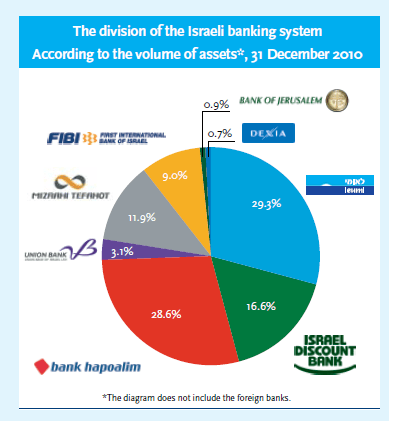
  9. The banking industry has played an important role in positioning the country as an advanced and developed economy that is attractive to international investors. The industry is comprised of 19 commercial banks with most of them concentrated into five banking groups: Leumi, Hapoalim,
    Discount, Mizrahi-Tefahot and FIBI. Along with these groups, three independent banks (Union Bank, Bank of Jerusalem and Dexia) and four branches of foreign banks (HSBC, Citibank, BNP Paribas and State Bank of India) operate more than 1,100 branches in the country.

10. The recent discovery of offshore natural gas fields should reduce the need for imported energy and will help the already strong state fiscal balances with the associated tax and royal revenues.

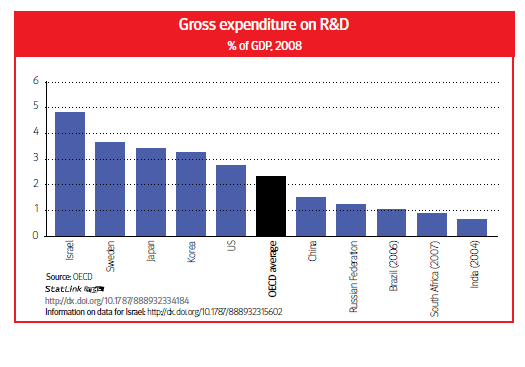
11. Widely praised as a “start-up nation”,  Israel has the highest number of companies listed on the NASDAQ after Canada and the US and the highest level of venture capital as a share of GDP. Israel implemented a hands-on approach to innovation by creating the Office of the Chief Scientist in 1969 within the Ministry of Industry, Trade and Labour to promote innovation  and development of commercial products in the high-tech industry.

12. The standard corporate tax rate currently stands at 24%, but will be reduced gradually to 18% by 2016 due to changes in tax laws. The income tax rate imposed on preferred income(i.e. income generated from activities in Israel only) may reach as low as 6%.

13. The Labor force participation in Israel is 64% among the working-age population which is lower than the OECD average of 71% but still good.

14. A large number of immigrants into the country are highly educated, skilled and talented. For example, many of the Jews that emigrated after the breakup of the Soviet Union were engineers, scientists, etc. who further strengthened Israel’s “human capital”.

15. Due to cultural and religious attractions and increasingly leisure, tourism is also a major contributor to the economy with the industry experiencing an average growth of 12%  in the last three years. Last year revenue from tourism totaled $4.3 billion.

In terms of investment options, generic drugs maker Teva Pharmaceutical Industries(TEVA) and security software company Check Point Software Technologies Ltd(CHKP) are two excellent candidates to consider. Some of the other companies that investors can review include Mellanox Technologies Ltd. (MLNX), Radware (RDWR), Protalix Biotherapeutics Inc. (PLX) and EZchip Semiconductor Ltd. (EZCH). According to an article by Shlomi Cohen in Seeking Alpha these four firms have a good chance of reaching a market capitalization of $1 billion this year.

The iShares MSCI Israel Capped Investable Market ETF (EIS) is a simple and easy way to invest in Israel. This ETF gives exposure to 86 companies with financials accounting for about 29% of the portfolio. The fund has an asset base of $93 million and the expense ratio is 0.61%.

Source: Spotlight on Israel, OECD Observer, Q2, 2011

Disclosure: No Positions

The 50 Largest U.S. Banks Based on Assets

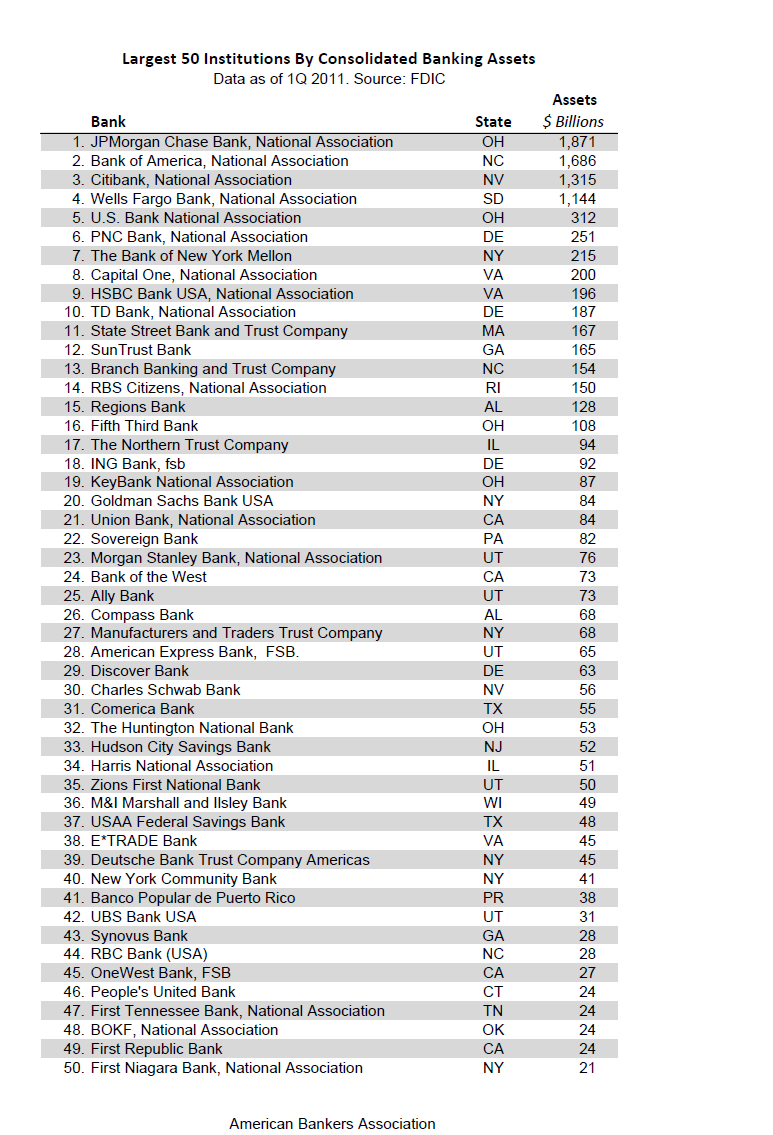
The landscape of the U.S. banking industry has changed in the past few years as strong banks became stronger and weak banks were either gobbled up or failed. The graphic below shows the 50 largest banks in the U.S. based on assets held as of first quarter 2001:

Click to enlarge

Source American Bankers Association

Wells Fargo (WFC), the smallest among the four super-banks, is four times larger than the next ranked U.S. Bank (USB). All the four largest banks hold over $1 Trillion in assets. It interesting to see that HSBC Bank USA and TD Bank are in the top ten. These banks are subsidiaries of their foreign parents HSBC plc(HBC)  of UK and TD Bank (TD) of Canada respectively. Last Thursday TD Bank overtook Royal Bank of Canada(RY) in market value momentarily on the Toronto Stock Exchange for the first time in a decade.

In December 2010 Canada’s Bank of Montreal (BMO) bought Marshall & Ilsley Corp. of Wisconsin for $4.1B in stock.

Disclosure: Long TD, RY, USB, BMO