Five OTC-Traded German Stocks To Consider

Germany’s DAX index rose over 3% yesterday after having fallen heavily in the past few weeks due to the debt crisis triggered by Greece and other weak European countries. While financials were focus of investors, non-financial firms were also thrashed in the recent sell-off. As a result, some of these non-financial stocks are now worth looking into for possible addition to one’s portfolio. Many of the German companies have strong export-based business models and so their earnings are not impacted by Greece, Italy but mostly by other countries especially by countries located outside of Europe.

Five OTC-traded German ADRs are listed below with their YTD change:

1.Company: Adidas AG (ADDYY)
YTD Change: 3.00%
Sector: Footwear

2.Company: BASF SE (BASFY)
YTD Change: -12.58%
Sector:Chemical Manufacturing

3.Company: Continental AG (CTTAY)
YTD Change: -14.84%
Sector:Auto & Truck Parts

4.Company: Hannover Rueckversicherung (HVRRY)
YTD Change: -8.43%
Sector: Reinsurance

5.Company: Linde (LNEGY)
YTD Change: -3.04%
Sector:Chemical Manufacturing

Each of the above five companies excel in their line of business. BASF is the undisputed world leader in chemical manufacturing. Hannover Re is a reinsurer which insures insurance companies. Last week Continental Tire announced plans to build a $500 million factory in South Carolina. Linde is a maker of speciality chemicals. Adidas owns the Reebok brand and is well respected around the world. In addition to footwear, the company also makes many sports-related products and clothing.

Disclosure: No positions

Top 20 Kazakhstan Companies by Market Capitalization

Kazakhstan became an independent country in 1991 after the breakup of the Soviet Union. It is the ninth largest country in the world and is bigger in size than Western Europe.

Unlike other natural resources-based economies, Kazakhstan is unique in that 99 of the 110 elements in the Periodic Table of the Elements are present in the country. Oil, gas, uranium, zinc, tungsten, barium, silver, lead, chrome, copper, fluorites, molybdenum, and gold are some of the resources that are currently being extracted from the land. In fact, the country’s vast mineral resources is estimated to be valued at over US$46.0 Trillions.

As an investment destination Kazakhstan is the wild west of the frontier markets and is slowly gaining the attention of international investors. Kazakh companies are not yet easily accessible to foreign investors as most of them are not traded on the major global exchanges. Fellow blogger and fund manager Roger Nusbaum has written about the country a few times. From one of his article last month:

The email in question shared news that many state owned companies will soon be sold into the market in a similar manner as many of the large Chinese companies, at least that is how I read it. Some companies mentioned were Air Astana, KEGOC which operates the electric grid, KazTransOil an oil pipeline company, KazTransGas a gas pipeline company, Kazmortransflot a shipping company, Samruk-Energo which generates power, Kazakhstan Temir Zholy a railroad operator and Kazatomprom a uranium miner. There are also a few materials companies that have been trading on other markets for a while with Kazakhmys (KZMYF) the one name most likely to be familiar. Kazakh Telecom appears to have a listing in France, but not on the US pinks, but it appears to have not traded since February. Kazmunaigas is also included in the announcement but it has shares trading on the AMEX; they’ve not done too well.

The ETF provider Global X filed for a country fund for Kazakhstan in July. But it is not clear when the ETF will actually be listed.

The Top 20 Kazakh Companies by Market Capitalization

Click to enlarge

Source: The attractiveness of the Kazakhstan Market, BNP Pribas

Two of the above companies trading on the London Stock Exchange(LSE) are Eurasian Natural Resources Corporation PLC (ENRC.L) and Kazakhmys PLC (KAZ.L). Polyus Gold International Limited GDR trades on the pink sheets under the ticker PLZLY.PK.

Related Links:

Kazakhstan Stock Exchange (KASE)

Also checkout:

Disclosure: No Positions

USA Has One of the Lowest Taxes Among OECD Countries

The current U.S. total public debt outstanding exceeds $14.8 Trillions. This huge debt has been accumulated over many years under the of administrations of both Republican and Democratic presidents.

Just like a business it takes money to run a government. One of the main sources of revenue for governments is taxes. So Tax Revenues as a percentage of GDP is an ideal measure to determine if a country’s tax collections is high or low. Based on this measure, the U.S. ranks lowest among most of the developed countries.

According to a recently released OECD report, the Tax Revenues as a percentage of GDP for the US was just 24% in 2009, the latest year for which data is available. This is lower than most other developed nations with sample countries like Denmark at 48.2%, UK at 34.3%, Canada at 31.1%, etc. Of course, higher taxes collected by these countries helps pay for generous benefits to citizens such as free high-quality healthcare for all, education, unemployment insurance, etc.

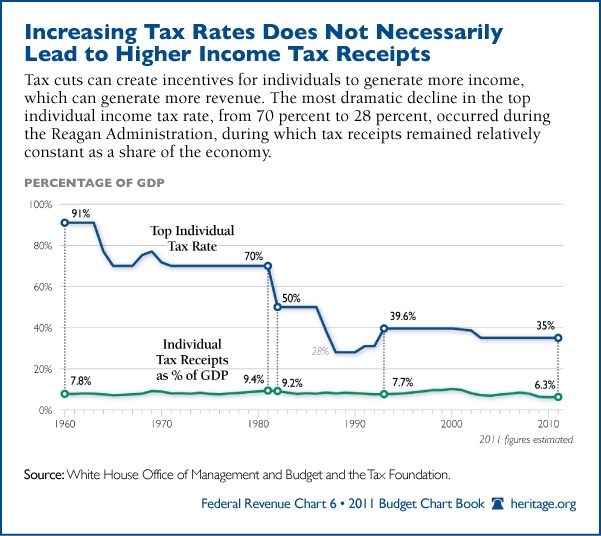
Until now the lower tax rate regime in the U.S. worked fine since the economy was mostly growing and a lower percentage of the population was dependent on the state for survival. However that scenario has changed dramatically in the past few years due to the sluggish economy. The U.S. Federal government’s tax revenues as a percentage of the GDP has for the most part stayed at around around 20% or lower while expenditures have increased due to wars, soaring healthcare costs, social security and other entitlement programs. Hence unlike other developed countries, in the U.S. the gap between tax revenues and expenditures is widening at an alarming rate. With both the parties unable to increase taxes or decrease expenditures substantially, the situation is bound to get worse in the future.

The table below lists Tax Revenues as a percentage of GDP for OECD countries:

[TABLE=1046]

Source: OECD

The following graph shows the U.S. Tax Revenues as a percentage of GDP from a historical perspective:

Click to enlarge

Source: 2011 Budget Chart Book, The Heritage Foundation

The Global Too-Big-To-Fail Banks

Many large U.S. banks were bailed out with tax payers’ funds during the Global Financial Crisis (GFC). Since then these banks have gotten even bigger by acquisitions and decline in competition as struggling smaller banks are left to fail by Uncle Sam. These small group of elite institutions aka known as “Systemically Important Financial Institutions” (SIFIs) are now required to hold more capital as a percentage of assets because of the Dodd-Frank law. This extra capital has come to be known as the “SIFI surcharge” in the industry.

According to an article in The Wall Street Journal recently the global equivalent of this charge is expected to confirmed by the G-20 leaders when they meet in Cannes, France next month.

So what are some of the Global Too-Big-To-Fail(TBTF) Banks?

Click to enlarge

Source: Big Banks Find No Comfort in Capital Cushion

Dexia is a French-Belgian bank that is on the verge being dismantled by France and Belgium. From an investment perspective investors may consider adding Sweden-based Nordea Bank (NRBAY). It has a dividend yield of over 5%. While states may declare these banks as TBTF banks it does not mean investors can invest in their common stocks without any worry of getting wiped out. Germany’s Commerzbank (CRZBY), UK’s Royal Bank of Scotland (RBS), etc. may still fail and equities can become worthless but the banks themselves will not disappear completely. They may be merged with other larger peers or reorganized in a different shape.

Disclosure: Long CRZBY, STD, ING,RBS, SCGLY, BBVA

Which Country is a Better Investment: Brazil or India ?

The emerging markets of Brazil and India are vastly different in many ways. Brazil is not only blessed with many natural resources that the world wants but is also increasingly becoming as an exporter of manufactured goods. But Brazil has a small population compared to India.

India on the other hand has limited natural resources but traditionally has had a large manufacturing sector. With a huge population India offers bigger market for growth.

For foreign investors, both the countries offer a wide variety of choices for investment from banking to consumer goods to real estate sectors. However the Brazil is ahead of India in terms of equity market performance based on the MSCI country indices.

Multi-year performance of MSCI India and Brazil indices:

Click to enlarge


5-year performance of MSCI India and Brazil indices:

Source: MSCI

The long-term performance of Brazil and India are incomparable as shown in the first chart. One reason for this huge gap between them could be that India adopted free-market economic policies only in the 1990s and for many years even after that discouraged foreign investment in a number of key sectors of the economy.

The 5-year chart shows that the equity market performance of Brazil and India tracked each other though Indian stocks always lagged. Brazilian stocks fell heavily at the height of the credit crisis in 2009, but have recovered better than Indian stocks.

The equity market performance of the next five years will be closely watched by investors as both countries are projected to have strong economic growth and continue to attract high foreign direct investment. Since each country has its own unique risks and certain sectors offer higher potential for growth than others, investors must evaluate and invest in individual companies (or) sectors rather than simply going with country-specific funds.

Related ETFs:
EGShares India Infrastructure ETF (INXX)
EGShares Brazil Infrastructure ETF (BRXX)
iShares MSCI Brazil Index (EWZ)
Market Vectors India Small-Cap Index ETF (SCIF)
WisdomTree India Earnings (EPI)
PowerShares India (PIN)
iShares S&P India Nifty 50 (INDY)

Disclosure: No positions