Comparing Sources of Electricity Generation in North American OECD Countries

I came across the following interesting chart showing the sources of power generation in the OECD countries of North America:

Source: International Energy Outlook 2011, U.S. Energy Information Administration

Coal is the major source of electricity generation in the U.S.. Accounting for about 50% of the fuel source in 2008, it is projected to decline by 2035 but still accounting for about 40% of the fuel used for power generation. This percentage is much higher than in Canada, Mexico and Chile. Canada produces much of the electricity from hydro power and Mexico and Chile use natural gas as the main fuel source.

Related ETFs:

Market Vectors-Coal ETF (KOL)
Utilities Select Sector SPDR Fund (XLU)

Disclosure: No Positions

What Are The Global Risks in 2012?

The World Economic Forum has published the Global Risks 2012 report. One of the key takeaways from the report is the graphic below that shows the top global risks this year with their likelihood of occurring and impacts:

Click to enlarge

It is interesting to note that the risk of “Chronic fiscal imbalances” is ranked high but “Hard landing of an emerging economy” is ranked low.

The graphic below shows the interconnection between the risks:

Source: Global Risks 2012 – Seventh Edition, World Economic Forum

PFC Energy: The World’s Top 50 Energy Companies 2012

The global energy consultancy PFC Energy has published its annual ranking of the World’s Top 50 Energy Companies for 2012 based on market capitalization.

The table below lists the PFC Energy 50 with their US market tickers if available:

[TABLE=1055]

Source: Bloomberg, PFC Energy estimates as of 12/31/2011

• Share price growth based on primary exchange tickers in $US.
• Prices for thinly traded companies are as of year’s last trade.
• Changes in market capitalization may differ from changes in share price due to mergers, share repurchases and other factors.

* BHP Billiton is ranked based on 20% of the market capitalization of the parent company, representing the contribution of the petroleum segment to corporate EBIT in the 12 months ended 6/30/11.

** Midstream/Infrastructure category added this year.

Note:

NOC – National Oil Companies
NOC – International Oil Companies
E&P – Exploration & Production
R&M – Refining & Marketing

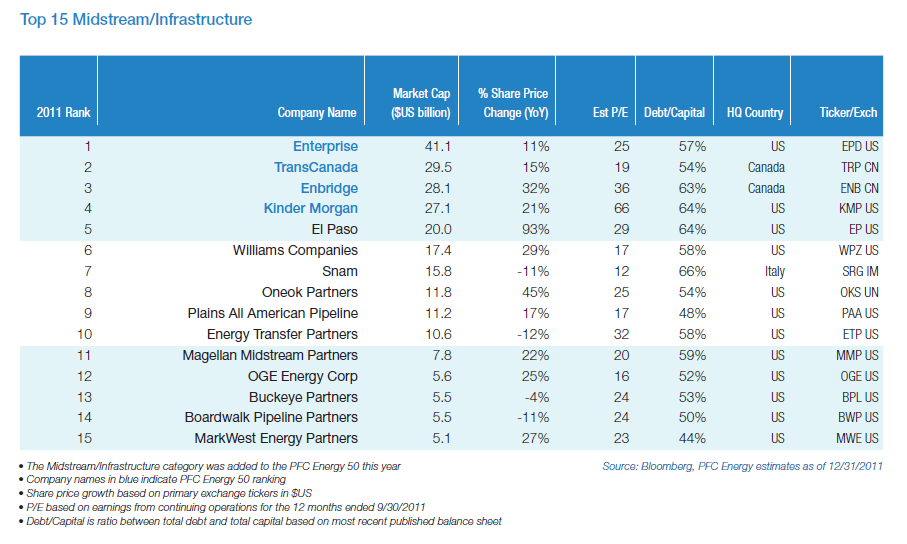
Oil supermajor ExxonMobil (XOM) maintained the top rank with a market cap of $406.3 billion followed by PetroChina. National Oil Companies and companies located in the emerging markets underperformed in this ranking as investors viewed “these companies more critically due to country risk exposure and lack of portfolio diversification”. In recognition of the expanding oil and gas potential of North American onshore this year’s list includes four midstream and pipeline companies – Enterprise (#25), TransCanada (#37), Enbridge (#40) and Kinder Morgan (#41).

Source: PFC Energy

Disclosure: Long EONGY, PBR

Looking for Opportunities Among Europe’s Largest Electricity Companies

Most European equity markets were down by digits last year due to the debt crisis. Along with stocks from other sectors investors also dumped the traditionally stable utility stocks. The STOXX® Europe 600 Utilities Index reached a high of over 600 before the global financial crisis (GFC) of 2008 in US dollar terms. On 1/20/12 it closed at well below 300 for a loss over 50% from the peak.

European markets are performing well so far this year and many utilities in particular look cheap at current levels. Fears over nuclear power generation in Germany has for the most part subsided and large European utilities are looking for growth both in the European market and emerging markets. For example, earlier this month German electric utility E.ON announced a strategic partnership with Brazilian company MPX to invest in the Brazilian and Chilean energy markets. E.ON plans to ultimately invest € 350 million for a 10% stake in MPX.

The chart below shows the Top 15 Electricity Producers in Europe in 2009:

Source: Vattenfall Annual Report 2010

The largest players in the European energy market in terms of sales are EDF (France), Enel (Italy),
E.ON (Germany), GDF Suez (France), and RWE (Germany). These firms have operations across Europe and some of them also have significant presence outside of Europe. In addition to these larger firms, there are a number of regional companies including Centrica and SSE (UK), CEZ (Czech Republic), Dong (Denmark), EDP (Portugal), Fortum (Finland), Gas Natural Fenosa and Iberdrola (Spain), Statkraft (Norway), Vattenfall (Sweden) and Verbund (Austria). There are also a large number of local electricity suppliers mostly municipality-owned. In Sweden there are some 120 such firms, in Germany about 900 and in The Netherlands some 80.

The Top European Electricity Producers are listed below together with their ADR tickers, if available and the current dividend yields for consideration:

1.Company: Electricite de France (ECIFY)
Current Dividend Yield: 7.00%
Country: France

2.Company: E.ON AG (EONGY)
Current Dividend Yield: 10.22%
Country: Germany

3.Company: RWE AG (RWEOY)
Current Dividend Yield: 14.50%
Country: Germany

4.Company: GDF Suez (GDFZY)
Current Dividend Yield: 7.46%
Country: France

5.Company: Enel (ENLAY)
Current Dividend Yield: 13.11%
Country: Italy

6.Company: Vattenfall
Current Dividend Yield: N/A
Country: Sweden

7.Company: Iberdrola (IBDRY)
Current Dividend Yield: 1.39%
Country: Spain

8.Company: EnBW
Current Dividend Yield: N/A
Country: Germany

9.Company: CEZ (CZAVF)
Current Dividend Yield: N/A
Country: Czech Republic

10.Company: PGE (PGPKY)
Current Dividend Yield: N/A
Country: Poland

11.Company: Statkraft
Current Dividend Yield: N/A
Country: Norway

12.Company: PPC
Current Dividend Yield: N/A
Country: Greece

13.Company: Fortum (FOJCY)
Current Dividend Yield: 6.92%
Country: Finland

14.Company: SSE (SSEZY)
Current Dividend Yield: 5.94%
Country: UK

15.Company: Edison Spa
Current Dividend Yield: N/A
Country: Spain

Note: Dividend yields noted above are as of Jan 20, 2012

It must be noted that the respective state is the majority owner in many European utilities such as EDF (France),  GDF Suez (France), Enel (Italy) and Fortum (Finland). Sweden’s Vattenfall is unlisted since it is 100% owned by the state.

Disclosure: Long EONGY, RWEOY

Some Fascinating Facts about the U.S. Financial Services Industry

The following are some interesting facts about the U.S. financial services industry from a research report published by The Financial Services Roundtable. I have included my comments for some of the events.

Year    Event

1782    Pennsylvania chartered the first bank in the U.S.

1790   The federal government refinanced all federal and state Revolutionary War debt, issuing $80

million in bonds. These bonds became the first major issues of publicly traded securities, marking

the birth of the U.S. investment markets.

1791   Secretary of the Treasury, Alexander Hamilton, established First Bank of the United States.

1792   Insurance Company of North America, first stock insurance company, established.The

Buttonwood  Agreement, pact between 24 brokers and merchants to trade securities on a

common commission basis, marked the origins of the New York Stock Exchange. Bank of

America(BAC) was first listed  stock.

1809  The first bank failure happened in Rhode Island. Bank failures continue to occur this day. To date

three banks have been shut down by the FDIC this year. These closures have become the Friday

Night Follies of this era. Bank of America (BAC) almost failed but exists in tact today as they

were  bailed out by the state.

1863   Office of the Comptroller of the Currency was established in the U.S. Treasury Department. The

agency was authorized to charter banks and issue national currency.

1875   American Express (AXP) established the first pension plan in the U.S. American Express exists

still today as a highly ranked player in the global credit card industry.

1909 St. Mary’s Cooperative, the first U.S. credit union, formed in New Hampshire. Today there are

7,535 credit unions serving 92 million customers in the country.

1913  The Federal Reserve was established to replace J.P. Morgan as lender of last resort. It is

interesting to see how one man was rich and powerful enough to bail out the whole economy in

those days. JP Morgan Chase (JPM) is one of the four US “super-banks”.

1924  First mutual funds established in Boston. As of 2010, there are a total of 7,581 funds in the U.S.

Despite the many crashes in the markets since 1924, the growth of the mutual fund industry is

simply astonishing.

1929 The stock market crashed. Nearly 10,000 U.S. banks failed across the land and millions of people

lost their savings.

1932 The Federal Home Loan Bank Act established Federal Home Loan Bank System to act as central

credit system for savings and loans institutions.

1933 The Glass-Steagall Act, separating banking and securities industries, passed by Congress. Much of

the restrictions placed by this law was repealed by President Clinton during the late 1990s.

Federal Deposit Insurance Corporation, guaranteeing accounts up to $2,500, opened. At the height

of the credit crisis, this limit was raised to $250,000.

1955 First U.S.-based international mutual fund introduced. But even today most US funds are focused

on the US markets.

1970 The U.S. government introduced mortgage-related securities to increase liquidity. National Credit

Union Administration was created to charter and supervise federal credit unions.

1972 Money market mutual funds were introduced for the first time.

1974 Automated teller machines (ATMs) were widely introduced by banks.

1975 The SEC deregulated broker commissions by eliminating fixed commissions brokers charged for

all securities transactions. As a result, the U.S. has the lowest securities transaction costs in the

developed world.

1989 The Financial Institutions Reform, Recovery and Enforcement Act was established, providing

government funds to insolvent savings and loan institutions (S&Ls) from the Resolution Trust

Corporation. Similar to the bailouts during of the credit crisis, tax payers footed the bill in the

earlier banking crisis as well.

1999 The Gramm-Leach-Bliley Financial Services Modernization Act allowed banks, insurance

companies and securities firms to affiliate and sell each other’s products.

2005 The Federal Bankruptcy Prevention and Consumer Protection Act was enacted to tighten rules

for personal bankruptcy.

2008 Failed lender Washington Mutual was taken over by JPMorgan Chase after it was shut down by

federal regulators, marking the largest failure in banking history. Confirming the failure of state

involvement in the free markets, the federal government took over Fannie Mae and Freddie Mac.

Securities giant Lehman Brothers also failed, marking the largest bankruptcy in U.S. history.To

prevent a total collapse of the financial system, the TARP was hastily established with a $700

billion rescue plan for the financial services industry.

2010 The Dodd-Frank Wall Street Reform and Consumer Protection Act, landmark regulatory

overhaul of the financial services industry, was signed into law. After years of failing to protect

consumers, the federal government finally enacted laws providing some consumer protections

related to credit cards. President Obama signed the Patient Protection and Affordable Care Act,

requiring most U.S. citizens to have health insurance thus giving a bonanza to the healthcare

industry.

Source: The Financial Services Fact Book 2011, The Financial Services Roundtable

Disclosure: No Positions