Here is an interesting chart on the future of the Top 10 Tobacco markets:
Click to enlarge
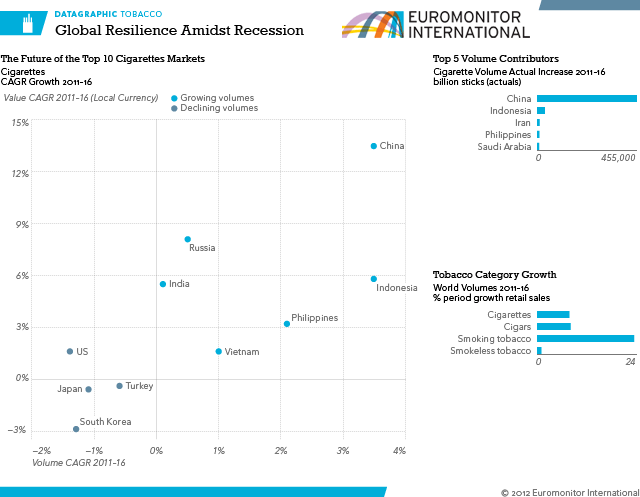
Source: Euromonitor International
Also checkout:
Here is an interesting chart on the future of the Top 10 Tobacco markets:
Click to enlarge
Source: Euromonitor International
Also checkout:
The current U.S. corporate tax rate at approximately 40% is among the highest in the world. This figure includes the marginal federal corporate income tax rate of 35% and state and local taxes according to KPMG. As many U.S. companies are multinationals with strong presence in overseas markets, some of them earn more profits abroad than in the US. According to one estimate, just 70 U.S. firms hold $1.2 trillion in profits in foreign countries.Companies have stashed such huge amount of funds abroad because if they are repatriated back to the U.S., Uncle Sam will charge the same high corporate tax rate on them. Hence for many years now companies have been reluctant to repatriate profits firm abroad. Since the great recession U.S multinationals have lobbied for a tax holiday on profits earned abroad. But Congress has not yet embraced the proposal so far.
In addition to the high corporate tax rate, the U.S. is one of the few OECD nations that does not follow the territorial tax
system. Under this system,corporations pay a very law tax on repatriated profits. 27 of the 34 OECD countries follow this
system with tax deductions of 95% to 100% on foreign source dividends.Hence a reduction in the taxes on repatriated
profits would put the U.S. closer to the territorial tax system.
Click to enlarge

Source: The Need for Pro-Growth Corporate Tax Reform, Repatriation and Other Steps to Enhance Short-and Long-Term Economic Growth. Prepared for the U.S. Chamber of Commerce, by Douglas Holtz-Eakin, August 2011
For individuals, the U.S. is one of the only seven OECD countries that levies taxes on worldwide income and not just income earned in the U.S. As shown in the chart above, the U.S. also has the highest tax rate among the seven OECD countries that levy taxes on worldwide income.
From the IRS site:
If you are a U.S. citizen or resident alien, the rules for filing income, estate, and gift tax returns and paying estimated tax are generally the same whether you are in the United States or abroad. Your worldwide income is subject to U.S. income tax, regardless of where you reside.
Hence a U.S. citizen working in Dubai or Timbuktu or Sao Paulo is required by law to file income and pay taxes. However a tax credit is allowed in order to prevent to double taxation. Currently the US has tax treaties with 65 countries to help reduce the burden of double taxation.
So the U.S. tax system has to be amended to bring the tax rates inline with other developed countries for both individuals and corporations.
For more details on US Tax Treaties, please go to the following IRS web sites:
Interesting table showing the Major U.S. and Foreign Futures Exchanges:
Click to enlarge
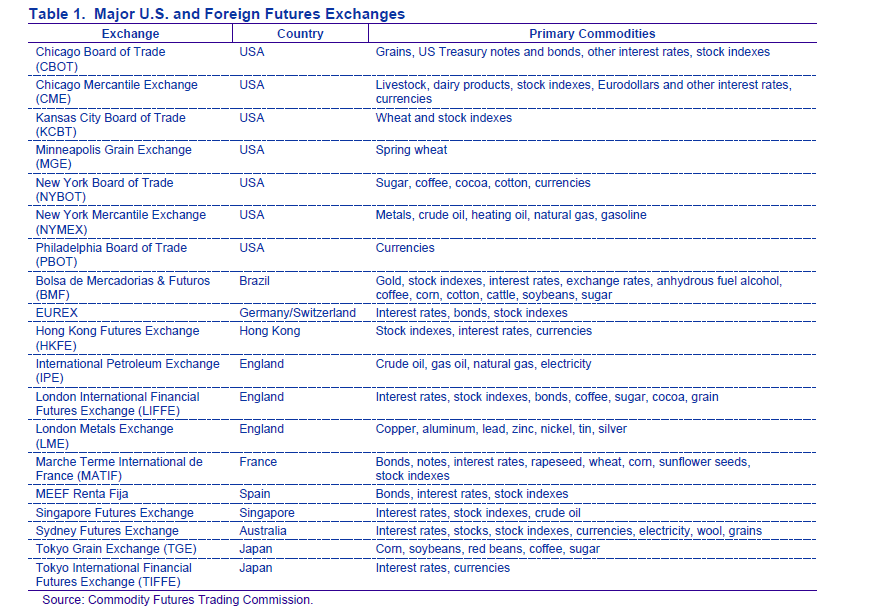
Source: Derivatives and Risk Management in the Petroleum, Natural Gas, and Electricity Industries, Energy Information Administration, Oct 2002
The healthcare industry in the U.S. is dominated by a few large companies.Private health insurance firms’ direct written premium totaled $395 billion in 2010. With additional health premiums written by life and other insurers, the total health premiums amounted to $560 billion according to SNL Financial. The number of people with no health insurance increased from 46.3 million in 2008 to 50.7 million in 2009 according to U.S. Census Bureau.
In 2010, about 16.3% of the total U.S. populated lacked any form of coverage for health care.With the passage of Obama’s The Patient Protection and Affordable Care Act (PPACA), these uninsured people will be required to buy health insurance starting in 2014. As a result, health insurers should see their business grow in the coming years and accordingly generate higher profits. In anticipation of the law, many health insurers have already increased premiums to compensate for insuring a larger risk pool.As in the past, healthcare costs is projected to soar more than the inflation rate each year. From an investment standpoint,larger health insurers are a better option than smaller ones since they can maximize the economies of scale and have stronger financial reserves to grow and pay claims.
The Top Ten U.S. Health Insurance Companies are shown in the table below:
Click to enlarge
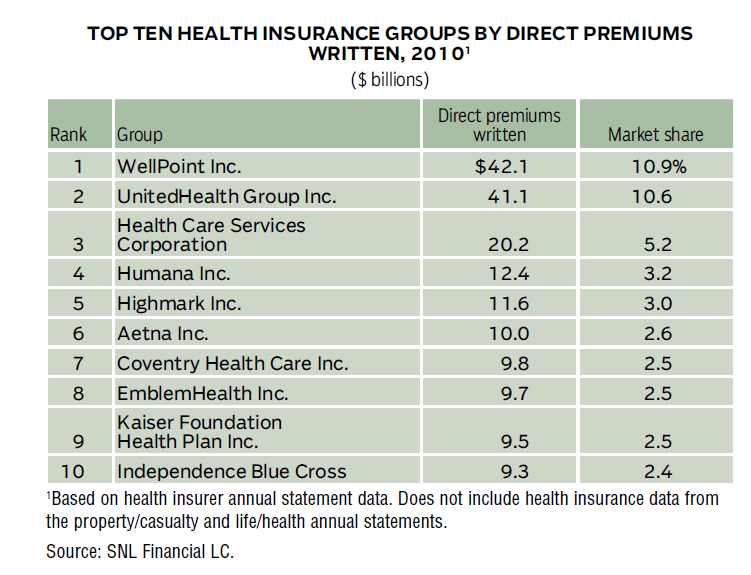
Source: 2012 Financial Services Fact Book 2012 by Insurance Information Institute and Financial Services Roundtable.
The two largest health insurers by market share are WellPoint(WLP) and UnitedHealth Group(UNH).
Some of the ETFs related to the health insurance industry are Health Care Select Sector SPDR (XLV), Vanguard Health Care ETF (VHT), iShares Dow Jones US Healthcare (IYH) and iShares Dow Jones U.S. Medical Devices Index ETF (IHI).
Disclosure: No Positions
Note to Bond King: Check Your Math
Investors Prepare for Euro Collapse
Why U.S. student loans are not the next financial bubble
Best Bank 2012: Santander storms through the Spanish crisis
North against South in Europe?
Car use declining in North America
China: least of our worries, greatest of our hopes
Is lending by state banks more stable over the business cycle?
Who Wants To Break Up The Big Banks?
Click to enlarge

Climber Kate Rutherford, Yosemite, USA
Photo Courtesy: The daredevils of Yosemite, BBC Travel