Germany’s Sources of Electricity Generation

Germany has set an ambitious plan to move away from fossil fuels and abandon nuclear power in the coming years. As a major industrial powerhouse this a big challenge since the country has to find other sources of electricity to replace the power generated from fossil fuels and nuclear power. Germany is increasingly depending renewable energy sources to meet its electricity needs, By the year 2020, one-third of power produced is projected to come from renewable sources.

Germany’s Sources of power generation in 2011:

Click to enlarge
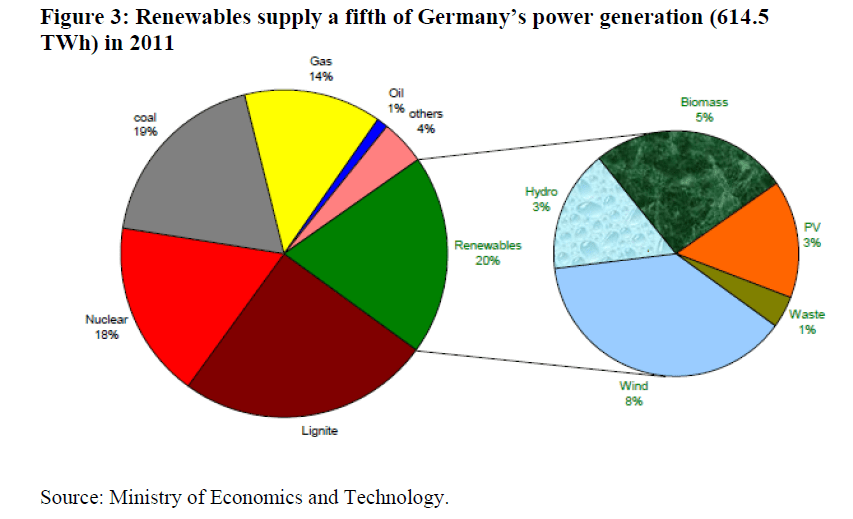
Source: The Energiewende – Germany’s gamble by David Buchan, June 2012, The Oxford Institute for Energy Studies, University of Oxford

Four companies dominate power generation in Germany. These firms include Germany-owned EnBW, E.ON(EONGY), RWE (RWEOY)and Swedish-owned Vattenfall which provides electricity generation in the former East German parts of the country. The three major German utilities noted above have seen their share prices plunge in the since last year due to the government’s decision to phase out nuclear power. However in the past few months their share prices have stabilized and have slowly started to crawl up. Up until now these three firms have been big players in the renewable energy market in other countries but not in their home country of Germany.

Vattenfall is one of Europe’s largest producers of electricity and heat. The group is 100% owned by the Swedish state. Vattenfall’s core markets are Sweden, Germany and the Netherlands  and has operations in Belgium, Denmark, Finland, Poland, France and the UK as well. The company’s share does not trade on the US markets.

The long-term performance of E.ON (EONGY) and RWE AG(RWEOY) is show below:
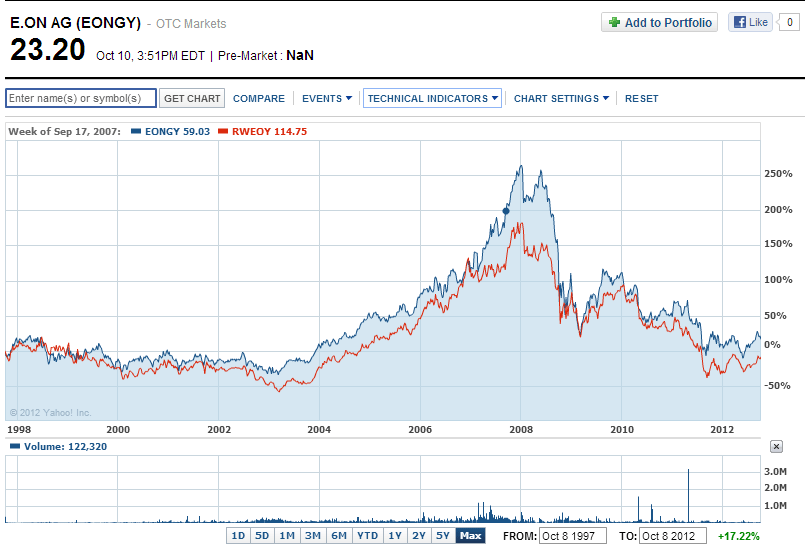
 

Source: Yahoo Finance

Related ETF:

iShares MSCI Germany Index Fund(EWG)

Related article:

German Energy Plan Plagued by Lack of Progress (Der Spiegel)

Clean Break: Germany’s Switch to Renewables (Bloomberg)

Disclosure: Long EONGY and RWEOY
Defensive Sector Stocks Offer Superior Returns To Long-Term Investors

Many investors consider defensive sector stocks to be boring and under-performing in both the short and long-terms. However contrary to their beliefs the defensive sector actually yields superior returns especially in the long-term, which can be defined as a holding period at least five years. Not only do these stocks offer higher returns they also also offer stability to a diversified portfolio during adverse market conditions such as the meltdown of global equity markets during the financial crisis.

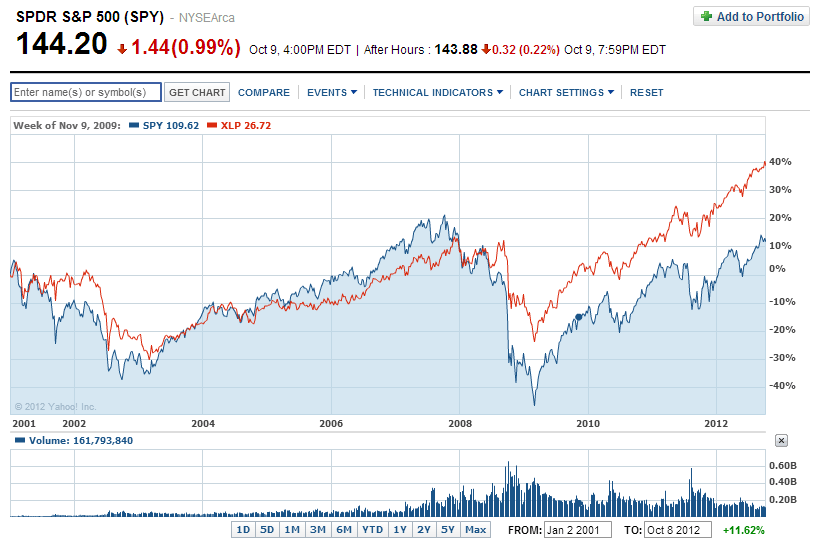
A research report by Credit Suisse research report last year noted that from 1995 thru 2011, defensive sectors outperformed the broader market as measured by the MSCI World Index by about 130 percent.  Using the US market as an example of this strategy, the following chart shows the performance comparison of the S&P 500 and Consumer Staples sector ETFs:

Click to enlarge


Source: Yahoo Finance

During the March 2009 lows reached by the S&P 500 index the defensive sector ETF held up well  and has continued to outperform. While the S&P 500 index ETF (SPY) has returned about 10% since 2001, the consumer staples ETF(XLP) has grown by about 40%.

Defensive sectors outperform over the long-term due to the compounding effect of dividends, stable growth and they are also relatively less affected by economic cycles. For example, regardless of the state of the economy consumers buy food, toothpaste, drugs and use electricity, mobile phones, etc. Companies operating in the sector are usually well-established and have strong cash-flows which helps to make consistent dividend payments and also dividend increases occasionally.

Investors looking to add defensive stocks to their portfolios can consider the foreign stocks listed below:

1.Company: Coca Cola Femsa SAB de CV (KOF)
Sector:Beverages (Nonalcoholic)
Current Dividend Yield: 1.46%
Country: Mexico

2.Company: Unilever NV (UN)
Sector:Food Processing
Current Dividend Yield: 3.34%
Country: The Netherlands

3.Company: Diageo PLC (DEO)
Sector:Beverages (Alcoholic)
Current Dividend Yield: 2.43%
Country: The UK

4.Company: Bayer AG (BAYRY)
Sector: Major Drugs
Current Dividend Yield: 2.42%
Country: Germany

5.Company: Vodafone Group PLC (VOD)
Sector: Telecom
Current Dividend Yield: 5.11%
Country: UK

6.Company: Danone SA (DANOY)
Sector:Food Processing
Current Dividend Yield: 2.98%
Country: France

7.Company: Henkel AG (HENKY)
Sector: Household goods
Current Dividend Yield: 1.53%
Country: Germany

8.Company: British American Tobacco PLC (BTI)
Sector: Tobacco
Current Dividend Yield: 4.01%
Country: UK

9.Company: Vina Concha y Toro (VCO)
Sector: Beverages (Alcoholic)
Current Dividend Yield: 2.41%
Country: Chile

10.Company: Teva Pharmaceutical Industries Ltd (TEVA)
Sector: Biotechnology & Drugs
Current Dividend Yield: 2.45%
Country: Israel

Note: Dividend yields noted are as of Oct 9, 2012

Disclosure: Long HENKY

Download: Barclays Equity Gilt Study 2012

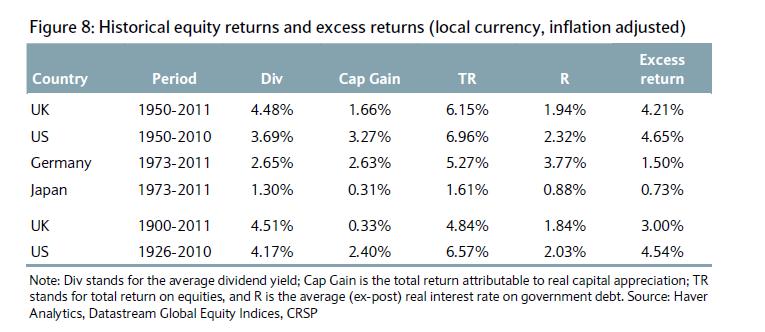
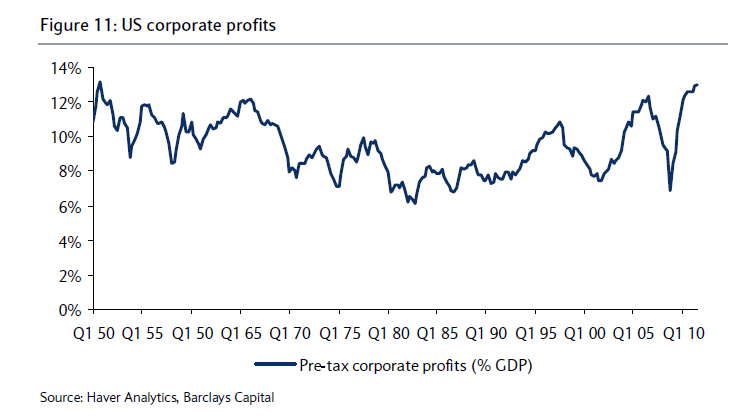
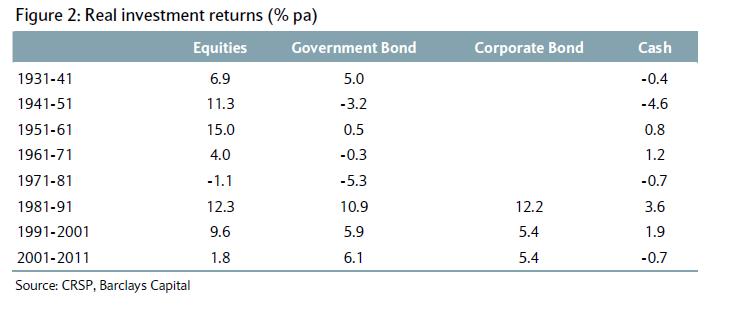
The Barclays Equity Gilt Study 2012 was published earlier this year. Below are few of the interesting charts from the report:

Click to enlarge

1.Historical equity returns and excess returns of select countries:

2.US Corporate Profits since 1950:

3.US Real Investment Returns by Decade:

Download:

To download the full report in pdf format click Barclays Gilt Study 2012 Full Report

Related:

Download: Barclays Equity Gilt Study 2011

UK Real Equity Returns From 1900 To 2011

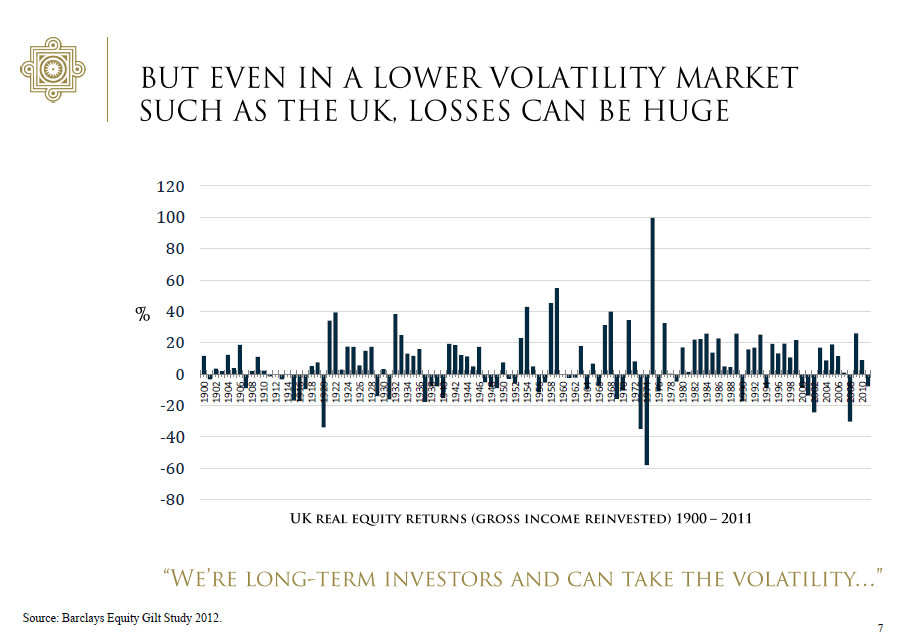
Stocks generally yield higher returns than bonds and cash over the long term. For example,  £1 invested in British stocks in 1900 would have grown to £116,394 by 2011. However the £1 would have grown to only £315 if invested in Gilts (British government bonds) or just £202 if held in cash during the same period, according to the Barclays Equity Gilt Study 2012. But holding stocks for the long term takes courage and patience as equity markets tend to be volatile and investors cannot expect a smooth upward trend year after year.

The chart below shows the UK Real Equity Returns from 1900 to 2011:

Click to enlarge


Source: Trustee Training 2012, Asset Allocation, Rathbone Investment Management, UK

While the developed markets such as the UK exhibit so much volatility, emerging markets have much higher volatility.So unlike investing for the long-term in developed stocks it is generally not advisable to hold emerging stocks for the long term.

Related ETFs:

iShares MSCI United Kingdom Index (EWU)

Disclosure: No Positions