Defensive Sector Stocks Offer Superior Returns To Long-Term Investors

Many investors consider defensive sector stocks to be boring and under-performing in both the short and long-terms. However contrary to their beliefs the defensive sector actually yields superior returns especially in the long-term, which can be defined as a holding period at least five years. Not only do these stocks offer higher returns they also also offer stability to a diversified portfolio during adverse market conditions such as the meltdown of global equity markets during the financial crisis.

A research report by Credit Suisse research report last year noted that from 1995 thru 2011, defensive sectors outperformed the broader market as measured by the MSCI World Index by about 130 percent.  Using the US market as an example of this strategy, the following chart shows the performance comparison of the S&P 500 and Consumer Staples sector ETFs:

Click to enlarge


Source: Yahoo Finance

During the March 2009 lows reached by the S&P 500 index the defensive sector ETF held up well  and has continued to outperform. While the S&P 500 index ETF (SPY) has returned about 10% since 2001, the consumer staples ETF(XLP) has grown by about 40%.

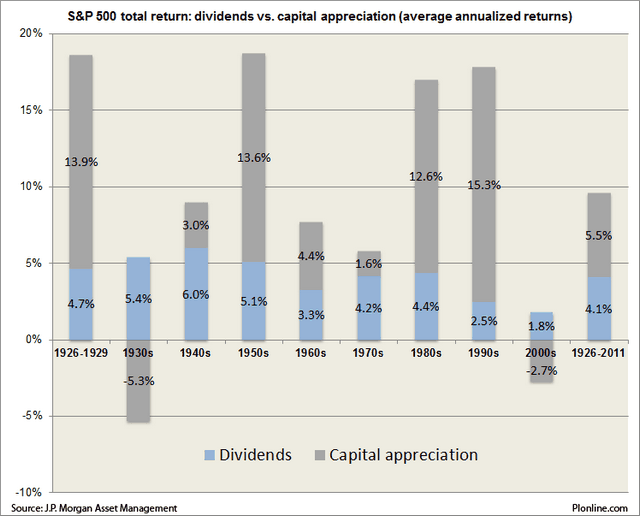
Defensive sectors outperform over the long-term due to the compounding effect of dividends, stable growth and they are also relatively less affected by economic cycles. For example, regardless of the state of the economy consumers buy food, toothpaste, drugs and use electricity, mobile phones, etc. Companies operating in the sector are usually well-established and have strong cash-flows which helps to make consistent dividend payments and also dividend increases occasionally.

Investors looking to add defensive stocks to their portfolios can consider the foreign stocks listed below:

1.Company: Coca Cola Femsa SAB de CV (KOF)
Sector:Beverages (Nonalcoholic)
Current Dividend Yield: 1.46%
Country: Mexico

2.Company: Unilever NV (UN)
Sector:Food Processing
Current Dividend Yield: 3.34%
Country: The Netherlands

3.Company: Diageo PLC (DEO)
Sector:Beverages (Alcoholic)
Current Dividend Yield: 2.43%
Country: The UK

4.Company: Bayer AG (BAYRY)
Sector: Major Drugs
Current Dividend Yield: 2.42%
Country: Germany

5.Company: Vodafone Group PLC (VOD)
Sector: Telecom
Current Dividend Yield: 5.11%
Country: UK

6.Company: Danone SA (DANOY)
Sector:Food Processing
Current Dividend Yield: 2.98%
Country: France

7.Company: Henkel AG (HENKY)
Sector: Household goods
Current Dividend Yield: 1.53%
Country: Germany

8.Company: British American Tobacco PLC (BTI)
Sector: Tobacco
Current Dividend Yield: 4.01%
Country: UK

9.Company: Vina Concha y Toro (VCO)
Sector: Beverages (Alcoholic)
Current Dividend Yield: 2.41%
Country: Chile

10.Company: Teva Pharmaceutical Industries Ltd (TEVA)
Sector: Biotechnology & Drugs
Current Dividend Yield: 2.45%
Country: Israel

Note: Dividend yields noted are as of Oct 9, 2012

Disclosure: Long HENKY

Download: Barclays Equity Gilt Study 2012

The Barclays Equity Gilt Study 2012 was published earlier this year. Below are few of the interesting charts from the report:

Click to enlarge

1.Historical equity returns and excess returns of select countries:

2.US Corporate Profits since 1950:

3.US Real Investment Returns by Decade:

Download:

To download the full report in pdf format click Barclays Gilt Study 2012 Full Report

Related:

Download: Barclays Equity Gilt Study 2011

UK Real Equity Returns From 1900 To 2011

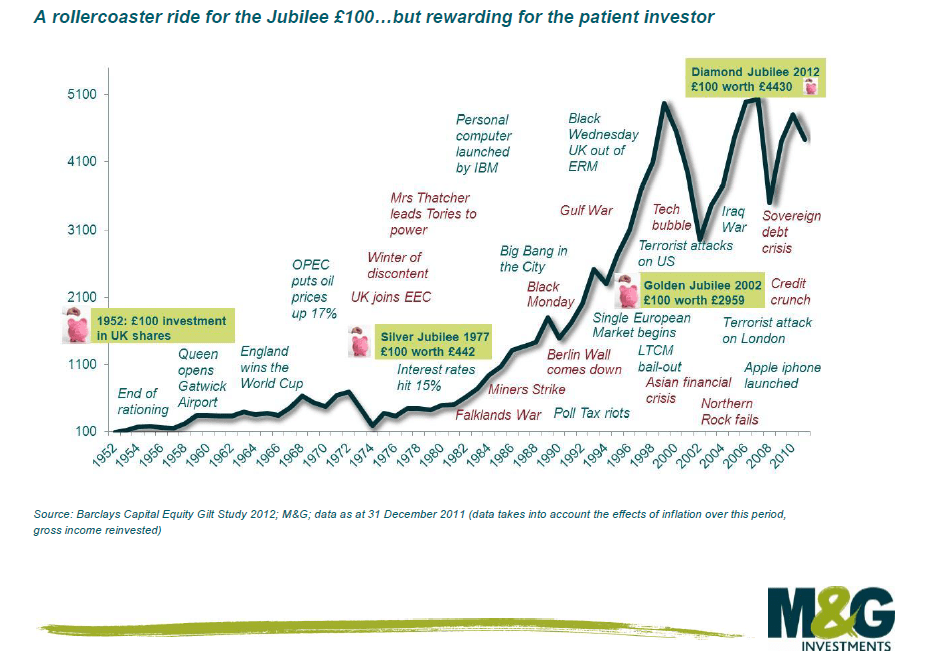
Stocks generally yield higher returns than bonds and cash over the long term. For example,  £1 invested in British stocks in 1900 would have grown to £116,394 by 2011. However the £1 would have grown to only £315 if invested in Gilts (British government bonds) or just £202 if held in cash during the same period, according to the Barclays Equity Gilt Study 2012. But holding stocks for the long term takes courage and patience as equity markets tend to be volatile and investors cannot expect a smooth upward trend year after year.

The chart below shows the UK Real Equity Returns from 1900 to 2011:

Click to enlarge


Source: Trustee Training 2012, Asset Allocation, Rathbone Investment Management, UK

While the developed markets such as the UK exhibit so much volatility, emerging markets have much higher volatility.So unlike investing for the long-term in developed stocks it is generally not advisable to hold emerging stocks for the long term.

Related ETFs:

iShares MSCI United Kingdom Index (EWU)

Disclosure: No Positions

U.S. Imports of Canadian Crude Oil and Petroleum Products Continue to Grow

Canada is the largest exporter of crude oil and other petroleum products to the U.S. Saudi Arabia ranks as second largest exporter to the U.S. followed by Mexico. Canada maintained the top position in both 2010 and 2011 and is likely to be a key supplier to the U.S. for many years to come.Due to continuing geo-political issues in the Middle East, the Canadian tar sands are bound to become more strategically important to meet the energy needs of the U.S.

The following graph shows the long-term trend of Canadian Crude Oil and Petroleum Products exports to the U.S.:

Click to enlarge

Source: U.S. Energy Information Administration

In Jan 1991, U.S. imported 32,597(thousand barrels) from Canada. This figure jumped to 57,927(thousand barrels) in the beginning of 2000. By July of this year the U.S. imported 92,154(thousand barrels) for a rise of about three-fold from 1991.

A little-known but an important factor that favors Canadian crude oil over oil from other countries is that the Canadian oil blend is cheaper.

From an article in the CBC news site:

Many factors are pushing the price for North American crude lower, but the hit for Canadian oil companies specifically is even worse. The most prevalent Canadian benchmark is called Western Canadian Select. A blend of conventional oil, bitumen and synthetics, WCS is heavier and therefore more difficult to process than some other types of oil like Brent and WTI.

Because of the added transportation and refining costs, the profit margin a refiner can earn from using WCS is less than they would get from WTI. So refiners are paying Canadian producers less per barrel as a result.

Canada exports almost three million barrels of oil per day, and the spread has at times been in excess of $30 per barrel of late, so that’s $90 million in lost revenue, every day, for the oil patch.

It’s one of the things the Bank of Canada warned about in its latest Monetary Policy Report this week. Despite being awash in fossil fuels, Canadian producers aren’t getting as much money for their crude as suppliers elsewhere in the world do, which eats into GDP.

It’s especially vexing because Canadians pay the same high prices as the rest of the world for finished petroleum products like gasoline. Add it all up and the price Canada pays for the Brent-based oil it imports is going up, and the price Canada gets for the oil we export is going down — giving our economy a hit both coming and going.

How to profit from the growing Canadian crude oil and petroleum products exports to the U.S. market?

One way for investors to capitalize on this growth is to invest in Canadian oil companies that are involved in the exploration, extraction, storage and transportation of crude oil and related products to the U.S. Ten such stocks trading on the US markets are listed below for further research:

1.Company:Imperial Oil Ltd (IMO)
Market Cap: $39.1B
Current Dividend Yield: 1.05%

2.Company: Suncor Energy Inc (SU)
Market Cap: $51.7B
Current Dividend Yield: 1.56%

3.Company: Nexen Inc (NXY)
Market Cap: $13.5B
Current Dividend Yield: 0.80%

4.Company: Enbridge Inc (ENB)
Market Cap: $32.8B
Current Dividend Yield: 2.77%

5.Company: TransCanada Corp (TRP)
Market Cap: $32.6B
Current Dividend Yield: 3.86%

6.Company: Talisman Energy Inc (TLM)
Market Cap: $13.6B
Current Dividend Yield: 2.05%

7.Company: Canadian Natural Resources Ltd (CNQ)
Market Cap: $33.8B
Current Dividend Yield: 1.40%

8.Company: Encana Corp (ECA)
Market Cap: $16.0B
Current Dividend Yield: 3.67%

9.Company: Cenovus Energy Inc (CVE)
Market Cap: $26.5B
Current Dividend Yield: 2.56%

10.Company: Husky Energy Inc (HUSKF)
Market Cap: $27.3B
Current Dividend Yield: N/A

Note: Dividend yields noted are of Oct 6, 2012

Disclosure: No Positions