Most Mexican Exchange-Listed ADRs are Up YTD

Mexico is one of the best performing emerging market this year. Mexico’s IPC index is up 9.7% so far this year. Despite the drug violence investors have been bidding up Mexican stocks  due to strong economic growth and political reforms. From an article in The Wall Street Journal in August:

Earlier this year, Mexican shares were driven higher largely by investors cheering the July election of incoming President Enrique Peña Nieto and the promise of market-friendly changes. Now the rally is showing more staying power as investors zero in on manufacturing-driven economic growth, the widening regional footprint of some Mexican companies and expectations of an expansion of consumer credit—even though Mexico’s close ties to the U.S. economy remain a concern, many investors and analysts say.

After reaching an all-time high of 42,750 last month the IPC index settled at 40,677 yesterday. The long-term performance of the Mexican equity market is astonishing as shown in the chart below:

Click to enlarge
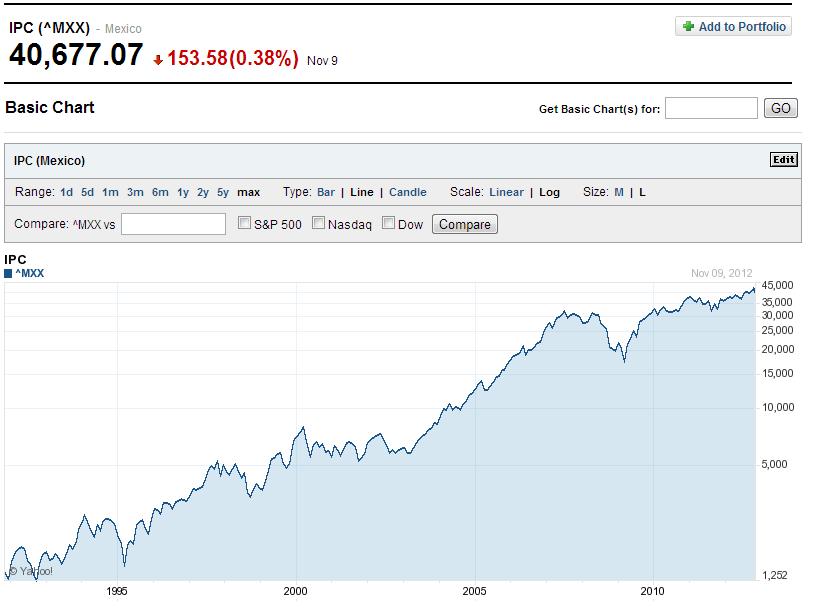
Source: Yahoo Finance

While the S&P 500 rose by under 500% in the period shown above, the IPC increased by just over 2,500%.

The graph below shows the Year-To-Date(YTD) performance of Mexican stocks listed on the US exchanges:

Click to enlarge
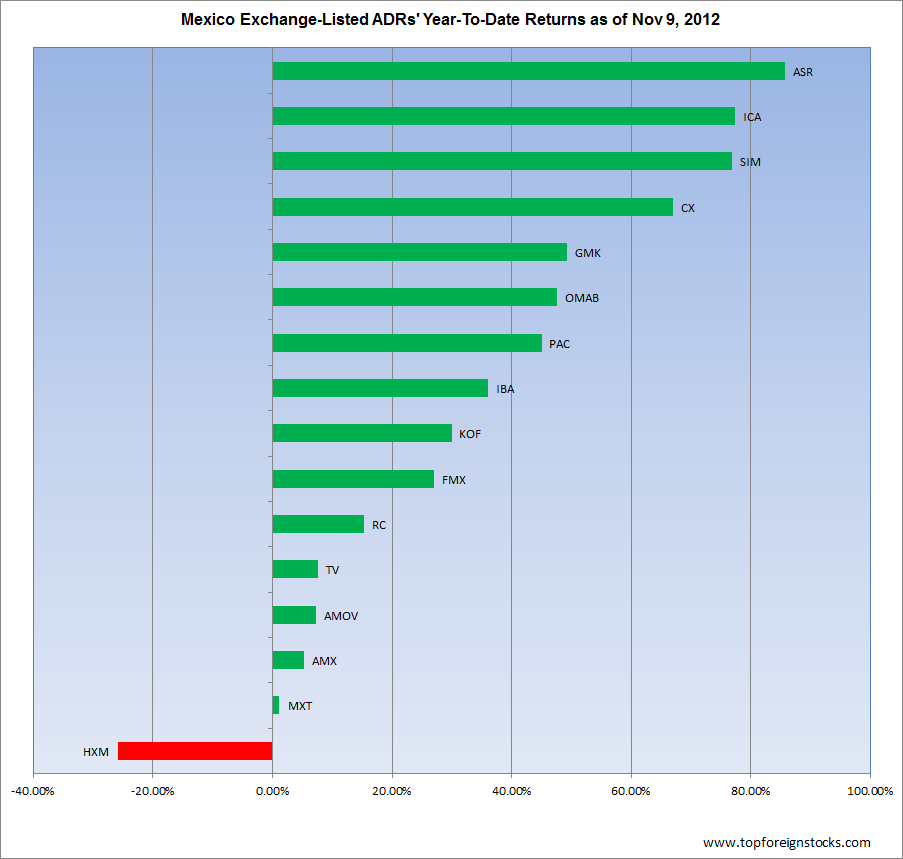
Airport operators Grupo Aeroportuario del Sureste (ASR), Grupo Aeroportuario del Pacifico(PAC) and Grupo Aeroportuario del Centro Norte (OMAB) have performed well due to increasing tourism traffic to the Mexican beach resorts such as Acapulco, Cozumel, Cancun, etc. While traditionally North Americans vacationed in Mexico in large numbers, the economic recession has given an added incentive to go cheaper vacation destinations such as Mexico. Coca-Cola Femsa(KOF), Fomento Economico Mexicano(FMX) and cement maker Cemex(CX)  are also good choices to profit from Mexico’s growing economy. Investors looking to add Mexican stocks can add during pullbacks from current levels.

The iShares MSCI Mexico Investable Market Index Fund (EWW) also gives a simple and easy way to gain exposure to the Mexican equity market. With assets of over $1.4 billion the ETF has an yield of 1.40%. The average annualized total returns in 10 years is 20.30%.

Disclosure: No Positions
Knowledge is Power: Jobs, Elizabeth Warren, China Model Edition

Barack Obama and America’s decline (Asia Times)

Budget DisarrayUS Set to Restage Greek Tragedy (Der Spiegel)

Emerging economies halve their debt (Deutsche Welle)

JOLTS – There were 3.4 People Looking for a Job for each Position Available in September 2012 (The Economic Populist)

The Importance Of Elizabeth Warren (The Baseline Scenario)

Obama’s Green Jobs Cost Big Bucks (CFR)

China – a model for success or an accident waiting to happen (The Asset)

Shares that are historically cheap and income of 6% persuaded my to dip a toe in European stock markets (This is Money, UK)

Click to enlarge

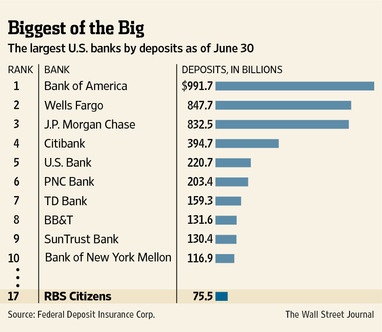
Source: RBS, U.K. Wrestle Over Fate of Citizens, The Wall Street Journal

A Note on Santander ADRs Trading on the NYSE

Four different type of Santander bank ADRs trade on the New York Stock Exchange.In order to clarify any confusion when identifying the relevant ticker, here is a brief overview of the four ADRs:

1.Banco Santander SA (SAN):

Santander is the Spain-based multinational banking group with operations in Spain, the United Kingdom, Portugal, the Latin American countries and the United States. The ticker changed a while ago to SAN from STD. Currently the bank has a market capitalization over $73.0 billion and the share price closed at $7.13 today with the dividend yield at 11.35%. Due to high losses stemming from its exposure to the Spanish real estate market and the financial crisis, the stock fell heavily and reached a low of $4.87 in March 2009.

2. Banco Santander-Chile (BSAC):

This bank is one of the largest private sector banks in Chile. Today the stock closed at $26.92 and the current dividend yield is 4.18%. Unlike SAN, Santander-Chile has a smaller market capitalization of over $12.0 billion and is a better long-term performer than the Spanish banking group. The former ticker for BSAC was SAN.

3. Banco Santander Brasil SA (BSBR):

Santander Brazil is one of the large full-service banks in Brazil. The ADR was listed on the NYSE in October 2009 . The current dividend yield is 3.63% and the market capitalization is over $26.0 billion. Though the stock reached a peak of over $15 in late 2010, it closed at $6.90 today.

4.Santander Mexico Financial Group, S.A.B. de C.V (BSMX):

Founded in 1991, Mexico City, Mexico-based Santander Mexico Financial Group offers banking services primarily in Mexico. The ADR became effective on October 1, 2012. The bank has a market capitalization of over $9.0 billion and the stock pays no dividends. At the end of September Santander Mexico served 9.7 million customers.

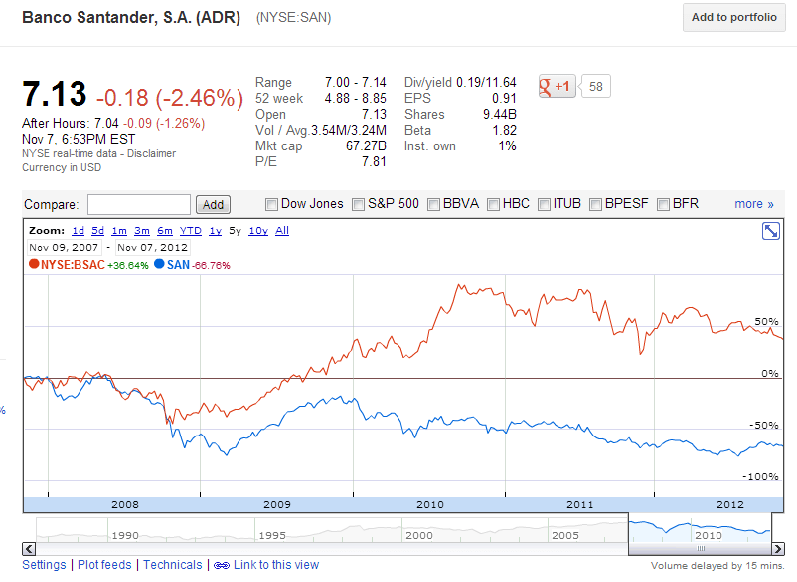
A comparison of 5-Year performance of Banco Santander of Spain and Santander-Chile:

Click to enlarge

Source: Google Finance

The difference is returns is due to the strength of the Chilean economy and the banking system compared to the poor performance of the Spanish economy in the past few years.

Note: Dividend yields and other data noted are of Nov 7, 2012

Disclosure: Long SAN

Knowledge is Power: German Banking, Brazil, Wealth Effect Edition

Germany: Europe’s quiet banking crisis (EuroMoney)

Euro-Zone Unemployment Higher than Ever Before (Der Spiegel)

The wealth effect: Spending like you are rich (Financial Post)

The world needs more food – and Latin America is the place to invest (MoneyWeek)

Presentation: Brazil – The end of the (love) affair? (DB Research)

America’s deleveraging- Still a long way to go (The Economist Blog)

Picking dividend stocks (Fidelity)

11 U.S. stocks with reliable dividend growth (The Globe and Mail)

 Analysis: Guns in America: The business of fear (Montreal Gazette)

Click to enlarge

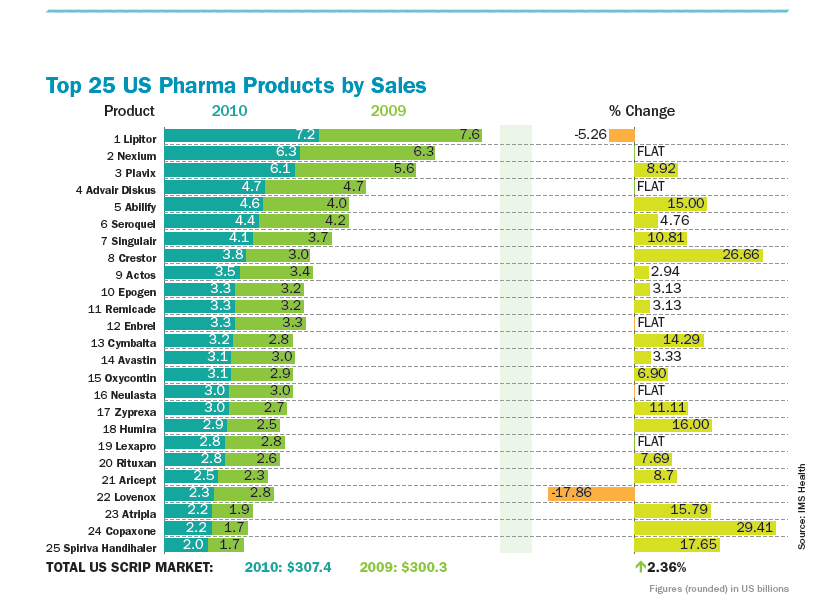
Top 25 US Pharma Products by Sales


Source: Pharmaceutical Executive

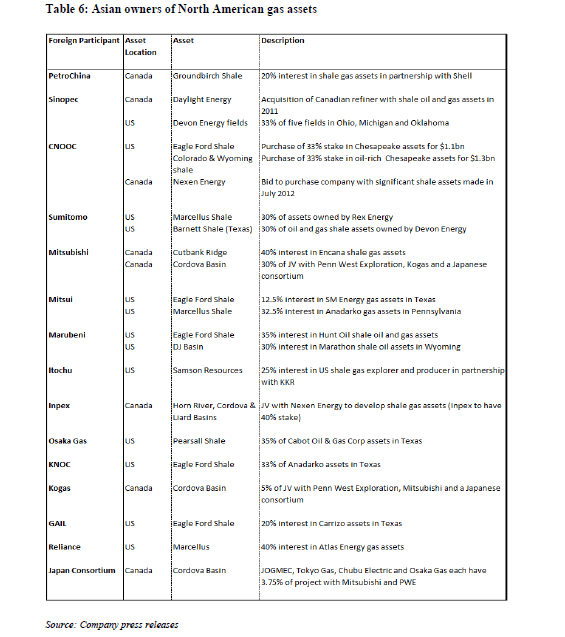
Which Asian Companies Own North American Gas Assets?

Many Asian energy companies and utilities have bought stakes in North American gas and oil assets to export North American gas to their home markets or sell in the North American market. The following table lists the Asian companies owning North American gas assets:

Click to enlarge


Source: The Potential Impact of North American LNG Exports, James Henderson, October 2012, The Oxford Institute for Energy Studies, UK