Relationship Between Federal Reserve’s Balance Sheet And Stock Prices

The Federal Reserve has provided an ocean of liquidity since the great recession that followed the global financial crisis through the QE1, QE2 and QE3 programs. In fact, the Fed’s balance sheet has grown significantly due to these programs. Total assets have soared from just $869.0 billion in August 2007 to well over $3.0 Trillion as of February 20, 2013.

Click to enlarge

Fed-Balance-Sheet

Source: The Federal Reserve

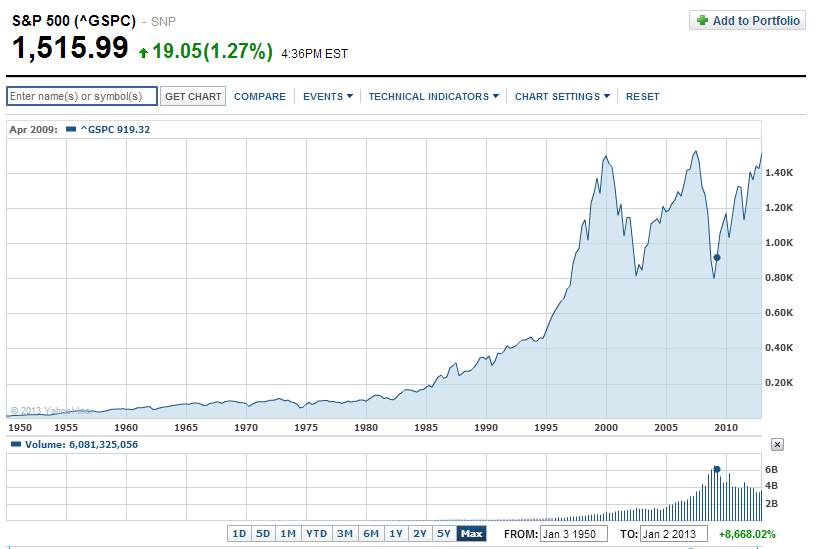
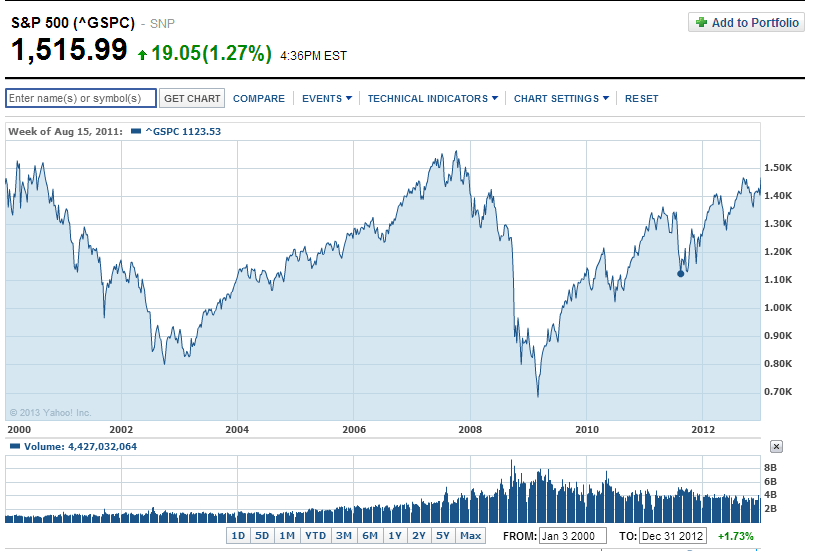
Equity prices have increased strongly in line with rising liquidity. The following chart shows the correlation between Fed’s growing balance sheet and the S&P 500:

Fed-Balance-Sheeet-vs-SP500

Source: The Week Ahead, February 25 – March 1, 2013, CIBC World Markets

Related ETF:

SPDR S&P 500 ETF (SPY)

Disclosure: No Positions

Ten Express Delivery Industry Stocks To Consider


The Air Courier and Express Delivery industry is a multi billion dollar industry in the U.S. Here are a few facts about this industry as of 2011:

  • Number of firms: Over 7,000
  • Same-day Market: $8.7 billion
  • Total Market: $14.5 billion

Source: Industry Profile,  MCAA

Antonov-Plane

Antonov An-225 – The largest airplane in the world

Competition is fierce in the industry. On this topic the MCAA article notes:

1.2.3 Value of competition in the sector
Courier firms provide an invaluable service because the “big four” (DHL, UPS, FedEx and USPS) in the delivery business simply do not provide same-day delivery services uniquely designed to meet specific individual customer needs. Expedited delivery firms also prevent the big four from having a complete monopoly on deliveries that must be completed in a short period of time. This competition, both among couriers and with the big four, has greatly increased the quality and professionalism of the industry, while also ensuring reasonable rates for customers. These 7,000 plus small businesses also help to keep the pricing competitive and the big four honest. Additionally, the courier industry consists almost entirely of small, locally owned and operated businesses, ensuring that revenue is retained within the community served, rather than siphoned off by a multi-national corporation.

Ten Express Delivery Industry Stocks are listed below with their current dividend yields for further research:

1.Company: Air Transport Services Group Inc (ATSG)
Current Dividend Yield: No Regular Dividends Paid

2.Company: Air Transport Services Group Inc (AIRT)
Current Dividend Yield: 2.58%

3.Company: Forward Air Corporation (FWRD)
Current Dividend Yield: 1.06%

4.Company: FedEx Corporation (FDX)
Current Dividend Yield: 0.53%

5.Company: United Parcel Service, Inc.(UPS)
Current Dividend Yield: 2.99%

6.Company: Atlas Air Worldwide Holdings Inc(AAWW)
Current Dividend Yield: No Regular Dividends Paid

7.Company:C.H. Robinson Worldwide (CHRW)
Current Dividend Yield: 2.42%

8. Company:Expeditors International of Washington Inc (EXPD)
Current Dividend Yield: 1.37%

9.Company: Pacer International Inc (PACR)
Current Dividend Yield: No Regular Dividends Paid

10.Company: Hub Group Inc (HUBG)
Current Dividend Yield: No Regular Dividends Paid

Note: Dividend yields noted are as of Feb 22, 2013

Disclosure: No Positions


Is the U.S. Government Spending High Relative to Other G-7 Countries ?

The U.S. Federal Spending for Fiscal Year 2012 was about $3.5 Trillion.On a percentage basis, healthcare and social security payments accounted for 45% of total spending. Defense expenditures amounted to 19% of total spending. Net interest paid on outstanding public debt added another 6% according to data provided by Congressional Budget Office (CBO).

U.S. Federal Spending – FY 2011

Click to enlarge

U.S._Federal_Spending_-_FY_2011


Source: Wikipedia

The public perception on U.S. spending is that the Federal government is too large and that spending is out of control leading to deficits year after year. All the conservatives and even some democrats would agree that government spending has to be reined in in order for the economy to move forward.

In reality how does the U.S. government spending compare to other G-7 countries?

U.S. government spending is not high compared to other G-7 countries. This is because unlike other countries, the Federal government in the U.S. spends most of the spending and not the state and local governments. In Germany or Japan for example, the sub-national governments dole out much of the spending pie. Hence even though the U.S. Federal spending as a share of GDP looks higher among G-7 countries the actual spending by other G-7 countries is much higher.

Click to enlarge

US-vs-G7-Countries-Spending-2


One of the suggested solutions put forth by conservatives is drastically cutting down the size of the government. Austerity is the new buzzword among the proponents of a lower government who propose to slash government services such as social programs and other entitlements. Despite the failure of austerity programs in many European countries, conservatives in the U.S. steadfastly believe that austerity is the panacea for solving the U.S. deficit. Here again their proposed solution is incorrect and bound to fail. This is because all government spending(federal, state and local) in the U.S. as a percentage of the GDP is still the lowest among G-7 countries as shown in the chart below. So slashing government spending when the country is barely recovering from the worst recession in decades is not a sensible strategy. Instead of focusing on slashing desperately needed social programs at this time, lawmakers should try to stimulate economic growth by implementing growth-oriented policies.

US-vs-G7-Countries-Spending

Source: US in Debtors’ Prison: A Life Sentence? by Emanuella Enenajor and Andrew Grantham, Economic Insights, January 29, 2013, CIBC World Markets

Sources of Electricity Generation in the U.S.

The following chart shows the major sources of power generation in the U.S. in 2011:

Click to enlarge

US-Sources-of-Electricity-Generation

Source: Energy in Brief, U.S. Energy Information Administration

Coal is the major source for power production followed by Natural gas at about 25%. Nuclear power accounted for about 19% which is lower than countries such France that depend on nuclear power for most of its electricity needs. Renewable sources which includes hydro power accounted for about 13% of the total power production. This is interesting since one would expect U.S. to produce more power from hydro as there is abundance of water resources in the country. Here again, countries like Canada and Brazil produce a higher percentage of their electricity from hydro power. Much of the hydro power produced in the U.S. comes from dams which were built before the mid-1970s and operated by Federal agencies. So it appears no new hydro power plants have been built in the past 40+ years.  However on a positive note, power production from wind increased from about 6 billion kilowatthours in 2000 to about 120 billion kilowatthours in 2011 according to EIA data.

Five electric utilities yielding more than 3% dividends are listed below for further research:

1.Company: Dominion Resources Inc (D)
Current Dividend Yield: 3.99%

2.Company: Duke Energy Corp (DUK)
Current Dividend Yield: 4.41%

3.Company: Southern Energy (SO)
Current Dividend Yield: 4.38%

4.Company: NextEra Energy Inc (NEE)
Current Dividend Yield: 3.63%

5.Company: Exelon Inc (EXC)
Current Dividend Yield: 6.89%

Note: Dividend yields noted are as of Feb 22, 2013

Disclosure: No Positions

Impact of Political Risks on MENA Equity Markets

Investing in the equity markets of Middle East and North Africa (MENA) involves high political risks since most of the countries are not democratic(with the exception of Israel) and are run by monarchies, dictators, etc.  As a result, economic growth is stagnant and social ills such as corruption, high unemployment, lack of transparency, nepotism, etc.others are the norm and not the exception. So investing in these markets involves higher risks than other frontier markets. Though many countries in the region have abundant natural resources such as oil and natural gas, equity markets are not mature and public participation in the markets are very low relative to developed countries.

From December, 2010 thru the end of 2012 the MENA region was rocked by the Arab Spring revolution. In country after country regimes fell amid widespread opposition from the general public against the status quo. For example, in Egypt the Western-backed longtime dictator Hosni Mubarak’s regime collapsed and was replaced by Egypt’s President Mohamed Morsi who himself is under fire from the public for his heavy-handed actions against protesters.

During the Arab Spring, Egypt, Lebanon, Tunisia and Morocco – the four biggest markets based on market capitalization in the region fell heavily. Egypt suffered the heaviest losses due to many months of uncertainty and violence as Mubarak tried in van to crush the revolution.  The Egyptian stock market was closed for eight weeks in early 2011 and the index by about 50%. The other markets in the region recovered from their lows but they remain very volatile. The following chart shows the performance of the performance of the four markets mentioned above:

Click to enlarge

Sample-MENA-Equity-Market-Returns
Source: Two years of Arab Spring: Where are we now? What’s next?, Deutsche Bank Research

However CASE3o, the benchmark index of the Cairo Stock Exchange, was the world’s third-best performing index in 2012 when it rose 50.8%. The dramatic plunge and the incredible rise of the Egyptian market underlines the risks and volatility involved in the MENA markets.

Most of the structural problems in the countries that experience the Arab Spring have not been resolved though regimes have been replaced. Hence further protests and anemic economic growth are likely to continue for years. From an investment standpoint, it is a wise idea to stay away from the equity markets of the region or invest only a very small portion of one’s portfolio via an ETF.

Related ETFs:

Market Vectors Gulf States (MES)
PowerShares MENA Frontier Countries ETF (PMNA)

Disclosure: No Positions