Texas Instruments is a Fantastic Dividend Growth Stock

The tech industry is not known for many stocks paying a dividend. Accordingly, most investors would not consider the industry when hunting for dividend growth stocks. However there are exceptions. According to an article by Algy Hall at CityWire, semiconductor maker Texas Instruments(TXN) is a winner. The stock has grown its dividend by an astonishing 4,900% in the past two decades thru October 5th of this year. Below is a brief excerpt from the piece:

For semiconductor maker Texas Instruments (US:TXN), returning cash to shareholders has become a source of immense pride. It’s easy to understand why.

Over the past two decades, the company has grown its dividend by an incredible 4,853%, from 8.5 cents a share in 2002 to $4.21 last year. The payout has risen in each of the last 18 years, helped by plentiful buybacks which have nearly halved the share count over the same period.

Source: The tech stock that’s grown its dividend 4,900% in two decades, CityWire

One of the products that helps the company rack in millions of dollars each year is the good old analog calculator specifically the TI-84 graphing calculator that is used by high school students. Despite hardly any changes in its features in the past 10 years, the TI-84 was the top selling calculator according to an article at The Washington Post back in 2014. Currently the calculator sells for over $100 a pop.

Texas Instruments currently has a marker cap of $154 billion. The stock closed at $169.55 on Friday and has an annual dividend yield of 2.93%. Though the company has reduced the number of outstanding shares, its still has 907 million of shares outstanding. A $10K investment would have grown to $20,315 by Dec 10th, 2022 according to S&P.

The stock price has declined by 11% year-to-date. In the last 5 years it has increased by 63% as shown in the chart below:

Click to enlarge

Source: Google Finance

The following chart shows the long-term return of the stock:

Source: Google Finance

We are not out of the current bear market yet. So investors looking to enter the semiconductor industry may want to keep an eye out for Texan Instruments.

Disclosure: No positions

Emerging Markets Are Attractive based on Valuation

Emerging markets have been poor performers for the past decade or so. Many years ago the BRICS were supposed to lead the growth of these markets. However that did not work out as expected. For instance, the decline in commodity markets led to the fall of Brazilian equities which were soaring during the commodity bull run. Political changes and poor economic policies added to the woes of investors.

Similarly decline in oil prices and more recently the shutting down of foreign listings of domestic companies made Russia one of the top worst performing markets. Economic contraction followed by Covid induced further decline in growth made Chinese equities average to poor performers. Overall most emerging markets are losers for equity investors.

However according to an article by James Johnstone at Redwheel, that emerging markets have reached an inflexion point and are attractive based of valuation. From the article:

Attractive valuations versus developed markets

The demand for metals is expected to support the growth of emerging markets and widen the real GDP growth differential with western markets. This marks forward price-to-earning (P/E) ratios for the sector look attractive.

In part, this is attributable to the commitment of emerging nations to maintain tight monetary policy over the past decade. These economies have largely avoided using unconventional policies (such as quantitative easing). They also raised rates before developed economies – and remain ahead of the curve.

As developed economies struggle with soaring inflation and interest rates, monetary constraint has made emerging market economies resilient.

Emerging markets have fallen to valuation levels not seen since 2008 while earnings continue to climb.

Source: Why emerging markets have reached an inflexion point by James Johnstone via FirstLinks

From an investment perspective, it is simpler and easier to invest in an ETF than individual companies. Unlike developed market equities, stocks in developing countries can be more risky and volatile for a multitude of reasons. So in order to avoid unnecessary risk and still have exposure to these markets is to go with ETFs.

Related ETFs:

  • iShares MSCI Emerging Markets ETF (EEM)
  • Vanguard MSCI Emerging Markets ETF (VWO)
  • iShares MSCI Mexico Capped Investable Market (EWW)
  • Global X FTSE Colombia 20 ETF (GXG)
  • iShares MSCI Brazil Index (EWZ)
  • WisdomTree India Earnings (EPI)
  • The iShares MSCI India ETF  (INDA)

Disclosure: No Positions

High-Speed Rail Network in Operation by Country 2022: Chart

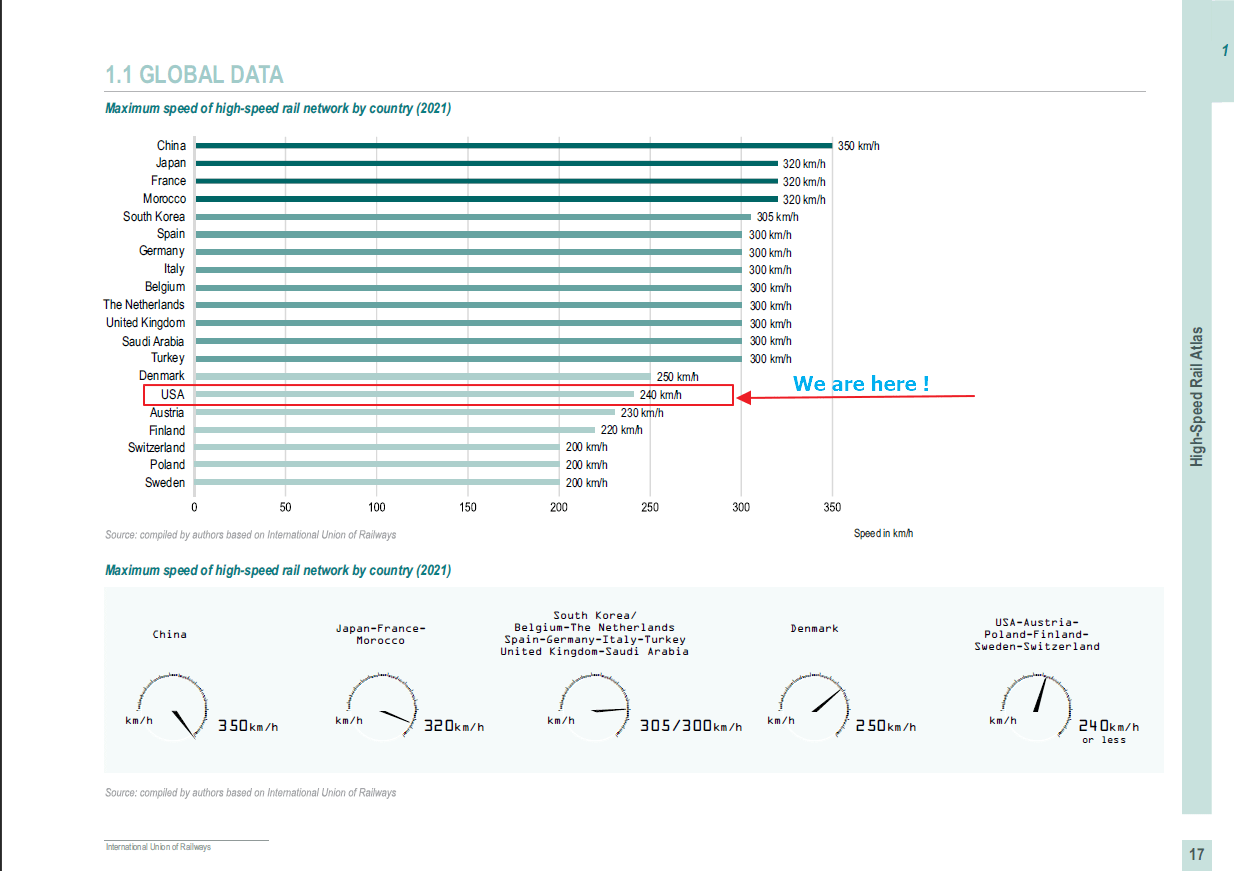
China leads the world in High-speed rail network as of December, 2021 according to the Atlas High-Speed Rail 2022 report published by the International Union of Railways (UIC). China has over 40,000 km of route network currently in operation. Spain ranks the second with over 3,600 kms followed by the original hi-speed leader Japan. The emerging country of Turkey is among the top 10 with over 1,000 kms of track. This is surprising.

The US ranks 11th in the list but ahead of Saudi Arabia with a total track length of 735 kms.

Length of high-speed rail network in commercial operation by country:

Click to enlarge

Source: Atlas High-Speed Rail 2022, UIC

The Number of Medical Doctors and Nurses per Capita by Country 2020

The number medical doctors and nurses per 1,000 people by country are shown in the chart below from OECD that was published last year. According to OECD, there were 2.64 doctors per 1,000 in 2019 in the US. Austria had the highest at 5.36 followed by Norway. Generally European countries have higher doctor density than the US.

However in terms of number of available nurses, some European countries and the UK fare worse than the US. There were 11.79 nurses per 1,000 in 2020 in the US.

Click to enlarge

Source: OECD

Annual Total Return of Key Market Indices 2012 to 2021: Chart

One of the simplest and easiest ways to reduce risk with investing in equity markets is via diversification. Instead of putting all eggs in one basket it is wise to spread the assets in a portfolio across many asset classes, types, regions, countries, sectors, etc. The following chart shows the total return of key indices from 2012 to 2021:

Click to enlarge

Source: Morningstar Direct, Russell Investments. Annualized return in CAD. Canadian equity=S&P/TSX Composite Index, US Equity=S&P 500 Index, International Equity=MSCI EAFE Index, Emerging Markets=MSCI Emerging Markets Index, Canada Bonds=S&P Canada Aggregate Bond Index, Emerging Markets Debt= JP Morgan Emerging Market Bond Index, Global High Yield=Bloomberg Global High Yield Index, Global Infrastructure=S&P Global Infrastructure Index, Global Real Estate Investment Trusts (REITs)=FTSE EPRA NAREIT Developed REITS Index, Commodities= S&P Goldman Sachs Commodities Index, Indexes are unmanaged and cannot be invested in directly. Past performance is not indicative of future results. Index performance does not include fees and expenses an investor would normally incur when investing in a mutual fund. Diversification and strategic asset allocation do not assure profit or protect against loss in declining markets. 

Note: The returns noted are in Canadian dollars

Source: Going Global: Finding Opportunities in a World of Uncertainty, Russell Investments