Who Benefits from Ultra-Low Interest Rates?

The Global Financial Crisis (GFC) started in the U.S. in 2008 and by any measure has ended. As a result of the crisis the Federal Reserve slashed the Fed funds rate to almost 0% effectively handing out money to banks and other institutions for “free”. The Federal Reserve has kept the rate between 0 to 0.25% since December 2008. Even though we are now in Q3,2013, the Feds continue to maintain the ultra-low rates crushing savers in the process and encouraging speculation and asset price growth. The disastrous effect of this policy for the past five years has been felt by seniors and others that depend on income from their savings in fixed income instruments such as bank CDs.

Currently the interest rate for a 1-year and 5-year CDs are 0.65% and 1.33% respectively according to Bankrate.com data. Hence a senior citizen with a cash savings of one million dollars in a 5-year bank CD would earn a shocking $13,300 in interest per year before taxes. Obviously the majority of the population does not have that kind of money in the bank and hence the intense competition for low-paying service sector jobs remains high.

Here is an excerpt from “At 77 He Prepares Burgers Earning in Week His Former Hourly Wage” in Bloomberg:

It seems like another life. At the height of his corporate career, Tom Palome was pulling in a salary in the low six-figures and flying first class on business trips to Europe.

Today, the 77-year-old former vice president of marketing for Oral-B juggles two part-time jobs: one as a $10-an-hour food demonstrator at Sam’s Club, the other flipping burgers and serving drinks at a golf club grill for slightly more than minimum wage.

While Palome worked hard his entire career, paid off his mortgage and put his kids through college, like most Americans he didn’t save enough for retirement. Even many affluent baby boomers who are approaching the end of their careers haven’t come close to saving the 10 to 20 times their annual working income that investment experts say they’ll need to maintain their standard of living in old age.

For middle class households, with incomes ranging from the mid five to low six figures, it’s especially grim. When the 2008 financial crisis hit, what little Palome had saved — $90,000 — took a beating and he suddenly found himself in need of cash to maintain his lifestyle. With years if not decades of life ahead of him, Palome took the jobs he could find.

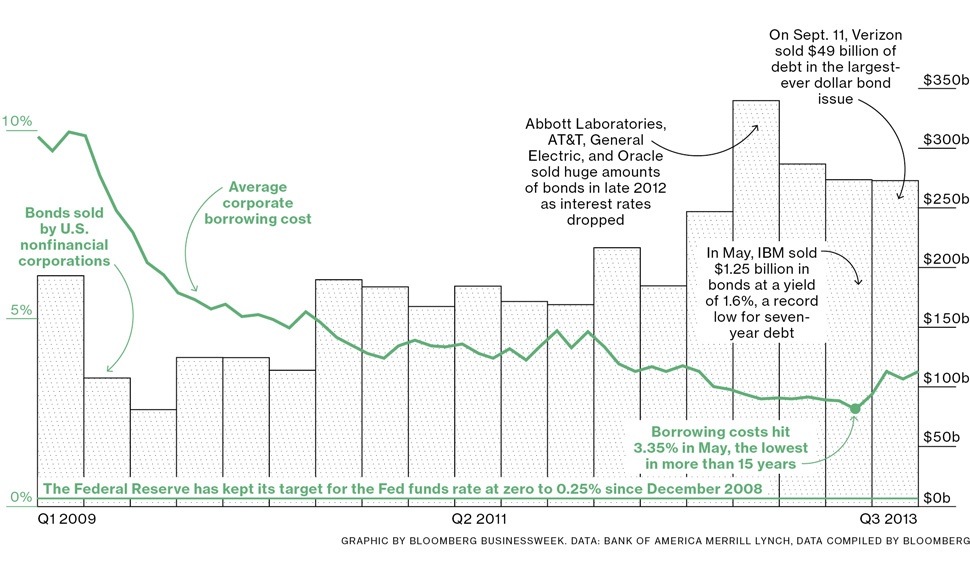
However not everyone is suffering from the low rates. According to an article in the recent edition of Bloomberg BusinessWeek American companies are highly benefiting from the Feds policy. The article states that corporate America saved $900 billion in interest in the past four years due to the low rates.

Click to enlarge
Feds-Gift

Source: Bloomberg BusinessWeek

For anyone curious to know why the Federal Reserve keeps rates so low for so long here is the answer straight from the feds themselves:

By law, the Federal Reserve conducts monetary policy to achieve maximum employment, stable prices, and moderate long-term interest rates. The economy is recovering, but progress toward maximum employment has been slow and the unemployment rate remains elevated. At the same time, inflation has remained subdued, apart from temporary variations associated with fluctuations in prices of energy and other commodities. To support continued progress toward maximum employment and price stability, the Federal Open Market Committee expects that a highly accommodative stance of monetary policy will remain appropriate for a considerable time after the economic recovery strengthens. In its September 2013 statement, the Committee indicated that it currently anticipates that a target range for the federal funds rate of 0 to 1/4 percent will be appropriate at least as long as the unemployment rate remains above 6-1/2 percent, inflation between one and two years ahead is projected to be no more than half a percentage point above the Committee’s 2 percent longer-run goal, and longer-term inflation expectations continue to be well anchored.

Source: Why are interest rates being kept at a low level?, The Federal Reserve

The unemployment rate stood at 7.3% in August according to the Bureau of Labor Statistics. Since it is well above 6.50%, we can expect the interest rates to remain for the foreseeable future.

Update:

Why U.S. uncertainty could mean ultra-low rates for years — or even ‘decades to come’ (Financial Post)
Which Emerging Markets Are Most Vulnerable To Capital Flight?

Emerging market stocks have lagged the performance of developed stocks this year. While the S&P 500 is up 18.6% year-to-date most emerging markets are in the negative territory or have yielded meager returns.

A sampling of emerging market returns YTD are listed below:

China’s Shanghai Composite: -4.8%
India’s Bombay Sensex: 1.5%
Brzail’s Sao Paulo Bovespa: -11.8%
Chile’s Santiago IPSA: -11.4%
Mexico’s IPC All-Share: -6.4%

Until a few years ago investing in emerging equities seemed like a no-brainer with stocks in countries like Brazil, China, India, etc. yielding spectacular profits. However that is that the case anymore. For example, just last month currencies of many developing countries from Brazil to South Africa plunged dramatically with volatility in the equity markets soaring in tandem. As is normal foreign capital fled these markets worsening the situation. Fears of another major crisis like the 1997 Asian Financial Crisis seemed likely.

When the Federal Reserve decided to delay the winding down of asset purchases earlier this month, emerging market stocks started to recover. With some countries stabilizing their currency falls and a few positive economic stories coming out of China, emerging stocks may continue their run through the end of the year.

In general, investing in developing countries is not for the faint-hearted. As the events of the past few weeks illustrate the these markets can go darlings to pariahs of international capital almost overnight. Hence investors have to be very cautious in selecting emerging markets for investment opportunities as some countries are more vulnerable to capital flight than others.

From a recent article on FT’s beyondbrics blog:

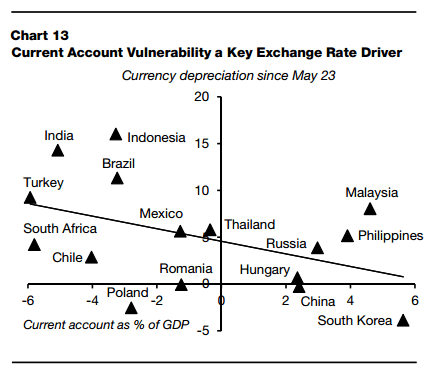
The economies to the left of the chart – such as India and Indonesia – have big current account deficits and plug the gap with foreign capital. Countries to the left therefore have most to lose from capital inflows drying up. Those towards the top of the chart have seen their currencies depreciate since May, as investors have pulled out.

Click to enlarge

Capital-flight-Vulnerable-Countries

Source: Institute of International Finance (IIF)

Via  Who’s afraid of the big bad capital withdrawal?, beyondbrics

Related ETFs:

  • iShares MSCI Mexico Capped Investable Market Index Fund (EWW)
  • PowerShares India (PIN)
  • iShares MSCI Brazil Index (EWZ)
  • iShares MSCI South Africa Index Fund (EZA)
  •  iShares FTSE/Xinhua China 25 Index Fund (FXI)

Disclosure: No Positions

Ten European Consumer Goods Stocks To Consider

The S&P 500 is up 19.9% year-to-date as of September 20th. Many of the European markets are also up by double digits YTD but they are still lower the U.S. market. Here are the YTD returns of major European indices:

  • France’s CAC 40: 15.5%s
  • Germany’s DAX Index: 14.0%
  • Spain’s IBEX 35 Index: 12.3%
  • UK’s FTSE 100: 11.8%

Despite the strong rises European stocks especially stocks in the consumer goods sector have more room to run. This is because of the economic recoveries currently underway in the continent. Unlike in the past no new sovereign debt crisis or other crises are on the horizon. The economies of Portugal, Ireland, Italy, Greece and Spain (PIGGS) are not the abyss and are actually in transition mode. The banking sector in these and other countries are in much better shape than before. Economic growth will lead to higher job growth and consumption. Consumer goods companies are bound to profit from this growth. Another advantage held by European multinational firms is that they have a strong presence in former colonies and generate a significant portion of their revenue from those markets.

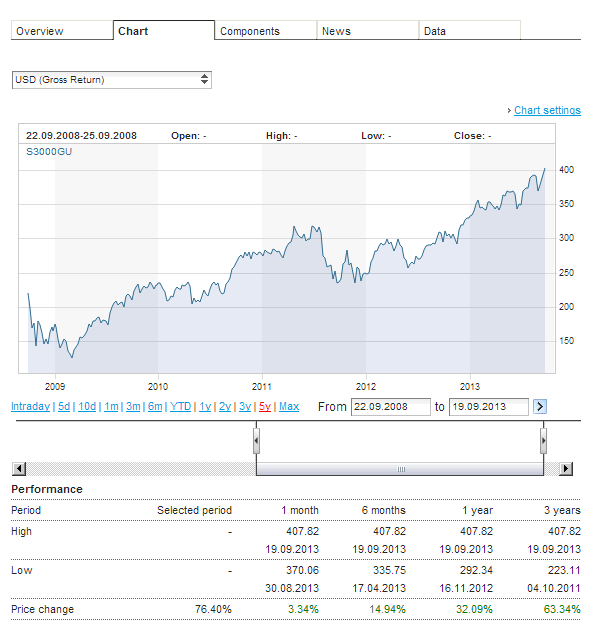
The chart below shows the 5-year return of the Euro STOXX Consumer Goods Index:

Click to enlarge

European-Consumer-Goods-Index-5-Yr-Return


Source: STOXX

Ten European consumer goods stocks are listed below for consideration:

1. Company:adidas AG (ADDYY)
Current Dividend Yield: 1.61%
Country: Germany

2.Company:Unilever NV (UN)
Current Dividend Yield: 3.34%
Country: The Netherlands

3.Company:Nestle SA (NSRGY)
Current Dividend Yield: 3.10%
Country: Switzerland

4.Company: Danone SA (DANOY)
Current Dividend Yield: 2.43%
Country: France

5. Company:Henkel AG (HENKY)
Current Dividend Yield: 1.37%
Country: Germany

6.Company:Heineken NV (HEINY)
Current Dividend Yield: 1.69%
Country: The Netherlands

7. Company:Coca Cola HBC AG (CCH)
Current Dividend Yield: 6.06%
Country: Switzerland

8. Company:Compagnie Generale des Etablissements Michelin SCA (MGDDY)
Current Dividend Yield: 2.85%
Country: France

9. Company:Diageo PLC (DEO)
Current Dividend Yield: 2.24%
Country: The UK

10. Company:Koninklijke Ahold NV (AHONY)
Current Dividend Yield: 3.29%
Country: The Netherlands

Note: Dividend yields noted are as of Sep 20, 2013. Data is known to be accurate from sources used.Please use your own due diligence before making any investment decisions.

Disclosure: Long HENKY

Knowledge is Power: Future of Blackberry, Job Losses, Central Europe Edition

Absolute Majority? Merkel Wins Easy Re-Election (Der Spiegel)

Does BlackBerry have a future? (CBC)

Finding cheap shares ready to move on up: How finance professor Josef Lakonishok turned his theory into a $70bn practice (This is Money)

Containing costly job losses (OECD Observer)

Hi-Fis and Low Gears: Manufacturing’s Bounce in the U.S. (IMF Direct Blog)

The American Myth of Cheap Oil and Gas (Bloomberg)

Why pessimism on emerging markets means it is time to buy (Trustnet)

10 retirement stocks to buy now (Canadian Business)

Central Europe: not such emerging markets after all (beyondbrics)

The American Dream, RIP? (The Economist)

Water Falls


New ADS: Volaris, A Discount Airline From Mexico

Mexico-based  ultra-low-cost airline Controladora Vuela Compañia de Aviación, S.A.B. or Volaris (VLRS) listed its American Depositary Shares (ADSs) on the NYSE on September 18, 2013.  The company priced the IPO at $12.00 per ADS for a total of about 26 million shares. Each ADS represents 10 ordinary shares.

Volaris

Here is a brief overview of Volaris:

  • The company was first formed in 2003 to serve the Mexican market.
  • The first flight flew from Toluca to Tijuana in March, 2006.
  • Today the airline operates 80 routes in Mexico and the U.S. with about 43 aircraft.
  • Volaris operates 203 flight segments daily on routes that connect 30 cities in Mexico and 10 cities in the United States.

After opening at $12.76 on listing day the stock closed at $13.83 on Friday. Investors may want to keep an eye on Volaris as the Mexican economy is performing better and the company has lots of potential for growth.

More information can be found on the investor relations site here.

Some of the other Latin American airlines that trade on the NYSE include Panama-based Copa Airlines (CPA), GOL Linhas  (GOL)and Chilean airline LATAM Airlines Group S.A.(LFL).

Disclosure: No Positions