Are Under-Performing European Banks A Better Investment Than American Banks?

European banks have lagged in performance relative to their American peers since the Global Financial Crisis for many reasons. For example unlike U.S. banks, most banks in Europe were reluctant to raise capital by issuing shares. This only made the situation worse as they were unable to recover quickly.

Five years after the crisis, the U.S. banking sector has recovered well and is growing again thanks to TARP and other actions taken by them. As a result U.S. banks stocks have taken off and many have reinstated the dividends or even increased dividends in the past few years. The SPDR® S&P® Bank ETF (KBE) which can be considered as a proxy for the sector has shot up by 27.60% as of the end of third quarter this year. On the other hand, the iShares MSCI Europe Financials ETF (EUFN) has risen by only 16.70%. Though bank stocks account for only about half of the fund and the rest are from the REIT, Insurance sector it can still be considered as proxy for the European banking industry. Another ETF that can be a proxy for European banks is the iShares STOXX Europe 600 Banks ETF trading on the Frankfurt Stock Exchange. This ETF is up by 20.99% year-to-date in Euro terms.

In a report published by Deutsche Bank Research Jan Schildbach notes three factors for the divergence between European and American banks. From the report:

Three main underlying causes: Macroeconomics, banks’ own decisions, insti-tutional differences. The US economy has been growing relatively steadily since 2010 already; output in Europe, by contrast, suffered a double-dip recession from which it is just about emerging. Furthermore, EU banks’ greater need to raise capital ratios to more prudent levels and their stronger deleveraging and shrinking has put them at a competitive disadvantage against their American competitors, not least in fast-growing emerging markets. Doubts by some market participants over the very survival of the European Monetary Union, weak domestic governments, an emerging patchwork of rules in the European financial market, and much more aggressive market interventions by the US Fed have also affected the Europeans and helped US banks to regain strength.

 
Outlook: Improvements ahead for both, but the “ocean” will turn into a “sea” only. With the US recovery now well established and Europe probably having turned the corner, banks may see this tailwind translate into better operating results, though much remains to do especially for European financial institutions. Given substantial catch-up potential, they may be able to narrow but probably will not close the gap to their US peers in the coming years. A gradual exit from the extremely loose monetary policy on both sides of the Atlantic does not seem to represent a major risk for the two banking systems.

Click to enlarge
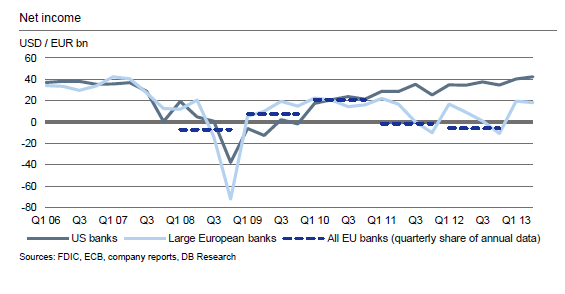
EU-vs-US-banks

Source: Bank performance in the US and Europe – An ocean apart, Sept 26, 2013  Deutsche Bank Research

I agree with Mr.Jan’s outlook for European banks. Though they will not close the gap with their U.S. peers in the coming years they may be able to narrow the gap between them and U.S. banks. Hence the “catch-up” potential presents some attractive investment opportunities in the European banking sector at current levels.

Five European banks trading on the U.S. markets are listed below for consideration:

1.Company: Barclays PLC (BCS)
Current Dividend Yield: 2.21%
Country: UK

2.Company: Credit Suisse Group AG (CS)
Current Dividend Yield: 0.34%
Country: Switzerland

3.Company: Banco Santander SA (SAN)
Current Dividend Yield: 7.24%
Country: Spain

4.Company:Deutsche Bank AG (DB)
Current Dividend Yield: 1.91%
Country: Germany

5.Company:ING Groep NV (ING)
Current Dividend Yield: No dividends paid
Country: The Netherlands

Note: Dividend yields noted are as of Oct 10, 2013. Data is known to be accurate from sources used.Please use your own due diligence before making any investment decisions.

Disclosure: Long ING, SAN
Why German Electric Utilities Are Stuck In Neutral

Two of the largest German electric utility stocks E.ON AG(EONGY) and RWE AG(RWEOY) were on a downtrend trend for a few years now and seemed to be stuck in neutral this year.The end of the Federal elections recently has also not yet brought changes to highly controversial German energy policies.

The main reason for the poor performance of traditional electric utilities is the subsidies offered to renewable energy companies. From an article in The Wall Street Journal:

In the late 1990s and early 2000s, Germany, France, Italy and some other EU countries began subsidizing solar and wind power in an effort to minimize the region’s reliance on imported fossil fuels and to reduce power prices.

“We’ve failed on all accounts: Europe is threatened by a blackout like in New York few years ago, prices are shooting up higher, and our carbon emissions keep increasing,” said GDF Suez CEO Gérard Mestrallet ahead of the news conference.

The European Commission, the bloc’s executive body, is scheduled to discuss the issue next week.

Under the subsidy mechanisms, wind and solar power producers benefit from priority access to the grid and enjoy guaranteed prices. In France, for instance, even as wholesale prices hover around €40 ($54) a megawatt hour, windmill electricity goes at a minimum of €83 a megawatt hour, regardless of demand. The difference is charged to customers.

The system certainly lured investors into wind and solar power projects. Germany now has 60 gigawatts of wind and solar capacity—about 25% of the country’s total power-generation capacity. But the guarantees mean households now pay double than before—29 euro cents a kilowatt-hour, up from about 14 cents a kilowatt-hour in 2000.

Source:  EU Chiefs Knock Solar Aid, The Wall Street Journal, Oct 12-13, 2013

In 2000, Germany implemented the German Renewable Energies Law (EEG). Under this law, the country aims to generate 80% of total energy from renewable energy sources by 2050. So in order to achieve this goal, high subsidies were given to renewable energy providers with higher prices paid by consumers.This made traditional electric utilities in uncompetitive. Earlier this year a reform proposal put forth by Environment Minister Peter Altmaier to cap subsidies for renewable energy producers failed to pass in the Bundesrat according to an article in the Deutsche Welle. From that article:

Under an ambitious new energy policy, Germany seeks to boost renewables to make up 80 percent of total power generated by 2050. Along the way, nuclear power is to be completely phased out by 2022, and fossil-fuel based energy production sharply reduced.

However, since the EEG law was implemented in 2000, German electricity retail prices have risen from then 14 eurocents per kilowatt-hour to almost 29 cents today, according to data released by the Association of Energy and Water Industries (BDEW).

Much of the increase is the result of a surcharge on electricity bills paid by private households and businesses to finance state subsidies for renewable energies. Wind, solar and biomass energy producers are guaranteed fixed so-called feed-in tariffs above market price for 20 years. These subsidies have led to an investment boom propelling the amount of renewable energy from 15 percent of German power generation in 2008 to 23 percent in 2012.

Accordingly, the surcharge on electricity rose steeply, too, increasing by 47 percent just within the last year. In a recent estimate, the government has calculated that the surcharge will likely rise from currently 5.3 eurocents per kilowatt-hour to 6.2 eurocents in 2014.

Source:  German energy transition caught in subsidies’ trap, Deutsche Welle

Clearly German policies for the past decade or so has tilted way too far on the side of renewable energy companies. As consumers become increasingly angry for footing the bill for this ambitious but badly-implemented policies,the pendulum may finally swing to the other side. Investors may want to monitor the developments with respect to the energy sector in Europe particularly any regulatory changes in Germany. Capping subsidies to renewable energy companies should provide a big boost to the share prices of E.ON and RWE AG.

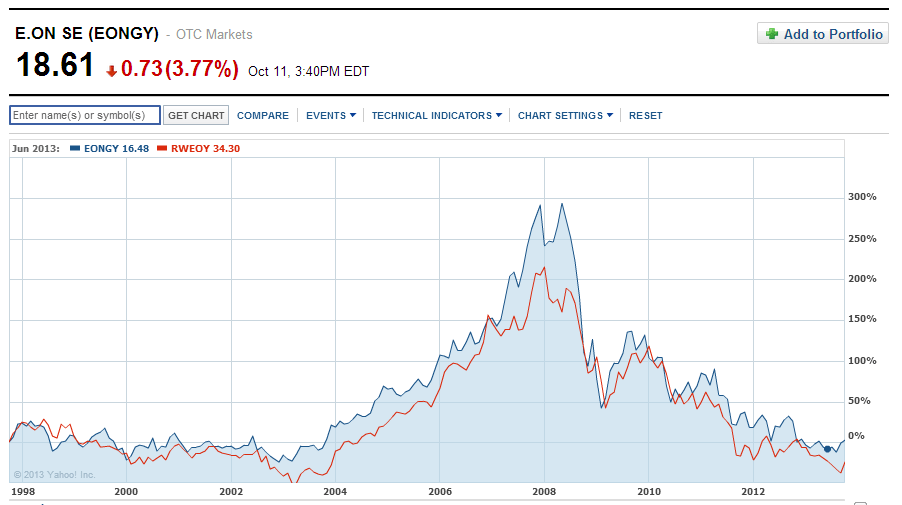
Currently EONGY and RWEOY have dividend yields of 5.68% and 7.16 respectively. The chart below shows the long-term performance of these stocks:

Click to enlarge

EONGy-vs-RWEOY

Source: Yahoo Finance

Disclosure: Dividend yields noted are as of Oct 11, 2013. Data is known to be accurate from sources used.Please use your own due diligence before making any investment decisions.

Disclosure: Long EONGY and RWEOY

Related:

German call to ‘undo’ energy privatisation amid Berlin vote (BBC)

Germany’s Energy Poverty: How Electricity Became a Luxury Good (Der Spiegel)

Travails of renewable power in Germany (The Hindu)

Comparing Pension Systems Across Countries

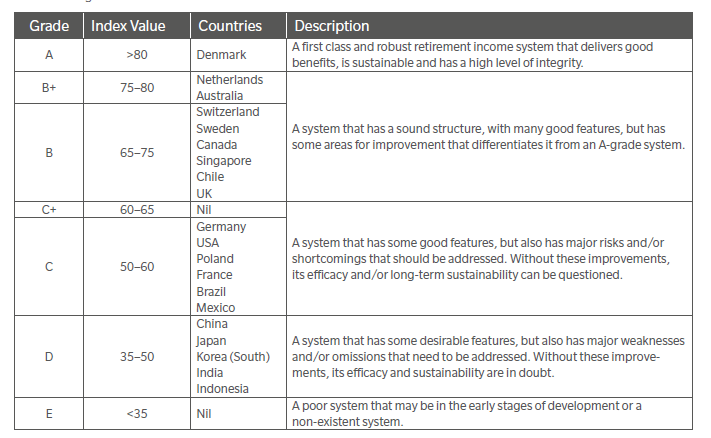
Mercer Consulting recently published the Melbourne Mercer Global Pension Index report rating pension systems around the world. The U.S. pension system received a “C” grade based on this study. Denmark has the world’s best system followed by The Netherlands and Australia. It is interesting that the pension system of Chile is ranked highly with the systems in many other developed countries.

Click to enlarge

Pension-Systems-Across-Countries

Source: Mercer

The study defines the U.S. pension system as follows:

The United States’ retirement income system comprises a social security system with a progressive benefit formula based on lifetime earnings, adjusted to a current dollar basis, together with a means tested top-up benefit; and voluntary private pensions, which may be occupational or personal.

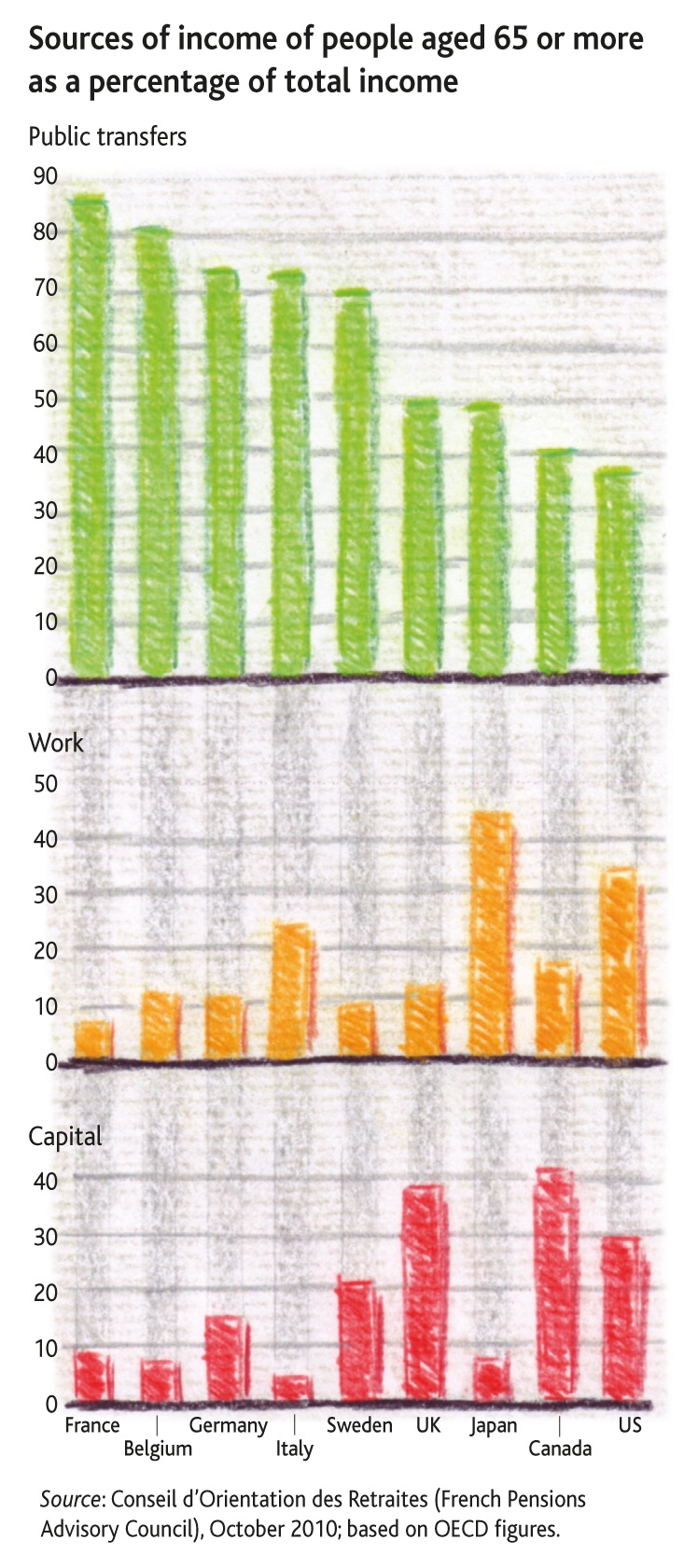
Here is a chart showing source of income as a percentage of total income for seniors among OECD countries:

LMDjune13_pp10-11_Japan_Haarhodd.indd

Source: Senir Citizens Around The World, Le Monde

For senior citizens in the U.S. the majority of the income comes from personal sources such as own’s savings (capital) and pensions offered by companies they worked for (work). Public transfers such as social security income is the lowest for U.S. seniors when compared to other countries. French senior citizens receive the highest income from public transfers.

Knowledge is Power: Obamacare, Robots, Great Rotation Edition

Four American blue-chips to add to your shopping list (MoneyWeek)

Predicting Death to Find Life in Emerging Market Stocks (Alliance Bernstein)

Obamacare is just a Bandaid. US healthcare needs radical surgery (The Guardian)

Why the U.S. consumer isn’t a safe bet (The Globe and Mail)

The Great Rotation spins its wheels (The Financial Post)

EMs: not all smooth sailing (FT beyondbrics)

Robots: Job Terminators (MaClean’s)

German ‘wise man’ says Italy, Spain could face downturn as severe as Greece (RBS)

Sex, drugs, software (BBC)

Versailles

Palace of Versailles, France

Five Reasons To Consider Chilean Stocks

Among the Latin American equity markets, the Chilean market does not get as much attention from international investors as other countries such as Brazil and Mexico do.However this need not be the case. The relatively smaller country of Chile offers many excellent investment opportunities.

Some of the reasons to consider buying Chilean stocks include:

1. Chile’s IPSA index is down 13.7% year-to-date as of Oct 9th while Brazil’s Bovespa is off by 13.8%. Despite the Chilean economy being in a better shape than Brazilian economy, investors are treating both the markets to be similar. Hence it can be argued that Chilean stocks are comparatively cheaper.

2. The P/E ratios of Brazil, Chile and Mexico are 15.8, 18.3 and 19.7 according to FT markets data. So there is room for some P/E expansion.

3.Chile has a budget surplus based on 2012 data as per the CIA’s The World Factbook.  Generally surplus countries are better for investment than deficit countries.

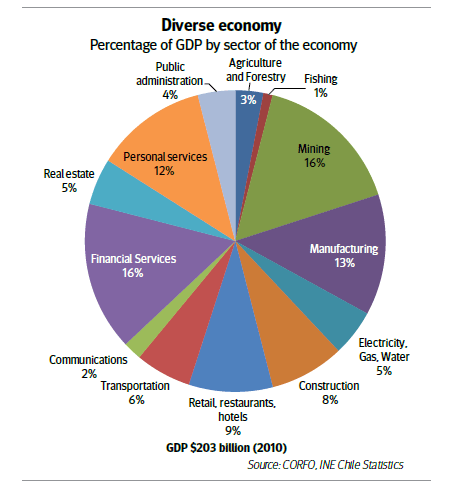
4.A common misconception of global investors is that the economy of Chile is mainly based on commodities especially copper. This is true in the sense that the mining sector brings the largest revenue for the country and is also the largest export-revenue earner. However the sector accounts for only 16% of the total economy. In fact Chile has a very diverse economy as shown in the chart below:

Click to enlarge

Chile-Economy

Source: Doing Business in Chile 2012, KPMG

So simply evaluating Chilean equities based on the price movement of copper and other commodities is not wise.

5.Chile has a highly attractive business environment with its low corporate income of 18.5% in 2012. The country’s GDP is projected to grow by a modest 4.6% this year and the unemployment rate is below 6%.

Five Chilean stocks trading on the US exchanges are listed below for further research:

1.Company: Compania Cervecerias Unidas SA (CCU)
Current Dividend Yield: 1.73%
Sector:Beverages

2.Company: Banco de Chile (BCH)
Current Dividend Yield: 3.73%
Sector:Banking

3.Company: Enersis SA (ENI)
Current Dividend Yield: 2.59%
Sector:Electric Utilities

4.Company: Vina Concha y Toro SA (VCO)
Current Dividend Yield: 1.65%
Sector:Beverages

5.Company: Empresa Nacional de Electricidad SA (EOC)
Current Dividend Yield: 1.69%
Sector:Electric Utilities

Note: Dividend yields noted are as of Oct 9, 2013. Data is known to be accurate from sources used.Please use your own due diligence before making any investment decisions.

Another simple and easy way to gain exposure to Chile is via the iShares MSCI Chile Capped ETF (ECH). It has an expense ratio of 0.61% and an annual dividend yield of 1.38%.

Disclosure: Long BCH, ENI