The Ten Largest U.S. Electric Utilities

The utility sector is lagging the S&P 500 this year as investors fret over the impact of rising interest rates on utilities.

For investors looking to gain exposure or take a contrarian view on this sector, the following are the ten largest US electric utilities:

1.Company: Consolidated Edison Inc. (ED)
Current Dividend Yield: 4.17%

2.Company: Northern Utilities (NU)
Current Dividend Yield: 3.62%

3.Company: Edison International (EIX)
Current Dividend Yield: 2.88%

4.Company: Portland General Elect. Co. (POR)
Current Dividend Yield: 3.46%

5.Company: Sempra Energy (SRE)
Current Dividend Yield: 3.10%

6.Company: Southern Co. (SO)
Current Dividend Yield: 5.08%

7.Company: Duke Energy Corp. (DUK)
Current Dividend Yield: 4.83%

8.Company: Entergy Corp. (ETR)
Current Dividend Yield: 5.30%

9.Company: NextEra Energy, Inc. (NEE)
Current Dividend Yield: 3.21%

10.Company: American Electric Power Co., Inc. (AEP)
Current Dividend Yield: 3.94%

Note: Dividend yields noted above are as of Sept 15, 2015. Data is known to be accurate from sources used.Please use your own due diligence before making any investment decisions.

Source: Electric Utilities:Perhaps not the Investment One Expects, Horizon Kinetics LLC

Disclosure: Long NEE
Despite Volatility Keep Calm And Stay Invested In The Market

Equity markets worldwide have become extrememly volatile in the past few weeks. After the Greek debt drama ended after many months of twists and turns, seemingly out of nowhere China took the center stage. Though the Chinese economy has been in doldrums for a year or more now, investors suddenly turned their attention to China. Changes in an economy is not an overweight process. Rather it takes many months for an economy to either enter the expansion or contracton mode. China’s economy is no different from others in this regard.

With US and other developed stock markets, going up and down violently on a daily basis like a wooden roller coaster, some investors may think of exiting this crazy market and then get back in at a later time. This is not a wise strategy for many reasons. Trying to time the market always works against an investor. While selling may be easy trying to find the clear bottom or entering the market when things calm down is easier said than done.

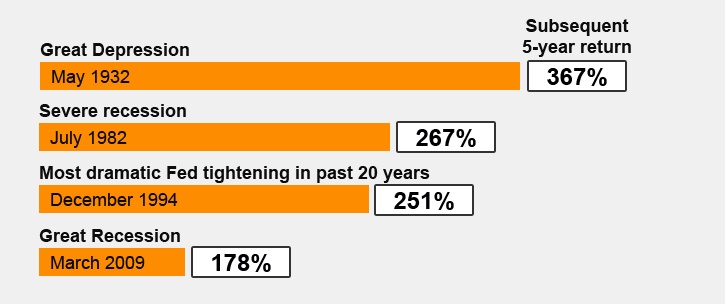
The following chart shows staying invested in volatile times yields excellent returns in the subsequent periods:

Click to enlarge

Stay Invested Chart-1

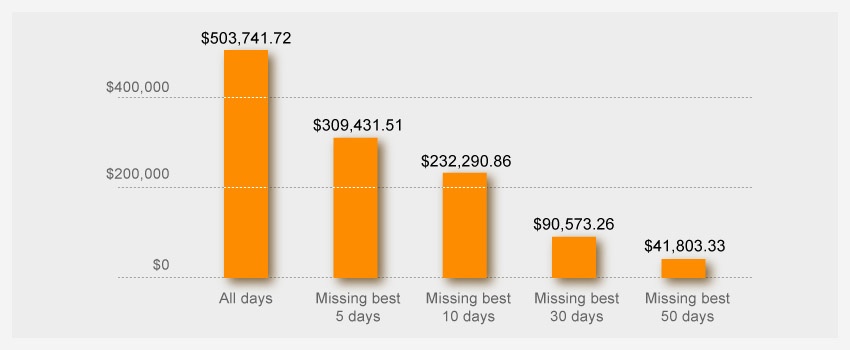
Here is another chart showing the impact of timing the market:

timing the market is bad chart

Source: Six strategies for volatile markets, Fidelity

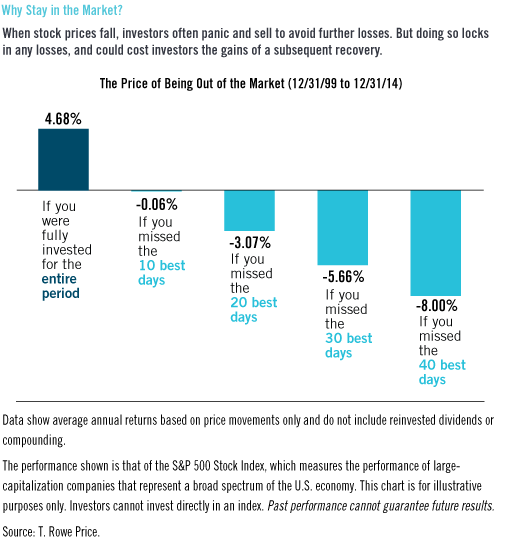
Another reason for staying invested is that markets can move violently up on any day in the future. Since no one can predict the future investors can easily miss out on big gains by not staying in the market.

Click to enlarge

WhyStayintheMarket-chart

Source: Overcoming Your Market Fears, T.Rowe Price

In summary, the key point to always remember is that one should not panic and sell on a big down day. Instead an investor can advantage of cheaper prices and add in phases if they have the funds available.

Banking Crises: U.S. vs Canada

I came across a fascinating Journal article that I had bookmarked before in 2013 on banking crises in Canada and the US.

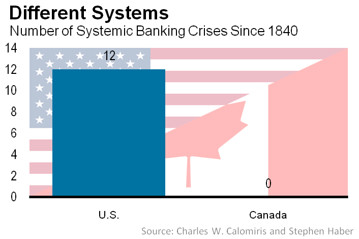
Since 1790, the United States has suffered 16 banking crises. Canada has experienced zero — not even during the Great Depression.

Banking Crises US vs Canada

Source: Why Canada Can Avoid Banking Crises and U.S. Can’t, WSJ, Apr 9, 2013

From the article:

That anti-populist political system — known in political science as liberal constitutionalism or liberal democracy — is a key ingredient in Canada’s stable banking track record, Mr. Calomiris contends in his paper, which is a summary of a much longer book he’s written with Stephen Haber due out in September. That’s because this kind of political system makes it difficult for political majorities to gain control of the banking system for their own purposes, the authors contend.

Populist democracies like the U.S., on the other hand, tend to create dysfunctional banking systems because a majority of citizens gain control over banking regulation that steers credit to themselves and to their friends at the expense of the citizens that are excluded from the banking system, he said.

The contrast between the U.S. and Canada was part of Mr. Calomiris broader argument that dysfunctional banking systems — which are by far the norm rather than the exception around the world — are the result of political factors.

“Whether societies have dysfunctional banking systems is really not a technical issue at all. It’s a political issue,” Mr. Calomiris said at the conference, introducing his premise as “we do know how to avoid dysfunctional banking but that we make political choices – you might even say consciously” not to have functional banking systems for most of the modern era in most countries of the world.

The history of the U.S. banking system is one in which the government forms partnerships with different interest groups at different points in history, and those coalitions jointly influenced the way the banking system was regulated, Mr. Calomiris argues.

“In populist democracies, such as the United States, the regulation of banking is used as a political tool to favor some parties over others. It is not that the dominant political coalition in charge of banking policy desires instability, per se, but rather, that it is willing to tolerate instability as the price for obtaining the benefits that it extracts from controlling banking regulation,” he writes in his paper.

Other ountries that have been crisis free are Singapore, Malta, Hong Kong, New Zealand and Australia.

Here are some exceprts from a NBER paper related to this topic:

When European and North American banks teetered on the brink of meltdown in 2008, requiring bailouts and extraordinary central bank intervention, Canadian banks escaped relatively unscathed. History explains why, according to co-authors Michael Bordo, Angela Redish, and Hugh Rockoff in Why Didn’t Canada Have a Banking Crisis in 2008 (or in 1930, or 1907, or …)? (NBER Working Paper No. 17312). Starting in the nineteenth century, Canada and the United States took divergent paths: Canada set up a concentrated banking system that controlled mortgage lending and investment banking under the watchful eye of a single, strong regulator. The United States allowed a weak, fragmented system to develop, with far more small (and less stable) banks, along with a shadow banking system of less-regulated securities markets, investment banks, and money market funds overseen by a group of competing regulators.

“[T]he stability of the Canadian banking system is not a one-off event,” the authors note. “In Canada the banking system was created as a system of large financial institutions whose size and diversification enhanced their robustness…. In the [United States] the fragmented nature of the banking system created financial institutions that were small and fragile. In response the [United States] developed strong financial markets and a labyrinthine set of regulations for financial institutions.”

The contrast is striking. While in 2008 and 2009 the United States experienced bank failures, bailouts, and the worst recession since the 1930s, Canada had no bank failures, no bailouts, and its recession was less severe than either that of the early 1980s or early 1990s. Long before 2008 in the United States, there were the failures of the private investment bank Jay Cooke and Co. (the 1873 crisis), the Knickerbocker Trust (the 1907 panic), and the runs on banks that deepened the Great Depression. Although Canada’s economy suffered a collapse equally as dramatic as America’s in the 1930s, not one of its banks failed.

“The twin weaknesses of the American financial system — a commercial banking system divided along state lines and volatile financial markets in which a ‘shadow banking system’ of unregulated or lightly regulated investment banks and other financial intermediaries participated — produced a series of financial panics,” the authors write. “There were major banking panics in 1837, 1857, 1873, 1893, and 1907, and minor panics in 1839, 1884, and 1890.”

Source: Why Canada Didn’t Have a Banking Crisis in 2008, NBER

The entire journal article and the NBER paper is worth a read.

Gold: Three Charts On Growth

Gold is an important asset class to own by most investors. It does not produce a steady stream of regular income such as dividends and the only gain one can expect is due to price appreciation. So it is a great asset for investors seeking income. However gold has its advantages. For example, during times of global market chaos, recessions, etc. gold can offer some stability to a well-diversified portfolio as investors flee risky assets for the safety of treasuries and gold. Generally investors can allocate a small portion of their total assets to growth. How much one should allocate depends on age and other individual factors.

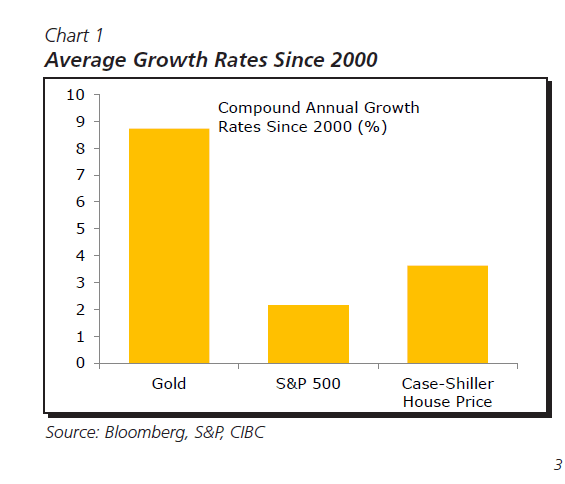
a) Gold great to hold during the global financial crisis of 2008-09 and the dot com bubble as the chart shows below. From 2000 to August this year, Gold has produced an average annual growth of 9% compared to about 2% for the S&P 500:

Click to enlarge

Gold Average Growth Rate

Source: Gold: Glittering no more, CIBC World Markets

From the CIBC report:

However, as a store of value since the turn of the millennium, gold is still performing better than others. An investment in gold made in 2000 has enjoyed a 9% compound growth rate. Of course, if that investment was cashed in in 2011, when gold prices peaked, the annual growth rate would have been much higher. But that 9% is still much healthier than the gains made by investments in the S&P 500 Index, or in the US housing market at that same time (Chart 1)

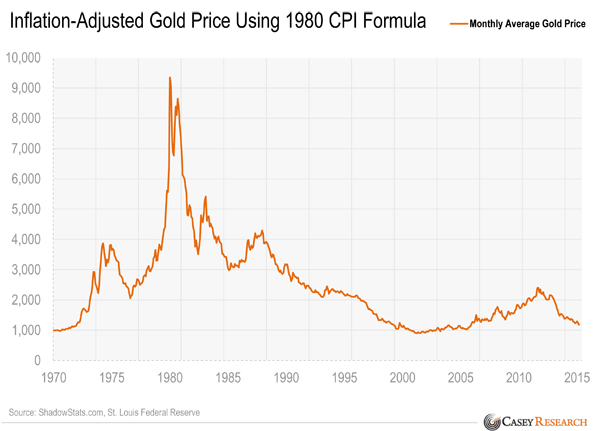
b) Despite huge run-up during the financial crisis, gold has never reached its inflation adjusted peak reached in 1980.

GOLD chart with inflation

Note: Chart data above is as of April 2015.

Source: Gold Is Near an All-Time Inflation-Adjusted Low, Casey Research

Here is another excerpt from a recent article on WSJ:

To understand the stock market, check out the gold market. The two tell a lot about each other.

People buy gold when they are afraid of the future. They buy stocks at the opposite time, when they are hopeful. Today, despite worries about China, Greece, a likely Federal Reserve interest-rate increase and an uncertain corporate-earnings outlook, the gold market is giving a clear signal: Investors, on the whole, aren’t very frightened.

The last time gold hit a record, after controlling for inflation, was 1980. It has never been back in inflation-adjusted terms and, at Friday’s close, was 57% below its 1980 peak. The Dow Jones Industrial Average, also adjusted for inflation, last hit a record on May 19. At Friday’s close it was 3.7% off that level.

Investors are nervous enough that they aren’t pushing stocks to new records, but not nervous enough to sell heavily or buy gold.

“We view gold as an Armageddon-scenario asset,” explained Jim McDonald, chief investment strategist at Northern Trust Corp., which oversees $946 billion in Chicago. Such a scenario isn’t among his concerns today.

For reference, New York gold futures peaked at $825.50 a troy ounce on Jan. 21, 1980, which in today’s dollars is about $2,532.08.

Source: Investors Are Far From Sold on Gold, The Wall Street Journal

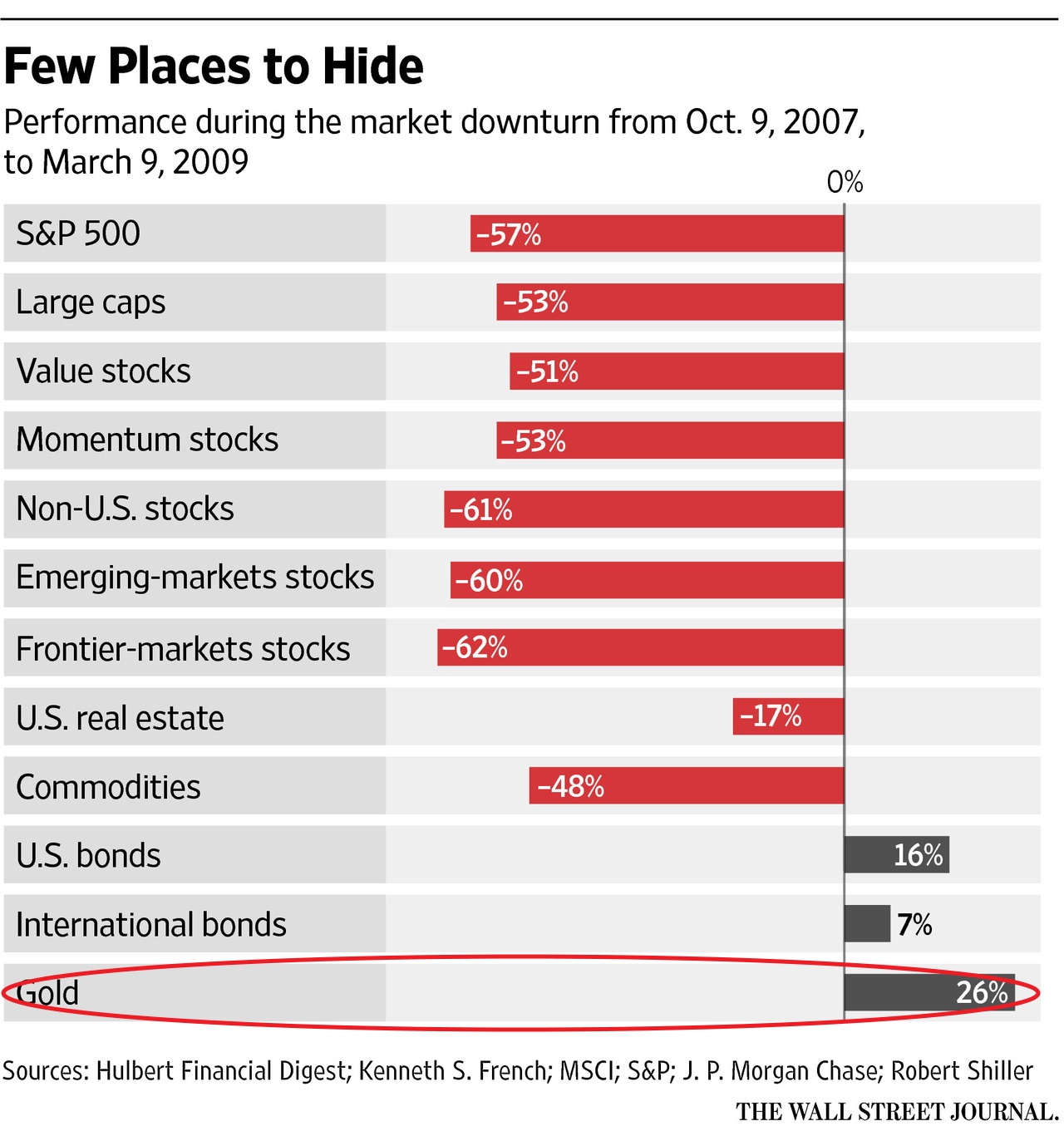
c) The following chart shows gold shot up during the global financial crisis and was one of the few places to hide.

gold


Source: If the Bear’s Near, Which Assets Protect You, WSJ

Dividend Withholding Tax Rates By Country 2015

*** UPDATE:  For the latest Dividend Withholding Tax Rates click :

Dividend Withholding Tax Rates By Country 2022

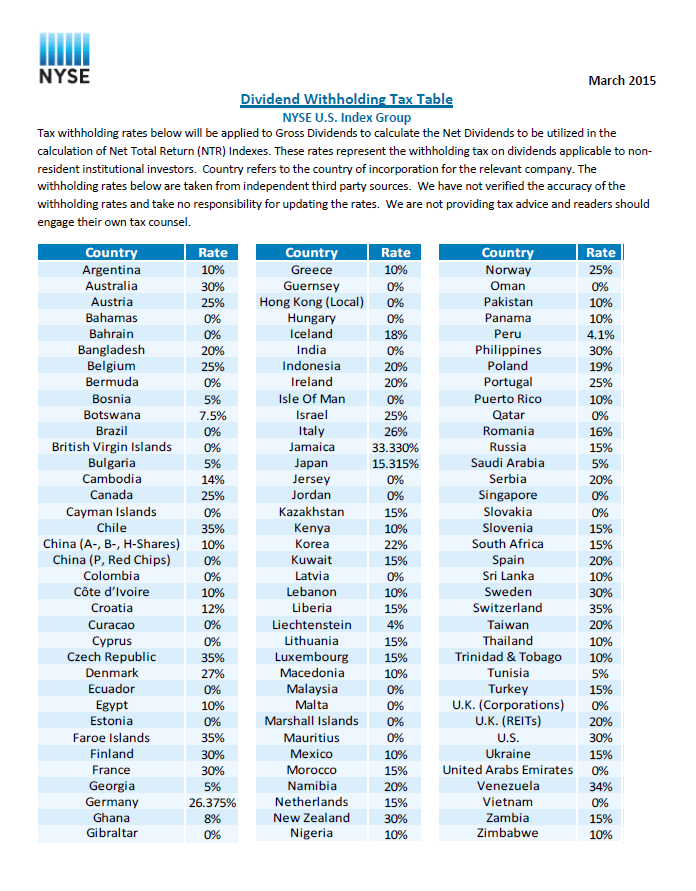
Dividend Withholding Tax Rates is an important to consider when investing in foreign stocks for US-based investors. These taxes vary by country and can be as high as 25% or more or as low as 0%.

The following table shows the dividend withholding tax rates for 2015:

Click to enlarge

Dividend withholding taxe rates 2015

Source: NYSE

Here are two points to consider:

  • Though the rate for Canada is noted as 25% above, it is actually possible to get a reduced rate of 15% for taxable accounts by filling a form with the tax authority of Canada. Also Canada does NOT deduct withholding taxes from dividends of stocks held in retirement accounts such as IRAs, 401Ks, etc. Hence it is a smart move to hold Canadian dividends stocks in retirement accounts.
  • A few countries such as UK, Malaysia, Singapore, India, etc. do NOT charge any dividend taxes for all types of accounts. Investors hunting for income stocks can focus on these countries although Indian stocks are not known for high dividends.

To save for future reference: Download the above table in a pdf document.

*** UPDATE:  For the latest Dividend Withholding Tax Rates click :

Related: