Share of Foreign-born Population in OECD Countries

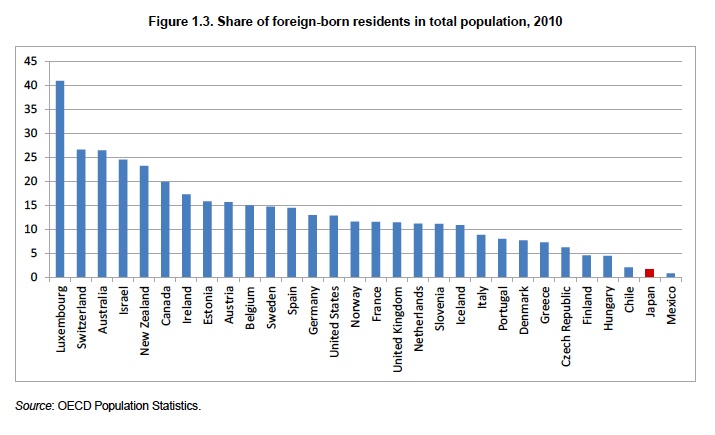
Foreign-born residents as a percentage of total population in OECD countries is shown in the chart below. Some countries such as Japan are facing severe labor shortage as the country is facing a shrinking and ageing population. Here is an excerpt from an OECD article:

Japan’s population peaked in 2010 at just over 128 million beginning what is projected to be a sustained and increasingly steep decline. Simultaneously, Japan’s population is ageing rapidly. From 1950 to 2015, the share of population age 65+ grew from just under 5% to over 25%. This is the highest such figure, worldwide. The population aged 80+ has risen even faster, from 0.4% in 1950 to 7.3% in 2013 (OECD average = 4.1%). Japan’s median age was 45.9 years in 2013, compared to a world average of 29 years and an OECD median age of 38.7 for the same year. Based on current projections, the Japanese government expects Japan’s population to decrease by 22-23% between 2010 and 2050, with the elderly (65+ years) accounting for 40% of the population.

Click to enlarge

Share-of-foreign-born-residents-OECD-Countries

Source: The case of the shrinking country: Japan’s demographic and policy challenges in 5 charts, OECD Insights

One solutions proposed in the article to solve Japan’s ageing population issue is immigration. Japan is one the few countries in the world with a very low population of immigrants. For the most part Japan is a homogeneous society. Some of the countries with low number of foreigners include Cuba, North Korea, Russia and most East European countries.

According to the OECD, foreign-born population was under 1.7% of the total population in Japan.

OECD countries with high foreign-born population include Luxembourg, Switzerland, Australia, etc. Countries like Australia, New Zealand and Canada have high foreign-born population due to liberal immigration policies.

Export and Import Partners of France

France is one of the largest economies in Europe and the world. With an estimated GDP of $2.6 Trillion in 2015 based on purchasing power parity the French economy is the 11th largest in the world.

France is a major player in international trade.Similar to other major developed European nations France trades with a diversified set of countries. The following chart shows the export and import partners of France based on 2014 data:

Click to enlarge

French Export and Import Countries 2014


The chart below shows the French export categories:

French Export Categories 2014

Source: Country in the Spotlight – France On a slippery path, ING

A few observations:

The top three countries for French exports were Germany (16.8% of total), U.S. (8.8%) and Belgium (8.6%). Since Germany is the largest economy in Europe it is not surprising that Germany is the top destination for French exports.

China accounts for only 5.5% of the total exports. This shows that France does not depend heavily on China from a trade perspective.

The top three source countries for French imports were Germany (19.2% of total), China (9.6%) and Belgium (9.0%).

Since Germany is the largest trade partner in terms of both exports and imports, the economies of these countries are highly dependent on each other.

The top three categories of French exports are road vehicles and transport equipment (20.3% of total), non-transport manufactured goods (18.4%), and chemicals (12.9%). Though pharmaceuticals account for only 6.3% of exports, it is projected to grow substantially in the next few years.

In terms of opportunities for investment, some of the major French firms trading on the US markets are Sanofi (SNY) in the pharma industry, Valeo SA (VLEEY) in the auto components business, oil giant TOTAL S.A. (TOT), Air Liquide (AIQUY ) in the chemicals sector, Danone (DANOY), etc. The full list of French ADRs can be found here.

Disclosure: No Positions


Knowledge is Power: Buybacks, Financial Stocks, Canada Trade Edition

Castle

Caernarfon Castle in North Wales, UK

Dividend Payments are Highly Concentrated in the UK Stock Market

Dividend paid out by British firms are unevenly distributed with a few large players accounting for a large portion of the dividends paid out. Traditionally the British dividend landscape is dominated by firms in certain sectors such as mining, oil, utilities, tobacco, consumer staples and telecom.

In fact, according to a research report by Schroder’s the top 10  payers account for just under half of the total dividends of the UK market. This shows the scale of concentration in the British market.

Click to enlarge

biggest-dividend-distributors-in-UK-stock-market

Source: What are the prospects for dividends in the UK?, Schroder’s

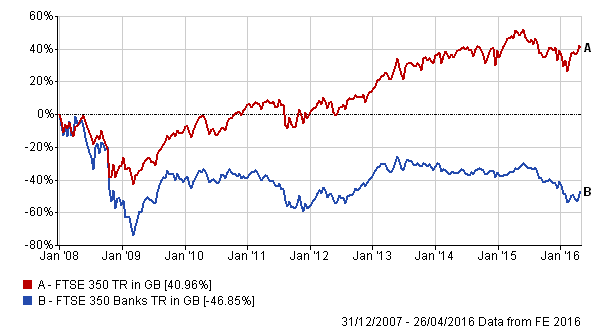
The takeaway here is that income investors looking for British dividend stocks should focus on some of the large-cap dividend payers due to the high concentration of dividends paid. The British banking sector can be avoided at this time. But others like Astra Zeneca(AZN), Vodafone(VOD), etc. are excellent dividend stocks for the long-term investor.

Disclosure: No Positions

Two Top British Fund Managers Favor Tobacco Stocks

Tobacco stocks are some of the consistent long-term winners in terms of both income and total returns. In a recent speech, two of the star rated fund managers in the UK noted their preference for stocks in this industry. Star fund managers Terry Smith and Neil Woodward noted a few reasons that support their views.

From an article in the CityWire UK:

Terrific tobacco

While Smith and Woodford were agreed on banks, they also share a fondness for tobacco stocks.Imperial Brands (IMB), formerly known as Imperial Tobacco, is Woodford’s biggest holding, and he also owns British American Tobacco (BATS) andReynolds American (RAI.N), having long been a backer of the sector. Smith is also an investor in Imperial Brands, alongside Philip Morris (PM.N).

While sceptics of the sector point to the mounting regulatory pressure on smoking and the rise of e-cigarettes as threats, Smith said they would have the opposite effects.

Bans on advertising and marketing had only served to erect barriers to new entrants to the sector, boosting the profitability of the market leaders, while e-cigarettes could expand the industry by allowing existing smokers more opportunities to smoke,’ he said.

‘The tobacco industry has been good for a period of time, and has been turbocharged by government action against the industry,’ he said.

Source: Terry Smith: I’d take a recession over a ‘lost decade’, CityWire UK

At a pretty basic level, tobacco firms operate in a unique environment in that the main ingredient in the product comes from a source that is very cheap to grow and the product is addictive.

Five tobacco stocks trading on the US markets are listed below with their current dividend yields:

1.Company: Reynolds American Inc (RAI)
Current Dividend Yield: 3.42%
Sector: Tobacco
Country: USA

2.Company: British American Tobacco PLC (BTI)
Current Dividend Yield: 3.61%
Sector:Tobacco
Country: UK

3.Company: Imperial Brands PLC (IMBBY)
Current Dividend Yield: 2.66%
Sector:Tobacco
Country: UK

4.Company: Philip Morris International, Inc. (PM
Current Dividend Yield: 4.06%
Sector: Tobacco
Country: USA

5.Company: Altria Group Inc. (MO)
Current Dividend Yield:3.64%
Sector: Tobacco
Country: USA

Note: Dividend yields noted above are as of April 19, 2016. Data is known to be accurate from sources used.Please use your own due diligence before making any investment decisions.

Disclosure: No Positions