Home Bias In Investors’ Equity Portfolio Allocation Across Countries

Investors across the world tend to biased towards their own country’s equity markets and accordingly overweight their portfolios with domestic stocks. However this home bias strategy can adversely affect an investor’s returns due to lack of diversification and depending too much on the domestic equities.

The chart below shows how the home bias issue varies among countries:

Click to enlarge

Home Country Bias in Investors Portfolio Allocation

Source: Your portfolio may be less diversified than you think, By Jeffrey Kleintop, Charles Schwab, Aug 22, 2016

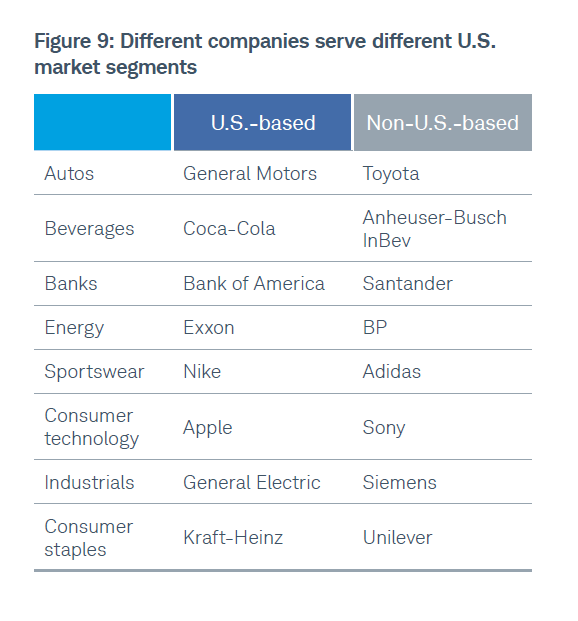
Jeff discusses the case of the equity markets of Canada, USA and Japan in terms of how they are heavily dependent on and follow the performance of specific sectors. Canadian stocks for example tend to follow the performance of the energy sector since Canada is a commodity-based economy and energy is the major driver of the economy.Similarly the US market performance mirrors the performance of the technology sector.

For optimal returns and reducing risks, investors should reduce their home bias and diversify their portfolios across sectors, countries and regions. Putting too many eggs in one basket is never a wise idea. Though it may seem unnecessary to venture abroad, investors need to at least allocate a small portion of their assets to overseas equities. This is especially important for investors in countries where the domestic market is highly reliant one sector.

The Top 10 Export and Import Partners of China

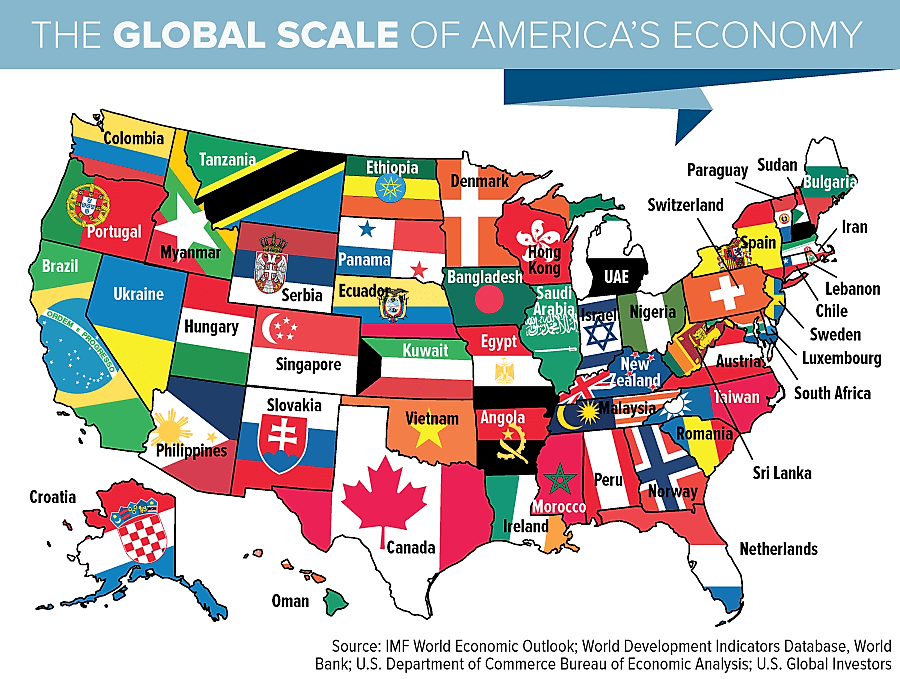
In this post let us take a quick look at the top 10 trade partners of China. As one of the world’s largest countries in terms of economy and population China plays a major role in global trade. Currently the top destination for exports from China is the U.S. According to a forecast by ING, the US will continue to be number export destination for Chinese goods in 2019.

The Top 10 Export Destinations of China are shown below:

Click to enlarge

China - Export Destinations

Hong Kong is the gateway to world for China and hence it is the 2nd largest destination for exports. China’s exports to India in growing strongly and forecast to double by 2019 from current levels.

The Top 10 Import Origin Countries of China are shown below:

Click to enlarge

China - Origin of Imports

South Korea is the largest source of imports for China. The US is next major import partner.It is interesting that commodity exporting majors such as Brazil, Saudi Arabia, etc. are not the top import sources. Instead South Korea, a top manufacturer of quality goods such as electronics ranks the top import source. By 2019 ING projects the US to replace South Korea as the top source of imports for China.

Source: Country trade view with China, ING

Emerging Markets Are Back. Here Are Ten Stocks To Consider

Emerging markets are hot this year as global investors are attracted to their for their higher growth potential and yields in some cases. With growth stagnating in the developed world especially in Europe it is not surprise that investors are turning their attention back to emerging markets. In the past few years emerging market stocks have been poor performers and many investors were disappointed when these markets failed to deliver due to the crash in commodity prices. For instance, emerging markets as represented by the MSCI Emerging Markets Index yielded negative returns in the past three years. However the perception that these markets are not worth the time and effort has changed. according developing markets are outperforming developed markets by a wide margin. The MSCI EM Index is up by 14.63% year-to-date as of Aug 19th compared to just 4.15% increase for Developed Markets represented by the MSCI World Index.

The graph below shows the yearly performance of major MSCI indices:

Click to enlarge

MSCI Emerging_Markets vs Other markets Returns Chart

Note: Data shown above are as of Aug 18, 2016

Source: Emerging markets are back in favour, Livemint, Aug 19, 2016

From the above article:

What has changed? First, it could just be simple rotation—valuations are much higher for the MSCI World Index than for the MSCI Emerging Markets Index. Second, Brexit led to funds moving out of the UK and to some extent Europe. Third, the fears of an interest rate hike by the US Federal Reserve have been pushed to the background and risk assets have rallied. Fourth, commodity prices have moved up from their lows, as China stabilizes its economy. And finally, market participants could also be deriving optimism on EM economies from the recent International Monetary Fund global growth outlook report, which says the pace of gross domestic product growth in EMs is likely to increase every year for the next five years, while growth in DMs will stagnate.

Inflows into emerging market equity funds has also reached a 58-week according to an FT article.

Click to enlarge

Em Fund Inflows

Source: Emerging markets back in vogue, FT, August 20, 2016

Since emerging markets underperformed in the past and commodity prices are on the upside, the current run in emerging markets can continue for while. Investors looking to profit from the growth potential of these markets can consider adding these stocks. But as these markets are riskier than developed markets, investors should not allocate a high portion of their assets to emerging stocks.

Ten emerging markets to consider are listed below with their ADR tickers and current dividend yields:

1.Company: Empresa Nacional de Electricidad SA (EOC)
Current Dividend Yield: 2.58%
Sector: Electric Utilities
Country: Chile

2.Company: Credicorp Ltd (BAP)
Current Dividend Yield: 1.45%
Sector: Banking
Country: Peru but company based in Bermuda

3.Company: HDFC Bank Ltd (HDB)
Current Dividend Yield: 0.60%
Sector: Banking
Country: India

4.Company: Ultrapar Participacoes SA (UGP)
Current Dividend Yield: 1.96%
Sector: Oil, Gas & Consumable Fuels
Country: Brazil

5.Company: Banco Santander-Chile (BSAC)
Current Dividend Yield: 4.90%
Sector: Banking
Country: Chile

6.Company: Fomento Economico Mexicano SAB de CV (FMX)
Current Dividend Yield: 1.37%
Sector: Beverages (Nonalcoholic)
Country: Mexico

7.Company:Philippine Long Distance Telephone Co (PHI)
Current Dividend Yield: 5.71%
Sector: Telecom
Country: Philippines

8.Company: PetroChina Co Ltd (PTR)
Current Dividend Yield: 1.98%
Sector: Oil
Country: China

9.Company: China Life Insurance Co Ltd (CHL)
Current Dividend Yield: 2.65%
Sector: Life Insurance
Country: China

10.Company: Ambev SA (ABEV)
Current Dividend Yield: 2.37%
Sector: Beverages
Country: Brazil

Note: Dividend yields noted above are as of Aug 19, 2016. Data is known to be accurate from sources used.Please use your own due diligence before making any investment decisions.

Disclosure: Long No Positions

Knowledge is Power: Fordlandia, Bond ETFs, Weapons R Us Edition

Click to enlarge

Chicago Skyline

Chicago Skyline

Real Estate to Become a New Sector in the S&P 500 Index

The S&P 500 currently is dividend into 10 sectors. This is about to change with Real Estate being added as the 11th sector. Real estate will be split from the financial sector and added as a sector of its own. No new companies will be added to the index.

The existing sector composition of the S&P 500:

Click to enlarge

S&P 500 Sector Composition Chart

Source: S&P

IT dominates the S&P 500 with over 20% weightage. Financials and Healthcare constitute about 15% each. With the upcoming addition of real estate sector, financials will have a smaller weight in the index.

A short excerpt from a Schwab article on this topic:

The S&P 500® index has been divided into 10 sectors for quite some time—but that’s all about to change. At the beginning of September, real estate will become a shiny, brand-new 11th sector.

A quick reminder: Since its inception in 1999, the Global Industry Classification Standard, or GICS®—the most widely used sector categorization system, published by Standard & Poor’s and MSCI—has considered real estate a part of the financials sector. However, S&P and MSCI have determined that the real estate group should be spun out from the financial sector and get its own heading. They’re not adding companies that weren’t in the S&P 500, they’re shifting companies—28 to be exact, according to S&P—from financials to real estate.

The majority of the new sector will be made of equity real estate investment trusts (REITs), with some real estate development companies included. Equity REITs are companies that own physical property and typically receive some sort of rental income. Included in this group are companies that own such things as apartments, office property, malls, storage, etc. So-called mortgage REITs, which purchase mortgages as opposed to actual physical property, will not be included in the new sector and will remain in the financial sector.

So what should investors do?

Not much—at least for now. Depending on the investments that investors hold, they may have to adjust allocations once the dust settles a bit, but investors that hold mutual funds or certain exchange-traded funds (ETFs) may have the adjustments done for them. There isn’t a huge amount of urgency here, and the actual change doesn’t take place until the beginning of next month. Nevertheless, over the next couple of months it would be a good idea to determine what your funds did, and then determine what you may need to do to add or subtract to real estate exposure. At this point it looks like the new sector will make up about 3% of the S&P 500—not insignificant, but certainly not a major percentage.

Source: Schwab Sector Views: There’s a New Sector Coming, Aug 18, 2016, Charles Schwab

Related: 

New Real Estate Component in S&P Index Could Leave Financial Stocks Adrift, WSJ, May 12, 2016

Related ETF:

  • SPDR S&P 500 ETF (SPY)

Disclosure: No positions

Update (9/3/16):

Current and Future GIC Sectors Classification:

Click to enlarge

REITS_GICS-Sector

REITs Returns Over Years:

REITS_Performance Over Periods

Source: Real Estate Breaks New Ground, Franklin Templeton Investments, Aug 29, 2016

Update (9/19/16):

Click to enlarge

reits-in-sp500

Source: WSJ