Americans Are The Largest Holders of US Government Debt

Many people believe that China owns most of the US debt. This is not true. US investors are the largest holders of US debt and not China. China is the largest holder of US debt among foreign holders.

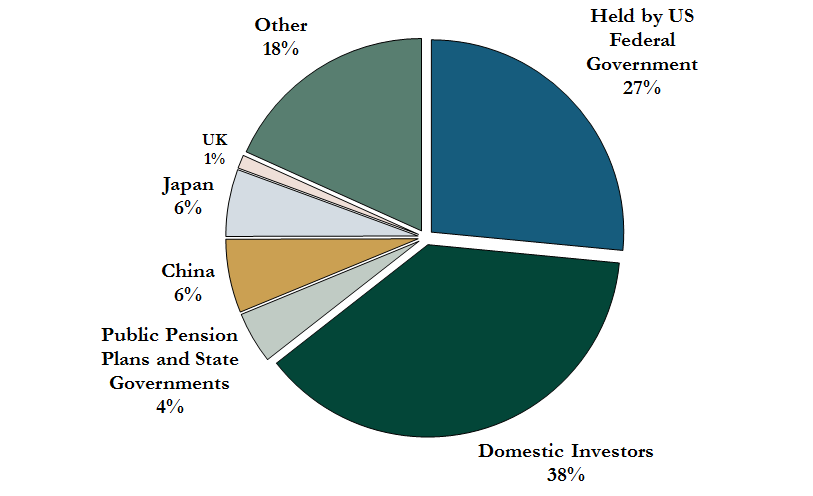
The chart below shows the holders of US treasury debt:

Click to enlarge
holders-of-us-debt

Source: The US is indebted to China: Fisher’s financial mythbusters, Oct 10, 2016, Money Observer

From the article:

Figure 1 (above, click to enlarge) shows who owns US Treasuries. American investors – individuals, corporations, charities, banks, mutual funds, hedge funds, and myriad other entities – own 38 per cent. They like owning Treasuries. They see them as safe (and they are!).

SAFE HAVEN

They don’t usually get a high return on them – haven’t since the early 1980s. Over long periods, stocks typically get better results, but investors are confident the US government will pay interest and return principal on maturity.

About 27 per cent is owned by hundreds of US federal government agencies, but mostly the Medicare and Social Security trust funds. People don’t worry about debt the US government owes to itself. States, public pension plans, and other local governments hold another 4 per cent.

So, 69 per cent of US federal debt is held by Americans, American governments, and/or American entities, which benefit Americans. Just 31 per cent is held by the non-US world. Of that, 6.2 per cent is held by China.

Interestingly, Japan holds 5.6 per cent – almost the same – but no one complains about that. And you don’t hear a lot of phobic fantasising about Japan dumping its Treasuries. Is there something magical about the Chinese that scares us, that isn’t magical about the Japanese?

Mathematically, it would make no difference to markets if the Japanese sold while the Chinese bought or vice versa. Then, the UK owns about 1 per cent – we’re perfectly sanguine about that.

Britain is our great friend! We don’t care about Mexico (0.4 per cent) or Thailand (0.2 per cent), Luxembourg (1.1 per cent), Germany (0.4 per cent), or India (0.6 per cent). All tiny!

Remember, China, Japan, the UK, Thailand, Luxembourg, and India are happy to buy and hold US debt. They can buy other nations’ debt. And they do! Just much less.

But they like buying US debt and do so to satisfy their own investing and/or policy ends, not from some sense of charity or kindness.

The total outstanding US public debt stands at 14,225,008,508,056.12 or $14.2 Trillion according to US Treasury. Out of this, China holds $1.2 Trillion followed by Japan at $1.11 Trillion. The majority of the $14.2 Trillion or about $10.0 Trillion is held by Americans.
Total Number of Mutual Funds vs. ETFs

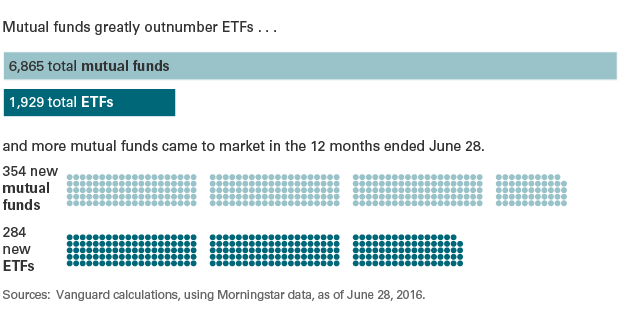
The ETF industry has grown tremendously in the past few years. However relative to mutual funds ETFs are still smaller in terms of total numbers of funds available on the market and the assets held in them. The following chart shows the number of mutual funds vs. ETFs:

Click to enlarge

mutual-funds-vs-etfs

Source: Vanguard Blog for Advisors

In the US market, there were 1,929 ETFs as of June 28 this year. Though this figure looks large, the total number of mutual funds available is in the thousands. In fact, 6.865 mutual funds are now available for investors. Thats not all. In the past 12 months thru June 28, 354 mutual funds were launched while only 284 ETFs came to the market.

A few reasons why mutual funds continue to thrive over ETFs are:

  • As the name implies ETFs are designed for easier trading all day when markets are open. So investors consider ETFs to be short-term instruments while mutual funds are something that buy and forget for years.
  • Mutual funds are the main funds offered to Americans in retirement accounts such as 401K by their employers. Hence most workers are indirectly forced to invest in mutual funds than ETFs or other assets. Hence the mutual fund industry has a stranglehold on the billions of retirement assets of most people.
  • Unlike an ETF which usually track an index, many investors go with mutual funds especially actively-managed funds falsely believing that a fund manager will be good enough to outperform the market. The mutual fund industry continues to convince Americans thru misleading marketing that star-fund managers are better at investing than ETFs or even individual investors building a portfolio themselves.

Some of the large ETFs on the US market include:

  • Vanguard Dividend Appreciation ETF (VIG)
  • SPDR S&P Dividend ETF (SDY)
  • SPDR S&P 500 ETF (SPY)
  • iShares MSCI Emerging Markets ETF (EEM)
  • Vanguard MSCI Emerging Markets ETF (VWO)

Disclosure: No Positions

Brazil: One of the Top Performing Stock Market So Far This Year

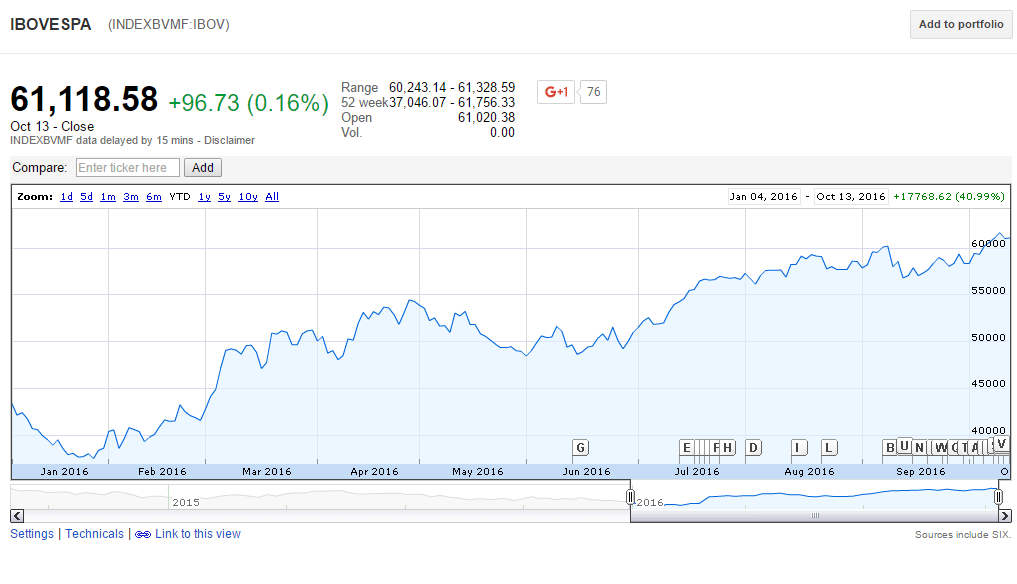
Brazil is the top performing market in the world so far this year. The Bovespa has shot up by 41% year-to-date,

The Olympics and more importantly the ousting of the Dilma Roussef government a while ago by a more pro-growth conservative administration made foreign investors turn their attention to Brazilian equities again.

Bovespa year-to-date return chart:

Click to enlarge

bovespa-1-year-returns

Source: Google Finance

The iShares Brazil ETF(EWZ) is a simple way to invest in Brazil. For investors looking to invest directly in individual companies a list of ADRs trading on the markets can be found here.

Disclosure: No Positions

Infographics: Building Wealth in Equity Investing Needs Patience

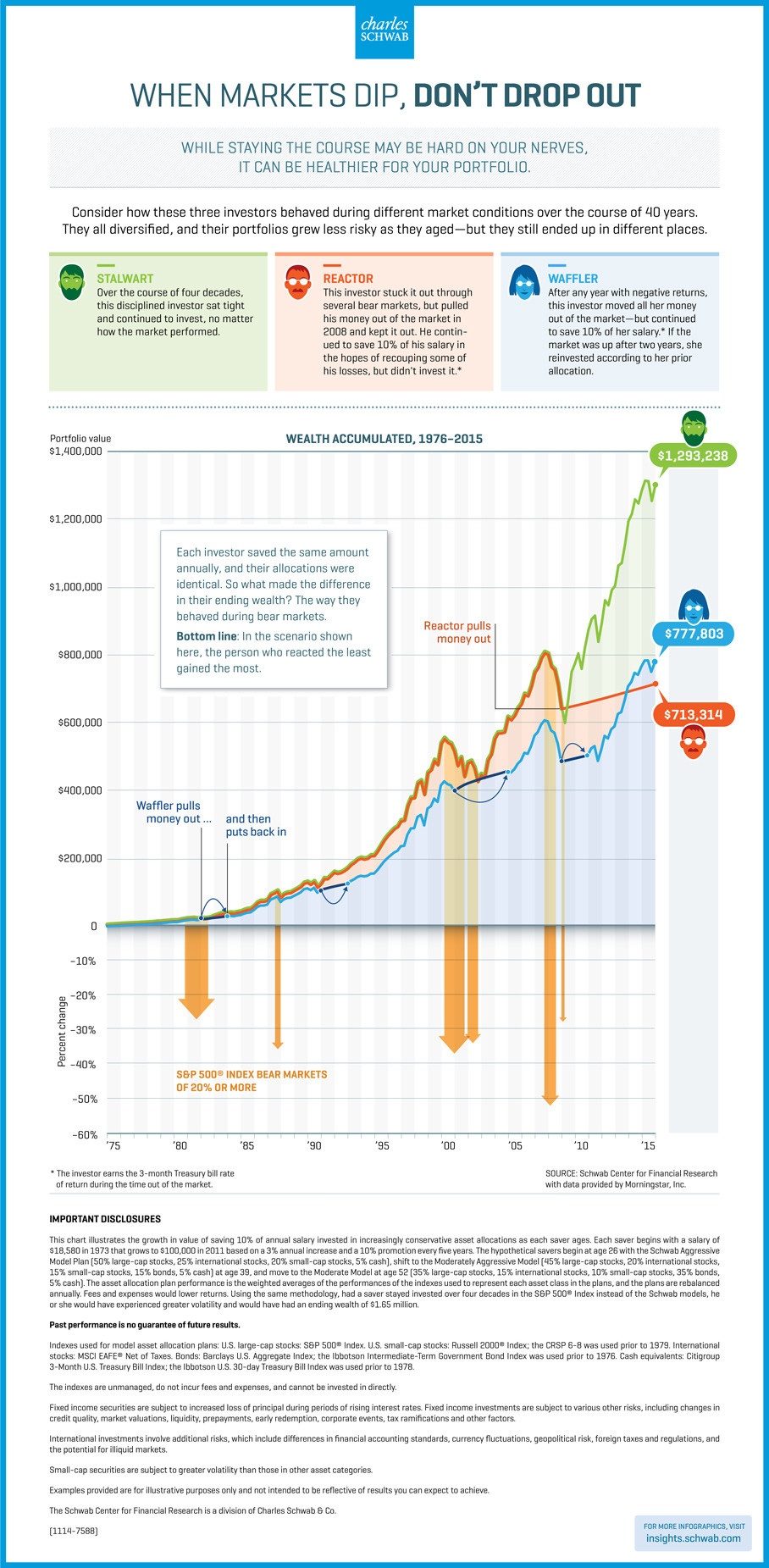
Timing the market never works. Investors looking to earn higher than average returns and build wealth by investing in stocks need patience. This involves the ability to stay put and not sell out when markets crash. Holding high-quality stocks for the long-term measured in decades and sitting tight during bull and bear markets is a successful strategy to build wealth.

The following infographics from Schwab demonstrates this concept:

Click to enlarge

infographics-patience-wins-in-stock-market-investing

Source: When Markets Dip, Don’t drop Out, Charles Schwab

Long-Term Investors Can Consider U.S. Utility Stocks Now

Utility stocks were the top performers in the first half of this year rising 21%. However they have declined substantially since June 20th with a loss of 10%. Overall the Dow Jones Utility Average Index-is up only 12.01% year-to-date.

Fear of rising interest rates led investors to dump income stocks such as utilities.While short-term volatility is understandable investors willing to take a long-term approach of 5 years or more can consider adding them in a phased manner. Even when interest rates increase, yield hungry investors will continue to look for income producing equities and utilities fit the bill. Unlike the chaotic European utility industry, US utilities are highly regulated and many are a monopoly in the markets they operate.

The following are ten US electric utilities with their current dividend yields:

1.Company: Duke Energy Corporation (DUK)
Current Dividend Yield: 4.51%

2.Company: NextEra Energy Inc (NEE)
Current Dividend Yield: 2.87%

3.Company: Dominion Resources, Inc. (D)
Current Dividend Yield: 3.91%

4.Company: Southern Company (SO)
Current Dividend Yield: 4.53%

5.Company: Exelon Corporation (EXC)
Current Dividend Yield: 3.96%

6.Company: American Electric Power Co. (AEP)
Current Dividend Yield: 3.65%

7.Company: PG&E Corporation (PCG)
Current Dividend Yield: 3.33%

8.Company: PPL Corporation (PPL)
Current Dividend Yield: 4.72%

9.Company: Public Service Enterprise Group Inc. (PEG)
Current Dividend Yield: 4.04%

10.Company: Edison International (EIX)
Current Dividend Yield: 2.77%

Note: Dividend yields noted above are as of Oct 12, 2016. Data is known to be accurate from sources used.Please use your own due diligence before making any investment decisions.

Disclosure: Long NEE