Why Do US Airlines Make Passengers Suffer? Because They Can

Air travel in the US is one of the miserable experiences that most of passengers have to put with. Today fellow blogger and Founder and chief investment officer Barry Ritholtz of Ritholtz Wealth Management posted a link to an interesting article in The New Yorker that discussed why and how airlines make their customers suffer. From the article titled “Why airlines want you to suffer” by Tim Wu and published in December, 2014:

It seems that the money was just too good to resist. In 2013, the major airlines combined made about $31.5 billion in income from fees, as well as other ancillaries, such as redeeming credit-card points. United pulled in more than $5.7 billion in fees and other ancillary income in 2013, while Delta scored more than $2.5 billion. That’s income derived in large part from services, such as baggage carriage, that were once included in ticket prices. Today, as anyone who travels knows well, you can pay fees ranging from forty dollars to three hundred dollars for things like boarding in a “fast lane,” sitting in slightly better economy-class seats, bringing along the family dog, or sending an unaccompanied minor on a plane. Loyal fliers, or people willing to pay a giant annual fee, can avoid some of these charges; others are unavoidable.

The fees have proved a boon to the U.S. airlines, which will post a projected twenty-billion-dollar profit in 2014. To be fair, airlines are not just profiting because of fee income. Reduced competition, thanks to mergers, helps. There is also the plummet in the price of oil, which the airlines seem to have collectively agreed is no reason to reduce fares or even remove “fuel surcharges.” But for the past decade it is fees that have been the fastest-growing source of income for the main airlines, having increased by twelve hundred per cent since 2007.

If fees are great for airlines, what about for us? Does it make any difference if an airline collects its cash in fees as opposed to through ticket sales? The airlines, and some economists, argue that the rise of the fee model is good for travellers. You only pay for what you want, and you can therefore save money if you, for instance, don’t mind sitting in middle seats in the back, waiting in line to board, or bringing your own food. That’s why American Airlines calls its fees program “Your Choice” and suggests that it makes the “travel experience even more convenient, cost-effective, flexible and personalized.”

But the fee model comes with systematic costs that are not immediately obvious. Here’s the thing: in order for fees to work, there needs be something worth paying to avoid. That necessitates, at some level, a strategy that can be described as “calculated misery.” Basic service, without fees, must be sufficiently degraded in order to make people want to pay to escape it. And that’s where the suffering begins.

The necessity of degrading basic service provides a partial explanation for the fact that, in the past decade, the major airlines have done what they can to make flying basic economy, particularly on longer flights, an intolerable experience. For one thing, as the Wall Street Journal has documented, airlines have crammed more seats into the basic economy section of the airplane, even on long-haul flights. The seats, meanwhile, have gotten smaller—they are narrower and set closer together. Bill McGee, a contributing editor to Consumer Reports who worked in the airline industry for many years, studied seat sizes and summarized his findings this way: “The roomiest economy seats you can book on the nation’s four largest airlines are narrower than the tightest economy seats offered in the 1990s.”

Source: WHY AIRLINES WANT TO MAKE YOU SUFFER by Tim Wu, The New Yorker,  Dec 2014

The full article is worth a read.

There are many reasons why US airlines are able to what can be called as daylight robbery and still get away with it. Listed below are four of the reasons:

  • The airline industry is an oligopoly with a handful of companies dominating the market. Just four airlines – Delta (DAL), United-Continental (UAL), Southwest (LUV) and American (AAL) – control the majority of the market share. I have written articles before about the industry’s oligopoly structure which you can find here and here.
  • Since the industry is an oligopoly and not a monopoly, the state cannot prevent airlines from all the things they do. So laws like The Sherman Anti-Trust Act of 1890 that makes monopoly illegal do not apply.
  • As airlines are allowed by the state to merge with one another, competition is eliminated. Lack of competition is one of the main reasons why air travelers are forced to endure misery at the hands of the airlines.
  • Unlike in other countries, alternative forms of transportation is practically non-existent in the US. The airlines know this simple fact and take advantage of it. For instance, an American trying to go from New York to LA on the west coast has to travel by airlines. There is no direct high-speed train service between these cities that this passenger can take and avoid all the airlines. Hence unlike Japanese or an European, we are held “hostage” by the airline industry in our own country without us realizing it. This is sad since the US is technically a free market economy where competition among companies and industries is supposed to be exist. As a result everyone including Nobel prize winners, educated professionals, free-market believers, world-class doctors, media pundits, legal scholars, regulators, politicians, corporate lobbyists, etc. have to fly in one of the airlines when travelling from point A to point B quickly.

Readers may also want to checkout:

Disclosure: No Positions

U.S. Economy: Is A Recession Inevitable?

President-Elect Trump has announced that he will withdraw from the Trans-Pacific Partnership (TPP) on his first day in office. In addition he has also proposed to tear up other trade deals the US has with countries around the world such as the NAFTA with Canada and Mexico or enact barriers such as tariffs. So the question now is: How will his proposals impact the U.S. economy?

According to The Petersen Institute, with all other things being equal and trading counterparts act in kind (meaning they also retaliate by imposing tariffs for imports from US which will hurt US companies) the US economy will  be adversely impacted leading to a mild recession in 2019 with a GDP drop of 0.10%

The chart shows the importance of global trade to US economy. According to Niels C. Jensen of Absolute Return Partners “In the US alone, the increased openness of the global economy has tripled the share of trade in national income in the last 50 years (chart 1).”

Click to enlarge

us-trade-and-gdp


Trump plans to impose a 45% and 35% tariff to China and Mexico respectively. If these are implemented it may lead to a full scale trade war if those countries retaliate according to the The Petersen Institute. The chart below shows how that trade war could lead to a decline in US economic growth (marked in dark blue color line)

Click to enlarge

us-gdp-projections-under-trump

Source: Trump – another Brexit moment?, The Absolute Return Letter, November 2016 , Absolute Return Partners

The Global Wealth Pyramid 2016

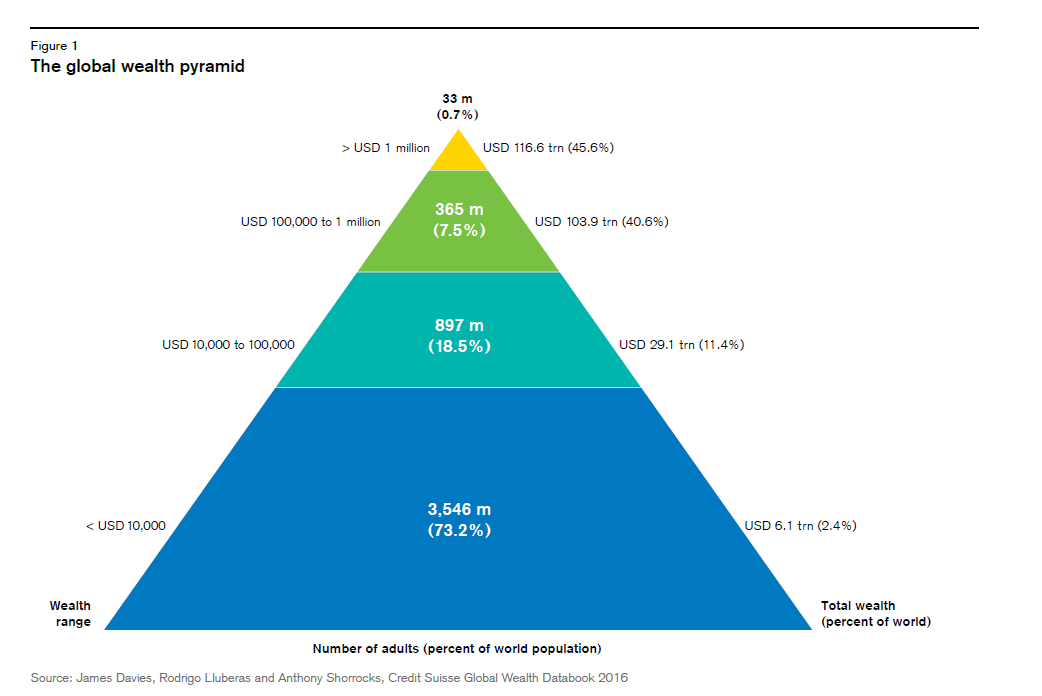
Credit Suisse recently published its annual the Global Wealth Report for this year, The below chart shows the The Global Wealth Pyramid 2016:

Click to enlarge

global-wealth-pyramid-2016

Source: Global Wealth Report 2016, Credit Suisse

The majority of the world’s population or about 3.5 billion people (73% of total adults) have less $10,000 in wealth. The top of the pyramid or 0.7% of the total population holds wealth of more than $1 million. Collectively this tiny group holds about half of the global wealth or about $116 Trillion.

The last time I posted this pyramid was in 2011 when the Occupy movement was popular in the US. Since then the movement has withered away into the oblivion. As more and more wealth is concentrated in the hands of a few, the majority of the population is forced to work as serfs or wage slaves in most countries for low wages.

Download: 

Five Under-The-Radar Growth Stocks To Consider

Mid-cap stocks are generally defined as stocks with market caps of under $2 billion or $5 billion. These companies tend to have bigger growth potential since they are small and many of these companies tend to be less followed by investors and Wall Street alike. Listed below are five under-the-radar US stocks that investors can consider for potential investment:

1.Company: WD-40 Co  (WDFC)
Sector: Household Products
This company is the maker of the famous WD-40 penetrating oil and water-displacing spray.that is an invaluable product that is found in most homes.

2.Company: Church & Dwight Co Inc (CHD)
Sector: Household Products
Some of the popular brands such as Mentadent tooth paste, Trojan condoms, Arm & Hammer baking soda are owned by Church & Dwight.

3.Company: Ametek Inc  (AME)
Sector:Electrical Equipment |

4.Company: Applied Industrial Technologies Inc  (AIT)
Sector: Industrial Products Distributors

5.Company: Atlas Air Worldwide Holdings Inc (AAWW)
Sector: Air Freight and Logistics

Disclosure: No Positions

On The State Of The US Coal Industry

The coal industry in the US has been on a decline for many years. With hundreds of miners closures thousands of mining jobs have disappeared. Just a few years ago some of the coal mining firms filed for bankruptcy as the demand for coal plunged.

President-elect Donald Trump has promised to revive the coal industry and in the process bring back thousands of those lost mining jobs. So many poor former miners in places like the Appalachia such as West Virginia have given their vote to Mr.Trump. Below is one of the photos from a rally in Wilkes-Barre in Pennsylvania:

Click to enlarge

trump-digs-coal-photo

To fulfill this promise Trump’s policies have to overcome a multitude of challenges facing the industry. To begin with the demand for US coal has declined because most utilities have shutdown coal burning power plants and switched to cheaper options like natural gas. Hence in order to first create demand massive capital is needed for utilities to re-open those coal power plants. Until that happens mines are not going to open simply to give jobs to miners.

From a recent article in the WSJ:

Donald Trump campaigned on a promise to resurrect the ailing U.S. coal industry and put miners back to work. Delivering on that vow could prove nearly impossible.

Electric utilities that buy more than 95% of the coal mined in America have already retired hundreds of their coal-burning power plants from Colorado to Connecticut—amounting to about a third of the total capacity—and have plans to mothball even more.

While in Appalachia earlier this year, Mr. Trump pledged to “bring the coal industry back, 100%” by rolling back environmental regulations. But coal’s biggest problem is that it is no longer the cheapest fossil fuel around. It is being displaced by natural gas.

American Electric Power Co. of Columbus, Ohio, one of the nation’s biggest utility companies, has sold or retired half its fleet of coal-burning power plants in recent years. No matter who occupies the White House, “it’s not coming back,” said Nick Akins, AEP’s chief executive.

Even if Mr. Trump makes good on his campaign promise to relax or repeal pending limits on carbon emissions, it won’t be enough to restore coal’s market share. “We’re moving to a cleaner-energy economy and we’re still getting pressure from investors to reduce carbon emissions,” Mr. Akins said. “I don’t see that changing.”

Source: Cheap Gas Tests Trump’s Promise to Revive Coal by Rebecca Smith, WSJ, Nov 13, 2016

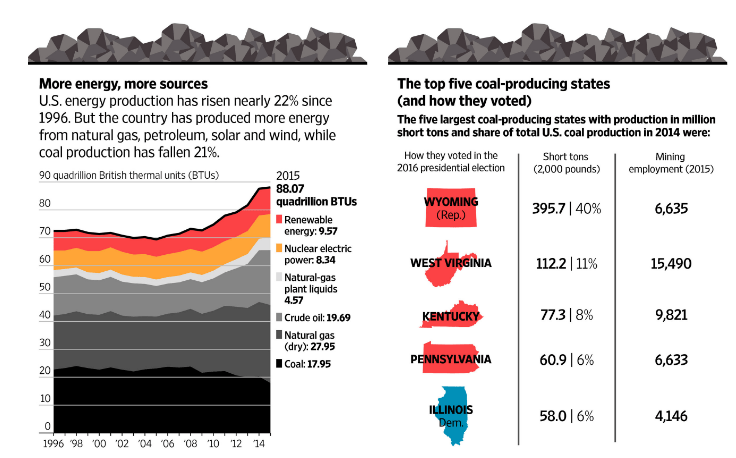
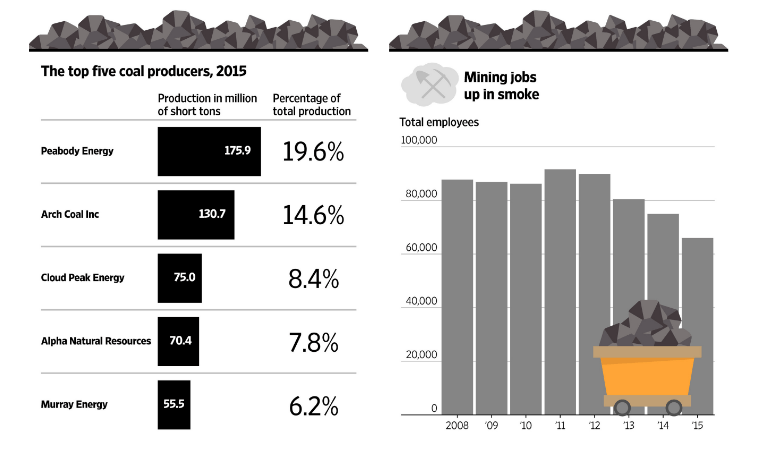
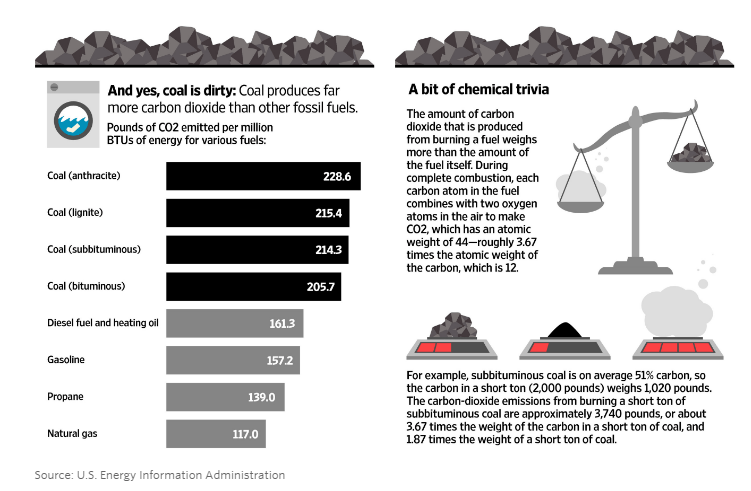
Below is an infographic showing the current state of the US coal industry:

Click to enlarge

coal-industry-1

coal-industry-2

coal-industry-3

Source: What Shape Is U.S. Coal In?, WSJ

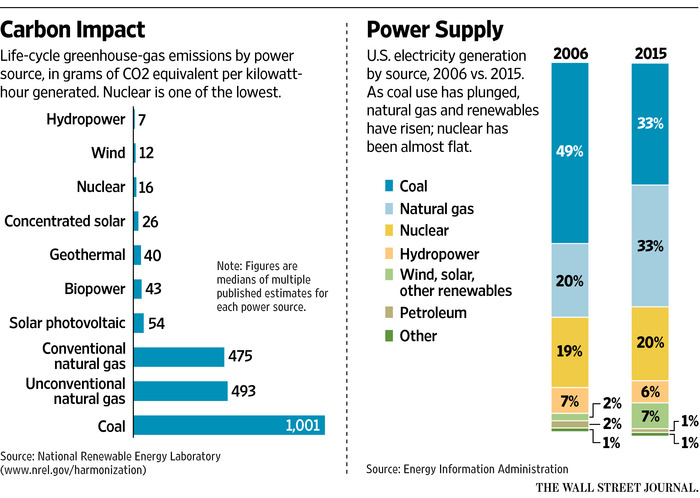
Another important factor is that coal as a source of energy decreased from 49% from 2006 to 33% in 2015. In addition to better and cheaper alternative fuel sources, utilities also face stiff opposition to operating highly polluting coal power plants. So even if those plants are brought back to service, the society’s perception on coal has to change. This is the most difficult of all the challenges.

Click to enlarge

sources-of-us-electrivity-2006-vs-2015

Source: Is Nuclear Power Vital to Hitting CO2 Emissions Targets?,  WSJ

The top five coal producers are: Peabody Energy Corporation which trades on the OTC market under the ticker (BTUUQ),  Arch Coal, Inc (ARCH), Cloud Peak Energy Inc (CLD), Alpha Natural Resources, Inc (ANR) and Murray Energy. The complete list of coal stocks on the NYSE can be found here.

It remains to be seen if the US coal industry recovers with Trump in office and if the miners that voted for him are able to get their mining jobs back.

Disclosure: No Positions

Readers may also want to checkout: